
As we move through 2026, the conversation around contact center modernization has fundamentally shifted. For business leaders, maintaining legacy on-premise systems is no longer just a technical debt—it’s a direct threat to growth, customer loyalty, and competitive relevance. Many organizations are feeling the intense pressure of the cloud crunch, needing to innovate while being anchored by expensive, inflexible technology.
If you’re grappling with high maintenance costs, frustrating scalability limits, and an inability to meet modern customer expectations, you are not alone. Migrating to a cloud platform is far more than a simple IT project; it’s a foundational business transformation designed to future-proof your entire customer experience (CX) [1]. This guide provides a proven cloud contact center migration strategy to help you navigate this change with confidence and unlock a new era of service excellence.
Why Is 2026 the Tipping Point for Your Contact Center?
The question for leaders is no longer if they should migrate, but how to execute a contact center modernization strategy without disrupting operations. When you compare the on premise vs cloud contact center models, the strategic advantages of a modern Contact Center as a Service (CCaaS) platform become undeniable [2]. Delaying the move is often far riskier and more costly than a planned transition.
Here’s why the cloud is now a business imperative:
Financial Transformation: On-premise solutions demand significant upfront Capital Expenditures (CapEx) for hardware and licensing. A cloud model transforms this into a predictable Operating Expenditure (OpEx) subscription. This move eliminates costs associated with server maintenance, forced upgrade cycles, and specialized IT overhead, allowing you to leverage scalable contact center software to cut costs. Teams staying on site for now can review Xima’s on-premises contact center.
Effortless Scalability: Cloud platforms empower you to scale your operations up or down instantly. This elasticity is crucial for handling unexpected call volumes, supporting seasonal business peaks, and enabling a global, remote workforce without ever needing to purchase or provision new hardware [3].
Immediate Access to Innovation: Essential tools like AI-powered speech analytics, real-time sentiment analysis, and intelligent routing are built directly into modern CCaaS platforms. These game-changing capabilities are difficult, if not impossible, to bolt onto rigid legacy systems [4]. With the cloud, you can implement an AI-powered playbook for greater efficiency from day one.
Superior Omnichannel CX: Today’s customers expect seamless interactions across voice, chat, email, and social media. Companies with strong omnichannel strategies retain an average of 89% of their customers, compared to just 33% for those with weak omnichannel capabilities [5]. A cloud contact center unifies these channels, providing a complete, consistent view of the customer journey.
The 4-Phase Blueprint for a Successful Migration
One of the biggest mistakes organizations make is attempting a “lift and shift”—moving everything to the cloud in one massive, high-risk event. This approach is a recipe for budget overruns, operational chaos, and frustrated teams [6]. A strategic, phased migration is the proven path to minimizing risk and maximizing your return on investment.
Phase 1: Assess, Plan, and Define Your Vision
This discovery phase is the most critical part of your journey. Before moving forward, you must deeply understand your present state and define exactly where you want to go.
Audit Your Current Environment: Document everything. Map your call flows, Interactive Voice Response (IVR) logic, telephony infrastructure, and all application integrations—especially with your Customer Relationship Management (CRM) platform [7].
Define Clear, Measurable Objectives: Your goal isn’t to simply replicate outdated workflows; it’s to innovate. Set specific, data-driven goals using Key Performance Indicators (KPIs). For example:
“Increase our First Contact Resolution (FCR)—the percentage of issues solved on the first try—by 15%.”
“Improve our Customer Satisfaction (CSAT) score by 10 points within six months.”
“Reduce Average Handle Time (AHT) by 30 seconds.”
Build Your Business Case: Use your audit and objectives to quantify the value of migration. A strong business case connects technology upgrades to concrete business outcomes like cost reduction, agent retention, and increased customer lifetime value [8].
For a detailed checklist to guide your planning, explore our Blueprint for a Smooth Contact Center Cloud Migration.
Phase 2: Choose the Right CCaaS Partner
The partner you choose will have a greater impact on your success than the technology itself. Look beyond a feature list and seek a provider who will serve as a strategic guide throughout your transformation.
Your evaluation criteria should include:
A Proven Migration Framework: Does the provider have a clear, battle-tested process for moving clients from on-premise to the cloud? Ask for case studies that show experience with complex migrations [9].
Robust Security and Compliance: Your partner must demonstrate enterprise-grade data governance, stringent security policies, and verified compliance with key standards like SOC 2 Type II, HIPAA, and PCI DSS.
A Unified, User-Friendly Platform: The best platforms bring all channels and tools into a single interface, simplifying workflows for agents and supervisors.
Dedicated Onboarding and Ongoing Support: A true partner doesn’t just hand you the software. At Xima Software, we provide comprehensive onboarding, user training, and ongoing “white-glove” support to ensure your team is successful long after launch.
Learn more about what a partnership-focused journey looks like by exploring Your Migration Path from On-Prem to Cloud.
Phase 3: Execute the Phased Migration
With your strategy and partner secured, it’s time to execute. A phased rollout is the safest and most effective method, allowing you to modernize without breaking stable, existing systems [10].
Launch a Pilot Program: Start with a small, well-defined group of agents, perhaps those handling a specific line of business. This allows you to test the new system in a live but controlled environment, gather invaluable feedback, and resolve any unforeseen issues. This approach aligns with proven migration patterns that accelerate deployment while managing risk [11].
Manage Data Migration: Work closely with your partner to execute a secure and accurate plan for migrating historical data, such as call recordings and customer records. Data integrity is non-negotiable.
Prepare Your People: Technology is only half the battle; change management is crucial. Invest heavily in training for both agents and supervisors. Focus on how the new platform makes their jobs easier and empowers them to deliver better customer outcomes.
To help navigate this critical phase, review these essential Cloud Contact Center Migration Do’s & Don’ts.
Phase 4: Go Live, Optimize, and Maximize ROI
Your migration project doesn’t end at go-live—it truly begins. The real power of a cloud platform is unlocked through continuous, data-driven improvement.
Monitor Performance Relentlessly: Use your new platform’s real-time analytics dashboards to track the KPIs you defined in Phase 1. Keep a close watch on metrics like handle time, resolution rates, and customer sentiment.
Gather Feedback Actively: Create formal channels for agents and supervisors to provide ongoing feedback. They are on the front lines and will have the best ideas for refining workflows and scripts.
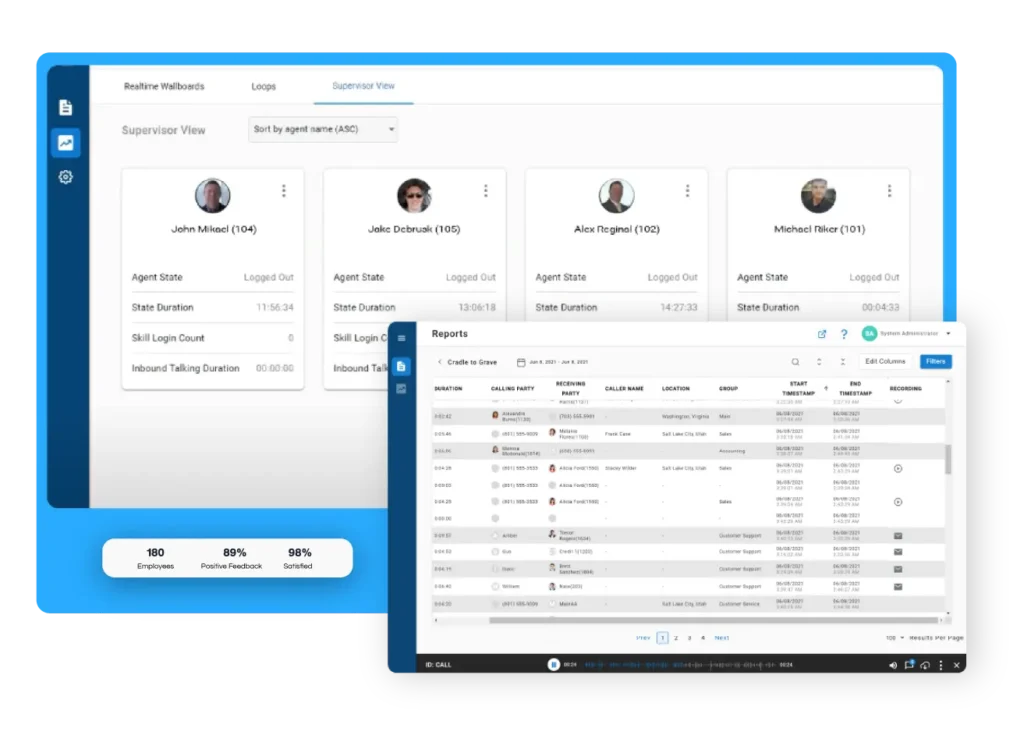
Optimize Continuously: Leverage actionable insights from your data to make improvements. For instance, Xima Software’s ‘cradle-to-grave’ reporting and speech analytics allow you to analyze 100% of interactions to refine intelligent routing rules, identify targeted agent coaching opportunities, and update IVR menus based on actual customer behavior. This ongoing cycle is how you prove the real ROI of modernizing your contact center. Xima’s cloud contact center software is the platform this blueprint migrates to.
Your Partner for a Seamless Cloud Transformation
A successful cloud migration is built on a strong partnership. At Xima Software, our experts become an extension of your team, guiding you through every stage of this 4-Phase Blueprint. We help you avoid common pitfalls and ensure your new platform delivers on its promise from day one.
Our holistic approach covers both the technology and the people who use it. This step-by-step guide to moving to the cloud mirrors our implementation process, ensuring nothing is left to chance. We understand that every organization is unique, so we help you answer the key questions you may have about making the switch to build a strategy that fits your specific goals. With Xima, you get more than a vendor—you get a partner committed to your long-term success.
Conclusion
In 2026, migrating your contact center to the cloud is a strategic imperative. A successful transition is not about flipping a switch; it is about executing a proven strategy, taking a phased approach, and choosing the right expert partner. By following this four-phase blueprint, you can de-risk the entire process and ensure your project delivers transformative results.
This journey will evolve your contact center from a rigid cost center into a dynamic, strategic asset that drives business growth, builds unbreakable customer loyalty, and gives you a powerful competitive edge for years to come.
Ready to build your migration strategy with an expert partner? Request a Demo of Xima Software today to see how we can ensure your transition to the cloud is a definitive success.