
As of February 2026, the imperative for businesses is clear: the future of customer experience is in the cloud. A contact center cloud migration is no longer a distant consideration but a critical strategic initiative for organizations seeking agility, advanced capabilities, and a competitive edge. While the process involves careful planning, the transition from rigid on-premise infrastructure to a dynamic cloud environment is a transformative upgrade that unlocks profound efficiencies and innovation.
This article presents a detailed, four-phase blueprint to demystify the migration process. We will dissect each stage, offering technical guidance and strategic insights to help you navigate common complexities, mitigate risks, and maximize the return on your technology investment. Let’s construct your roadmap to a more resilient and intelligent contact center.
What Are the Technical and Business Drivers for Cloud Migration?
Before delving into the migration mechanics, it is essential to understand the underlying technical and business catalysts. Legacy on-premise systems, often characterized by monolithic architecture and significant technical debt, are proving inadequate for the demands of modern customer engagement. Migrating to a Contact Center as a Service (CCaaS) solution is the strategic response to these limitations.
The Inherent Constraints of On-Premise Infrastructure
High Total Cost of Ownership (TCO): On-premise solutions require substantial upfront capital expenditure (CapEx) for hardware, perpetual licenses, and dedicated data center space. Ongoing operational expenditures (OpEx) for maintenance, patches, and specialized IT personnel add to this burden.
Limited Scalability and Elasticity: Scaling capacity to handle demand fluctuations—such as seasonal peaks or unexpected events—is a slow, manual, and costly process involving hardware procurement and complex configuration. This lack of elasticity is a major competitive disadvantage, as detailed in the CIO Guide to Cloud Contact Center Readiness.
Architectural Rigidity and Data Silos: These systems frequently isolate data across disparate applications (e.g., ACD, IVR, recording), preventing a unified view of the customer journey. Integrating modern technologies like AI or establishing a cohesive omnichannel experience is often technically prohibitive. For a more detailed technical comparison, explore our guide on On-Premise vs. Cloud Contact Centers.
The Transformative Advantages of a CCaaS Architecture
A modern, cloud-native platform like Xima’s CCaaS solution directly addresses these challenges, delivering significant architectural and operational benefits.
Superior Customer Experience (CX): In today’s market, CX is the sum of all interactions a customer has with your brand. Cloud architecture natively supports omnichannel communication, enabling seamless transitions between voice, chat, email, and social channels. Advanced features like AI-powered intelligent routing match customers with the best-suited agent based on skills, sentiment, and historical context, dramatically improving first-contact resolution and helping you unlock a faster CX.
Hyper-Scalability and Global Reach: Cloud platforms provide near-instant scalability, allowing you to dynamically adjust resources based on real-time demand. This elasticity also facilitates the deployment of a geographically distributed, remote, or hybrid workforce.
Economic Efficiency: CCaaS operates on a Software as a Service (SaaS) model—a subscription-based software delivery method—which converts unpredictable CapEx into predictable OpEx. This pay-as-you-go model eliminates hardware maintenance and provides a clear path to cut operational costs in 2026.
Continuous Innovation and Actionable Intelligence: Leading CCaaS providers continuously deploy new features and security updates without service disruption[1]. You gain immediate access to advanced analytics, speech-to-text transcription, and sentiment analysis, enabling data-driven improvements to agent performance and customer journeys.
Teams that need to keep call processing on site can review Xima’s on-premises contact center.
Your 4-Phase Technical Migration Blueprint
A successful contact center cloud migration hinges on a meticulous, phased methodology. This structured approach minimizes disruption, ensures stakeholder alignment, and maximizes the probability of achieving desired outcomes.
Phase 1: Discovery, Planning, and Architecture
This foundational phase is the most critical for success. Thorough discovery and planning prevent costly scope creep and technical roadblocks later in the project[2].
Conduct a Comprehensive Technical Audit: Go beyond surface-level workflows. Document your entire technology stack, including:
Telephony Infrastructure: PBX/ACD models, Session Border Controllers (SBCs), carrier connections (SIP/PSTN), and existing Interactive Voice Response (IVR) call-flow logic.
Integrations: Document all APIs connecting to your CRM (e.g., Salesforce, HubSpot), Workforce Management (WFM), and internal business intelligence tools.
Data and Reporting: Catalog existing databases, historical data formats, and custom reports that are critical to operations.
Define Specific, Measurable Success Criteria: Establish clear business and technical Key Performance Indicators (KPIs).
Business KPIs: Improve Customer Satisfaction (CSAT) by 10%, reduce Average Handle Time (AHT) by 15%, or increase First Call Resolution (FCR) by 20%.
Technical KPIs: Achieve 99.99% uptime, maintain voice call latency under 150ms, and ensure a Mean Opinion Score (MOS) of 4.0 or higher for voice quality.
Assemble a Cross-Functional Migration Team: Secure buy-in by involving key stakeholders from IT (networking, security), operations, finance, and agent/supervisor representatives. As Gartner notes, involving business stakeholders is crucial for positive outcomes[3].
Select a Strategic Partner: Choose a provider that offers not just a platform but also deep migration expertise and consultative support. A true partner can answer your toughest questions about moving to the cloud with proven solutions.
Phase 2: Design, Preparation, and Testing
With a solid plan, you can now design the future state and prepare your environment for the transition.
Select and Design Your Migration Strategy: Choose the methodology that best fits your risk tolerance and operational needs[4].
Migration Strategy | Description | Pros | Cons |
|---|---|---|---|
Big Bang | A complete, one-time cutover from the old system to the new one. | Fastest time-to-value; minimizes period of managing two systems. | Highest risk; any failure impacts the entire operation. |
Phased Rollout | Migrating teams, departments, or functions in controlled stages. | Lower risk; allows for iterative learning and refinement. | Longer migration timeline; requires managing a hybrid environment. |
Parallel Run | Running the new and old systems simultaneously for a set period. | Safest approach; provides a fallback if issues arise. | Highest cost and resource overhead; can confuse agents. |
Perform Network Readiness Assessment: The cloud runs on your network. Work with your provider to test bandwidth, latency, jitter, and packet loss to ensure it can support high-quality, real-time voice and data traffic[5].
Map Configuration and Data: This is not a simple “lift and shift.” You must re-create or map existing configurations like IVR menus, routing logic, agent profiles, and disposition codes into the new platform. Planning for historical data migration is also critical, as direct import is rarely feasible and may require a dedicated data-warehousing strategy[6].
Phase 3: Execution, Cutover, and Validation
This is the implementation phase where your meticulous planning is put into action.
Execute User Acceptance Testing (UAT): Before go-live, a pilot group of agents and supervisors must rigorously test the new system. They should validate call flows, integration functionality, and reporting accuracy to identify and resolve bugs.
Conduct Comprehensive Training: Empower your team with hands-on training tailored to their roles. Agents need to master the new interface and workflows, while supervisors must learn to use new monitoring and analytics tools.
Execute the Cutover: Follow your chosen migration strategy with clear, consistent communication. Your IT team and migration partner should be on high alert.
Initiate “Hypercare” Support: For the first few days or weeks post-launch, dedicate an elevated level of support. This involves having experts from your team and your CCaaS partner (like Xima) actively monitoring the system and available for immediate issue resolution[7].
Phase 4: Optimization and Continuous Improvement
The migration project doesn’t end at go-live. The true value of CCaaS is realized through ongoing optimization.
Monitor KPIs and Performance Baselines: Use the platform’s real-time dashboards and analytics to track the business and technical KPIs defined in Phase 1. Compare post-migration performance against your pre-migration baselines.
Gather Feedback and Iterate: Establish a formal feedback loop with agents and supervisors. Use their frontline insights combined with performance data to refine IVR scripts, routing strategies, and agent workflows.
Leverage Advanced Capabilities: Once the core system is stable and adopted, begin rolling out advanced features. Explore AI-driven speech analytics for quality management, use workforce optimization tools for better scheduling, and implement proactive engagement strategies to enhance your ROI and overall customer experience. See how this drives real value in our webinar on elevating ROI through CX and cloud migration.
How Xima De-Risks Your Contact Center Cloud Migration
Navigating a contact center cloud migration requires a powerful, reliable platform and an experienced, dedicated partner. Xima Software excels at both, providing the technology and the expertise to ensure your transition is a success.
A True Partnership Approach: We begin by understanding your specific business objectives. Our implementation specialists work alongside your team to architect a migration plan that aligns with your goals, ensuring a smooth process from discovery to optimization.
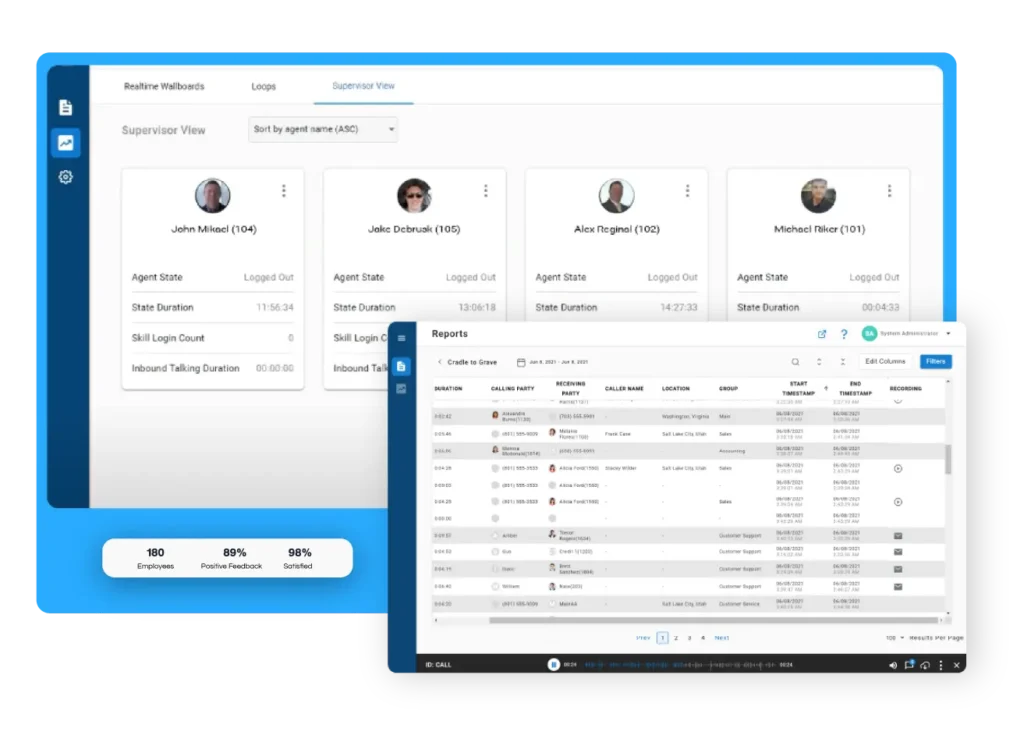
A Feature-Rich, Unified CCaaS Platform: The Xima platform is an all-in-one solution designed for performance and usability. With core features like Skills-Based Routing, Realtime Monitoring, Queue Callback, and Cradle-to-Graze Reporting, you have a complete toolkit to manage and enhance every customer interaction. Learn more about our cloud-based CCaaS solutions.
Proven, Expedited Implementation: We have a track record of guiding organizations of all sizes through successful migrations. Our structured process manages technical complexity, allowing implementations to be completed in as little as three weeks, minimizing disruption and accelerating your time-to-value.
Focus on Measurable Business Outcomes: We help you connect technology to tangible results. Our platform is designed to provide actionable insights that empower you to improve customer loyalty, boost operational efficiency, and drive long-term business growth.
Conclusion: Architect Your Future-Ready Contact Center Today
Migrating your contact center to the cloud is a definitive step toward building a resilient, agile, and customer-centric organization. By following a structured technical blueprint—from meticulous planning and design to disciplined execution and continuous optimization—you can navigate the transition with confidence. With the right strategy and a dedicated partner like Xima, you can harness the full power of the cloud to not only meet but exceed modern customer expectations.
Ready to start architecting your migration? Let Xima be your expert guide.
Request a Demo Today to see how Xima’s CCaaS platform can transform your contact center.