
Why Contact Center Infrastructure Decisions Can’t Keep Getting Deferred
For CIOs and IT leaders, contact center modernization has quietly shifted categories.
What once lived comfortably on a long term roadmap is now surfacing in infrastructure reviews, AI planning discussions, and cost governance conversations. Not because contact centers suddenly became more important, but because the systems behind them increasingly determine how fast the business can adapt.
As 2026 approaches, many organizations are discovering that delaying cloud readiness is no longer a neutral decision. It compounds operational cost, limits scalability, and restricts access to the data and flexibility modern customer experience demands.
This is the Cloud Crunch of 2026, driven not by hype, but by infrastructure reality.
Why contact center infrastructure is under pressure
Contact centers no longer operate as standalone environments. They now sit at the intersection of customer experience, data strategy, workforce flexibility, and AI enablement.
Customer expectations continue to rise. Faster resolution, personalization, and consistency across channels are no longer differentiators, they are baseline requirements. At the same time, IT teams are being asked to support hybrid workforces, integrate more systems, and enable real time insights without increasing risk. Xima’s on-premises contact center remains supported for teams that need it.
Gartner’s Leadership Vision for 2026: Heads of Service and Support highlights a clear shift in executive priorities, urging service and support leaders to stop deferring infrastructure modernization and instead focus on blending human agents with AI enabled, cloud based systems to meet rising customer and operational demands. By 2026, the majority of new contact center deployments are expected to be cloud first, driven by scalability, flexibility, and access to advanced capabilities.
For CIOs, this creates a practical challenge. Legacy infrastructure was designed for predictability. Today’s operating environment requires constant adaptation.
On prem vs cloud, the scalability gap is widening
On prem contact center platforms can still function well, but scaling them is increasingly inefficient.
Adding capacity often requires hardware investments, extended planning cycles, maintenance windows, and upgrades that compete with other IT priorities. These constraints become more visible during seasonal spikes, unexpected demand surges, or shifts in staffing models.
Cloud contact centers remove many of these limitations. Capacity scales dynamically. Updates are delivered continuously. New capabilities become available without forcing infrastructure refreshes or downtime.
Modern cloud contact center platform architectures are built to support this flexibility by allowing teams to scale users, channels, and capabilities without reengineering the underlying system.
The financial reality behind infrastructure decisions
Cost is often cited as a reason to delay cloud migration, but long term economics tell a different story.
Industry analysis consistently shows that cloud contact centers reduce total cost of ownership over time by shifting spend from capital intensive upgrades to predictable operating expenses. Savings typically come from reduced maintenance overhead, fewer infrastructure refresh cycles, and lower reliance on specialized on prem support.
For CIOs managing multi year budgets, predictability matters as much as absolute cost. This is one reason many organizations are reevaluating scalable contact center infrastructure as part of broader cost governance and modernization initiatives.
Cloud readiness is now inseparable from AI readiness
One of the most underestimated risks of legacy contact center infrastructure is its impact on AI adoption.
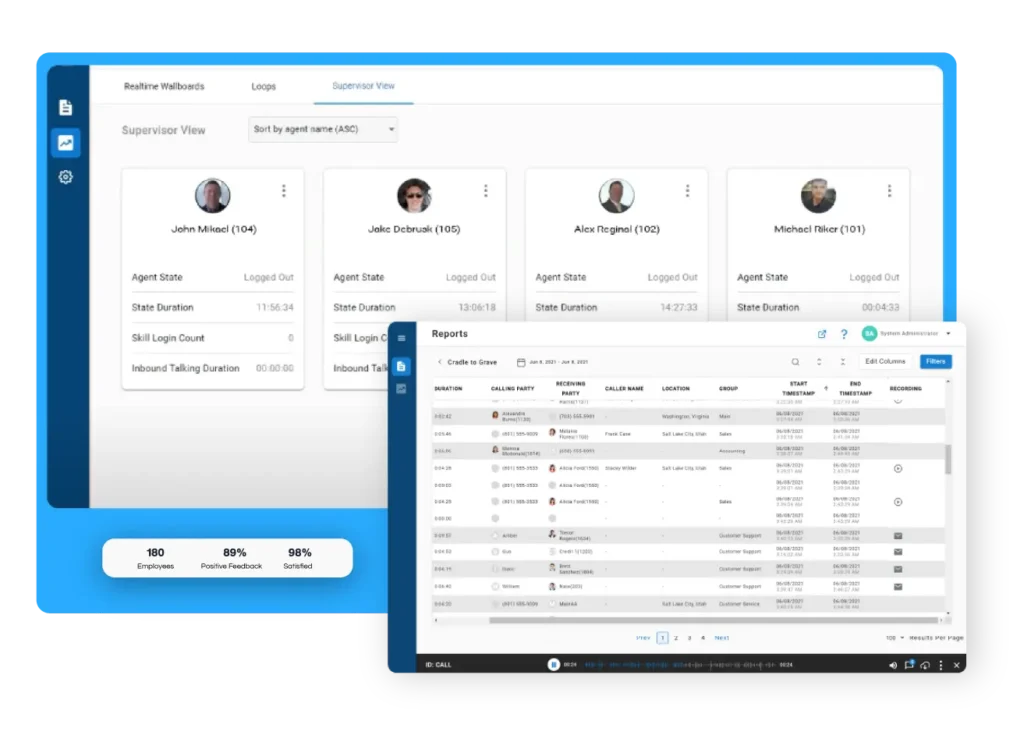
Capabilities such as intelligent routing, sentiment analysis, automated quality management, and real time reporting and analytics rely on centralized, accessible interaction data. When that data is fragmented across on-prem systems, AI initiatives slow or stall entirely.
Cloud platforms simplify this by design. Interaction data is available in real time and integrates more easily with analytics and AI tools already in use across the enterprise.
This shift toward AI ready contact center data is becoming a prerequisite for organizations that want to move beyond experimentation and deploy AI capabilities at scale.
The real cost of waiting
Most organizations don’t delay cloud migration because they doubt its value. They delay because their current system still works.
The risk is that “still works” often hides accumulating cost and growing constraints.
Delaying modernization commonly leads to:
- Rising maintenance and support overhead
- Limited agility during demand fluctuations
- Slower adoption of AI driven CX improvements
- Increased operational risk as systems age
By the time migration becomes unavoidable, it is often more complex and disruptive than if it had been planned proactively.
A practical path forward
For organizations beginning to evaluate what a move to the cloud could look like, understanding the mechanics matters.
This practical guide to cloud contact center migration outlines phased migration approaches, common pitfalls, and ways to modernize without unnecessary disruption.
It is designed to help CIOs and IT leaders move from abstract strategy to informed planning.
CIO Takeaway
The Cloud Crunch of 2026 is not about urgency, it’s about exposure.
CIOs should evaluate:
- Where contact center infrastructure limits scalability today
- How legacy systems affect AI and analytics initiatives
- What operational risk is being carried forward by delaying modernization
The goal is not immediate migration. The goal is clarity early enough to retain control over timing, cost, and complexity.
Frequently Asked Questions: Cloud Contact Center Readiness
Should I move my contact center to the cloud now or wait?
For most organizations, the question is no longer whether cloud migration makes sense, but whether delaying increases operational risk. Planning early preserves options, even if migration happens incrementally.
What are the biggest risks of staying on prem through 2026?
Rising maintenance costs, limited scalability, slower AI adoption, and growing technical debt are the most common risks.
How does cloud contact center software support scalability?
Cloud platforms scale dynamically, allowing organizations to add users, channels, and capacity without new hardware or long upgrade cycles.
Is cloud contact center migration disruptive?
Migration does not need to be disruptive. Many organizations adopt phased approaches, running hybrid environments while transitioning teams gradually.
How does cloud infrastructure support AI in the contact center?
AI driven capabilities rely on centralized, accessible data. Cloud platforms provide real time data availability that accelerates AI deployment.
Sources:
Leadership Vision for 2026: Heads of Service and Support: This webinar and report outline how leaders must stop putting off infrastructure modernization to prioritize blending human agents with AI-native cloud systems in 2026.