
The customer service landscape is undergoing a massive transformation, thanks to AI in contact centers. Businesses are leveraging artificial intelligence to streamline operations, enhance customer experiences, and deliver personalized interactions at scale. Technologies like conversational AI, AI agents, virtual agents, and Natural Language Processing (NLP) are at the forefront of this shift, enabling businesses to automate support, improve response times, and reduce operational costs. Many organizations, particularly small and mid-sized businesses (SMBs), often rush to adopt AI without fully understanding its capabilities or defining clear goals. To truly harness AI’s potential, businesses must implement the right systems and tools while setting realistic expectations about what AI can achieve. SMBs, in particular, should be cautious not to overcommit to AI features they cannot fully utilize, ensuring they have a clear strategy before implementation.
What is an AI Contact Center?
An AI contact center is a customer service hub that integrates artificial intelligence to automate and enhance interactions. Unlike traditional call centers that rely solely on human agents, AI-powered contact centers utilize AI agents, virtual agents, chatbots, and Natural Language Processing (NLP) technologies within a unified platform to manage inquiries efficiently. These systems handle high volumes of requests, and offer instant support, ensuring a seamless customer experience. Businesses must take a strategic approach when implementing AI, as adopting the technology without clear objectives can lead to inefficiencies rather than improvements. By defining business goals and understanding AI’s role, companies can avoid overcomplicating implementations and focus on real, measurable enhancements in service quality and efficiency.
Xima’s AI contact center capabilities are documented on the product page
Understanding this shift also means looking at the broader call center technology landscape, where AI is just one part of a larger system that powers modern customer experience.
Key Technologies in AI Contact Centers
AI-driven contact centers leverage several cutting-edge technologies to improve customer service and operational efficiency.
- Natural Language Processing (NLP): Enables AI to understand and interpret human speech, allowing for more natural interactions.
- Conversational AI: Powers chatbots and virtual assistants, enabling automated yet intuitive conversations.
- AI Agents: Intelligent systems that can autonomously handle customer interactions, make decisions, and optimize workflows.
Predictive Analytics: Helps anticipate customer needs and optimize resource allocation for improved efficiency.
Benefits of an AI Contact Center
AI in contact centers is redefining customer interactions by making them more personalized, efficient, and responsive. Businesses that implement AI-driven solutions can offer quicker resolutions, reduced wait times, and tailored responses based on customer history and behavior. AI in contact centers also enhances operational efficiency by automating repetitive tasks and providing data-driven insights.
24/7 Conversational AI
Chatbots and intelligent IVR systems manage complex queries by analyzing customer intent and providing real-time responses. These tools ensure constant availability and handle escalations to human representatives when necessary. Conversation analysis runs through Xima’s speech analytics.
Virtual Agent Automation
Virtual agents resolve repetitive tasks like troubleshooting and self-service guidance. By managing high-volume interactions, these assistants allow human representatives to focus on problems requiring a personal touch.
Personalized Predictive Analytics
Predictive tools analyze past interactions to anticipate customer needs and forecast call volumes. This data-driven approach allows for tailored recommendations and more proactive service strategies.
Automated Routine Tasks
AI handles administrative processes like appointment scheduling and call routing. Automating these workflows reduces the manual workload on staff, ensuring customers receive faster and more accurate responses.
Performance Monitoring Insights
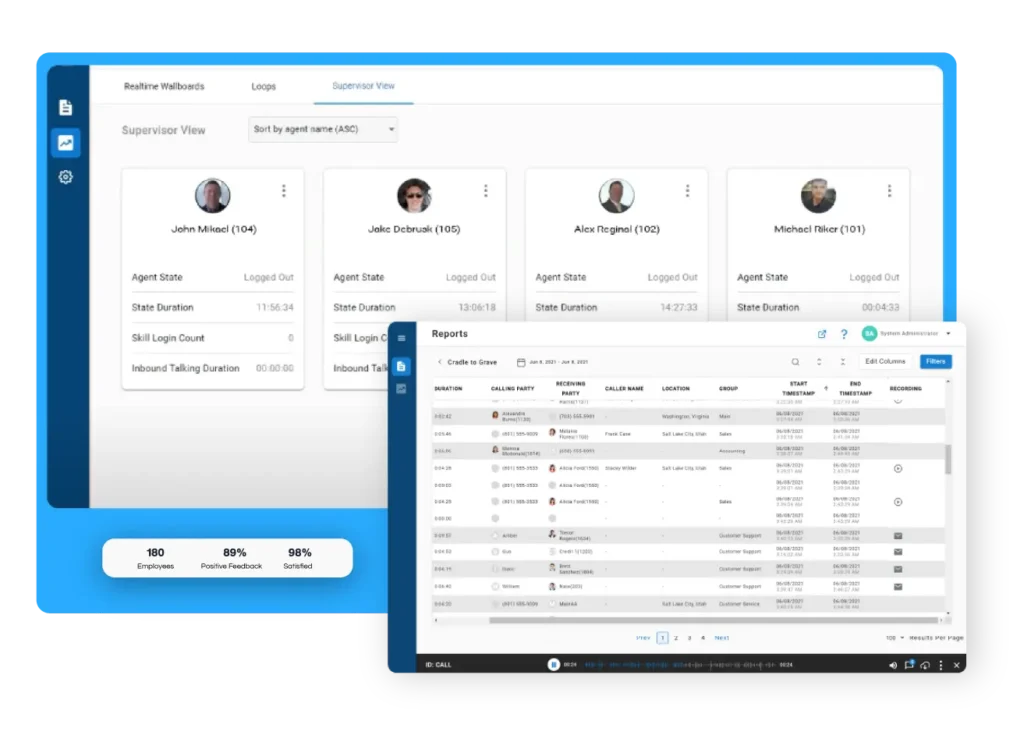
Real-time dashboards track interaction metrics and identify service bottlenecks. These analytics empower managers to refine strategies and make data-driven improvements to overall service quality.
Secure Voice Biometrics
Voice biometrics analyze unique vocal patterns to automate identity verification. This technology strengthens security and speeds up the authentication process for a more seamless experience. Learn more about its impact on financial services in this webinar.
Real-Time Sentiment Analysis
AI monitors the tone and emotional state of every interaction to detect frustration or dissatisfaction as it happens. This allows the system to prioritize urgent issues and alert supervisors when an interaction requires immediate human intervention.
Operations Scalability
AI allows organizations to manage fluctuating call volumes without increasing headcount. Businesses can scale their support capacity to meet rising demand while maintaining lower operational costs.
Real-Time Agent Assistance
AI provides immediate support to human agents by surfacing relevant information and suggesting responses during active interactions. This assistance ensures consistent quality and helps agents resolve issues more efficiently.
Automated Interaction Summaries
AI tools automatically generate structured notes and record follow-up actions immediately after a conversation. This eliminates manual data entry, allowing agents to move quickly to the next customer inquiry.
Addressing Challenges in Contact Center Automation
Best Practices for AI Implementation in Contact Centers
A structured approach to deploying automated tools ensures a balance between technical efficiency and high-quality customer service.
- Establish Success Metrics: Define specific benchmarks, such as reduced wait times or improved resolution rates, to accurately track return on investment.
- Prioritize Human Connection: Ensure a seamless transition from automated tools to human representatives for complex issues that require empathy and nuanced decision-making.
- Maintain Data Quality: Regularly update your knowledge base and CRM to ensure that automated responses remain accurate and relevant to the user.
- Scale Gradually: Begin by automating high-volume, simple tasks like password resets before expanding to more complex customer journeys.
- Monitor Interaction Quality: Use performance dashboards and automated summaries to identify areas where the system requires additional training or adjustment.
- Keep Humans in the Loop: Maintain active human oversight to review automated interactions, ensuring the system remains accurate, ethical, and safe for all users.
- Provide Instant Escalation: Always offer a clear and immediate path for customers to reach a human representative for sensitive or high-priority inquiries.
Addressing Challenges in Contact Center Automation
While AI in contact centers offers significant benefits, businesses must address challenges when implementing it. Many SMBs rush to adopt Conversational AI without fully understanding its capabilities, defining clear goals, or setting realistic expectations. It’s important to define specific objectives, like reducing wait times or improving workflows, that align with the business strategy. SMBs should assess their current infrastructure to ensure they have the right tools, training, and resources to support AI in contact centers. Technologies like Conversational AI and Virtual Agents can be effective, but only if used strategically. AI in contact centers is not a “set it and forget it” solution—it requires continuous evaluation. SMBs should start small, such as using Natural Language Processing (NLP) to enhance automation or leveraging Conversational AI for customer interactions, and scale gradually. With clear goals and the right infrastructure, businesses can maximize the impact of AI in contact centers to improve customer experience and operational efficiency.
Ensuring Data Privacy and Compliance
When implementing AI in contact centers, businesses must prioritize securing customer data and adhering to privacy regulations. As AI systems process vast amounts of sensitive data, complying with privacy laws such as GDPR or CCPA is critical to maintaining customer trust. Businesses must ensure that their Conversational AI systems follow best practices for data protection and that customers’ personal information is handled securely. This not only minimizes legal risks but also enhances the customer experience by building trust in the company’s commitment to privacy.
Balancing AI with Human Touch
While AI in contact centers can automate numerous tasks and improve efficiency, human empathy remains crucial in customer service. It’s important to maintain a balance between automation and personal interaction. For complex or sensitive issues, customers still value human agents who can provide understanding and nuanced responses. A hybrid approach, where Virtual Agents handle routine inquiries and human agents address more challenging concerns, ensures a well-rounded customer experience. By combining the speed and efficiency of Conversational AI with the warmth of human service, businesses can provide the best of both worlds.
Success Stories: How AI is Used in Contact Centers
Many businesses are already seeing tangible improvements by adopting AI in contact centers. From faster response times to more personalized customer experiences, Conversational AI and Virtual Agents are revolutionizing customer service. Let’s take a look at a few case studies that demonstrate the real-world benefits of AI.
Case Studies
Vodafone is a prime example of successfully implementing Conversational AI and Virtual Agents in their contact center. By using AI-powered chatbots to handle routine inquiries, such as billing and technical support, Vodafone saw a remarkable 40% reduction in response time and a 30% increase in customer satisfaction. Additionally, integrating Virtual Agents allowed them to free up human agents to focus on higher-priority tasks, reducing agent burnout and improving service levels across the board.
Similarly, Sephora integrated Natural Language Processing (NLP) into their customer service operations by using AI-powered chatbots to engage customers with a more human-like conversational experience. This use of NLP led to a 25% increase in customer engagement and significantly decreased abandoned calls, as customers were able to resolve their queries more efficiently while enjoying a personalized experience.
Getting Started with AI Contact Centers
For businesses considering adopting AI in contact centers, it’s essential to take a measured approach. Here’s a step-by-step guide to help you get started.
Building a Strong Knowledge Base
One of the foundational elements of AI-powered customer service is a robust knowledge base. This allows Conversational AI systems to provide quick, accurate answers to common questions. By centralizing information in an AI-powered knowledge base, businesses can enhance both customer service and agent performance, ensuring faster resolutions and fewer escalations.
Customizable AI Models for Unique Needs
No two businesses are alike, and the flexibility of AI models is one of their greatest strengths. Whether you’re a small business or a large enterprise, AI in contact centers can be tailored to suit your specific needs. From customizable Virtual Agents to AI models that adapt to different industries, businesses can leverage AI solutions that align with their unique goals and customer service requirements.
Request a Demo
Ready to take the first step toward improving your customer service? Explore how Xima’s AI-powered solutions can transform your AI contact center with a personalized demo.