
As a contact center leader, you know there’s a goldmine of intelligence locked within your customer conversations. But when it’s time to secure a budget, how do you prove the financial return on the technology that unearths it? Justifying an investment in speech analytics can feel abstract when you can’t connect better conversations directly to the bottom line.
This guide provides a clear, practical framework for measuring the return on investment (ROI) of AI-powered speech analytics. We will move beyond theory to show you exactly how to calculate the AI contact center ROI by connecting analytics to operational efficiency, revenue growth, and risk reduction. As experts in building efficient and intelligent AI contact centers, we at Xima Software understand that data is only valuable when it drives action and proves its worth. Let’s walk through how to build your business case.
Why Bother Measuring ROI? Beyond a “Nice-to-Have”
In today’s economic climate, where every dollar of spending is scrutinized, “nice-to-have” technology doesn’t get approved. While standard Key Performance Indicators (KPIs) like Average Handle Time (AHT) and Customer Satisfaction (CSAT) are essential, they only tell you what happened, not why. Did CSAT scores drop because of a product bug, a confusing new policy, or a gap in agent training? Without context, you’re just guessing.
This is where AI contact center speech analytics becomes a critical business intelligence tool. It digs deeper to uncover the root causes behind your metrics, transforming your contact center from a cost center into a strategic intelligence hub. Think of it this way: tracking KPIs without speech analytics is like seeing your car’s “check engine” light is on but having no diagnostic tool to find the problem. Speech analytics is the tool that tells you exactly what to fix. By analyzing 100% of your interactions, it turns unstructured audio into searchable, actionable data, providing a definitive guide to boosting CX with data-driven insights.
The Four Pillars of Speech Analytics ROI
To calculate a credible AI contact center ROI, you need to break down its value into distinct, measurable categories. Let’s explore the four primary pillars where speech analytics delivers a tangible financial impact.
1. Driving Operational Efficiency
Perhaps the most direct way speech analytics pays for itself is by helping your team do more with less. By analyzing every single interaction, you can pinpoint and eliminate process friction, optimize resources, and automate manual tasks.
Reduced Average Handle Time (AHT): AI can automatically flag the exact reasons for long calls—such as extended silences, process confusion, or system issues—and present them in a dashboard. By isolating keywords like “I can’t find” or “the system is slow,” you can address the root cause with targeted training. Shaving just 30 seconds off AHT in a 50-agent center can save the need for 3-4 new hires a year, a savings of $150,000–$200,000. This is just one way to drive measurable ROI without disrupting your operations.
Improved First Call Resolution (FCR): Speech analytics automatically identifies trends in repeat calls, revealing why customers are calling back [1]. Is a specific billing question always getting transferred? Are agents lacking knowledge on a new promotion? Fixing these gaps directly reduces the volume of costly repeat interactions.
Automated Quality Management: Manually reviewing 2-3% of calls is time-consuming, expensive, and leaves massive blind spots. With Xima’s Auto QA, you can automatically score 100% of interactions against your specific evaluation criteria. This is how AI-powered Auto QA is transforming quality management by freeing up supervisors to focus on high-impact coaching instead of tedious reviews.
2. Increasing Revenue & Customer Retention
Insights from customer conversations contribute directly to top-line growth and strengthen customer loyalty. Speech analytics helps you protect and grow revenue streams by listening at scale.
Proactive Churn Reduction: The system can automatically flag calls with negative sentiment or keywords like “cancel,” “frustrated,” or “switch to [competitor]” [2]. This creates an early warning system, allowing a manager or retention specialist to intervene and save the customer relationship before it’s too late. The risk of inaction is silent churn that you only discover when it’s too late.
Uncovering Sales Opportunities: Support agents are often a customer’s most trusted point of contact. Speech analytics can identify phrases that indicate an upsell or cross-sell opportunity (e.g., “I wish you also offered…”). This ensures potential revenue isn’t lost, even if the agent doesn’t flag it themselves.
Boosting Customer Loyalty: By quickly identifying and fixing points of customer friction—like a broken website link or confusing policy—you directly improve the customer experience (CX). This leads to measurable increases in key loyalty metrics like CSAT, Net Promoter Score (NPS), which measures willingness to recommend, and Customer Effort Score (CES), which tracks how easy it is to do business with you. This is how you can maximize CX in 2026 with AI and speech analytics.
3. Mitigating Compliance & Risk
For businesses in regulated industries like finance and healthcare, cost avoidance is a massive ROI driver. The tradeoff of an initial software investment is minimal compared to the risk of a single violation, which can more than justify the entire cost of a speech analytics solution.
Automated Compliance Monitoring: Speech analytics automatically monitors 100% of calls to ensure agents are reading mandatory disclosures (e.g., “this call is being recorded”) and avoiding prohibited language [3].
Reducing Financial Penalties: A single compliance breach can result in significant fines and brand damage. Automated monitoring provides a comprehensive and searchable audit trail, drastically reducing your risk exposure compared to manual spot-checks. Xima’s Speech Analytics allows you to build custom topics to automatically flag these specific risks, providing invaluable peace of mind.
4. Informing Broader Business Strategy
The intelligence gathered from customer conversations extends far beyond the contact center walls, providing invaluable insights for the entire organization.
Voice of the Customer (VoC) Insights: Speech analytics aggregates thousands of conversations to reveal what customers are really saying about your products, marketing campaigns, and brand perception. This is the unfiltered voice of your market and is key to boosting customer insight with AI.
Product & Service Feedback: Are customers consistently complaining about a specific product feature or a confusing part of your website? This direct feedback is a goldmine for your product and marketing teams, helping drive data-driven improvements that increase satisfaction and sales.
A Practical Framework for Calculating Your Speech Analytics ROI
The first step in demonstrating ROI from your contact center is to establish a baseline of your current metrics before implementation. Once you have that, you can calculate the net benefit of your investment.
The formula is simple: ROI % = (Net Annual Benefit / Initial Investment) x 100.
To help you get started, use the simple worksheet below to estimate your potential “Net Annual Benefit.” Be conservative with your estimates to build a credible business case. For a deeper dive with real-world examples, download our free guide: Real Numbers, Real Customers: The ROI of Modernizing Your Contact Center.
ROI Category | Your Calculation (Annual) | Example (50-Agent Center) |
|---|---|---|
A. Operational Savings | (AHT Savings + FCR Savings + QA Time Savings) | $95,000 |
B. Revenue & Retention Gains | (Value of Retained Customers + New Upsell Revenue) | $75,000 |
C. Risk Mitigation | (Estimated Cost of Fines Avoided) | $25,000 |
Total Annual Benefit | (A + B + C) | $195,000 |
D. Annual Software Cost |
| -$40,000 |
Net Annual Benefit | (Total Benefit – D) | $155,000 |
Why a Unified Platform Is Crucial for Maximizing ROI
Many organizations fall into the “franken-stack” trap—a collection of disconnected tools for their contact center platform, speech analytics, and quality assurance. This approach creates data silos, integration nightmares, and a higher Total Cost of Ownership (TCO) that actively erodes your ROI. The risk is that you spend more time managing vendors and troubleshooting data gaps than acting on insights.
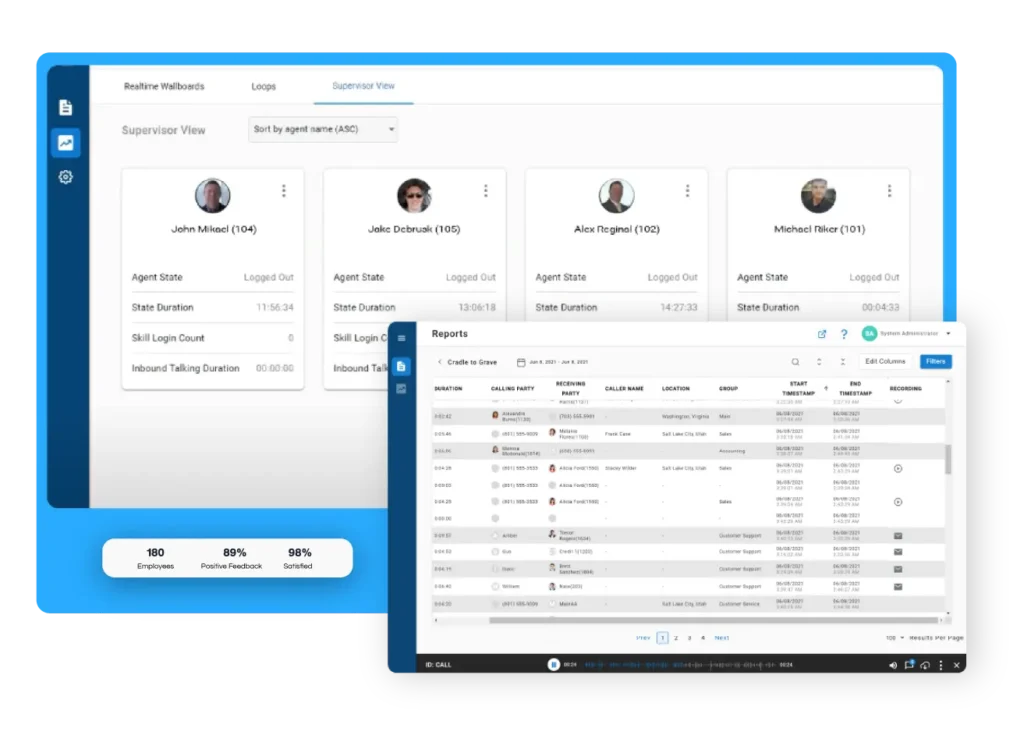
The real power comes from an integrated platform like Xima CCaaS. When your Contact Center Speech Analytics, Auto QA, and cradle-to-grave reporting all exist in one system, you can:
Act on insights instantly: A supervisor can see a low-scoring call flagged by analytics and immediately access the recording, transcript, and evaluation for coaching—all in one place.
Reduce complexity: One vendor, one interface, and one source of truth simplifies training, management, and the entire automation process, helping you transform your business with less friction.
Lower Total Cost of Ownership: A unified platform is often more affordable than patching together multiple solutions. Xima’s concurrent licensing ensures you only pay for what you use, making enterprise-grade, AI-driven analytics accessible even for smaller contact centers.
Turn Your Conversations into Your Greatest Asset
Measuring the ROI of contact center speech analytics isn’t an academic exercise—it’s how you prove the strategic value of your operations and secure the resources you need to excel. By focusing on the four key pillars—driving efficiency, increasing revenue, mitigating risk, and gaining business intelligence—you can build a powerful business case that resonates with executive leadership. Stop leaving money and insights on the table.
Ready to stop guessing and start measuring? Request a Demo of Xima’s integrated platform and let us show you how to turn your customer conversations into undeniable ROI.