
No matter what challenge a contact center leader brings to the table, high agent turnover, frustrated customers, rising costs, it almost always traces back to one thing: revenue. That was the central insight from our most recent Xima Software webinar, led by Jon Florence, who has spent over 20 years in the contact center space.
The good news? You don’t have to tear your contact center apart to start seeing real, measurable returns. In fact, the most impactful improvements are often the ones that cause the least disruption.
Here’s a breakdown of the key takeaways.
The Four Buckets of Contact Center ROI
- Cost Reduction — Lowering the time and cost of each customer interaction, Cost inputs are outlined on Xima pricing.
- Revenue Protection — Reducing churn and staying compliant to avoid penalties
- Customer Experience — Improving satisfaction scores and first-call resolution
- Manager Efficiency — Giving supervisors better tools to coach agents and act on real data
The key question to ask for any initiative: how much disruption will this cause, and how much ROI will it generate? The best wins are high-impact and low-disruption.
You Can’t Improve What You Can’t Measure
Before you can fix anything, you need data you can actually trust. This sounds obvious, but Jon pointed out that many contact centers are making decisions based on flawed or misleading numbers.
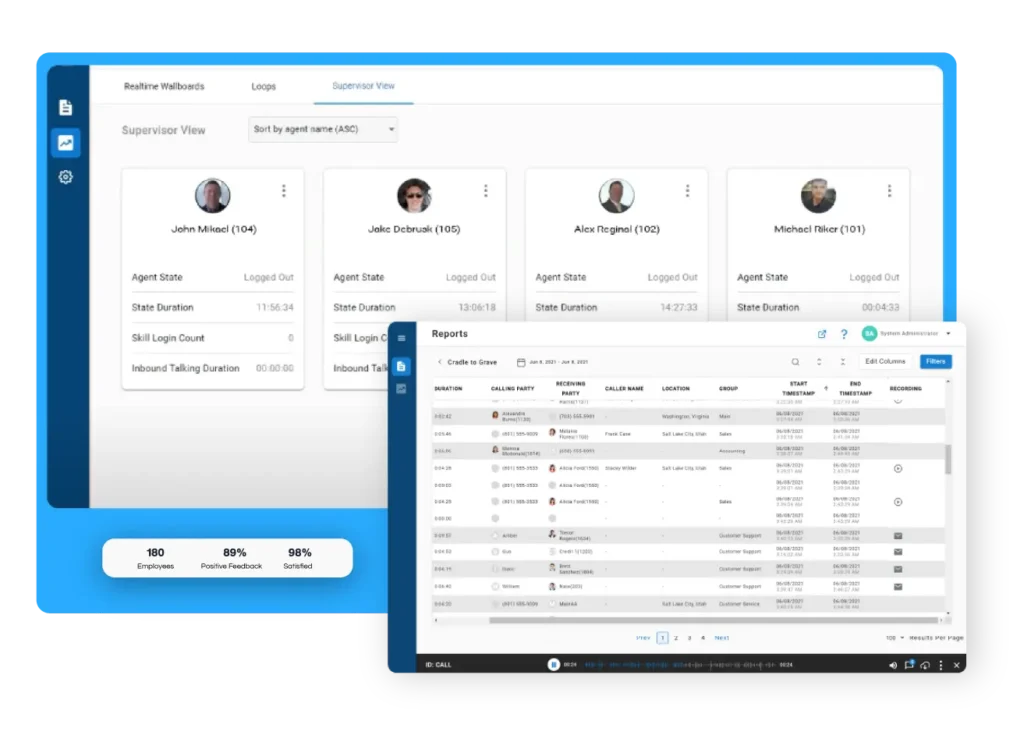
A common culprit: call transfers. Many platforms count each leg of a transferred call as a separate interaction, which artificially inflates call volume, skews average handle time (AHT), and erodes confidence in the data. Xima’s Cradle-to-Grave reporting solves this by tracking every customer journey as a single interaction from start to finish. Measurement comes from Xima’s contact center reporting.
The metrics every contact center should be tracking:
- Average Handle Time (AHT) — Total time per interaction, including hold time and after-call work
- First Call Resolution (FCR) — Whether the customer’s issue was resolved in a single call
- Transfer Rate — How often calls bounce between agents or teams
- Abandonment Rate — How many customers hang up before reaching anyone
- QA Scores — How consistently agents are following process and delivering quality
- Cost Per Interaction — Total agent cost divided by call volume (a simple but powerful metric many teams overlook)
As Jon put it: “Just by implementing a good analytics tool, you’ll easily identify 5–10% inefficiencies, often producing immediate cost ROI.”
Reducing Average Handle Time: Small Changes, Big Returns
Average handle time is one of the highest-impact, lowest-disruption levers available to any contact center. The math adds up fast.
Here’s a real example Jon shared: in a 50-agent environment, shaving just 30 seconds off AHT, the time it takes an agent to manually pull up a customer account, increases overall agent capacity by 6–8%. That translates to avoiding 3–4 new hires per year, which can represent $150,000–$200,000 in savings. The cost of the tooling to make it happen? Far less.
What’s driving unnecessary handle time?
- Poor screen pop setup — Agents spending the first 30 seconds of every call saying “let me pull up your account” is pure waste. A proper screen pop surfaces customer and ticket information the moment the call connects.
- Manual after-call work — Many agents spend 1–5 minutes after every call manually logging notes, dispositioning the call, and updating the CRM. AI can automate all of this, and do it more accurately.
- Hidden hold time — Agents consulting internal chat or colleagues without actually pressing hold. Call recordings reveal these silent gaps, which can run 3+ minutes and go completely unnoticed without the right analytics.
The fix: AI-powered call summaries, auto-disposition, and out-of-the-box CRM integrations (Zendesk, ConnectWise, and others) that require no custom development to get running.
Smarter Routing: Get Calls to the Right Person the First Time
Misrouted calls are a hidden tax. Every unnecessary transfer adds to AHT, frustrates customers, and inflates your abandonment rate. A few approaches that deliver outsized results:
Queue Callback
One of the most underutilized features in contact centers. Jon shared a striking example: a customer was averaging over 1,200 abandoned calls per quarter, and had never enabled queue callback. Enabling it alone can reduce abandonment rates by roughly 40%. Customers opt in voluntarily; you’re not forcing anything on them. Turning it on is one of the easiest wins available.
Availability Tiers
Many teams handle overflow by routing to separate agent groups, which creates messy reporting. Xima’s availability tiers accomplish the same goal, cascading calls to secondary agents after a set wait time, but within a single group. That means cleaner data and no distorted call volume numbers.
AI Topic Detection for Skills-Based Routing
Not all calls in a queue are created equal. A password reset and a full system outage are both “support tickets,” but they require very different skill sets and take very different amounts of time. AI topic detection can classify calls in real time and route them to the best-fit agent automatically, reducing handle time and improving resolution rates without changing anything the customer experiences.
AI-Driven QA: The Lowest-Disruption, Highest-Impact Tool in the Stack
Traditional QA means supervisors manually reviewing a random 3–5% of calls. It’s time-consuming, inconsistent, and leaves the vast majority of calls completely unreviewed. AI-driven QA evaluates every single call, automatically, against whatever criteria you define.
How it works in practice:
- You set the evaluation criteria: did the agent greet the customer properly? Ask for ID verification? Offer to resolve the issue before ending the call?
- AI scores every call against those criteria and provides written rationale for each score
- Supervisors can review AI evaluations alongside recordings and push back where they disagree, which trains the model to score more accurately over time
What does it measure?
- CSAT (without relying on customer surveys, the AI infers it from the conversation)
- Single call resolution
- Process adherence and compliance
- Objection handling
- Upsell and cross-sell attempts
Jon walked through a live demo where AutoQA caught that an agent had failed the verification step entirely, missing both required forms of ID, while correctly crediting the same agent for resolving the customer’s issue on the call and proactively offering further help at the end.
How long until you see ROI? The basic setup can be live in a day. The first two to three weeks involve some refinement, making sure evaluations are mapped to the right call types, and then the system becomes highly calibrated. Teams that keep doing manual reviews alongside AI evaluations during that period see the fastest improvement.
Speech Analytics: Identifying Churn Before It Happens
Speech analytics gives managers visibility into what’s actually being said across all customer interactions, not just the handful someone happened to listen to. Key use cases:
- Churn indicators — Flagging calls with high negative sentiment or explicit language like “I’m thinking about canceling.” If no one takes action, that customer is likely gone. Speech analytics can alert the right person in real time so they can intervene.
- Identifying routing gaps — Which call types are consistently generating long handle times or negative sentiment? That data points directly to where routing or coaching needs to change.
- Sales and upsell triggers — Support agents are often the most trusted people in the organization from a customer’s perspective. Speech analytics can identify moments when an upsell opportunity arises and ensure the right follow-up happens, even if the agent doesn’t escalate it themselves.
Jon’s take: “Support engineers are the best salespeople, because the customer has a sense of trust with those agents.” The problem is that support teams don’t always flag those opportunities. Speech analytics makes sure nothing falls through the cracks.
The Crawl-Walk-Run Principle: Don’t Skip Steps
One of the most important themes of the webinar: resist the urge to implement everything at once.
Jon sees this mistake repeatedly, companies want to jump straight to AI voice bots without having deployed speech analytics or AutoQA first. The result is that they’re designing automation around assumptions rather than actual data. One example: a company that wanted a chatbot but had no live chat on their website. Going from zero chat to an AI chat agent is a recipe for investing a lot in solving the wrong problem.
The better approach: start with live chat. Understand why customers want to chat with you. Use that data to inform what the AI should handle. Then build.
The same logic applies to contact center improvements broadly. Start with the metrics and measurement infrastructure. Use that data to identify your highest-impact, lowest-disruption opportunities. Make targeted improvements. Measure again. Repeat.
Rome wasn’t built in a day. Neither is a high-performing contact center.
The Bottom Line
Driving ROI from your contact center doesn’t require a complete overhaul. It requires the right measurement tools, the willingness to act on what the data shows, and a disciplined approach to rolling out improvements incrementally.
The frameworks Jon shared, reducing AHT through automation, smarter routing, AI-powered QA, and speech analytics, are all available today and can be implemented without disrupting what’s already working.
Want to see these tools in action? Contact the Xima Software team.