
We’ve all been there: you call a company with a problem, explain the situation, get put on hold, and are then transferred to someone else who asks, “So, how can I help you?” Having to repeat your story is a universal customer frustration that damages trust and loyalty. On the flip side, when an agent resolves your issue on the very first try, it creates a positive, memorable experience that can turn a frustrated customer into a loyal advocate.
This is the power of First Call Resolution (FCR), a metric that measures the percentage of customer contacts resolved during the first interaction, with no need for a follow-up. FCR is a vital indicator of your contact center’s efficiency and the quality of your Customer Experience (CX). A high FCR rate directly boosts other key metrics like Customer Satisfaction (CSAT) and reduces operational costs, making it one of the most important call center statistics to track.
This guide will walk you through five powerful, data-driven practices your contact center can implement to significantly increase your FCR rate and set your team up for success in 2026 and beyond.
Why Is Improving FCR More Critical Than Ever in 2026?
As we move through 2026, customer expectations are at an all-time high. People want fast, easy, and complete resolutions to their problems. With the rise of self-service portals and AI chatbots, the issues that actually reach a live agent are often more complex, requiring a higher level of skill and knowledge to solve.
Focusing on FCR is no longer just a good idea—it’s a business necessity. The hypothesis is simple: a higher FCR rate leads directly to better business outcomes. The evidence is clear:
Reduced Operational Costs: Fewer repeat calls mean your agents’ time is optimized, significantly lowering your cost-per-contact.
Increased Customer Loyalty: Effortless experiences build trust and reduce customer churn. For every 1% improvement in FCR, there is a corresponding 1% improvement in CSAT [2]. Resolving an issue on the first try can also dramatically improve a customer’s Net Promoter Score (NPS), which measures their willingness to recommend your brand.
Improved Agent Morale: Agents who feel equipped and empowered to solve customer problems are more engaged, satisfied, and less likely to burn out. This creates a positive cycle of excellent service.
Achieving a world-class FCR rate, which many experts place at 80% or higher [13], isn’t about rushing agents off the phone. It’s about using data to empower them and streamline your processes for resolution. FCR tracking comes from Xima’s contact center reporting.
What Are the 5 Data-Driven Practices to Increase Your FCR Rate?
Let’s dive into the increase FCR rate best practices that leverage data to drive meaningful improvement. Getting the call to the right agent first time is handled through skills-based routing.
1. Empower Agents with an Accessible Knowledge Base and Continuous Training
Hypothesis: One of the most common reasons a call requires a transfer or a callback is that the agent lacks the information or authority to solve the problem on their own [11].
Evidence: To solve this, you must invest directly in your frontline team with the right tools and training.
Build a Centralized Knowledge Base: Your agents need a single source of truth that is fast, searchable, and easy to navigate during a live call. This repository should contain everything from product information and troubleshooting steps to company policies.
Provide Continuous, Data-Informed Coaching: Use call recordings and performance reports to identify common knowledge gaps or areas where agents struggle. This transforms training from a one-time onboarding event to an ongoing, targeted coaching process supported by a strong call center quality assurance program.
Grant Appropriate Agent Authority: Empower agents to handle common requests like small refunds, account credits, or shipping updates without needing a supervisor’s approval. This reduces transfers, cuts down on hold times, and makes the customer feel valued.
Platforms like Xima Software provide detailed analytics that pinpoint calls with multiple transfers or long hold times, highlighting specific areas where agent training or knowledge base content is needed to boost agent performance.
2. Leverage AI and Speech Analytics for Real-Time Guidance
Hypothesis: In 2026, Artificial Intelligence (AI) is an essential tool for improving FCR because human managers can’t listen to every call, but AI can analyze 100% of them.
Evidence: AI offers several practical applications that directly impact resolution rates.
Uncover “Why” with Speech Analytics: AI-powered speech and text analytics can analyze every customer interaction to identify trends, gauge customer sentiment, and find the root causes behind repeat calls. This moves you from knowing that FCR is low to knowing why.
Provide Real-Time Agent Assistance: Modern AI tools can listen to conversations as they happen and automatically surface relevant knowledge base articles, compliance checklists, or next-best-action suggestions directly on the agent’s screen [12].
Automate Post-Call Work: AI can handle tedious tasks like writing call summaries and categorizing interaction types, freeing up agents to focus completely on the customer during the call and move to the next one faster.
Xima’s AI contact center analytics provide the insights needed to understand customer friction at scale, while real-time tools guide agents to the right answer the first time. It’s a core part of an effective AI-powered contact center playbook.
3. Optimize Call Routing and IVR Systems
Hypothesis: A call that lands with the wrong agent is almost guaranteed not to be resolved on the first attempt.
Evidence: Getting the customer to the right expert from the start is one of the most effective ways to improve First Call Resolution (FCR) in 2026.
Implement Skills-Based Routing: Instead of sending calls to the next available agent, route them based on the customer’s specific need (as identified by your IVR) and the agent’s unique skills, such as “billing inquiry,” “technical support,” or “Spanish-speaking” [4].
Analyze and Simplify Your IVR: Use call data to see where customers are getting confused, choosing the wrong menu option, or dropping out of your Interactive Voice Response (IVR) system. Your IVR menu should be clear, concise, and always offer a simple path to a live agent.
Provide Customer Context: Ensure that when a call is transferred, all relevant information—such as the customer’s name, account number, and IVR selections—is passed along to the new agent. This simple step prevents the customer from having to repeat themselves.
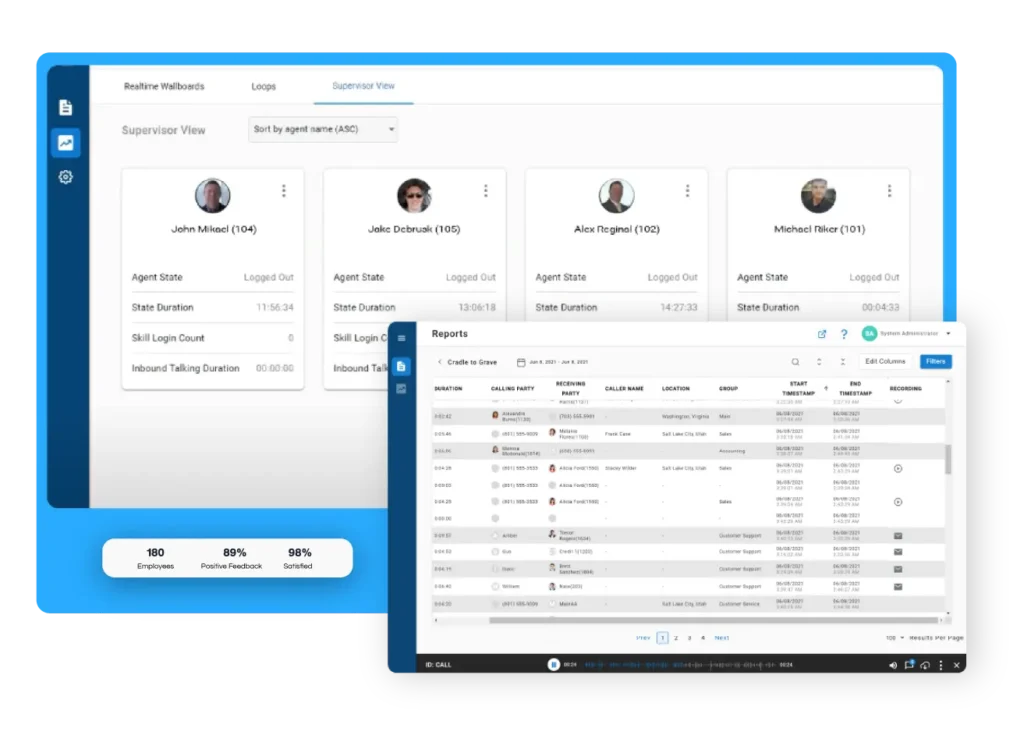
Xima’s contact center reporting provides cradle-to-grave visibility into the entire call journey, making it easy to spot routing inefficiencies and transfer patterns that hurt your FCR.
4. Conduct Root-Cause Analysis on Repeat Calls
Hypothesis: Simply tracking your FCR rate isn’t enough; to truly improve it, you must dig deeper and understand why calls are not being resolved on the first attempt.
Evidence: A data-driven root-cause analysis process provides an actionable roadmap for improvement.
Tag and Categorize Non-FCR Interactions: Systematically label every interaction that requires a follow-up. Are repeat calls caused by a system outage, a confusing policy, an agent knowledge gap, or a product defect?
Use Analytics to Find Patterns: Look for trends in your non-FCR data. Do repeat calls spike after a new software update? Is one specific issue driving the majority of follow-up contacts?
Share Insights Beyond the Contact Center: FCR is often an organizational metric, not just a contact center one. Share your findings with product, marketing, and engineering teams to help them fix the underlying issues that cause customers to call in the first place.
With the right reporting and analytics software, you can filter and analyze interaction data to quickly identify the top reasons for repeat contacts. Xima’s platform helps you use AI to find these root causes efficiently, turning raw numbers into concrete actions.
5. Establish Feedback Loops and Align Goals
Hypothesis: Improving your FCR rate is a continuous cycle, not a one-time project, that requires creating a culture of resolution where everyone is focused on the same goal.
Evidence: This culture is built by actively seeking feedback and aligning incentives with desired outcomes.
Collect Multi-Channel Feedback: The most accurate way to measure FCR is to ask the customer directly. Use post-call SMS or email surveys with a simple question: “Was your issue resolved today?” [14]. Also, gather feedback from your agents on what prevents them from resolving issues.
Align Agent KPIs with FCR: If you only reward agents for low Average Handle Time (AHT), they’ll be incentivized to end calls quickly, not necessarily resolve them. Shift your Key Performance Indicators (KPIs) to prioritize resolution quality and customer satisfaction.
Review FCR in Team Huddles: Use dashboards to track FCR in real-time. Make it a regular topic of conversation, celebrating agents who excel at FCR and brainstorming solutions for common challenges as a team.
Customizable dashboards and reports from Xima make it simple to track FCR alongside CSAT, creating a clear picture of performance that can be shared with your entire team to drive data-driven improvements.
Putting It All Together: Your FCR Success with Xima
Improving your FCR is a journey that rests on five key pillars: agent empowerment, AI-driven guidance, optimized routing, root-cause analysis, and continuous feedback. These practices don’t work in isolation; they combine to create an operating model designed for first-contact resolution.
Xima Software provides the unified, all-in-one platform that brings these strategies to life. With our powerful AI contact center analytics, detailed reporting, and integrated QA tools, you have everything you need to unlock actionable insights and drive meaningful change. By investing in these practices, you’re not just improving a metric; you’re building unbreakable customer loyalty and ensuring long-term business success. For more ideas, explore these 7 ways to boost FCR with Xima.
Conclusion
Improving your First Call Resolution rate is one of the most impactful investments you can make in your customer experience, operational efficiency, and agent satisfaction. By moving beyond simply tracking the number and embracing a data-driven approach to understand the “why” behind it, you can empower your team to deliver the resolution-focused service your customers expect in 2026.
See the data for yourself. Get Your Demo Today and start your journey toward resolution excellence. For more insights, visit the Xima Software blog.