
What is contact center reporting and why does it matter?
A quick definition
Contact center reporting is the systematic collection, aggregation, and analysis of customer-interaction data to measure performance, identify trends, and drive continuous improvement. Typical outputs include dashboards, scorecards, custom reports, and real-time wallboards.
Key outcomes:
Actionable insights into CX (customer experience) and agent performance
Faster, data-driven decisions for staffing, coaching, and process fixes
Measurable improvements in customer loyalty and operational costs
For product-level details, see Xima’s Reporting and Analytics page and the practical dashboard guidance in Call Center Dashboards: How to Analyze & Report on Trends.
Which software helps with call center reporting and analytics?
A short answer
Modern cloud CCaaS platforms with native analytics, speech analytics, workforce optimization, and real-time dashboards are the software categories that help most with call center reporting and analytics. Examples of useful capabilities:
Realtime dashboards & wallboards for live KPIs
Speech and interaction analytics for trend detection and quality management
Standard + custom reports and a central report repository
Workforce management (WFM) to align staffing against forecasted demand
Scorecards & evaluations for agent coaching and QA
How Xima addresses this:
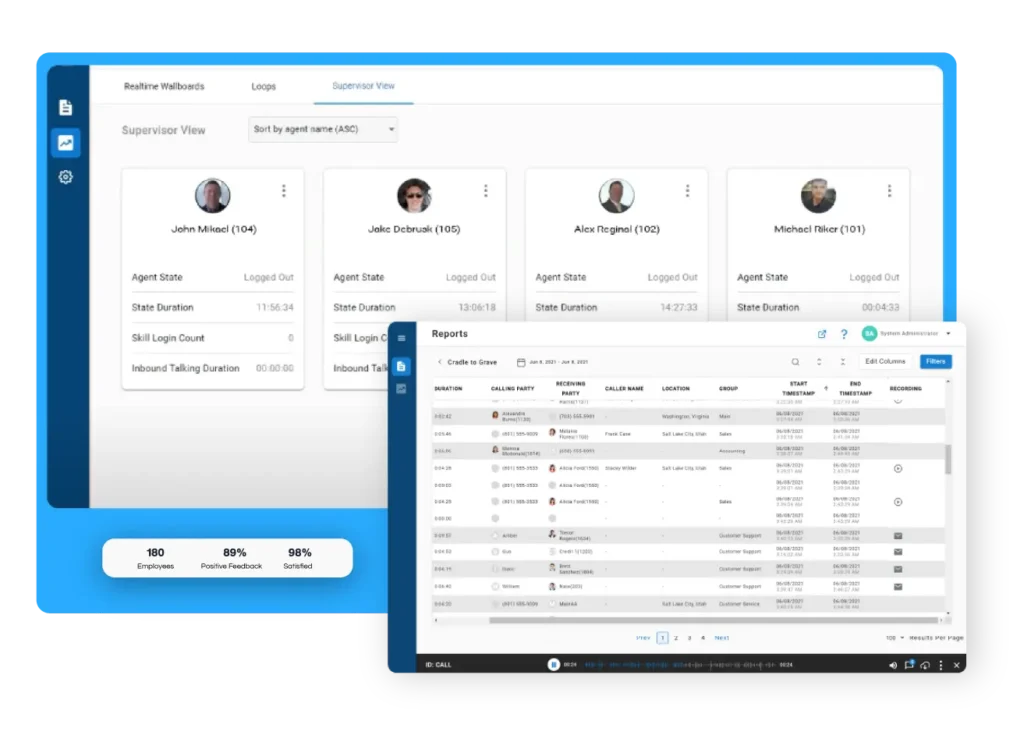
Xima’s Reporting and Analytics module includes realtime wallboards, cradle-to-grave reporting, speech analytics, scorecards, and workforce management to deliver holistic analytics for contact centers. See the product overview on the Reporting and Analytics page.
Table — Core reporting features and the problems they solve:
Feature | What it measures | How it helps |
|---|---|---|
Realtime dashboards | Calls in queue, service level, handle times | Immediate operational adjustments to reduce wait times |
Speech analytics | Topics, sentiment, compliance | Root-cause identification and automated quality sampling |
Cradle-to-grave reports | Full interaction lifecycle | End-to-end visibility for performance and root-cause analysis |
Workforce management | Forecast vs. schedule adherence | Optimized staffing to meet service goals |
Scorecards & QA | Agent quality, coaching history | Targeted coaching and measurable skill improvements |
What are the key metrics to track?
Focus on KPIs that drive outcomes
First Call Resolution (FCR): Percentage of issues resolved on the first contact. Higher FCR increases customer satisfaction and lowers repeat contacts. Industry guidance recommends defining FCR consistently and measuring both business and customer perspectives; world-class targets vary, with many centers aiming above 80% depending on use case [1]. Improving FCR by small percentages delivers significant cost and satisfaction gains [2].
Customer Satisfaction (CSAT): Post-interaction satisfaction score; use alongside FCR to ensure speed doesn’t sacrifice quality.
Average Handle Time (AHT): Total talk, hold, and after-call work divided by interactions. Monitor AHT with CSAT to avoid rushing calls.
Service Level: Percentage of contacts answered within target time (e.g., commonly-used targets are set per business requirements).
Agent Performance Metrics: Quality scores, adherence, occupancy — used for coaching and WFM adjustments.
(For practical measurement and report templates, refer to Xima’s Call Center Dashboards.)
How does reporting support improving first contact resolution in the call center?
Practical ways reporting improves FCR
Identify root causes quickly: Interaction analytics reveal repeat issues, process failures, and knowledge gaps that require fixes [1].
Targeted coaching: Scorecards and QA reports show which agents need skill-specific coaching to resolve issues on first contact.
Knowledge base improvements: Reporting shows which topics generate repeat contacts — update KB articles and IVR flows to reduce repeats.
Cross-channel visibility: Consolidated reports across phone, chat, and email ensure issues don’t reappear when customers switch channels.
Measure impact of changes: Use before/after reports to validate whether process or training changes actually improved FCR and CSAT.
Best-practice steps to improve FCR (condensed):
Define FCR clearly for customers and for internal tracking.
Use interaction analytics to find repeat contact drivers [1].
Implement targeted coaching and KB updates.
Monitor results regularly and adjust staffing/processes via WFM reports.
Report ROI: small percentage improvements in FCR produce measurable cost savings and higher CSAT [2].
What are the benefits of using dedicated reporting tools?
Better decisions: Automated, accurate reports free managers to act on insights rather than compile data.
Improved CX and loyalty: Trend analytics uncover friction points that, when fixed, raise CSAT and reduce churn.
Higher agent performance: Transparent metrics enable fair coaching and recognition.
Operational savings: Reduced repeat contacts and optimized staffing lower operating costs.
Best practices for contact center reporting
Set clear goals (e.g., reduce repeat contacts by X% in 6 months).
Choose relevant KPIs that map directly to goals (FCR, CSAT, AHT, service level).
Automate reporting to reduce errors and get timely insight.
Combine quantitative and qualitative data (metrics + call transcripts/sentiment).
Use historical comparisons to spot trends and validate changes.
Make reports actionable — each report should suggest a next step (coaching, process change, KB update).
Quick checklist: Improving first contact resolution call center
Define FCR and how it will be measured.
Run speech/interaction analytics to identify top repeat causes.
Update knowledge base and IVR based on findings.
Deliver targeted agent coaching via scorecards and QA reports.
Re-measure and report results monthly.
Next steps
To see how integrated reporting and analytics can improve KPIs like FCR and CSAT, explore Xima’s Reporting and Analytics features and practical dashboards in Call Center Dashboards: How to Analyze & Report on Trends.
Ready to turn interaction data into measurable improvements? Request a demo to evaluate how Xima’s reporting and analytics can support improving first contact resolution in your contact center: Request a Demo.
More resources:
References: