
Your customers expect fast, accurate answers. Your agents face growing call volumes. And your supervisors need visibility they often don’t have. An AI contact center changes what’s possible by putting automation, analytics, and real-time insights at the center of every interaction.
This article explains how AI contact centers work—from virtual agents that handle routine inquiries to speech analytics that surface patterns in every conversation. You’ll learn what automated quality assurance actually delivers and how these technologies help contact center managers and customer service leaders improve both speed and experience.
Xima Software gives you a cloud-based contact center platform built for these exact challenges, making enterprise-grade AI accessible without enterprise complexity.
Key Takeaways: How AI Contact Centers Improve Customer Service
- AI contact centers use virtual agents to handle routine questions, freeing your team for complex issues that need a human touch.
- Speech analytics examines every call to identify coaching opportunities, compliance risks, and customer sentiment patterns you’d otherwise miss.
- Automated QA scores 100% of interactions instead of the 1-3% most manual programs review, closing dangerous blind spots.
- Xima Software delivers AI-powered auto QA and real-time dashboards that give supervisors instant visibility into agent performance.
- These technologies reduce average handle time, improve first-call resolution, and decrease agent burnout across your operation.
- Routing decisions are handled through skills-based routing.
What Is an AI Contact Center?
An AI contact center is a customer service operation that uses artificial intelligence to automate tasks, analyze interactions, and support agents in real time. Unlike traditional call centers that rely entirely on human effort, AI contact centers add a layer of intelligent automation across voice, chat, email, and SMS channels.
Xima’s AI contact center capabilities are described in full on the product page.
The core components include virtual agents (also called conversational AI or chatbots), speech analytics engines, automated quality assurance, and sentiment analysis tools. Together, these technologies create a system that learns from every interaction and helps your team perform better.
According to McKinsey research, contact centers that blend human expertise with AI see significant improvements in both efficiency and customer satisfaction. The key is finding the right balance between automation and human connection.
How Do Virtual Agents Improve Customer Service?
Virtual agents are AI-powered systems that interact with customers through voice or text, handling inquiries without human intervention. They work around the clock, answering frequently asked questions, routing calls to the right department, and completing basic transactions like appointment scheduling or account lookups.
Here’s where virtual agents change your daily operation: when a customer calls about their account balance at 2 AM, a virtual agent handles that request instantly. Your human agents never get pulled away from complex issues during peak hours to answer questions that don’t need them.
The result is faster response times for customers and better workload distribution for your team. Virtual agents handle the predictable volume so your agents can focus on conversations that require empathy, judgment, and problem-solving—the interactions where human connection matters most.
Where Virtual Agents Work Best
Virtual agents perform well with high-volume, repetitive tasks: checking order status, resetting passwords, confirming appointments, and collecting basic information before transferring to a live agent. They struggle with nuanced complaints, emotional situations, or requests that fall outside their training.
Smart implementation means understanding this boundary. You deploy virtual agents for the 40% of calls that follow predictable patterns, and you make the handoff to human agents smooth when conversations need escalation.
What Does Speech Analytics Do in a Contact Center?
Speech analytics technology transcribes and analyzes voice conversations to extract insights about what’s happening in your contact center. It identifies keywords, phrases, emotional tone, and conversation patterns across thousands of calls that no human team could review manually.
This is what speech analytics makes possible: you discover that customers who mention a competitor’s name during calls are three times more likely to cancel their service. You find that a specific phrase your agents use during billing disputes correlates with faster resolution. You catch compliance language being skipped before an auditor does.
Xima Software’s speech analytics capabilities transcribe calls in real time and surface trends that matter—helping supervisors identify coaching opportunities and spot issues before they become patterns.
From Recorded Calls to Actionable Insights
Recording is not analysis. Recording is raw material. Most contact centers record calls but never turn those recordings into insights because manual review takes too long. A supervisor might listen to five calls per agent per month—a sample so small it reveals almost nothing about actual performance.
Speech analytics changes this equation. Every call gets analyzed. Every required disclosure gets tracked. Every escalation trigger gets flagged. You move from guessing about what’s happening to knowing.
How Does Automated QA Transform Quality Assurance?
Traditional quality assurance programs review 1-3% of customer interactions. The other 97% happens with no oversight. Automated QA applies consistent evaluation criteria to every single interaction—voice, chat, email—giving you complete visibility into agent performance and compliance.
Here’s the operational reality: your supervisors spend hours each week listening to calls and filling out scorecards. That time comes directly from coaching, training, and managing their teams. Automated QA handles the scoring so supervisors can focus on the conversations that improve performance.
Xima Software’s AI-powered auto QA evaluates 100% of interactions against your criteria, flagging calls that need attention and tracking trends over time. This means problems get caught in days, not months.
Why 100% Coverage Matters
When you review 2% of calls, you’re building your quality program on statistical noise. An agent might have a bad week—or a great one—and you’d never know because the sample size is too small to show patterns.
With automated QA, you see everything. You identify which agents need help with specific skills. You catch compliance gaps before they become audit findings. You recognize top performers with data that’s actually representative of their work.
How Do AI Contact Centers Reduce Average Handle Time?
Average handle time drops when agents have the right information at the right moment. AI contact centers make this happen through real-time agent assist tools, intelligent call routing, and automated after-call work.
Agent assist technology listens to conversations and surfaces relevant knowledge base articles, customer history, and suggested responses as the call progresses. Your agent doesn’t need to put the customer on hold to search for information—it appears automatically.
Skills-based routing ensures calls reach agents with the right expertise on the first transfer. And automated call summaries eliminate the minutes agents spend typing notes after each interaction.
Real-Time Dashboards for Supervisors
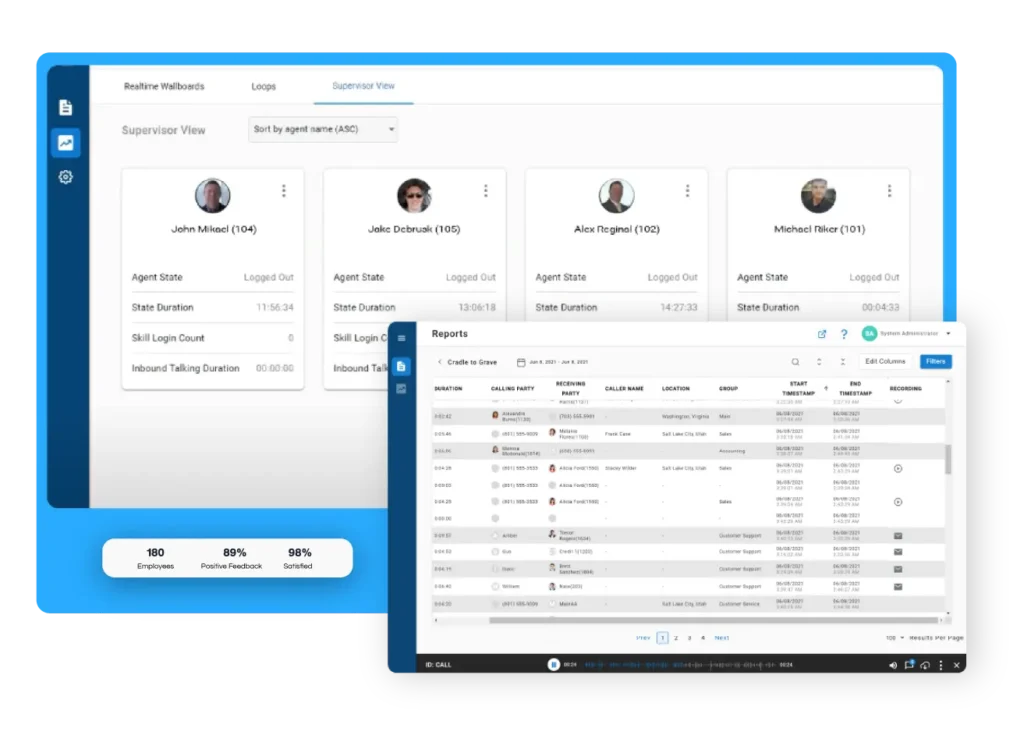
Xima Software’s real-time wallboards and dashboards show supervisors exactly what’s happening across their team at any moment. Queue depth, wait times, agent status, service levels—all visible without running reports or waiting for end-of-day data.
This visibility enables immediate action. When call volume spikes, supervisors can reallocate resources before customers start abandoning. When an agent’s handle time climbs, they can intervene with support or coaching while the pattern is still forming.
How Does Sentiment Analysis Improve Customer Experience?
Sentiment analysis uses natural language processing to detect emotional signals in customer conversations. It identifies frustration, satisfaction, confusion, and urgency—giving you insight into how customers actually feel, not just what they say.
This matters because customer surveys capture maybe 10% of your interactions, and the customers who respond aren’t representative of everyone who calls. Sentiment analysis shows you the emotional landscape of every conversation.
When patterns emerge—a product launch generating confused calls, a policy change frustrating customers—you see it in the data before complaint volume builds. That early warning gives you time to respond with better training, clearer communication, or process changes.
What Are the Benefits of AI Contact Centers for SMBs?
AI contact center technology used to require enterprise budgets and dedicated IT teams. That’s no longer true. Cloud-based platforms make these capabilities accessible to contact centers of all sizes, with implementation timelines measured in weeks rather than months.
For small and medium businesses, this means access to the same tools that large organizations use to optimize customer experience—without the complexity, cost, or steep learning curve that traditionally came with them.
Xima Software was built with this reality in mind. The platform delivers cradle-to-grave reporting, omnichannel support, and AI-powered analytics through a user-friendly interface that doesn’t require technical expertise to manage.
Scalability Without Complexity
As your contact center grows, your AI tools should grow with you. Look for platforms that offer flexible licensing, transparent pricing, and the ability to add capabilities as your needs evolve.
The goal is a system that handles your current volume while giving you room to expand—without forcing you to switch vendors or rebuild your operation from scratch when you outgrow your starting configuration.
In Conclusion: How AI Contact Centers Deliver Better Customer Service
AI contact centers combine virtual agents, speech analytics, and automated QA to address the operational challenges contact center managers face every day. These technologies increase service speed, improve agent performance, and give supervisors the visibility they need to lead effectively.
The question isn’t whether AI belongs in your contact center. It’s how quickly you can close the gap between what you’re reviewing manually and what’s actually happening across your operation.
Xima Software helps you answer that question with a platform built for contact centers that need enterprise-grade capabilities without enterprise complexity. See how Xima can help your team deliver faster, more consistent customer experiences.
FAQs About How AI Contact Centers Improve Customer Service
What is the difference between a traditional call center and an AI contact center?
A traditional call center relies entirely on human agents to handle customer interactions. An AI contact center adds automation, analytics, and intelligent routing to support agents and improve efficiency.
Xima Software’s AI-powered platform gives your team real-time insights and automated QA that manual processes can’t match.
How do virtual agents handle complex customer issues?
Virtual agents work well for routine, predictable inquiries. When conversations require human judgment or empathy, they transfer calls to live agents with context intact.
The best implementations use virtual agents to filter simple requests so human agents can focus on complex problems.
Can speech analytics help with compliance monitoring?
Speech analytics tracks required disclosures, monitors for compliance language, and flags calls where scripts weren’t followed. This gives compliance teams evidence-based oversight instead of random sampling.
Xima Software’s speech analytics reviews every interaction, helping you catch compliance gaps before auditors do.
How does automated QA compare to manual quality assurance?
Manual QA typically covers 1-3% of interactions. Automated QA evaluates 100% against consistent criteria, revealing patterns manual review misses.
Xima Software’s auto QA scores every call, chat, and email—freeing supervisors to coach instead of score.
What should contact center managers look for in an AI platform?
Look for real-time dashboards, speech analytics, automated QA, and omnichannel support in a single platform. Integration with your existing phone system and CRM matters too.
Xima Software delivers all these capabilities with transparent pricing and white-glove support to help you get started quickly.