Somewhere in your contact center right now, an agent is on a call handling sensitive customer data. Maybe they’re processing a payment. Maybe they’re discussing a patient’s healthcare information. You might have policies for how these interactions should be handled—but can you verify those policies are being followed on every single call?
That’s the operational reality behind call center compliance. It’s not an abstract regulatory concern. It’s a concrete question about what’s actually happening in your operation today. Xima Software helps contact center managers answer that question with call recording, real-time monitoring, and AI-powered QA that covers 100% of your interactions.
This article breaks down what call center compliance means in 2026, the regulations you need to know, and how to build recording policies and data privacy practices that hold up under scrutiny.
Key Takeaways: What Is Call Center Compliance in 2026
- Call center compliance means meeting legal, security, and operational requirements across every customer interaction your team handles.
- Recording consent rules vary by state and country—some require all-party consent while others only require one-party consent.
- Xima Software’s cradle-to-grave reporting and AI-powered QA give you verifiable compliance documentation across 100% of calls.
- PCI DSS and HIPAA set strict requirements for how your agents handle payment data and protected health information.
- A compliance program built on 1-3% call sampling leaves 97% of your interactions unreviewed—and unprotected.
What Is Call Center Compliance?
Call center compliance refers to the policies, procedures, and technology controls that ensure your contact center operations meet legal requirements, industry regulations, and internal quality standards. It covers everything from how you record calls to how you store customer data to what your agents say during interactions.
Xima’s contact center compliance capabilities support the obligations described here.
The scope includes federal and state laws, industry-specific regulations like HIPAA for healthcare and PCI DSS for payment processing, and internal policies you’ve established for quality assurance. Compliance isn’t a one-time checkbox—it’s an ongoing operational discipline that requires consistent monitoring and documentation.
What Regulations Govern Call Center Operations?
Several overlapping regulatory frameworks shape how contact centers must operate. Understanding which ones apply to your organization depends on your industry, the data you handle, and where your customers are located.
Telephone Consumer Protection Act (TCPA)
The TCPA restricts how and when you can contact consumers via phone. It governs outbound calling practices, requiring prior express consent for automated calls and establishing rules for the National Do Not Call Registry.
Violations carry penalties of $500 to $1,500 per call, and class action lawsuits under TCPA have resulted in multi-million dollar settlements. Your outbound campaigns need documented consent records and scrubbed calling lists.
Health Insurance Portability and Accountability Act (HIPAA)
If your contact center handles protected health information (PHI), HIPAA compliance is non-negotiable. This includes healthcare providers, insurance companies, and any business associate that touches patient data.
HIPAA requires administrative, physical, and technical safeguards for PHI. Your call recordings containing health information must be encrypted, access-controlled, and retained according to specific timelines. Xima Software integrates with over 70 EHR/EMR systems and maintains HIPAA-compliant recording and storage protocols.
Payment Card Industry Data Security Standard (PCI DSS)
Any contact center that processes, stores, or transmits credit card data must comply with PCI DSS requirements. The standard includes 12 requirements covering network security, access controls, and cardholder data protection.
For contact centers, this means implementing pause-and-resume recording during payment capture, securing any stored cardholder data, and maintaining audit trails for all access to sensitive payment information.
General Data Protection Regulation (GDPR)
If you serve customers in the European Union, GDPR applies to your call center operations regardless of where your organization is located. GDPR requires explicit consent for data processing, the right to erasure, and strict breach notification timelines.
Call recordings qualify as personal data under GDPR. You need clear consent mechanisms, documented data retention policies, and the ability to delete specific recordings upon customer request.
What Are Call Recording Consent Requirements?
Recording consent rules vary significantly based on jurisdiction. Getting this wrong exposes your organization to legal liability on every recorded call.
One-Party vs. All-Party Consent States
In one-party consent states, you can record a call if one participant (including your agent) consents. In all-party consent states, every person on the call must agree to the recording.
Currently, 11 states require all-party consent: California, Connecticut, Florida, Illinois, Maryland, Massachusetts, Michigan, Montana, New Hampshire, Pennsylvania, and Washington. The remaining states follow one-party consent rules.
How to Handle Multi-State Operations
If your contact center serves customers across multiple states, the safest approach is following the stricter all-party consent standard for all calls. This means implementing clear disclosure at the start of every interaction.
Your IVR or agent script should state that the call may be recorded for quality and training purposes, and customers should have an opportunity to object or request an unrecorded interaction.
How Does Data Privacy Apply to Contact Centers?
Data privacy in call centers extends beyond recording consent. It covers how you collect, store, access, and eventually dispose of customer information across all channels.
Data Minimization and Purpose Limitation
Collect only the customer data you actually need to resolve their inquiry. Every additional data point you capture increases your compliance burden and breach exposure.
Document specific business purposes for each type of data you collect, and ensure your agents aren’t gathering information outside those defined purposes. Xima Software’s real-time speech analytics can flag when conversations drift into areas where unnecessary data collection might occur.
Retention Policies and Secure Deletion
Establish clear retention timelines for call recordings and customer data based on regulatory requirements and business needs. Industry standards typically range from 30 days to 7 years depending on the data type and applicable regulations.
When retention periods expire, data must be securely deleted—not just archived. Your compliance program needs documented proof that deletion occurred.
What Does a Compliant Quality Assurance Program Look Like?
Quality assurance and compliance monitoring go hand in hand. The question is whether you’re reviewing enough interactions to actually verify compliance across your operation.
The Problem with Manual Sampling
Most contact centers review 1-3% of calls manually. An average agent handles 60 calls per day. A 20-agent contact center generates 1,200 interactions daily. At 3% sampling, you’re reviewing 36 calls while 1,164 go completely unexamined.
That’s not a compliance program. That’s an assumption that everything is fine in the 97% you never look at.
AI-Powered QA for 100% Coverage
Xima Software’s AI-powered Auto QA and speech analytics score 100% of your interactions automatically. Every call gets evaluated against your compliance criteria, not just a small sample selected by chance or convenience.
This approach surfaces compliance issues in real time rather than weeks later when a supervisor finally gets around to reviewing an old call. You can identify patterns, coach agents immediately, and document that every interaction was monitored.
How Do You Build an Audit-Ready Compliance Program?
When a regulator asks to see your compliance documentation, the answer can’t be “give us a few weeks to pull that together.” Audit readiness means having verifiable records accessible on demand.
Ongoing verification runs through Xima’s call monitoring and quality assurance.
Cradle-to-Grave Interaction Tracking
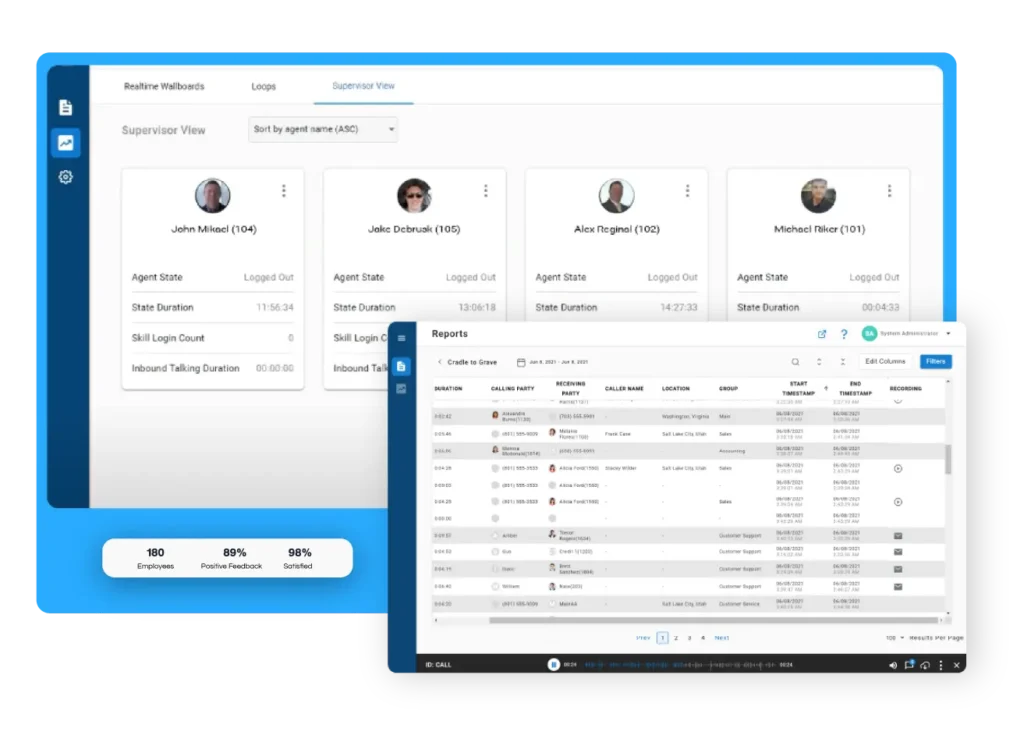
Your compliance documentation should capture the complete lifecycle of every customer interaction—from initial queue entry through resolution and wrap-up. Xima Software’s cradle-to-grave reporting creates this audit trail automatically across all channels.
This documentation proves not just what happened, but what your agents did at each step and whether required procedures were followed.
Real-Time Monitoring and Alerts
Compliance issues that go undetected for days or weeks become much harder to address. Real-time wallboards and automated alerts let supervisors intervene while problems are still small.
Configure alerts for specific compliance triggers—agent scripts being skipped, sensitive topics flagged in speech analytics, or unusual call patterns that might indicate procedural drift.
In Conclusion: Building Call Center Compliance That Holds Up
Call center compliance isn’t a document on a shelf. It’s what’s actually happening in your contact center right now, on every call, across every agent.
The regulations—TCPA, HIPAA, PCI DSS, GDPR—establish the floor. Your recording consent procedures, data privacy practices, and QA monitoring determine whether you’re actually meeting those requirements or just hoping you are.
The question isn’t whether you need compliance visibility. The question is how long you’re willing to operate with 97% of your interactions unreviewed—and who finds that blind spot first.
FAQs About Call Center Compliance
What are the main regulations that affect call center compliance?
The primary regulations include TCPA for calling practices, HIPAA for healthcare data, PCI DSS for payment card handling, and GDPR for European customer data. Your specific requirements depend on your industry and customer locations.
Xima Software’s compliance reporting helps you track adherence to these regulations across every customer interaction.
Do I need consent to record customer calls?
Yes, though requirements vary. Eleven U.S. states require all-party consent where everyone on the call must agree. Other states follow one-party consent rules where only one participant needs to consent.
For multi-state operations, implementing all-party consent disclosure protects you across all jurisdictions.
How does HIPAA affect contact center operations?
HIPAA requires healthcare contact centers to protect patient health information through administrative, physical, and technical safeguards. Call recordings containing PHI must be encrypted and access-controlled.
Xima Software integrates with over 70 EHR systems while maintaining HIPAA-compliant recording and data handling protocols.
What percentage of calls should be reviewed for compliance?
Manual sampling typically covers only 1-3% of calls, leaving most interactions unreviewed. AI-powered QA makes 100% coverage possible by automatically scoring every interaction against compliance criteria.
Xima Software’s Auto QA evaluates all your calls, eliminating the blind spot that random sampling creates.
How long should call recordings be retained?
Retention requirements vary by regulation and business purpose, typically ranging from 30 days to 7 years. HIPAA requires six years for PHI-related records, while other industries may have different timelines.
Document your retention policies and ensure secure deletion occurs when periods expire.
What is PCI DSS compliance for call centers?
PCI DSS governs how contact centers handle credit card data. Requirements include pause-and-resume recording during payment capture, encrypting stored cardholder data, and maintaining access audit trails.
Xima Software supports PCI-compliant call recording workflows to help protect payment information during customer interactions.