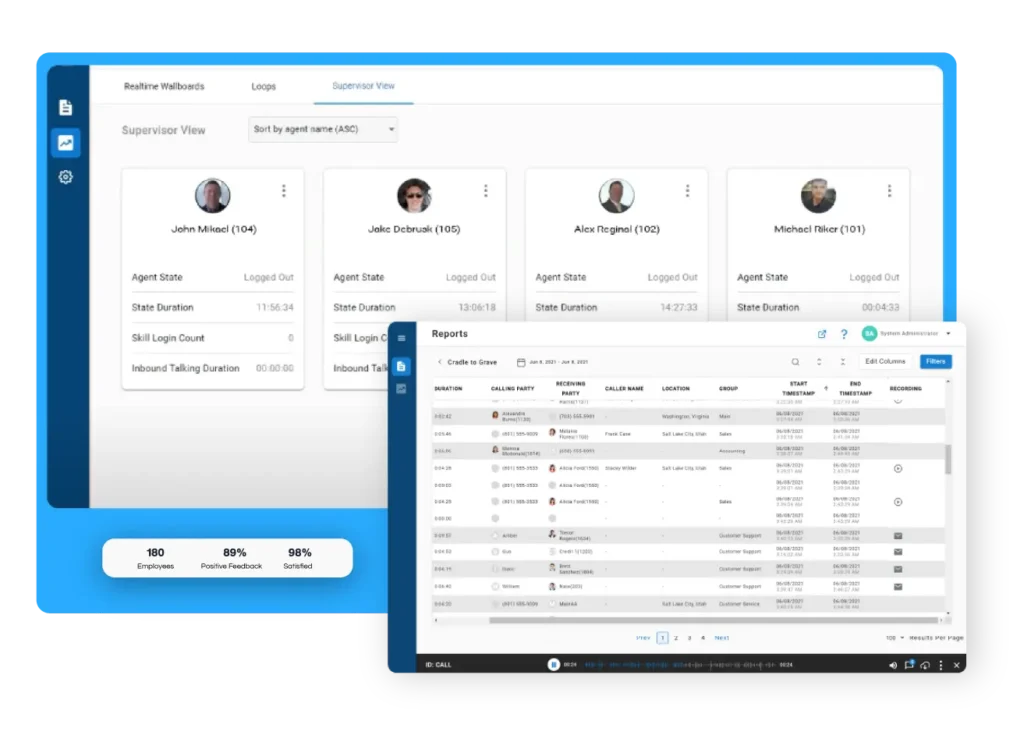

Your contact center is fielding fifty, maybe a hundred calls a day. A customer asks about their account status. An agent transfers them to another department. Somewhere in that handoff, the interaction disappears from your reporting. You won’t find it later because nobody tracked what happened between point A and point B.
That’s the operational reality for most small and midsize business contact centers running on outdated phone systems or entry-level tools. Xima Software builds contact center software that tracks every interaction from the moment a call enters your queue until the final wrap-up—what’s called cradle-to-grave reporting. This guide walks you through every factor you need to consider when selecting call center software in 2026.
By the time you finish reading, you’ll know exactly what questions to ask vendors, which features actually matter for your operation, and how to avoid the expensive mistakes that trap SMBs in contracts that don’t serve their needs.
Key Takeaways: How to Choose Call Center Software for SMBs in 2026
- Cloud call center platforms eliminate hardware costs and let you scale agents up or down based on actual demand.
- CRM integration is non-negotiable—your agents need customer context without switching between four different screens.
- Xima Software delivers cradle-to-grave reporting that captures every interaction from queue entry to wrap-up.
- Skills-based routing and queue callback reduce wait times and improve your first-call resolution rates.
- Transparent pricing matters more than the lowest quote—ask vendors to itemize every cost before signing.
What Is Call Center Software and Why Do SMBs Need It?
Call center software is the platform your agents use to handle inbound and outbound customer communications. It routes calls to the right people, records interactions, generates reports, and connects with your other business tools.
Xima’s contact center solutions for small businesses are built for the team sizes described here.
For small and midsize businesses, the right software means the difference between a three-person team handling 200 calls efficiently and that same team drowning in missed calls and frustrated customers. You don’t need the complexity of an enterprise system, but you do need the core features that make customer service scalable.
A 2023 Salesforce State of Service report found that 88% of service professionals say technology helps them perform their jobs more effectively. The question isn’t whether you need contact center technology—it’s whether you’re using the right technology for your operation’s size and complexity.
How Has Cloud Call Center Technology Changed the SMB Market?
Five years ago, running a contact center meant server rooms, IT staff, and capital expenditures that put real reporting tools out of reach for most small businesses. Cloud-based call center platforms changed that equation entirely.
With cloud deployment, you’re not buying hardware. You’re not managing infrastructure. You’re paying for the software and the capacity you actually use. When call volume spikes during your busy season, you add seats. When it drops, you scale back.
What Are the Main Benefits of Cloud-Based Call Center Solutions?
The first benefit is cost predictability. Monthly or annual subscriptions replace unpredictable capital expenditures. You know what you’re spending before the bill arrives.
The second is deployment speed. On-premise systems can take months to install and configure. Cloud platforms typically go live in days or weeks, depending on your integration requirements.
The third is accessibility. Your agents can work from your office, from home, or from a satellite location. The platform doesn’t care where they’re sitting—it cares whether they’re logged in and ready to take calls.
When Does On-Premise Call Center Software Make Sense?
On-premise deployment still has a place in specific situations. If your industry has strict data residency requirements, keeping customer records on servers you physically control may be mandatory. Some healthcare and financial services organizations fall into this category.
On-premise systems also offer absolute control over uptime. Your call quality doesn’t depend on internet connectivity to a third-party data center. For operations where even brief outages create significant business risk, that control matters.
Xima Software offers both cloud and on-premise deployment options, which means you’re not locked into a single approach. You can start with cloud deployment and migrate to on-premise later if your compliance requirements change—or vice versa.
What Features Should SMBs Prioritize in Call Center Software?
Not every feature on a vendor’s spec sheet matters for your operation. Here’s how to separate the essentials from the nice-to-haves.
How Does Automatic Call Distribution Work?
Automatic call distribution (ACD) is the engine that routes incoming calls to available agents. At its most basic, ACD sends calls to the next agent in line. More advanced systems use skills-based routing—matching callers to agents based on language, product expertise, or issue type.
Skills-based routing matters when your team has specialists. If you have three agents who handle billing and two who handle technical support, you want billing calls going to billing agents. Otherwise, you’re transferring calls constantly, frustrating customers, and inflating your handle times.
What Is Interactive Voice Response and Do You Need It?
Interactive voice response (IVR) is the automated menu system callers encounter before reaching an agent. “Press 1 for sales, press 2 for support.” Done well, IVR directs callers to the right department without human intervention. Done poorly, it creates a maze that makes customers hang up before they ever reach a person.
For SMBs, the question is complexity. If your operation handles three distinct call types, a simple IVR makes sense. If every call is essentially the same, you might skip IVR entirely and route directly to your team.
Why Does CRM Integration Matter for Contact Centers?
When a customer calls, your agent needs context. Who is this person? What did they purchase? What was their last interaction? CRM integration pulls that information automatically so agents aren’t asking customers to repeat information they’ve already given.
The key word here is “native.” Some platforms integrate with CRMs through third-party middleware—extra software sitting between your contact center and your CRM. That middleware introduces complexity, potential points of failure, and often additional cost.
Xima Software offers bi-directional CRM integrations that sync data both ways without middleware. Customer information flows into your contact center, and interaction records flow back into your CRM. Your sales and service teams see the same complete picture.
What Reporting and Analytics Capabilities Should You Expect?
Here’s where most SMB-focused platforms fall short. They’ll show you basic metrics—call volume, average handle time, abandonment rate. But they won’t tell you what happened on individual calls or give you the operational visibility supervisors need to coach their teams.
Look for these specific capabilities:
- Cradle-to-grave reporting: The ability to trace any interaction from the moment it entered your system through every transfer, hold, and wrap-up note. This is how you find the calls that went wrong.
- Real-time dashboards: Wallboards that show queue depth, wait times, and agent status as they happen. Supervisors need this information to make decisions now, not tomorrow when they pull a report.
- Custom reporting: The ability to build reports around your specific KPIs rather than being limited to whatever the vendor decided to measure.
Xima Software was built around reporting. Real-time wallboards, scheduled reports, and customizable dashboards give you visibility into every metric that matters for your operation.
How Do You Evaluate Call Center Automation Features?
Automation in contact centers falls into two categories: features that reduce agent workload and features that handle customer interactions without agents.
What Is Queue Callback and How Does It Reduce Abandonment?
Queue callback lets customers request a return call instead of waiting on hold. The system holds their place in line and calls them back when an agent becomes available.
This single feature can dramatically reduce call abandonment. Customers aren’t sitting on hold listening to the same music loop for twenty minutes. They’re going about their day, knowing they’ll get a call when it’s their turn.
From an operational perspective, queue callback smooths out demand spikes. Instead of ten customers in queue at 9:15 AM, you have five on hold and five waiting for callbacks. Your agents work through the same volume, but your abandonment rate drops.
How Does AI Change Quality Assurance for SMB Contact Centers?
Traditional quality assurance means supervisors listening to a sample of calls and scoring them manually. At most contact centers, that sample is somewhere between 1% and 5% of total call volume. The other 95% to 99% goes unreviewed.
AI-powered QA changes the math. Automated speech analytics can score 100% of your calls against your quality criteria. Sentiment analysis flags calls where customers became frustrated. Supervisors stop hunting randomly through call recordings and start focusing on the interactions that actually need attention.
Xima Software’s AI-powered Auto QA covers every interaction, not just a statistical sample. That means your supervisors spend their time coaching agents and improving processes rather than listening to hundreds of randomly selected calls hoping to find something worth addressing.
What Should You Know About Chatbots and Omnichannel Support?
Customers don’t just call anymore. They send emails, start web chats, text, and reach out through social media. Omnichannel support means handling all those communication types through a single platform rather than separate tools for each channel.
The integration piece matters here. If a customer starts a conversation on chat and then calls about the same issue, your agent should see that chat history. Siloed channels create siloed information, and siloed information creates frustrated customers repeating themselves.
What Questions Should You Ask Call Center Software Vendors?
Use these questions in every demo. If a vendor pivots away from any of them or redirects to a different part of the presentation, that’s information worth noting.
Questions About Pricing and Contracts
- “What is the total monthly cost for my team size, including all features, integrations, and support?” Don’t accept “it depends” without specific numbers.
- “What costs are not included in the base price?” Implementation, training, premium support, and integrations often carry separate fees.
- “What are the contract terms and exit options?” Avoid long-term contracts without clear exit clauses.
- “How does pricing change if I add or remove agents?” Understand the per-seat economics before you sign.
Questions About Implementation and Support
- “What does the implementation timeline look like for a contact center my size?” Get specific milestones, not vague estimates.
- “What training is included versus additional cost?” Some vendors include training; others charge separately.
- “What support levels are available and what do they cost?” Understand the difference between standard and premium support before you need it.
- “Do I have a dedicated account manager or implementation specialist?” For SMBs, white-glove support often determines implementation success.
Questions About Technical Capabilities
- “Show me the complete lifecycle of a single interaction, from queue entry to wrap-up.” Not a summary—the actual data trail.
- “How does your system integrate with [your specific CRM]?” Ask for a demonstration, not a claim.
- “Can I build custom reports around metrics you don’t track by default?” Standard reports rarely cover everything an SMB needs.
- “What happens to my data if I leave?” Understand data ownership and export options before you’re locked in.
How Do You Calculate Total Cost of Ownership for Call Center Software?
The sticker price on a vendor’s website is never the complete number. Total cost of ownership includes everything you’ll spend over the contract period.
What Costs Do Vendors Often Leave Out of Initial Quotes?
Watch for these frequently omitted items:
- Implementation fees: Professional services for setup, configuration, and data migration.
- Integration costs: Connecting to CRMs, ERPs, or other business systems may require additional development.
- Training expenses: Getting your team up to speed, both initial and ongoing.
- Premium support: Higher tiers of support with faster response times and dedicated contacts.
- Usage overages: Minutes, storage, or feature usage beyond included allotments.
How Do You Compare Cloud Versus On-Premise Costs?
Cloud platforms typically have lower upfront costs and predictable monthly expenses. On-premise systems require larger initial investments but may cost less over five to seven years for stable operations.
Cost structures are outlined on Xima pricing.
The calculation depends on your situation. A growing contact center that might double in size over three years will likely find cloud economics more favorable. A stable operation with consistent call volume might benefit from on-premise deployment.
Xima Software’s transparent pricing approach means you know exactly what you’re paying before implementation begins. No hidden add-ons, no surprise fees when you need a feature that seemed included.
What Are the Most Common Mistakes SMBs Make When Choosing Call Center Software?
These are the patterns that lead to failed implementations and expensive do-overs.
Buying More Capability Than You Need
Enterprise platforms marketed to SMBs come with enterprise complexity. If you’re running a fifteen-agent contact center, you don’t need the feature set designed for fifteen hundred agents. You need tools that match your operational reality.
The wasted features aren’t just a cost problem—they’re a usability problem. Every feature your team doesn’t use is interface clutter making the features they do use harder to find.
Underestimating the Importance of Reporting
Basic call volume numbers don’t tell you what’s actually happening in your contact center. If you can’t see which agents are struggling, where calls are getting stuck, and what’s causing customer frustration, you’re operating blind.
Before you sign with any vendor, ask to see their reporting dashboard with real data. If the reports feel limited or the custom reporting options seem complicated, you’ll feel that limitation every day you use the platform.
Ignoring the Integration Requirements
Your contact center doesn’t exist in isolation. It connects to your CRM, your helpdesk, your billing system, and possibly your EHR if you’re in healthcare. Every integration that doesn’t work smoothly creates manual workarounds and data gaps.
Get a list of native integrations before you demo. Ask about API documentation if you need custom connections. And verify that the integrations are bi-directional—data flowing one way is only half a solution.
Choosing Based on Price Alone
The cheapest option rarely stays cheapest. Entry-level platforms often charge for features that should be included, nickel-and-dime on usage, and require upgrades as soon as you hit any kind of growth.
Total value matters more than monthly line items. A platform that costs more per seat but includes better reporting, faster support, and deeper integrations often delivers better ROI than the budget option that requires workarounds for everything beyond basic calling.
How Do You Evaluate Call Center Software for Specific Industries?
Different industries have different requirements. Here’s what matters most for common SMB verticals.
What Do Healthcare Contact Centers Need?
HIPAA compliance is non-negotiable. Your call center software must support encryption, access controls, audit trails, and business associate agreements. If a vendor can’t clearly explain their HIPAA compliance posture, move on.
Integration with electronic health record (EHR) systems matters for patient context. Xima Software integrates with over 70 EHR systems, giving agents patient information without requiring separate system logins.
What Do Financial Services Contact Centers Need?
PCI DSS compliance protects payment card data. Call recording must mask or exclude sensitive information when customers read card numbers over the phone.
Compliance reporting is equally critical. Regulators want audit trails showing who accessed what information and when. The software that generates those reports with minimal manual effort saves your compliance team significant time.
What Do Retail and E-Commerce Contact Centers Need?
Seasonal scalability matters more in retail than almost any other industry. Your Black Friday call volume may be ten times your average Tuesday. The platform needs to handle those spikes without performance degradation or emergency upgrade negotiations.
Omnichannel support is particularly important when customers move between web chat during browsing and phone calls when they need help completing orders.
What Should Your Evaluation Timeline Look Like?
Rushing a contact center platform decision leads to regret. Here’s a realistic timeline for a thorough evaluation.
Weeks 1-2: Define Requirements
Before you talk to vendors, document what you actually need. How many agents? What channels? Which integrations are mandatory? What reporting matters most? What’s your budget range?
Involve the people who will use the system. Supervisors know what reporting gaps hurt them. Agents know what makes their jobs harder. IT knows what integrations will be problematic.
Weeks 3-4: Initial Research and Shortlist
Identify five to seven potential vendors. Review their websites, read case studies, and check third-party review sites. Narrow to three or four for deeper evaluation.
Weeks 5-8: Demos and Technical Evaluation
Schedule demos with your shortlist. Bring your requirements document and your question list. Watch how vendors respond to specific questions about your use cases rather than following their standard presentation.
If possible, get trial access to the platforms. Nothing reveals usability issues faster than trying to accomplish real tasks in the actual interface.
Weeks 9-10: Reference Checks and Final Decision
Ask vendors for customer references—specifically customers similar to your size and industry. Talk to those references about implementation, support, and any surprises they encountered.
Make your decision based on the complete picture: capabilities, cost, support, implementation approach, and the confidence you have in the vendor relationship.
How Do You Ensure a Successful Implementation?
Selecting the right software is only half the challenge. Getting it deployed and adopted determines whether you realize the value you expected.
What Makes Implementation Succeed?
Executive sponsorship matters more than most teams realize. When leadership visibly supports the project and allocates resources, implementation moves faster and encounters fewer roadblocks.
Dedicated internal resources are equally important. Someone on your team needs ownership of the project—coordinating with the vendor, managing internal stakeholders, and making decisions when issues arise.
Realistic timelines prevent rushed deployments and the problems they create. Push back on aggressive schedules that don’t account for testing, training, and the inevitable surprises.
What Training Approach Works for SMB Teams?
Role-based training is more effective than general platform overviews. Agents need to know how to handle calls. Supervisors need to understand dashboards and reports. Administrators need configuration and management skills.
Document your processes as you build them. The knowledge shouldn’t live only in the heads of the people who participated in implementation. Written procedures ensure consistency and make onboarding future team members straightforward.
How Do You Measure Implementation Success?
Define your success metrics before implementation begins. Reduced abandonment rate? Faster average handle time? Higher first-call resolution? Specific numbers give you something to measure against.
Check those metrics regularly after go-live. If you’re not hitting your targets, diagnose the gaps and work with your vendor to address them. The first ninety days post-implementation often determine long-term success.
In Conclusion: Choosing the Right Call Center Software for Your SMB
The call center software market has never offered more options for small and midsize businesses. Cloud deployment, AI-powered features, and competitive pricing have made enterprise-grade capabilities accessible at SMB budgets.
Your job is to match those capabilities to your operational reality. You need the features that address your specific pain points—not every feature a vendor wants to sell you. You need integrations that connect your tools without middleware complexity. And you need reporting that gives you visibility into what’s actually happening in your contact center.
Xima Software built its platform around exactly these SMB needs: powerful reporting, flexible deployment options, native integrations, and transparent pricing. When you’re ready to see what audit-ready, fully integrated call center software looks like for your operation, start with a platform that understands the operational realities you face every day.
FAQs About How to Choose Call Center Software for SMBs in 2026
What is the difference between a call center and a contact center?
A call center handles voice calls only, while a contact center manages multiple communication channels including voice, email, chat, SMS, and social media. Most modern platforms are contact centers that include call center functionality as one component of a larger communication toolkit.
How much does call center software cost for a small business?
Costs vary based on features, number of agents, and deployment model. Cloud platforms typically charge per agent per month, with prices ranging widely depending on included capabilities. Xima Software offers transparent, all-in pricing so you know your total cost before implementation—no hidden add-ons or surprise fees.
Can SMBs use enterprise call center features without enterprise complexity?
Yes. Platforms designed for SMBs now offer features like skills-based routing, real-time analytics, and AI-powered QA that were previously available only to large enterprises. Xima Software delivers enterprise-grade capabilities through an interface that doesn’t require dedicated IT staff to manage.
How long does it take to implement call center software?
Cloud implementations typically take two to six weeks depending on integration complexity. On-premise deployments may require additional time for hardware setup and configuration. Xima Software’s white-glove implementation approach includes dedicated support throughout the process to minimize deployment time.
What is cradle-to-grave reporting in call center software?
Cradle-to-grave reporting tracks every interaction from initial queue entry through transfers, holds, and final wrap-up. This complete visibility lets supervisors see exactly what happened on any call. Xima Software’s Chronicall platform was built around this capability, capturing every touchpoint in a single audit trail.
Do I need different software for inbound and outbound calls?
Most modern call center platforms handle both inbound and outbound calling through the same interface. Features like click-to-dial, call logging, and outbound campaign management are typically included. Verify that your chosen platform supports your specific outbound use cases before committing.
How important is mobile access for call center software?
Mobile access matters primarily for supervisors who need dashboard visibility away from their desks. Agent-facing mobile apps are relevant for remote or field-based teams. Evaluate mobile capabilities based on your actual use cases rather than assuming you need full mobile functionality.
What should I look for in call center software support?
Look for tiered support options, clear response time commitments, and access to technical resources beyond basic troubleshooting. Xima Software offers tiered support levels including dedicated contacts for partners and end users, ensuring you get help appropriate to the urgency of your issue.