
As we navigate through 2026, customer expectations have reached unprecedented heights. Today’s consumers expect rapid, highly personalized support regardless of a company’s size, meaning small and medium-sized businesses (SMBs) are routinely judged against enterprise-level standards.
To meet these demands, understanding CX (Customer Experience)—which encompasses the total journey and every interaction a customer has with your brand—is vital. Fortunately, the rise of SaaS (Software as a Service) has leveled the playing field. SaaS delivers cloud-based software over the internet, eliminating the need for expensive, clunky on-premise hardware. Because of this accessibility, upgrading from basic phone systems to next generation contact center technology is no longer a luxury for SMBs; it is a fundamental necessity for survival and growth.
Why Do SMBs Need Next-Gen Contact Center Technology?
Relying on legacy call center software for small business often holds growing teams back. Traditional setups are plagued by siloed communications, a severe lack of data visibility, and rigid infrastructure that cannot adapt to modern consumer habits. Xima’s contact center solutions for small businesses are scoped to SMB teams.
By modernizing your tech stack, your business can quickly unlock powerful, organization-wide advantages:
Reduced operational costs: Cloud efficiency lowers maintenance overhead and eliminates expensive hardware upgrades.
Improved agent productivity: Streamlined workflows and automation significantly reduce task repetition and agent burnout.
Enhanced customer loyalty: Smarter routing and unified data lead to faster, more accurate resolution times.
5 Must-Have Features in Modern Contact Center Software
To ensure long-term business success, you need a platform built for action. Here are the five core features to look for when upgrading your communications infrastructure.
1. Omnichannel Routing & Communication
Delivering a Seamless Customer Experience
Modern contact center software differs from standard call centers by seamlessly integrating multiple channels—voice, email, web chat, SMS, and social media—into a single, unified agent interface.
Actionable Implementation: Set up omnichannel routing so that agents see a comprehensive timeline of every interaction on one screen. This prevents customers from the frustrating experience of having to repeat their problem when switching from a website chatbot to a live agent.
2. Advanced Analytics and Reporting
Actionable Insights for Data-Driven Improvements
Gut feelings aren’t enough to manage a growing support team; SMBs need real-time data to track performance and make data-driven improvements.
To get started, you must understand and monitor three vital metrics:
CSAT (Customer Satisfaction Score): A metric measuring a customer’s immediate happiness following a specific interaction or transaction.
NPS (Net Promoter Score): A standardized survey gauging long-term customer loyalty and evaluating how likely users are to recommend your business to others.
CES (Customer Effort Score): A score tracking exactly how easy (or difficult) it was for the customer to get their specific issue resolved.
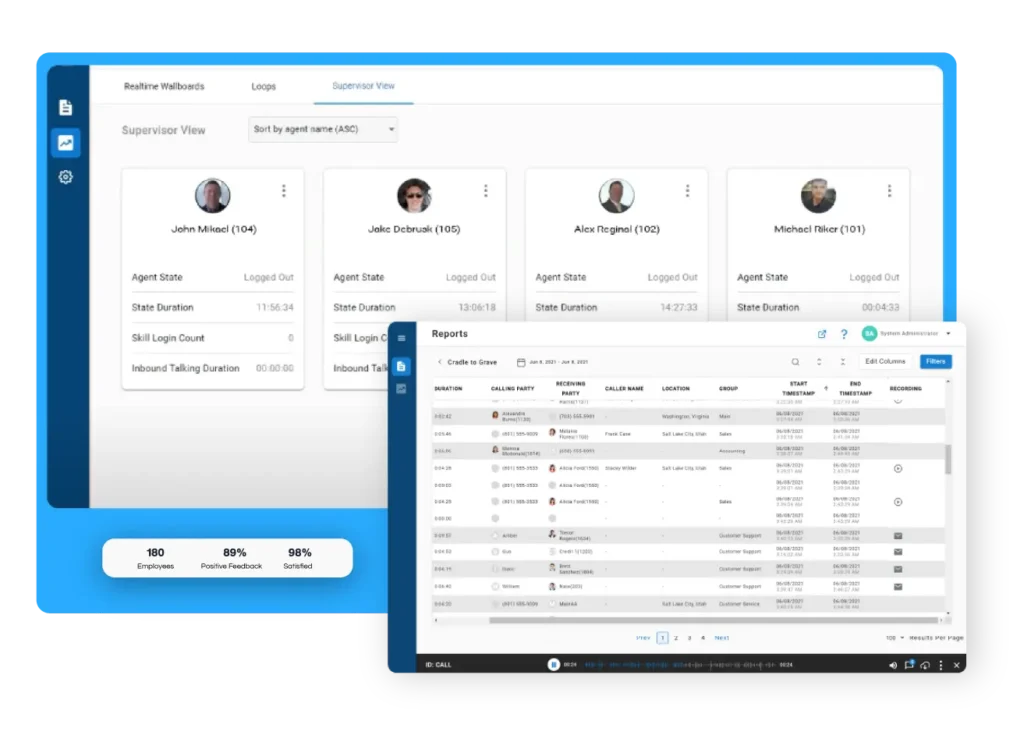
Actionable Implementation: Configure custom, real-time dashboards for your supervisors. Track these scores daily to identify friction points and immediately adjust your agent training programs.
3. Auto QA and AI Insights
Improving Efficiency and Empowering Supervisors
For SMBs, artificial intelligence is not about replacing human agents. Rather, it is about making your existing team faster, more accurate, and ensuring consistent compliance.
Practical AI tools to implement include:
Skills-based routing: Automatically analyzing an incoming inquiry and routing the caller to the best-equipped agent based on their specific expertise.
Interactive Voice Response (IVR): Utilizing smart menus to guide customers to fast self-service options, freeing up the live queue.
Auto QA: Using AI to automatically evaluate 100% of calls—rather than the traditional 3-5% that can be manually reviewed—ensuring strict compliance and quality standards.
AI Insights: Generating root cause analysis in seconds rather than requiring supervisors to perform exhausting 30-minute reporting deep dives.
Actionable Implementation: Deploy Auto QA to instantly flag at-risk interactions in real-time, allowing supervisors to intervene, de-escalate, and coach proactively.
4. Seamless CRM Integrations
Unified Customer Data
Syncing your contact center with foundational CRM platforms like Salesforce, HubSpot, or Zendesk is non-negotiable for modern support.
When your systems are unified, incoming calls trigger immediate screen pops. These allow the agent to view the caller’s entire purchase history and open support tickets before they even say “hello,” leading to a highly personalized support experience.
Actionable Implementation: Establish deep CRM integrations before taking your new contact center live. Mapping your customer data accurately ensures you deliver VIP-level personalization on day one.
5. Scalability and Cloud Flexibility
Growing with Your Business
SaaS models grant SMBs the agility to scale user seats up or down instantly based on seasonal demand, all without purchasing new physical hardware. Furthermore, cloud-based next-generation contact center technology natively and securely supports remote and hybrid workforces.
Actionable Implementation: Start with the exact number of core licenses you need today to protect your budget. As your call volume grows, incrementally build out specialized roles (such as dedicated QA managers) with seamless cloud provisioning.
Xima’s contact center features are grouped by capability.
Evaluating the Right Call Center Software for Small Business Needs?
Selecting the ideal platform requires balancing your budget, the software’s ease of use, and implementation speed. To help guide your decision-making framework, compare the stark differences between older setups and modern platforms:
Criteria | Legacy Systems | Next-Gen Software |
|---|---|---|
Deployment Time | Weeks or months (Hardware required) | Days or weeks (Cloud-based setup) |
Channel Support | Voice only (Siloed databases) | Omnichannel (Voice, SMS, Chat, Email) |
Scalability | Rigid (Requires manual updates & hardware) | Highly flexible (Scale seats instantly) |
Data Analytics | Basic, delayed historical reports | Real-time dashboards and AI insights |
Actionable Implementation: Map out your non-negotiable features using the table above. Prioritize vendors that offer rapid deployment, intuitive interfaces, and dedicated onboarding support.
How Xima Empowers Your Long-Term Business Success
Finding a vendor that checks all five of these boxes doesn’t have to be complicated. Xima Software provides industry-leading, cloud-based solutions built precisely with the SMB in mind.
Xima delivers enterprise-grade features without the enterprise-level complexity. Featuring a highly user-friendly interface, robust reporting capabilities, and seamless CRM integrations, Xima empowers your team to deliver exceptional support. Partnering with Xima provides the actionable insights and data-driven improvements required to foster sustainable growth and outpace your competition.
Conclusion
Transitioning to modern support technology is no longer optional. By embracing omnichannel routing, real-time analytics, AI-driven automation, seamless CRM integration, and total cloud scalability, you position your SMB to compete with industry giants.
Investing in the right contact center software is a direct investment in your business’s future, ensuring unparalleled customer loyalty and streamlined operations.
Ready to upgrade your customer experience? Get Your Demo Today.