The reality is more nuanced. While enterprise systems boast advanced features and extensive integrations, their complexity can quickly outpace the operational needs of a growing SMB. Implementation delays, steep learning curves, and unnecessary add-ons can slow adoption and frustrate teams. For many businesses, the question isn’t just which platform is most powerful—it’s which solution provides the right balance of usability, scalability, and support.
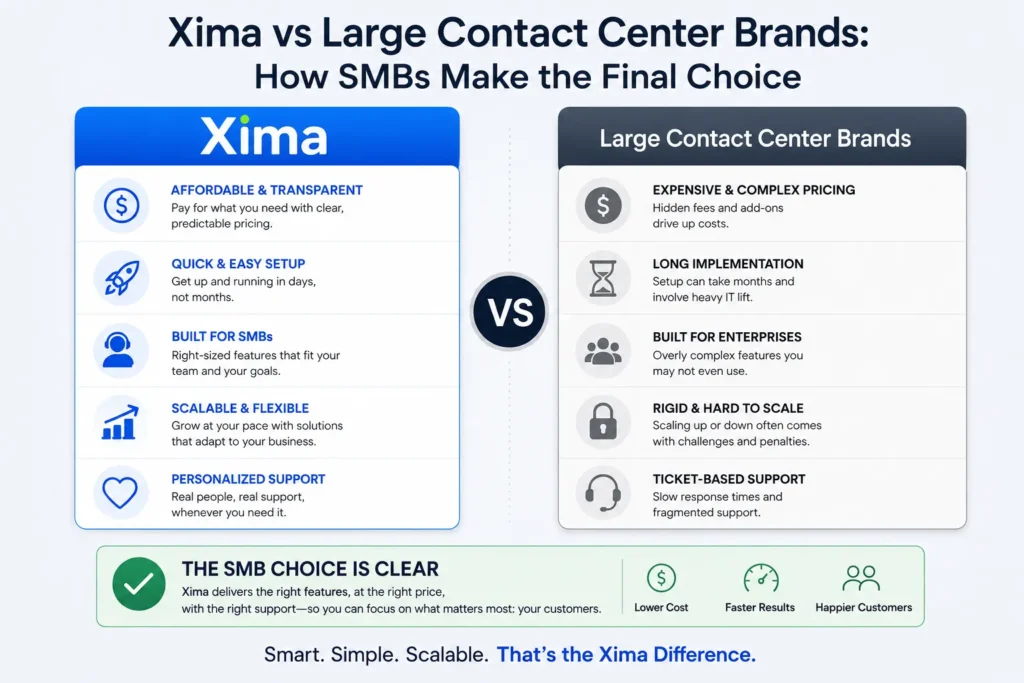
This is where comparing Xima vs large contact center brands becomes critical. Unlike enterprise-first platforms, Xima focuses on simplifying operations while delivering the functionality that SMBs actually use every day, positioning itself as a long-term partner rather than a stopgap solution.
Key Takeaways for SMB Decision-Makers
- Large contact center brands are primarily built for enterprise-scale operations, with infrastructure and feature sets designed to support complex, multi-layered organizations rather than lean SMB teams.
- Enterprise platforms often introduce layered configuration, add-on modules, and tiered pricing structures that can increase both implementation complexity and long-term operational costs.
- SMBs frequently evaluate these platforms with future growth in mind, sometimes prioritizing “future-proofing” over what their business actually needs at their current stage of maturity.
- Xima emphasizes structured queue control and clear reporting visibility, helping growing teams maintain operational clarity without unnecessary system complexity.
- Ultimately, the right contact center solution depends less on brand recognition and more on operational maturity, team size, and how efficiently the platform supports day-to-day customer interactions.
Why SMBs Evaluate Enterprise Contact Center Platforms
Enterprise contact center brands often carry strong market credibility. They signal scale, global reach, and advanced AI-driven capabilities—qualities that naturally appeal to growing SMBs planning for the future. For many decision-makers, choosing a well-known enterprise platform feels like the safest long-term investment, especially when anticipating growth in agent volume or customer demand.
Xima’s contact center solutions for small businesses are scoped to the team sizes described here.
However, what SMBs often discover during evaluation is that these platforms are designed with assumptions about operational maturity. Enterprise systems typically expect higher agent counts, dedicated administrators, and complex routing environments to fully realize their value. This creates a tension between perceived future-proofing and present-day usability, where the platform may be powerful—but not always practical for current team size or structure.
What Makes a Contact Center Platform Enterprise
Enterprise-grade contact center systems are defined less by individual features and more by the scale and depth of their operational architecture. These platforms are typically built around:
- Multi-region and global routing architecture designed to support distributed customer bases
- Advanced orchestration engines that manage complex interaction flows across departments
- Deep customization layers that allow highly tailored workflows and system behavior
- Extensive workforce management modules for forecasting, scheduling, and performance tracking
- Dedicated administrative and IT oversight to configure, maintain, and optimize the system
These capabilities are highly valuable in large, distributed organizations with complex operational requirements. However, for smaller or fast-growing support teams, this level of infrastructure can exceed day-to-day needs and introduce unnecessary complexity into routine workflows.
The Operational Tradeoffs of Enterprise-Scale Platforms
While enterprise platforms offer depth and scalability, they often introduce operational tradeoffs that become more visible for SMBs during implementation and daily use. Layered configuration, tiered feature access, and extended setup cycles can create administrative strain—especially for teams without dedicated contact center specialists.
Instead of focusing fully on customer engagement, smaller teams may find themselves managing system complexity, workflows, and configuration overhead.
Common tradeoffs include:
- Extended setup timelines that delay time-to-value
- Higher training requirements for agents and supervisors
- Contract rigidity that limits flexibility as needs evolve
- Overbuilt analytics tools that require expertise to interpret and maintain
For SMBs, these factors don’t just affect IT—they directly impact productivity, agility, and the ability to respond quickly to customer needs.
How Xima Aligns with Structured SMB Growth
Xima takes a different approach by focusing on structured operational clarity rather than enterprise-wide orchestration. Instead of layering complexity, the platform is designed to help growing teams maintain control, visibility, and consistency as they scale.
Key advantages include:
- Clear routing logic that simplifies how interactions are distributed across agents and queues
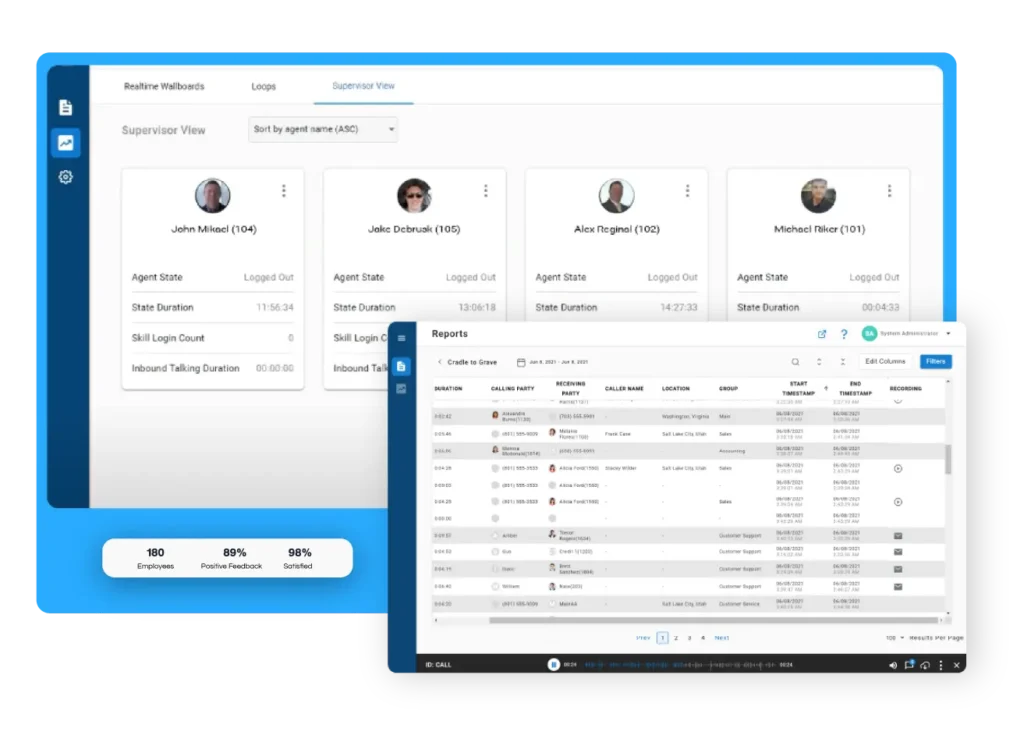
- Real-time dashboards that give supervisors immediate visibility into performance and workload
- Configuration that does not require engineering or deep IT dependency, enabling faster adjustments
- Pricing aligned with steady, predictable growth rather than complex enterprise packaging
This approach allows SMBs to scale their support operations without adopting enterprise infrastructure that may be unnecessary for their current stage of growth.
Growth does not always require enterprise architecture. Platforms built around structured queue management and reporting clarity allow teams to scale without adding layers of administrative overhead.
Ultimately, Xima is positioned for growing teams that need structure, visibility, and scalability—without the operational burden that often comes with enterprise contact center systems.
Operational Comparison: Enterprise Platforms vs Xima
To better understand the practical differences between enterprise contact center systems and Xima, it helps to look at them through an operational lens. Rather than focusing solely on feature depth, the real distinction lies in how each approach impacts day-to-day management, scalability, and team efficiency for SMBs. The table below highlights this contrast from a usability and operational impact perspective.
|
Operational Area |
Large Enterprise Platforms |
Xima |
|
Implementation Complexity |
Multi-layer configuration and deployment planning |
Structured setup centered on queues and reporting |
|
Administrative Overhead |
Dedicated admin roles common |
Designed for lean team management |
|
AI & Automation |
Extensive modules and orchestration engines |
Practical automation aligned to SMB needs |
|
Reporting |
Highly customizable enterprise analytics |
Real-time dashboards focused on contact center KPIs |
|
Pricing Model |
Tiered for enterprise-scale deployments |
Predictable scaling aligned to SMB growth |
|
Scalability |
Global, high-volume routing environments |
Structured expansion for growing teams |
This comparison is not about capability breadth or technological sophistication. Instead, it highlights operational fit—how effectively each platform supports the actual structure, resources, and growth stage of an SMB. While enterprise platforms prioritize depth and complexity for large-scale environments, Xima focuses on clarity, manageability, and efficiency for teams that need to scale without adding unnecessary operational burden.
Cost Structure and Contract Realities
One of the most important yet often overlooked differences between enterprise contact center platforms and SMB-focused solutions is how pricing is structured over time. Enterprise vendors typically design their pricing models around scale, bundling features into tiered packages that expand as organizational needs grow. While this can provide access to a wide range of capabilities, it often results in higher per-seat costs, long-term contracts, and additional fees for advanced modules or premium functionality.
For SMBs, this structure can make it difficult to predict the true total cost of ownership. As teams grow or operational needs evolve, costs may increase in ways that are not immediately visible during initial procurement discussions. This is why evaluating cost predictability over time is just as important as reviewing headline feature sets.
In contrast, more focused platforms like Xima emphasize subscription models that align with business growth stages. Rather than requiring teams to adopt bundled enterprise tiers, pricing is structured to support steady scaling—helping SMBs maintain financial clarity as they expand operations.
Feature Bundling vs Feature Necessity
A common challenge with enterprise pricing models is feature bundling. Packages often include a wide range of advanced capabilities designed for large-scale environments, many of which may exceed the immediate needs of an SMB.
While these bundled features can be valuable in the right context, they can also lead to organizations paying for tools they do not actively use. For growing teams, this creates a gap between perceived value and actual utilization, reinforcing the importance of evaluating feature necessity alongside cost structure.
Vendor Support and Responsiveness
For SMBs, support experience is not just a service function—it is a critical part of day-to-day operations. When contact center issues arise, teams often need fast answers, clear guidance, and hands-on assistance to maintain service continuity.
Large enterprise vendors typically operate with standardized global support processes designed to serve a broad customer base. While this ensures consistency, it can sometimes introduce layers of escalation and longer resolution timelines, particularly for smaller accounts.
In contrast, smaller or more focused providers are often evaluated for their ability to offer more direct access, faster configuration assistance, and a more responsive onboarding experience. For SMBs without large internal IT teams, this difference can significantly impact operational confidence and day-to-day usability.
Ultimately, support effectiveness is less about the number of channels available and more about how quickly teams can resolve issues and maintain momentum.
When Enterprise Platforms May Be Appropriate
While enterprise contact center platforms are not the right fit for every organization, there are scenarios where their scale and complexity are justified. These environments typically include:
- Large agent counts requiring advanced workforce coordination
- Global routing complexity across multiple regions and business units
- Advanced AI orchestration as a core part of customer engagement strategy
- Dedicated internal IT or systems administration teams managing ongoing configuration and optimization
In these cases, the depth and extensibility of enterprise systems can provide meaningful operational advantages.
When a Focused Contact Center Platform Is the Better Fit
For many growing organizations, however, success depends less on maximum system complexity and more on clarity, speed, and manageability. A more focused contact center platform is often better suited for environments such as:
- Growing but centralized support teams with defined workflows
- Organizations with clear service levels and structured queue management
- Supervisors who rely on real-time performance visibility to manage daily operations
- Businesses without large IT departments dedicated to system administration
In these cases, simplicity and operational transparency often deliver more value than expansive enterprise feature sets.
Assessing Your Organization’s Readiness for Enterprise Complexity
Before committing to an enterprise contact center platform, it is important for SMB decision-makers to evaluate their organization’s readiness for operational complexity. This includes a clear assessment of:
- Current agent count and projected growth trajectory
- Reporting requirements and data complexity
- Internal administrative capacity and technical resources
- Budget tolerance for layered systems and long-term contracts
- Scalability needs relative to actual operational demand
This checkpoint is not about limiting ambition—it is about ensuring that the chosen platform aligns with both current capabilities and realistic growth expectations.
Choosing Between Enterprise Scale and Operational Clarity
At its core, the decision between enterprise platforms and focused solutions like Xima comes down to a fundamental tradeoff. Enterprise systems prioritize maximum flexibility, depth, and global scalability. In contrast, Xima prioritizes structured contact center performance, operational clarity, and manageable complexity for growing teams.
Neither approach is inherently better—but the right choice depends on the pace of growth and the internal capacity available to support it. SMBs that prioritize usability, visibility, and predictable scaling often benefit from solutions designed specifically for their stage of maturity.
Rather than rushing toward enterprise-scale infrastructure, organizations are better served by carefully evaluating whether added complexity will actually support—or hinder—their day-to-day operations.
Conclusion
Ultimately, the choice between Xima and large contact center brands is not a competition of features, but a question of operational alignment. Growing SMB teams must weigh reporting clarity, pricing predictability, and system manageability against the breadth and depth of enterprise platforms.
Before committing to a large-scale solution, it is essential to consider not only where your organization is going, but also what level of complexity your team can realistically support along the way.
FAQs
Not typically. While enterprise platforms offer advanced capabilities, most SMBs do not require that level of complexity to manage daily customer interactions. Smaller and mid-sized teams usually benefit more from contact center software for growing businesses that prioritizes usability, faster setup, and operational clarity over large-scale infrastructure.
The main risks include extended implementation timelines, higher training requirements, and ongoing administrative overhead. SMBs may also find themselves managing the platform itself instead of focusing on customers, especially when systems are designed for larger, more complex environments. This can slow down responsiveness and reduce operational agility.
Xima is designed for structured, SMB-focused operations rather than global enterprise orchestration. Instead of layered configurations and heavy administrative requirements, it emphasizes clear queue management, real-time visibility, and practical reporting. Compared to traditional enterprise systems, Xima prioritizes simplicity and manageability while still supporting scalable growth.
Enterprise customization becomes excessive when it requires dedicated administrators or specialized technical expertise just to maintain daily operations. If configuration changes, reporting, or routing adjustments become complex projects rather than simple updates, the system may be more advanced than the business actually needs at its current stage.
Growing teams should focus on scalability that matches their actual operational trajectory rather than theoretical future size. This includes assessing whether the platform supports incremental growth, simple configuration adjustments, and transparent pricing. Scalability should enhance efficiency—not introduce unnecessary layers of system management.
SMBs should evaluate whether they truly need global routing, multi-region orchestration, and enterprise-grade customization. They should also consider internal support capacity, budget flexibility, and the learning curve required to manage the system. In many cases, a more focused solution can deliver the same customer experience benefits without the operational overhead.