
We’ve all been there. You meticulously explain an issue to a chatbot, only to be transferred to a live agent and forced to repeat the entire story from scratch. For an enterprise, this isn’t just a minor annoyance; it’s a critical failure that erodes trust and inflates costs. This breakdown stems from disconnected systems and siloed data, leading to a poor customer experience (CX) and significant operational waste.
The definitive solution is a modern enterprise omnichannel customer service platform. Unlike legacy multichannel support, which simply offers various disconnected channels, a true omnichannel strategy integrates every touchpoint. It creates a single, persistent conversation where context follows the customer seamlessly from one channel to the next [1].
This guide breaks down the essential features that define a powerful enterprise-grade omnichannel platform and explains why they are critical for your business in April 2026 and beyond.
Why Do Enterprises Need More Than a Standard Omnichannel Solution?
While the goal of a unified CX is universal, enterprises face a unique matrix of scale, complexity, and risk. Standard solutions inevitably falter under the pressure of a large organization. Enterprise-grade platforms are architected specifically to handle these intense demands, creating a resilient and scalable foundation for service excellence.
Massive Scalability: An enterprise platform must seamlessly support thousands of concurrent agents across global locations and process millions of customer interactions without performance degradation.
The Risk: A standard platform can crash during peak volume events like product launches or holiday sales, leading to lost revenue, customer abandonment, and brand damage. The right solution is designed to unlock growth, not constrain it.
Advanced Security and Compliance: Enterprises are prime targets for data breaches and must adhere to a complex web of regulations.
The Risk: A security lapse in a non-enterprise tool can result in massive fines, legal battles, and a catastrophic loss of customer trust. Enterprise platforms offer certified security protocols, granular access controls, and comprehensive audit trails to protect sensitive data.
Complex Ecosystem Integrations: Large organizations rely on a sophisticated tech stack of ERPs, proprietary databases, and multiple CRM instances.
The Risk: A platform with a weak API becomes just another data silo, forcing costly and fragile custom workarounds that fail to deliver a unified view [2].
Sophisticated and Actionable Analytics: The sheer volume of data an enterprise generates requires a powerful analytics engine that can process and unify data from all channels.
The Risk: Without this capability, you lack the holistic insights needed to make strategic workforce and service decisions, allowing competitors to outmaneuver you.
What Are the Must-Have Features of an Enterprise Omnichannel Platform?
To deliver a truly seamless customer journey and overcome the risks of fragmentation, omnichannel contact center software must possess a core set of deeply integrated capabilities. Let’s explore the features that separate best-in-class platforms from the rest.
A Unified Customer Data Layer
This is the architectural heart of any true omnichannel platform. A unified data layer consolidates every interaction—from calls and emails to web chats and social media messages—into a single, chronological timeline for each customer [3]. It creates a single source of truth for the entire relationship. By eliminating data silos, you empower agents with the complete context of a customer’s journey. This ensures your teams deliver exceptional and consistent unified customer experiences. Xima’s platform is built on this foundational unified data model, providing the complete picture your teams need.
The Risk: Without proper structure, a unified data layer can become a “data swamp”—a messy, unusable repository. A true enterprise platform ensures data is clean, organized, and easily accessible.
Seamless Cross-Channel Continuity
This is the feature that brings the unified data layer to life, allowing a single conversation to move fluidly across different channels without interruption. For example, a customer can start a query with a chatbot, escalate to a live chat agent, and then seamlessly transition to a voice call with a specialist who already has the full chat transcript and customer history. This frictionless journey dramatically improves the Customer Effort Score (CES), a key metric measuring how easy it is for a customer to resolve their issue.
The Risk: A “clunky” handoff, where some but not all context is transferred, can be even more frustrating for a customer than starting over. True continuity must be absolute and invisible to the customer.
Intelligent and Skills-Based Routing
Modern routing is far more sophisticated than sending a call to the next available agent. An enterprise platform leverages intelligent, skills-based routing to connect customers to the agent best equipped to solve their specific problem on the first attempt. The routing engine uses rich data—language preference, CRM data, IVR selections, and even AI-detected sentiment—to make the optimal match.
This capability delivers measurable improvements to critical contact center KPIs:
First-Contact Resolution (FCR): Problems are solved correctly the first time, preventing costly callbacks.
Average Handle Time (AHT): Experts resolve issues more quickly, increasing overall capacity.
Customer Satisfaction (CSAT): This metric directly measures customer happiness with an interaction. CSAT naturally rises when customers connect to a knowledgeable agent without delay.
Xima’s powerful skills-based routing logic ensures your most valuable resource—your expert agents—is deployed with maximum impact.
Integrated AI and Automation
In 2026, Artificial Intelligence (AI) is not an add-on; it is an essential, integrated component of an efficient contact center. In an enterprise platform, AI serves multiple critical functions to boost efficiency and personalization.
Intelligent Self-Service: AI-powered chatbots and voicebots handle routine queries 24/7, providing instant answers and freeing human agents for more complex interactions.
Agent-Assist Tools: During a live conversation, AI provides agents with real-time coaching, knowledge base article suggestions, and next-best-action recommendations.
Sentiment and Speech Analytics: AI analyzes conversations to gauge customer sentiment, automatically flagging at-risk interactions for a supervisor’s attention.
The Risk: Poorly implemented AI can damage your brand more than no AI at all. To avoid this, it’s critical to choose the right AI contact center platform that offers transparent, well-trained models.
Robust, Unified Analytics and Reporting
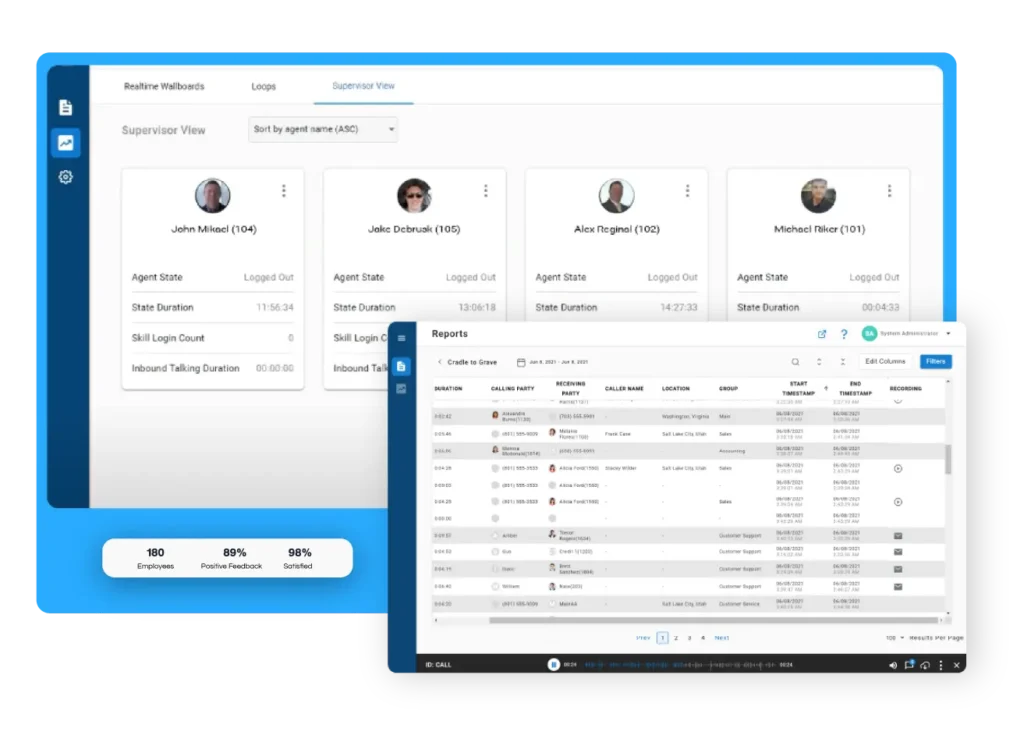
You cannot optimize what you cannot measure holistically. An enterprise platform must consolidate all channel data into a single, unified analytics dashboard. With a unified view, you can generate deep, actionable insights into everything from agent productivity to the root causes of customer churn. This allows you to track high-level metrics like Net Promoter Score (NPS)—a crucial measure of long-term customer loyalty—and drill down to understand the specific touchpoints that impact it. These omnichannel analytics solutions are what transform raw data into a data-driven strategy.
Deep CRM and Business System Integrations
An omnichannel platform must function as the central nervous system of your customer service ecosystem, not another isolated application. This requires deep, bidirectional integrations with core business systems, especially Customer Relationship Management (CRM) platforms like Salesforce. When your platform and CRM are perfectly synchronized, agents gain a true 360-degree view of the customer. Xima offers robust integrations that embed communication controls directly within your existing CRM, streamlining agent workflows and maximizing productivity.
How Do These Features Drive Real Business Results?
Implementing an enterprise omnichannel platform is not merely a technology upgrade; it is a strategic investment that drives tangible business outcomes resonating all the way to the C-suite.
Dramatically Improved Customer Loyalty: Seamless, personalized, and low-effort experiences make customers feel understood and valued, which is the foundation of building lasting customer loyalty.
Higher Agent Productivity and Morale: Empowering agents with complete context and AI-driven assistance reduces frustration and burnout, allowing them to focus on high-value problem-solving instead of repetitive tasks.
Significant Operational Cost Savings: Automation deflects costly live interactions, intelligent routing reduces handle times, and improved FCR prevents expensive repeat contacts. A scalable contact center is a more cost-effective one.
Smarter, Data-Driven Decisions: Unified analytics provide leadership with the clarity needed to optimize everything from workforce schedules to product development, ensuring long-term business success.
Finding the Right Omnichannel Partner for Your Enterprise
Choosing a platform is also choosing a strategic partner. The right partnership accelerates your success, while a poor one can lead to failed implementations and low user adoption. As you evaluate vendors, look beyond the feature checklist and seek a partner that offers:
A true cloud-native architecture (CCaaS): CCaaS, or Contact Center as a Service, is a cloud-based software model that eliminates on-premise hardware, ensuring limitless scalability, flexibility, and continuous innovation.
A transparent roadmap for future development, especially around practical AI applications.
A proven track record of successful enterprise deployments and a clear cloud migration strategy.
A demonstrable focus on user-centric design for both agents and supervisors.
At Xima, we are committed to not just providing a world-class CCaaS solution, but also to being a dedicated partner that ensures your implementation is seamless, predictable, and successful.
Unify Your Customer Experience for Future Growth
In the competitive landscape of 2026, a disconnected customer experience is a severe business liability. An enterprise omnichannel service platform—powered by a unified data layer, seamless continuity, intelligent routing, and integrated AI—is no longer a luxury. It is the essential foundation for building a resilient, efficient, and customer-centric organization.
By unifying your customer service strategy, you don’t just fix today’s problems; you unlock a new level of operational efficiency and customer loyalty that will fuel your company’s growth for years to come.
Ready to see how a true enterprise omnichannel platform can transform your customer service? Request a Demo of Xima today and unlock a new level of customer loyalty and operational efficiency.