
As manufacturing operations grow more complex, customer service can no longer operate as a disconnected function. Service teams today must manage inquiries tied directly to orders, production schedules, warranties, and long-term account relationships—all while coordinating with operations, logistics, and field service. The best manufacturing customer service software in 2026 is no longer defined by generic CRM features, but by how well a platform supports service delivery within the realities of manufacturing environments.
This ranked comparison focuses on customer service platforms that excel in operational visibility, workforce coordination, and lifecycle management rather than sales-first CRM functionality. While many vendors position themselves as CRM manufacturing software, this list evaluates which platforms truly align with manufacturing service workflows, not just contact management. Deployment flexibility, escalation control, and end-to-end service visibility are central to this comparison.
What Manufacturing Customer Service Software Actually Covers
Manufacturing customer service software refers to platforms designed to manage service interactions that are tightly connected to production, fulfillment, warranties, and post-sale support. Unlike traditional CRMs that prioritize lead tracking and pipeline management, these systems support service teams operating in parallel with manufacturing and operations.
In practice, this means managing inquiries related to order status, backorders, quality issues, returns, field service coordination, and long-term account support within a single system. The most effective platforms unify customer communication with operational context, giving service agents visibility into production status, inventory availability, and historical service activity.
This is where manufacturing-focused platforms separate themselves from general-purpose tools. The goal is not simply to track tickets, but to support complex, multi-stage service workflows that extend across the entire customer lifecycle. Xima’s contact center software for manufacturing covers this scope.
Why Generic CRMs Miss the Mark
Generic CRMs often struggle to meet the demands of manufacturing service teams. While they perform well in sales and marketing environments, they typically lack the production context required for effective service delivery.
Common gaps include limited escalation logic for complex service cases, disconnected order and warranty data, and poor alignment between service agents and operations. Agents are often forced to switch between systems to answer basic questions about production status or shipment delays. Managers face the same problem at scale—data exists, but not in a form that supports real-time decision-making.
This is why many manufacturers find that traditional CRM manufacturing software solutions require heavy customization to approximate true service alignment, increasing both implementation cost and long-term maintenance overhead.
Top Customer Service Software Platforms for Manufacturing
The platforms below are presented as best-fit options rather than feature checklists. Each entry highlights where the software performs best within manufacturing service environments. Xima’s cloud contact center software is included in this category.
1. Xima
Xima is purpose-built for organizations that require deep lifecycle visibility, workforce control, and deployment flexibility. It is particularly well-suited for manufacturers managing high service volumes, complex escalation paths, and internal accountability across service teams.
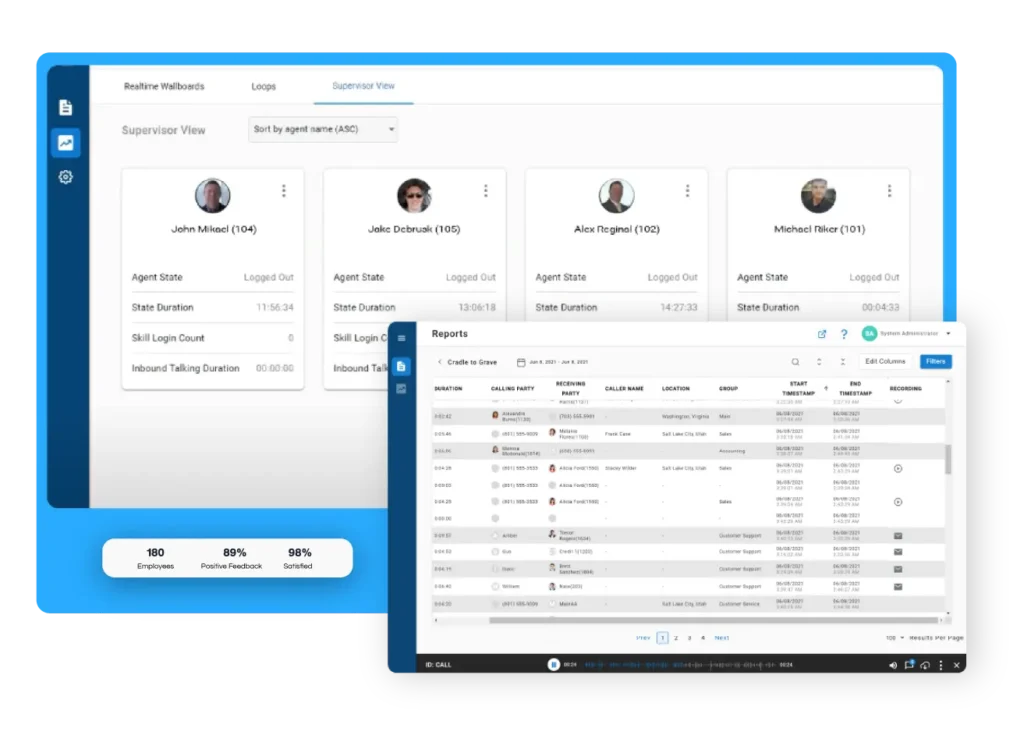
A core differentiator is Xima’s Cradle-to-Grave customer visibility, which provides full insight into every customer interaction across the entire relationship. This includes inquiries, order-related communication, service cases, and escalations—all unified within a single customer record.
Xima’s Workforce Management (WFM) capabilities support forecasting, scheduling, shift management, and service-level oversight, enabling manufacturers to balance workloads and maintain consistent service performance.
Deployment flexibility is another strength. Xima offers both cloud and on-premise deployment, giving manufacturers control over hosting based on security, compliance, and infrastructure requirements. This flexibility makes Xima a strong choice for regulated industries and organizations with complex IT environments.
2. MRPeasy
MRPeasy is an ERP-first platform with customer service capabilities closely tied to production and inventory workflows. It works well for smaller manufacturing operations that want basic service tracking embedded within their manufacturing system.
While MRPeasy provides strong alignment between service and production, its service functionality is more limited than enterprise-focused platforms, making it best suited for small to mid-sized manufacturers with simpler service models.
3. Method CRM
Method CRM is an accounting-driven solution centered on QuickBooks integration. Service workflows are built around financial data, invoices, and order management, making it a good fit for manufacturers that prioritize financial visibility in service operations.
However, its service tooling is best suited for organizations with straightforward service processes rather than complex, multi-tier support environments.
4. Salesforce
Salesforce offers broad flexibility and a massive ecosystem, making it a common choice for enterprise manufacturers. With sufficient configuration, it can support manufacturing service workflows effectively.
That flexibility comes at a cost. Manufacturing teams often face long implementation timelines, heavy customization, and significant administrative overhead to achieve operational alignment.
5. Zendesk
Zendesk is a service-first platform well-suited for manufacturers handling large volumes of inquiries across multiple channels. Its strengths include ticketing automation, workflow rules, and knowledge management.
Zendesk performs best when paired with external systems that provide production and order context. On its own, it lacks deep manufacturing visibility but excels as a high-volume service engine.
6. Freshdesk
Freshdesk is a lightweight customer service platform that works well for mid-sized manufacturers seeking faster deployment and straightforward workflows. It offers strong omnichannel support and intuitive automation.
Deeper manufacturing workflows typically require integrations with ERP and production systems, making Freshdesk best suited for organizations with moderate service complexity.
7. ServiceNow
ServiceNow is an enterprise-grade platform designed for organizations with mature IT operations and strict compliance requirements. It excels in cross-department service coordination and governance.
For manufacturing service teams, the primary challenge is implementation complexity. ServiceNow often requires significant administrative overhead relative to manufacturing-specific service needs.
8. HubSpot Service Hub
HubSpot Service Hub is a logical extension for manufacturers already invested in the HubSpot ecosystem. It offers shared customer data, fast adoption, and a clean user experience.
While effective for general service management, it draws a clear line between service tooling and true manufacturing operational alignment unless heavily integrated with production systems.
How to Choose the Right Platform for Your Manufacturing Operation
Selecting the right platform depends less on brand recognition and more on service reality. Manufacturers should evaluate platforms based on service complexity, staffing models, integration requirements, deployment constraints, and expected growth.
Organizations with high service volume and complex escalation paths benefit most from platforms that offer lifecycle visibility and workforce management. Those with simpler service environments may prioritize faster deployment and ease of use.
Integration strategy is also critical. The best manufacturing customer service software connects seamlessly with ERP, inventory, and production systems, ensuring agents have full operational context when serving customers.
As manufacturers look ahead, many will also evaluate vendors positioning themselves as the best manufacturing customer service software 2026 to ensure their investment supports long-term scalability and evolving service expectations.
Final Takeaways
Manufacturing service environments demand more than generic ticketing tools. The most effective platforms are designed around manufacturing realities—lifecycle visibility, workforce control, escalation management, and operational alignment.
While many vendors compete in the market for the best manufacturing customer service software 2026, true differentiation comes from how well a platform supports service teams working alongside production and operations.
For manufacturers evaluating long-term solutions, prioritizing platforms built for manufacturing workflows—rather than sales-first CRM systems—remains the most reliable path to consistent service performance and customer satisfaction.