
In April 2026, the conversation around Artificial Intelligence in the contact center has moved beyond “if” to “how.” You’ve heard the promises of massive cost savings, revolutionary customer experiences, and unparalleled efficiency. But when it’s time to report to leadership, you need more than promises—you need proof. How do you actually prove your AI investment is delivering tangible value?
While AI promises transformation, its true value is only realized when it can be measured. Calculating AI contact center ROI can feel abstract, but it doesn’t have to be. It requires moving beyond the buzzwords to build a practical framework for tracking real, quantifiable results. This guide will provide that framework, helping you translate AI capabilities into financial outcomes.
Why Traditional ROI Metrics Aren’t Enough for AI
For years, contact centers have measured success with a standard set of Key Performance Indicators (KPIs). While metrics like call volume and agent occupancy are still important, they don’t capture the full, multifaceted impact of AI. Relying on them alone means you’re leaving a significant part of the value story untold.The measurement side is handled through Xima’s contact center reporting.
Shifting from Cost Center to Value Creator
Traditionally, contact center ROI calculations have focused almost exclusively on cost reduction—shorter calls, fewer agents. This paints the contact center as a cost to be minimized. AI fundamentally changes this equation. It introduces powerful opportunities for value creation, transforming your service hub into a revenue and loyalty driver.
Modern AI ROI calculations must also account for:
Improved customer retention through faster, more personalized, 24/7 service.
Automated upsell and cross-sell opportunities identified during interactions.
Enhanced lead capture and conversion from prospects who receive immediate, intelligent assistance.
This shift is crucial, as the real cost of not modernizing your contact center is often paid through customer churn and missed opportunities. To succeed today, you must measure both the savings and the new value being generated.
The Hidden ROI Gap: Escaping the Data Silo Trap
One of the biggest obstacles to proving AI contact center ROI isn’t the technology itself, but a lack of integration. In fact, one study found that a staggering 56% of contact centers fail to realize their expected AI value, with poor integration cited as a primary culprit [1].
When your chatbot data is in one system, your voice interaction data in another, and your CRM in a third, you create technology silos. This makes it impossible to accurately trace the complete customer journey. You can’t technically correlate a failed chatbot interaction with a subsequent—and more expensive—agent call, making it impossible to calculate true self-service effectiveness.
This is where Xima’s CCaaS platform becomes a game-changer, driving ROI by unifying your data streams into a single source of truth. Without this unified view, you’re measuring in the dark.
The Three Pillars of AI Contact Center ROI
To build a comprehensive business case, you need a clear framework. We can organize the benefits of AI into three core pillars. This approach makes the concept of ROI less abstract and more actionable, covering every angle from savings to strategic growth [2].
Xima’s AI contact center capabilities map to the pillars described here.
Pillar 1: Driving Down the Cost to Serve
This is the most direct and easily measured pillar of AI contact center ROI. AI streamlines operations and automates repetitive tasks, leading to significant cost savings. Some estimates suggest AI can reduce the cost per interaction from $8–$15 for a human agent to as low as $0.50–$2.00 for an AI agent [3].
Key applications include:
Interaction Deflection: AI-powered chatbots and voicebots can resolve routine inquiries—like password resets or order status checks—24/7 without ever needing an agent. This is a primary driver of cost savings.
Reduced Average Handle Time (AHT): AI Agent Assist tools provide agents with real-time, context-aware guidance. They automatically surface knowledge base articles and suggest responses, drastically cutting down on manual search time.
Automated After-Call Work (ACW): AI uses Natural Language Processing (NLP)—a field of AI that gives computers the ability to understand text and spoken words—to generate accurate summaries of conversations, assign disposition codes, and update CRM records automatically, often reducing ACW by 80% or more.
Optimized Staffing: AI-driven forecasting analyzes historical data to predict demand with high accuracy, helping you align staffing levels to reduce both costly overstaffing and agent burnout.
Even minor efficiency gains in these areas can drive measurable ROI without disrupting your core operations.
Pillar 2: Boosting Revenue and Customer Loyalty
A superior customer experience (CX) is not just a “nice-to-have”; it’s a direct path to revenue. AI helps you deliver the fast, effective, and personalized service that turns satisfied customers into loyal advocates.
Key applications include:
Improved Customer Retention: By providing instant answers and 24/7 support, AI boosts key experience metrics like Customer Satisfaction (CSAT) and Net Promoter Score (NPS)—a measure of customer loyalty.
Increased Upsell/Cross-sell Opportunities: Using Natural Language Understanding (NLU), a more advanced subset of NLP focused on interpreting intent, AI can detect buying signals in real-time and prompt agents with targeted upsell scripts or competitive offers, creating clear pathways to revenue growth [4].
Reduced Churn: AI-powered intelligent routing and high self-service rates mean more customers get their issues resolved on the first try, preventing the frustration that causes them to leave for a competitor.
Higher Lead Conversion: When a sales lead calls or chats, intelligent routing ensures they are instantly connected to the most qualified available agent, dramatically increasing the chance of closing the deal.
Pillar 3: Mitigating Risk and Enhancing Quality
This pillar focuses on the advanced, strategic benefits of AI that protect your business and foster a culture of continuous improvement.
Key applications include:
Automated Quality Assurance: Instead of manually sampling 1-2% of interactions, AI-powered Quality Management (QM) can analyze 100% of calls, chats, and emails. It automatically flags interactions for review based on sentiment scores, keyword detection, or the absence of required compliance statements.
Data-Driven Agent Coaching: AI pinpoints specific agent knowledge gaps or behaviors that need improvement. This allows managers to provide targeted, effective coaching that truly moves the needle on performance.
Reduced Human Error: Automating tasks like data entry and call summarization via technologies like Robotic Process Automation (RPA)—which uses software ‘bots’ to mimic human actions and automate digital tasks—eliminates the risk of costly manual errors in customer records.
Enhanced Compliance: With 100% monitoring, you can ensure agents are consistently following regulatory scripts and internal procedures, reducing legal and financial risk.
This level of insight is key to how you can transform your business with AI contact center automation.
How to Build Your AI ROI Measurement Framework: A 4-Step Guide
Now that you know what to measure, let’s walk through how to do it. This simple, four-step process will help you build a robust business case and track your success over time.
Step 1: Establish Your Baseline
You can’t measure improvement if you don’t know your starting point. Before implementing any AI tools, gather data on your current performance. This initial data-gathering is the first step in demonstrating ROI from your contact center to stakeholders.
Capture these key baseline metrics:
Cost Per Interaction: The total cost of your contact center divided by the total number of interactions.
First Call Resolution (FCR): The percentage of interactions resolved without a callback or escalation.
Average Handle Time (AHT): The average duration of a single agent-led interaction, including hold time and ACW.
Experience Scores: Customer Satisfaction (CSAT), Net Promoter Score (NPS), and Customer Effort Score (CES).
Agent Attrition Rate: The rate at which agents leave the contact center.
Escalation Rate: The percentage of interactions that start in a self-service channel but require a live agent.
Step 2: Define Clear, Measurable Goals
Tie your AI implementation to specific, quantifiable business outcomes.
Be Specific: Instead of a vague goal like “improve efficiency,” aim for “Reduce AHT by 15% within 6 months by implementing an AI Agent Assist tool.”
Be Realistic: Start with high-impact use cases, like automating the top 3-5 most frequent and simple customer inquiries.
Align with Pillars: Ensure your goals map back to the three pillars: reducing costs, growing revenue, and mitigating risk.
Step 3: Track the Right KPIs Post-Implementation
Once your AI tools are live, track the “after” picture by measuring the same baseline metrics and adding new, AI-specific KPIs. A unified platform is essential for tracking these metrics accurately.
Area of Impact | Traditional KPI | AI-Driven KPI |
|---|---|---|
Efficiency | Average Handle Time (AHT) | Self-Service Resolution Rate |
Customer Experience | Overall CSAT | CSAT for AI-only Interactions |
Agent Productivity | Calls Handled Per Hour | Reduction in After-Call Work (ACW) |
Quality | QA Score (from manual sample) | Automated QA Score (from 100% of calls) |
Step 4: Calculate Your Financial ROI
Finally, translate your performance improvements into a clear financial figure.
The Core Formula
At its heart, the calculation is simple:
ROI = (Financial Gain – Cost of Investment) / Cost of Investment
Breaking Down the Components
The rigor comes from accurately defining the inputs:
Financial Gain: This is the sum of all new value created.
Hard Cost Savings: Quantify the agent hours saved through automation. A detailed formula looks like this:
Savings = [(ΔAHT × Total Calls) + (ΔACW × Total Calls) + (Deflected Interactions × Baseline Agent Handle Time)] × Fully Loaded Agent Hourly Rate.Revenue Growth & Protection: Calculate the value of retained customers
(Change in Churn Rate × Customer Lifetime Value)and add any new revenue directly attributable to AI-assisted upsells.
Cost of Investment: This includes the total cost of ownership (TCO) for the AI solution.
SaaS Fees: The subscription fees for your Software-as-a-Service (a software licensing and delivery model in which software is licensed on a subscription basis and is centrally hosted).
Implementation Costs: One-time fees for setup, integration, and configuration.
Internal Resources: Costs associated with training, change management, and ongoing administration.
Once you have these figures, you can begin the crucial work of demonstrating ROI to your leadership team.
Putting It All Together: How Xima Delivers Actionable ROI
The framework above is powerful, but it relies on one critical component: clean, unified data. This is where Xima Software provides the foundation for success.
Unify Your Data, Unlock Your Insights
Xima’s all-in-one CCaaS platform solves the data silo problem by design. It creates a unified data model where every interaction—from an initial chatbot query to a follow-up email—is part of a single customer journey thread. This unified view is what makes accurate, cross-channel AI contact center ROI calculation technically possible. You can finally see the complete customer journey and measure what truly matters.
Your Efficiency and Performance Playbook
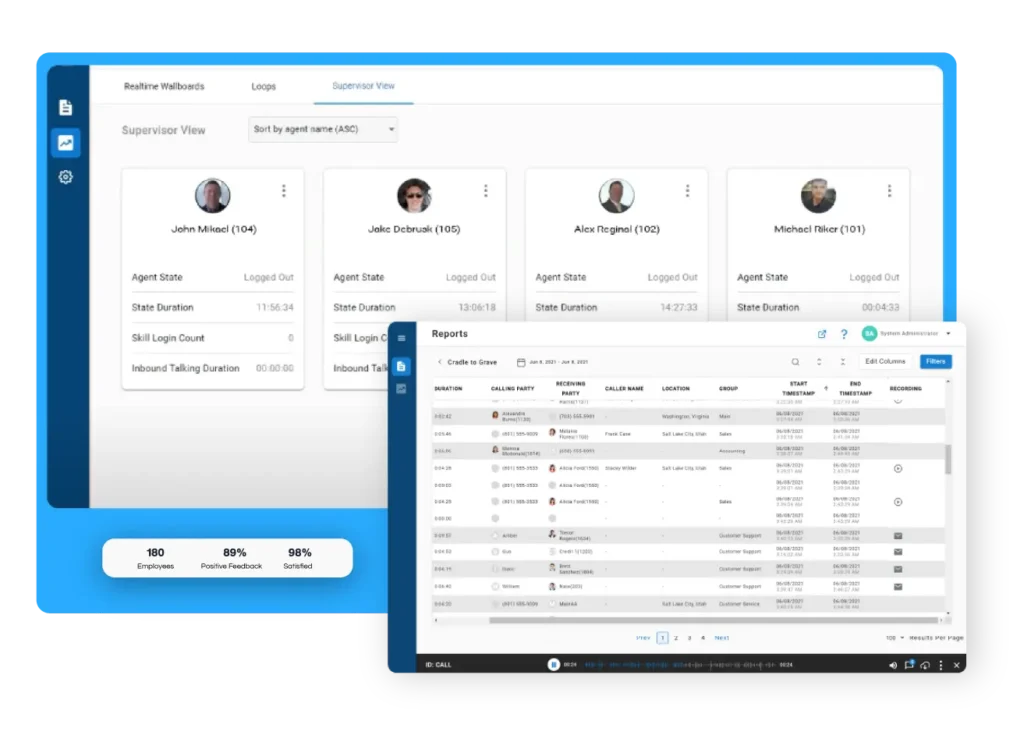
More than just a data repository, Xima provides the analytics and reporting tools you need to turn information into intelligence. Our platform comes with intuitive, pre-built dashboards designed to track the very KPIs discussed in this article.
With Xima, you can easily:
Track key efficiency metrics like self-service containment rates, escalation rates, and shifts in AHT using our powerful, built-in analytics.
Leverage Xima’s Speech Analytics to power your Automated QA programs from Pillar 3, analyzing 100% of interactions for sentiment and compliance.
Use our real-time dashboards to monitor agent performance against AI-driven goals, enabling the data-driven coaching outlined in Pillar 3.
Turn raw data into actionable insights that highlight what’s working and where you can improve, all within a comprehensive AI-powered efficiency playbook right out of the box.
Start Measuring, Start Winning
In 2026, measuring AI contact center ROI is no longer optional—it’s a business imperative. By focusing on the three pillars of Cost, Revenue, and Risk and following a clear four-step measurement framework, you can move beyond the hype to prove tangible value.
The journey to maximizing your AI investment is a strategic one, and it starts with a single, clear step: measurement.
Ready to unlock real savings and prove the value of your contact center? Request a Demo of Xima today and see how our platform provides the actionable insights you need to measure and maximize your AI ROI.