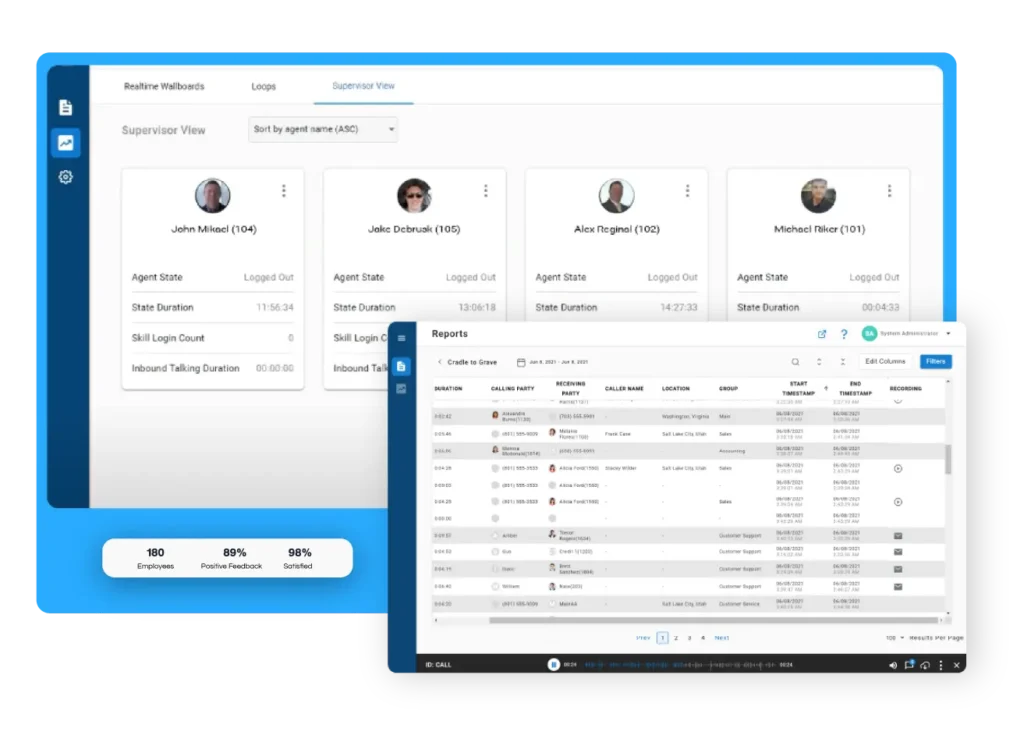

Are your agents overwhelmed with repetitive questions? Are customers frustrated by long wait times and disconnected experiences? As we move through the first half of 2026, many businesses find themselves struggling to balance rising operational costs with ever-increasing customer expectations. The solution isn’t just about working harder; it’s about working smarter through strategic transformation.
That transformation is powered by AI contact center automation. It’s the key to unlocking new levels of efficiency, intelligence, and customer satisfaction by creating a system where technology and human agents work in perfect harmony. This article will serve as your guide, exploring what AI automation is, why it’s critical for a modern business, and providing a practical walkthrough on how to implement contact center automation in your business.
What Exactly Is AI Contact Center Automation?
At its core, AI Contact Center Automation is the application of intelligent technologies—like Artificial Intelligence (AI), machine learning, and Natural Language Processing (NLP)—to manage customer interactions and automate complex operational workflows.
This is a monumental leap beyond the clunky, frustrating Interactive Voice Response (IVR) systems of the past. Where older systems relied on rigid, keyword-based menus (“Press 1 for Sales”), modern AI uses NLP to understand the intent and sentiment behind a customer’s unstructured speech or text. It learns from every interaction to get smarter, personalizes responses in real-time, and can handle nuanced conversations [1].
The goal isn’t to replace your valuable human agents but to build a unified ecosystem that empowers them. The result is a seamless experience where customers get fast, accurate answers, and agents are free to handle the complex, high-value work they were hired for. For a comprehensive look at the technology, explore this in-depth overview of contact center automation.
Why Should You Automate Your Contact Center? The Core Business Benefits
Implementing AI automation is about driving tangible business outcomes that resonate from the balance sheet to your customer reviews. Let’s break down the core advantages.
Drive Unprecedented Efficiency and Cut Operational Costs
One of the most immediate impacts of automation is on your bottom line. By intelligently handling tasks that once required manual intervention, you can streamline operations and reallocate resources far more effectively.
Reduce Repetitive Work: Automation excels at handling high-volume, routine tasks like password resets, order status updates, and FAQs. This directly lowers key metrics like Average Handle Time (AHT) and frees up agent capacity [2].
Offer 24/7 Service: AI-powered virtual agents can provide instant support around the clock, giving your customers help whenever they need it without the prohibitive cost of 24/7 human staffing [3].
Scale with Demand: Seamlessly manage unexpected spikes in traffic during peak seasons or marketing campaigns. Automation allows your operations to scale for long-term business success without the cost and delay of hiring temporary staff.
Radically Enhance the Customer Experience (CX)
In today’s market, the Customer Experience (CX)—a customer’s total perception of your brand across all touchpoints—is the ultimate battleground. AI automation gives you the tools to win by directly improving metrics that measure satisfaction, like CSAT (Customer Satisfaction Score).
Provide Instant Resolutions: AI-powered chatbots and voicebots can resolve a high percentage of common issues on the first attempt. This dramatically boosts First Contact Resolution (FCR) rates and reduces customer effort.
Deliver Hyper-Personalization: By integrating with your CRM, AI can access a customer’s history to deliver a tailored, context-aware experience. This makes customers feel understood and valued, not like just another ticket number.
Empower Through Self-Service: Many modern customers prefer finding answers on their own. Intelligent automation provides self-service options that are fast, effective, and available on their terms, which is a key driver for building customer loyalty in 2026.
Empower and Retain Your Agents
Contrary to common fears, automation doesn’t make agents obsolete; it makes them more valuable. By taking over monotonous tasks, AI elevates the role of your human team.
Focus on High-Value Work: When agents aren’t drained by repetitive queries, they can dedicate their skills and empathy to complex problem-solving, building customer rapport, and handling sensitive situations that demand a human touch.
Reduce Agent Burnout: Overwhelming queues and the monotony of answering the same questions are leading causes of agent burnout [5]. Automation alleviates this pressure, leading to higher job satisfaction and lower staff turnover.
Deliver Real-Time Support: Advanced tools like agent-assist bots act as a co-pilot, providing agents with real-time guidance and knowledge base articles during live calls. This approach, detailed in our AI-powered efficiency playbook, turns every agent into your best agent.
How to Implement Contact Center Automation in Your Business: A 5-Step Guide
Embarking on this transformation requires a structured, strategic approach. While the benefits are immense, a poorly planned implementation can lead to wasted resources and frustrated customers. Follow this practical roadmap to navigate the potential pitfalls and ensure a successful deployment.
Step 1: Assess Your Needs and Define Clear Goals
Before looking at any technology, look inward. The biggest risk in automation is investing in a solution without a clear problem to solve.
Analyze Interaction Data: Dive into your existing data. Review interaction transcripts, call disposition codes, and CRM notes to identify the most common, repetitive, and time-consuming customer inquiries.
Identify Bottlenecks: Where do customers and agents get stuck? Pinpoint areas with high handle times, repeat contacts, or low CSAT scores.
Set Measurable Objectives: Based on this analysis, establish specific Key Performance Indicators (KPIs). A clear goal is not “improve efficiency,” but rather “automate the top five inbound query types to reduce AHT by 15% and increase the self-service containment rate by 20% within six months.”
Step 2: Choose the Right Automation Platform
With your goals defined, it’s time to evaluate technology. The risk here is creating a fragmented tech stack. While standalone chatbots or Robotic Process Automation (RPA) tools exist, stitching together solutions from multiple vendors often creates data silos, a disjointed customer journey, and a complex web of contracts that is difficult to manage and scale.
The most effective, future-proof solution is a unified CCaaS (Contact Center as a Service) platform. CCaaS is a cloud-based software model that centralizes all your communication channels and management tools into a single, integrated system. You can learn more about its core benefits in our guide to Contact Center as a Service.
A comprehensive platform like Xima CCaaS provides an all-in-one solution that mitigates these risks. It brings together intelligent routing, AI-powered bots, and deep analytics, preventing a fragmented tech stack. These integrated CCaaS solutions transform your contact center using flexible cloud technology.
Step 3: Develop a Phased Rollout Plan
One of the biggest implementation risks is attempting a “big bang” rollout, which can overwhelm your team and severely disrupt customer service. A phased approach is a powerful risk-mitigation strategy that allows you to learn, gather data, demonstrate ROI, and build momentum.
Start with a pilot project focused on a high-impact, low-risk area. Begin by automating the top 3-5 most frequent and simple inquiries identified in Step 1, like “order status checks” or “password resets.” This controlled launch establishes crucial baseline metrics, minimizes disruption, and builds internal confidence in the technology. For organizations leaving legacy systems behind, this methodical approach is a cornerstone of a successful cloud migration strategy.
Step 4: Integrate and Train Your People and Systems
For automation to work, it must be woven into the fabric of your business. This means seamless API-driven integration with your core systems, especially your CRM, to create a single source of truth. Without it, you risk a broken experience where bots and agents lack context.
Just as important is managing the human element. The risk of poor agent adoption can doom an otherwise perfect technical implementation. Your training must go beyond software tutorials; it’s about change management. You must help agents see AI as a partner that augments their abilities, not a replacement. Train them on how to handle warm transfers from bots and leverage agent-assist tools to excel in their roles. A truly unified platform simplifies this. For instance, Xima’s AI ecosystem connects the entire customer journey, from the initial bot interaction to the live agent and the final quality assurance score.
Step 5: Test, Monitor, and Continuously Optimize
AI automation is not a “set it and forget it” project. The risk of stagnation is real; a bot that works perfectly today may become outdated as your products or customer expectations evolve. Continuous improvement is essential.
Monitor Key Metrics: Pay close attention to automation-specific metrics like containment rate (how many queries are resolved without an agent) and escalation rate (how often bots pass conversations to a human).
Gather Feedback: Use customer feedback and analytics to understand where bots are succeeding and where they are struggling.
Iterate and Refine: Use these actionable insights to A/B test bot scripts, refine workflows, and improve knowledge base articles. Platforms like Xima are built to provide the data-driven improvements you need to optimize performance and expand automation opportunities over the long term.
Ready to Build Your AI-Powered Contact Center?
Transforming a traditional cost center into an intelligent, customer-centric powerhouse requires more than just tools—it demands a powerful, unified platform and a clear strategy that navigates the potential risks.
Xima provides an all-in-one solution that empowers you to execute every step of this journey. From omnichannel self-service and intelligent routing to AI-driven insights and workforce optimization, our CCaaS platform is designed to create a contact center that is more efficient, more intelligent, and ready for the future. By moving to the cloud, you can transform your call center with a scalable CCaaS solution.
See how Xima can transform your customer experience. Request a Demo today and let our experts show you the power of unified AI automation.
Conclusion
AI contact center automation is no longer a futuristic concept; it is a present-day necessity for any business aiming to boost efficiency, elevate the customer experience, and empower its agents. The journey to a fully automated, AI-powered contact center starts with a single, strategic step. By following this guide and mindfully navigating the risks, you can build a more resilient, intelligent, and customer-focused operation ready for whatever comes next.
Ready to start your transformation? Get Your Demo Today!