
You know your agents are working hard, but their performance results are inconsistent. Some customer interactions are great, while others fall flat—and traditional Quality Assurance (QA) only gives you a tiny piece of the puzzle. What if you could understand the emotional journey of every single call and use that insight to build a team of top performers?
As of March 2026, this is a reality powered by contact center sentiment analysis. This AI-driven technology moves beyond simple metrics to reveal the emotions behind customer conversations. It provides the objective data you need to coach more effectively, empower your agents, and dramatically improve your overall customer experience (CX).
What Is Contact Center Sentiment Analysis (And Why Does It Matter)?
At its core, sentiment analysis is an AI-powered technology that automatically identifies the emotional tone within a customer conversation, categorizing it as positive, negative, or neutral. It’s a key part of modern contact center speech analytics, a set of tools designed to extract deep insights from customer interactions.
While voice analytics focuses on the how (tone, pitch), sentiment analysis combines that with what is said to give you a complete picture of the customer’s true experience.
From Spoken Words to Actionable Insights
How does sentiment analysis transform a simple phone call into a source of rich, usable data? The process is surprisingly straightforward.
Transcription: Every call is automatically converted from audio to text using advanced speech-to-text technology. This creates a searchable, digital record of the conversation.
AI Analysis: Natural Language Processing (NLP) algorithms analyze the transcribed text, looking at word choices, context, and even acoustic qualities like tone of voice, speaking rate, and periods of silence [2].
Scoring: The interaction is assigned a sentiment score, which allows you to quickly identify positive, negative, and neutral conversations across your entire contact center [1].
This process gives you an objective, measurable, and consistent way to gauge interaction quality. You can even apply this technology to past interactions with historical transcription to uncover long-term trends and patterns.
Moving Beyond the Limits of Manual QA
For years, contact center managers have relied on manual QA, where supervisors listen to a small, random sample of calls. While well-intentioned, this method has significant limitations. AI-powered sentiment analysis offers a far more effective alternative.
Manual QA | AI-Powered Sentiment Analysis |
|---|---|
Analyzes only 1-3% of calls, leaving massive blind spots. | Analyzes 100% of interactions, providing total visibility. |
Relies on subjective interpretation, which can lead to biased feedback. | Uses objective, AI-driven data to score every call consistently. |
Extremely time-consuming and resource-intensive for supervisors. | Identifies trends and key moments in near real-time, automatically. |
Often identifies problems long after they’ve impacted multiple customers. | Frees up supervisors for high-value coaching and proactive problem-solving. |
Sticking with outdated QA methods means making critical decisions based on incomplete data. Adopting a unified platform provides the power to see the full picture of your contact center’s performance.
How Does Sentiment Analysis Directly Improve Agent Performance?
Let’s dive into the practical ways this technology can transform your team’s effectiveness. When you have objective emotional data on every interaction, you can elevate your agents from simply competent to truly exceptional.
Create Hyper-Personalized and Objective Coaching Plans
Generic feedback like “be more empathetic” is hard for an agent to act on. Sentiment analysis replaces guesswork with data, allowing for hyper-personalized coaching that drives real improvement.
Pinpoint Friction Points: You can filter for all interactions with negative sentiment to find the exact words or phrases that consistently frustrate customers. This allows you to train agents on better, field-tested alternatives.
Replicate Success: Identify which agents excel at de-escalation by finding calls that start with negative sentiment but end positively. You can then use these call recordings as best-practice examples for the entire team.
Uncover Knowledge Gaps: Notice an agent’s sentiment scores dropping whenever they discuss a specific product or policy? This is a clear indicator of a knowledge gap that needs to be addressed with targeted training.
By focusing on these specific, data-backed opportunities, you can boost agent performance with targeted coaching that feels supportive, not critical.
Empower Agents with Real-Time De-escalation Support
One of the most powerful applications of sentiment analysis is its ability to provide support during a difficult call, not just after.
Real-time sentiment analysis can trigger automated alerts for supervisors when a customer’s sentiment turns sharply negative. This allows a manager to discreetly listen in, provide guidance to the agent via private chat, or join the call to assist if necessary.
This transforms the supervisor’s role from a post-call critic to an in-the-moment coach. Agents feel more supported, are better equipped to handle tough situations, and are more likely to achieve First Call Resolution (FCR), which reduces costly escalations and improves customer satisfaction.
Reduce Agent Burnout and Increase Retention
Agent burnout is a major challenge in the contact center industry. High stress, difficult calls, and the feeling of being unfairly judged can lead to low morale and high turnover. Sentiment analysis helps combat this in several ways:
Promotes Fairness: When performance is evaluated based on 100% of calls, agents feel the system is more objective and fair. They are no longer judged solely on a few randomly selected “bad calls.”
Provides Support: Real-time assistance and data-driven coaching show agents that management is invested in their success, not just focused on their mistakes.
Drives Success: Effective coaching helps agents succeed more often. This leads to more positive customer interactions, greater job satisfaction, and a renewed sense of purpose.
Putting Sentiment Analysis to Work: Your 4-Step Action Plan
Implementing sentiment analysis is more accessible than you might think. Here’s a simple framework to get started.
Step 1: Unify Your Data with the Right Platform
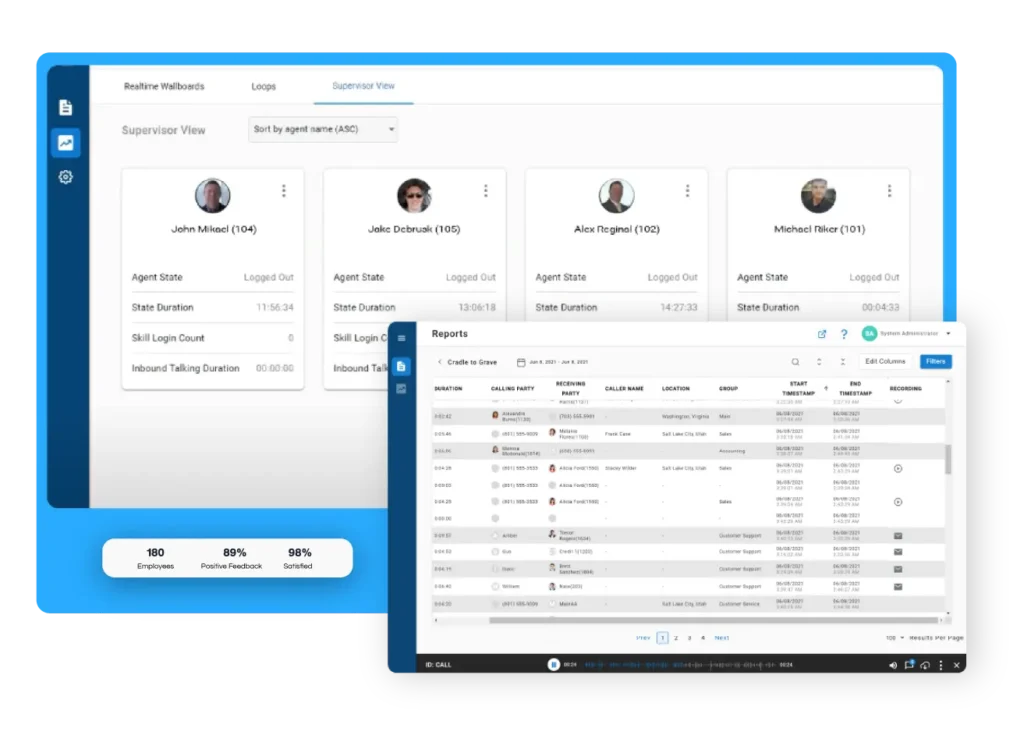
To get the most out of sentiment analysis, you need a solution that combines it with comprehensive contact center speech analytics in one place. Siloed data creates confusion. Xima Software provides this unified view, integrating insights from every channel into a single, intuitive dashboard.
Step 2: Identify Key Performance Indicators (KPIs)
Decide what you want to achieve. Are you aiming to reduce customer churn, improve your Customer Satisfaction (CSAT) score, or decrease the average handle time on negative calls? Clear goals will help you focus your analysis.
Step 3: Analyze Trends and Share Insights
Use your platform’s dashboard to spot patterns. With a solution like Xima, you can easily filter for all calls with negative sentiment to uncover common friction points in your customer journey. Just as importantly, share positive examples and celebrate agents who demonstrate exceptional emotional intelligence.
Step 4: Integrate Insights into Your Coaching Cadence
Build your one-on-one meetings around sentiment data. Show agents their scores over time, listen to key moments together, and collaborate on concrete improvement goals. By leveraging these AI insights, you can follow an efficiency playbook for 2026 that puts your team ahead of the curve.
Gain Total Performance Visibility with Xima Speech Analytics
Sentiment analysis isn’t a far-off, futuristic technology—it’s accessible, affordable, and ready to implement today with Xima Software. Our platform is designed to give you a complete and actionable view of your contact center’s performance.
With Xima, you can:
Analyze 100% of Interactions: Move beyond random sampling with comprehensive, AI-driven analysis of every call, chat, and email to boost customer insight.
Leverage Historical Transcription: Go back in time to analyze past interactions, uncovering long-term customer trends and tracking agent performance over months or even years.
Use Objective Scoring: Rely on AI-driven sentiment and quality scores for fair, consistent, and unbiased agent evaluations across your entire team.
Access a Unified AI Platform: Combine sentiment analysis with other powerful tools to maximize your CX with AI in 2026 and gain a complete view of your operations.
These are just some of the powerful tools available. Xima is constantly innovating with new AI features you need in your contact center to keep you competitive. For more information on these and other topics, feel free to explore our blog.
Conclusion: Build a Stronger, Smarter Team Today
In today’s competitive landscape, understanding the emotional context of customer interactions is no longer a luxury—it’s essential. Contact center sentiment analysis is a powerful, practical tool that transforms agent performance by enabling data-driven coaching, providing real-time support, and reducing burnout.
By analyzing every interaction, you can finally move away from guesswork and subjective feedback. Stop wondering what makes a great agent, and start using data to build them.
See How Data-Driven Coaching Can Transform Your Team
Ready to unlock the full potential of your agents? See Xima’s sentiment analysis and speech analytics in action. Schedule your personalized demo today and discover how to turn every interaction into an opportunity for improvement.