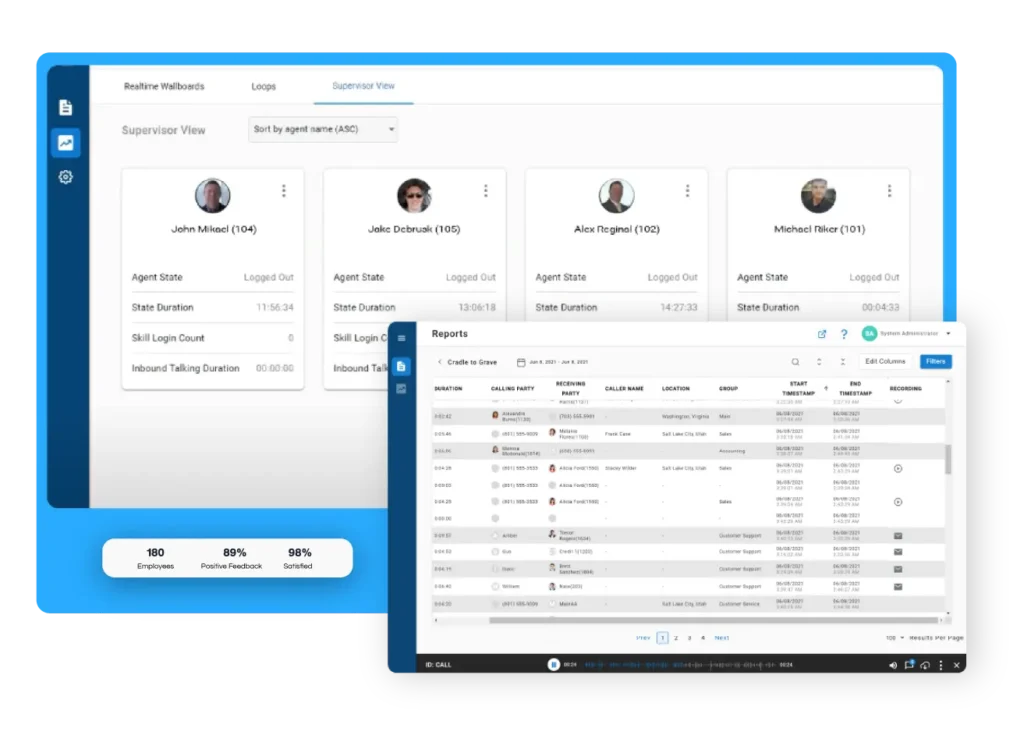

Your contact center wallboard shows numbers, but are you tracking the ones that matter? The right real-time metrics do more than fill a screen—they help your team spot issues before they escalate, make faster routing decisions, and deliver better customer experiences across every channel.
Xima Software gives you real-time wallboards and AI-powered analytics that turn raw data into actionable insights. This guide covers nine wallboard metrics every AI cloud contact center platform should track—and explains how each one connects to smarter routing, stronger QA coverage, and improved CX for your omnichannel team.
You’ll learn what each metric measures, why it matters for your operations, and how to use it to drive decisions in the moment.
Quick guide: 9 real-time wallboard metrics for contact centers
- Calls in Queue: The foundation of real-time capacity planning
- Longest Wait Time: Your early warning signal for service level risk
- Service Level Percentage: The benchmark that keeps SLAs on track
- Agent Availability: Know who’s ready to handle the next interaction
- Average Handle Time (AHT): Balance efficiency with quality
- First Contact Resolution Rate: Measure problem-solving effectiveness
- Abandonment Rate: Identify when customers give up waiting
- AI-Scored Quality Percentage: Track QA coverage across every interaction
- Customer Sentiment Score: See how customers feel in real time
How we selected these wallboard metrics
Not every number belongs on your wallboard. We focused on metrics that contact center managers and support operations leaders at SMBs can act on immediately—KPIs that connect directly to routing decisions, quality outcomes, and customer satisfaction.
These metrics are displayed through Xima’s real-time wallboards.
- Real-time actionability: Each metric updates live so your team can respond to changing conditions, not review yesterday’s data
- Routing impact: Metrics that help you direct interactions to the right agents based on skills, availability, and current workload
- QA coverage: KPIs that support AI-powered quality assurance across 100% of interactions rather than random sampling
- Omnichannel relevance: Numbers that apply across voice, chat, email, and SMS so you see the full picture
- Supervisor visibility: Data points that help managers coach in the moment and make staffing adjustments when they matter most
- Customer experience connection: Metrics tied directly to satisfaction scores and loyalty outcomes
The 9 real-time wallboard metrics your AI contact center needs
1. Calls in Queue: Track current demand at a glance
Calls in Queue shows the number of customer interactions waiting for an available agent right now. This metric is the starting point for capacity management—when the number rises, you know demand is outpacing supply.
For AI cloud contact centers, this metric does more than count waiting customers. Modern platforms connect queue depth to intelligent routing logic, automatically adjusting how interactions get distributed based on current load. When you can see queue depth in real time, you can activate queue callback features, pull agents from lower-priority tasks, or adjust skill-group assignments before wait times climb.
Xima Software displays calls in queue on customizable wallboards that update every second. Your supervisors can set threshold alerts that change colors when the number crosses a critical level—helping your team act before service levels break.
Why calls in queue matters for routing and CX
- Triggers skills-based rebalancing: When one queue builds while another sits idle, intelligent routing shifts interactions to available agents with matching skills
- Activates callback options: High queue counts can automatically offer customers the choice to receive a callback instead of waiting on hold
- Informs staffing decisions: Real-time visibility helps supervisors add agents during unexpected volume spikes
2. Longest Wait Time: Catch service level risks early
Longest Wait Time displays the duration that your oldest waiting customer has been in queue. While average wait time tells you what’s typical, longest wait time shows your worst-case scenario right now.
This metric serves as an early warning system. A single customer waiting eight minutes signals a potential problem even if your average wait time looks acceptable. By tracking the longest wait, your team can intervene before that customer abandons—or worse, answers the call already frustrated.
AI-powered contact centers use longest wait data to prioritize routing. Interactions that have waited beyond a threshold can automatically jump ahead in queue or get routed to a supervisor for faster handling.
How to use longest wait time effectively
- Set escalation thresholds: Configure alerts when any interaction waits beyond your target (e.g., 3 minutes)
- Connect to routing rules: Route long-waiting customers to your most experienced agents
- Track patterns over time: Identify which times of day or queue types consistently produce outliers
3. Service Level Percentage: Keep your SLA commitments
Service Level Percentage measures the proportion of interactions answered in your target timeframe—typically expressed as “X% of calls answered in Y seconds.” An 80/20 service level means 80% of interactions were handled in 20 seconds.
This metric matters because it directly reflects whether you’re meeting the commitments you’ve made to customers. A live service level display helps your team see where they stand throughout the day rather than discovering at 5 PM that they missed targets at 10 AM.
Xima Software calculates service level in real time across all channels—voice, web chat, SMS, and email—so you get a complete view of omnichannel performance. Cradle-to-grave reporting captures every interaction from start to finish, giving you accurate data without the miscounting that happens when calls transfer between agents.
What service level percentage reveals
- SLA compliance status: Know instantly if you’re meeting contractual obligations
- Staffing adequacy: Low service levels often indicate understaffing during peak periods
- Process efficiency: Consistent service level misses may point to workflow issues beyond headcount
4. Agent Availability: Know who’s ready for the next interaction
Agent Availability shows how many agents are logged in and in a ready state to handle the next customer interaction. This goes beyond headcount—it tells you who’s actually available versus who’s on break, in after-call work, or handling another channel.
For omnichannel contact centers, availability tracking gets more complex. An agent might be ready for voice calls but currently handling a chat session. Real-time wallboards need to show availability by channel and skill group so routing decisions match the actual capacity.
When availability drops below the level needed for current demand, your wallboard should surface that gap immediately. This gives supervisors time to pull agents back from offline activities or request support from overflow teams.
Agent availability best practices
- Display by skill group: Show availability for each queue or skill set separately
- Include channel status: Track voice, chat, and email readiness independently
- Set minimum thresholds: Alert when available agents drop below the number needed for projected demand
5. Average Handle Time (AHT): Balance speed with quality
Average Handle Time measures the total duration of customer interactions, including talk time, hold time, and after-call work. This metric helps you understand how long it takes your team to resolve issues on average.
AHT is a balancing act. Pushing agents to reduce handle time can hurt customer satisfaction if they rush through interactions. On the other hand, consistently long handle times may indicate training gaps, process inefficiencies, or overly complex customer issues.
AI-powered analytics add context to AHT data. By analyzing speech patterns and interaction content, platforms can identify why certain calls take longer—whether it’s a product issue, agent knowledge gap, or complex customer need. Xima Software connects AHT data to AI-powered transcription and sentiment analysis, so you can see what’s driving the numbers rather than just the numbers themselves.
Using AHT to improve operations
- Benchmark by interaction type: Different issues require different handling times—track AHT by reason code or category
- Identify coaching opportunities: Agents with consistently high AHT may need additional training or resources
- Spot process issues: Rising AHT across the team often points to systemic problems, not individual performance
6. First Contact Resolution Rate: Measure problem-solving success
First Contact Resolution (FCR) Rate tracks the percentage of customer issues resolved during the initial interaction without requiring follow-up contacts. Higher FCR means fewer repeat calls, lower operational costs, and happier customers.
This metric directly impacts customer satisfaction. Research from CX industry analysts consistently shows that customers who get their issues resolved on the first contact report significantly higher satisfaction scores than those who need to call back.
For AI cloud contact centers, FCR measurement benefits from intelligent routing and real-time agent guidance. When your platform matches customers with agents who have the right skills and knowledge, first-contact resolution rates climb. Xima Software tracks FCR across channels and integrates with your CRM to verify whether customers contact you again about the same issue.
How to improve first contact resolution
- Route by skill match: Connect customers to agents with expertise in their specific issue type
- Equip agents with context: Surface customer history and previous interactions automatically
- Track repeat contacts: Identify which issue types most often require follow-up
7. Abandonment Rate: Identify when customers give up
Abandonment Rate measures the percentage of customers who disconnect before reaching an agent. High abandonment signals that wait times have exceeded customer patience—and those abandoned customers may not call back.
This metric ties directly to revenue and reputation. Every abandoned interaction represents a customer who didn’t get help and may take their business elsewhere. For support operations, abandonment also means you’re spending money on infrastructure and staffing without completing the service delivery.
AI-powered platforms reduce abandonment through queue callback and intelligent routing. Xima’s queue callback feature gives customers the option to receive a callback instead of waiting on hold—recovering interactions that would otherwise become abandonment statistics.
Reducing abandonment in your contact center
- Offer callback options: Let customers choose to receive a return call rather than wait
- Set queue time expectations: Inform callers of estimated wait times so they can decide whether to hold
- Analyze abandonment timing: Identify at what point customers typically give up
8. AI-Scored Quality Percentage: Cover 100% of interactions
AI-Scored Quality Percentage shows what proportion of your interactions receive automated quality evaluation. Traditional QA processes sample only 1-3% of calls—AI-powered auto QA can score every single interaction.
This metric matters because you can’t improve what you can’t measure. When QA covers only a small sample, you miss patterns and outliers that could reveal coaching opportunities or compliance risks. Full coverage means you see the complete picture.
Xima Software offers AI-powered QA scoring that analyzes 100% of interactions for compliance, script adherence, and customer sentiment. Rather than hoping your random sample catches issues, you get visibility across your entire operation. This connects directly to coaching workflows—when AI identifies a specific agent behavior, supervisors can act on real data rather than assumptions.
Benefits of AI-powered quality coverage
- Eliminate sampling bias: Review every interaction rather than hoping random selection catches issues
- Identify patterns faster: Spot trends across thousands of interactions that manual review would miss
- Connect QA to coaching: Use AI findings to trigger targeted agent development
9. Customer Sentiment Score: See how customers feel in real time
Customer Sentiment Score uses AI to analyze the emotional tone of customer interactions as they happen. Rather than waiting for post-call surveys, sentiment analysis tells you whether conversations are trending positive, neutral, or negative in real time.
This metric adds a layer of insight that traditional KPIs miss. An interaction might have a short handle time and achieve resolution, but if the customer expressed frustration throughout, that’s valuable information. Real-time sentiment tracking helps supervisors identify interactions that need intervention before they escalate.
Xima Software analyzes sentiment across voice and text channels using speech analytics and AI transcription. When a conversation’s sentiment drops, alerts can trigger supervisor attention or route the interaction to a more experienced agent. This proactive approach helps prevent escalations and protects customer relationships.
Putting sentiment data to work
- Trigger real-time alerts: Notify supervisors when sentiment drops below a threshold
- Route sensitive interactions: Direct negative-sentiment conversations to senior agents
- Connect to CSAT outcomes: Validate that sentiment scores predict actual customer satisfaction
Comparison table: Wallboard metrics for AI contact centers
| Metric | Primary Use | Updates | AI Enhancement |
|---|---|---|---|
| Calls in Queue | Capacity planning | Live | Triggers auto-routing |
| Longest Wait Time | Risk detection | Live | Priority escalation |
| Service Level % | SLA tracking | Live | Predictive alerts |
| Agent Availability | Staffing visibility | Live | Skills-based routing |
| Average Handle Time | Efficiency tracking | Rolling | Root cause analysis |
| First Contact Resolution | Quality measurement | Rolling | Pattern detection |
| Abandonment Rate | Service gap ID | Rolling | Callback automation |
| AI-Scored Quality % | QA coverage | Batch | Auto-scoring |
| Customer Sentiment | CX monitoring | Live | Real-time analysis |
Xima’s contact center supervisor tools put these metrics in front of the people watching the floor.
What should you display on your contact center wallboard?
A wallboard loses its value when it shows too much information. Display four to six metrics that your team can act on immediately—the numbers that should change behavior when they move.
Start with operational metrics like calls in queue, longest wait time, and service level percentage. These tell your team whether demand matches capacity right now. Add agent availability so supervisors know who’s ready to help.
Consider your audience when selecting metrics. A wallboard for agents might focus on queue depth and service level to drive motivation. A supervisor display might include AHT trends and sentiment scores to identify coaching opportunities. The goal is actionable visibility, not a wall of numbers that becomes background noise.
How do real-time wallboard metrics improve AI routing decisions?
AI-powered routing uses real-time wallboard data to make smarter decisions about where to send each interaction. When your platform sees queue depth rising in one skill group while another has available agents, it can automatically adjust routing to balance the load.
Sentiment scores add another layer of intelligence. If an interaction shows negative sentiment early, AI routing can direct that customer to an agent with higher resolution rates or specific de-escalation skills. This matches customer needs with agent capabilities in real time.
The connection between metrics and routing creates a feedback loop. Better routing reduces wait times, which improves service levels, which reduces abandonment. Real-time visibility lets you see these relationships as they happen rather than discovering them in weekly reports.
Why Xima Software is the best wallboard solution for AI contact centers
Xima Software brings together the metrics that matter with the AI capabilities to act on them. Our real-time wallboards display live KPIs across voice, chat, email, and SMS—giving your team complete visibility into omnichannel operations from a single view.
What sets Xima apart is how wallboard data connects to action. Cradle-to-grave reporting captures every interaction from start to finish, eliminating the data gaps that plague platforms with incomplete tracking. AI-powered auto QA scores 100% of interactions, not just a sample. Skills-based routing uses real-time availability and queue data to match customers with the right agents. These capabilities work together so the numbers on your wallboard translate into better routing, stronger QA coverage, and improved customer experiences.
Ready to see how real-time wallboard metrics can improve your contact center operations? Schedule a demo with Xima Software and discover how our AI-powered CCaaS platform helps SMB teams deliver enterprise-grade customer experiences.