
Delivering a standout contact center experience in 2026 means going beyond managing call volumes — it requires a unified strategy that serves both customers and agents across every channel. This guide from Xima breaks down what defines the contact center experience, why it directly impacts retention, loyalty, and revenue, and how to improve it with the right mix of technology, metrics, and team empowerment.
Key Takeaways
- The contact center experience is dual-sided. It encompasses the quality of interactions for customers and the tools, training, and environment provided to agents. Neglecting either side undermines the other.
- Cloud-based (CCaaS) platforms outperform legacy on-premise systems in scalability, cost-efficiency, accessibility, and access to continuous AI-driven feature updates.
- AI is a force multiplier, not a replacement. Intelligent routing, real-time agent assist, conversation intelligence, and AI-powered chatbots improve speed and personalization — but over-automation of complex interactions is a significant risk.
- Metrics like FCR, CSAT, NPS, AHT, and abandonment rate are essential for data-driven decision-making. Tracking them together provides a balanced view of both efficiency and service quality.
- Agent well-being is a business priority. Investing in continuous training, intuitive workspaces, real-time coaching tools, and clear career pathways reduces costly turnover and directly improves customer outcomes.
- Omnichannel consistency is non-negotiable. Customers expect to move between phone, chat, email, and social media without repeating themselves or losing context.
In 2026, customer expectations are at an all-time high, and the ways they connect with your brand are more diverse than ever. This new reality presents a significant challenge: providing a seamless, high-quality customer experience contact center is more complex than it has ever been.
Businesses are no longer just managing call volumes. You are now expected to deliver efficient, personalized resolutions across phone calls, live chat, email, and social media. So, how can you design a cohesive contact center strategy that delights customers without overwhelming your agents and supervisors?
This guide offers a comprehensive look at what makes a superior contact center experience. Let’s explore the key metrics to track, the technologies that make a difference, and actionable ways to empower your team for long-term business success.
What Is the Contact Center Experience?
A holistic view of every interaction.
At its core, the contact center experience encompasses the total quality of interactions that both customers and agents have within your contact center environment. This includes every touchpoint, from the moment a customer initiates contact on any channel to the final resolution of their inquiry.
Crucially, this experience isn’t just about the customer. It also includes the internal processes, tools, and overall environment your agents work in. Their experience directly impacts the service they provide. The greatest risk here is viewing these two experiences as separate; in reality, they are two sides of the same coin.
Customer Service vs. Customer Experience (CX)
While often used interchangeably, these terms have distinct meanings that are crucial for your strategy.
Customer Service: This is a reactive component of the customer journey. It focuses on specific interactions where agents resolve issues, answer questions, and provide direct support.
Customer Experience (CX): This is a much broader concept. CX represents the customer’s entire journey and their overall perception of your brand. It includes every interaction, from their first marketing touchpoint to the purchase process and all post-sale support. A modern customer experience (CX) platform is designed to manage and optimize this entire journey.
What About the Agent Experience?
The agent experience extends far beyond daily customer interactions. It includes the software they use, the training they receive, and the supportive structure of their workplace. A positive agent experience is critical for boosting efficiency and maintaining high service quality.
The primary risk of neglecting the agent experience is high employee turnover, which is incredibly costly and disruptive to service consistency. Happy, empowered agents are the foundation of a successful contact center.
Why Is a Superior Contact Center Experience So Important?
Investing in your contact center experience isn’t just a “nice-to-have”—it’s a strategic imperative with a direct impact on your bottom line. Understanding these benefits helps prioritize your efforts and investments to achieve the best possible outcomes.
Improves Customer Retention and Loyalty: A positive contact center experience is a cornerstone of customer satisfaction. Happy customers are more likely to remain loyal, which boosts retention rates and increases lifetime value. The risk of failing here is significant, as satisfaction with contact center interactions directly impacts a customer’s loyalty to a brand [Qualtrics].
Boosts Agent Morale and Performance: A well-supported team is a productive team. When agents have the right tools and a positive work environment, their morale and performance soar. Providing them with modern software solutions is a direct way to boost agent performance with AI-powered cloud software.
Enhances Brand Reputation: Satisfied customers become brand advocates. Their positive word-of-mouth is powerful, organic marketing that builds an excellent reputation and drives referrals. The tradeoff of ignoring this is negative social proof, which can actively deter new customers.
Drives Operational Efficiency: A well-run contact center operates on streamlined processes. By optimizing workflows and leveraging technology like scalable contact center software, you can significantly reduce operational costs and improve overall efficiency.
Creates a Competitive Advantage: In a crowded marketplace, exceptional service can be your key differentiator. A brand known for providing fast, empathetic, and effective support will consistently attract and retain customers, even when competitors offer lower prices.
What Key Factors Shape the Contact Center Experience?
Several critical factors influence how customers perceive your contact center. By understanding and optimizing these elements, you can implement targeted improvements that create a consistently positive experience.
Agent Knowledge and Skills: A well-trained, knowledgeable agent is your most valuable asset. The risk of under-investing in training is low First Contact Resolution (FCR) and frustrated customers. To handle inquiries effectively, agents need ongoing training and access to tools that provide them with the right information at the right time. Platforms like Xima empower agents with real-time data and integrated knowledge bases.
Response Time & Resolution Speed: Today’s customers expect speed. Long wait times are a leading cause of dissatisfaction [Qualtrics]. First Contact Resolution (FCR)—resolving an issue in a single interaction—is a golden metric because it shows respect for the customer’s time.
Channel Availability and Consistency: Customers want to connect on their preferred channel, whether it’s voice, chat, or email. More importantly, they expect a consistent experience if they need to switch channels. The risk of a siloed, multi-channel approach is forcing customers to repeat themselves, a major point of friction. An omnichannel cloud contact center platform ensures context is never lost.
Personalization: Generic, one-size-fits-all service is a thing of the past. Leveraging CRM data and interaction history allows you to tailor conversations and offer personalized solutions. This shows customers you know and value them.
Which Technologies Elevate the Contact Center Experience?
Integrating the right technologies is essential for building a modern, effective contact center. By 2026, these tools are no longer optional—they are the backbone of exceptional customer and agent experiences.
On-Premise vs. Cloud Contact Center
The debate between on premise vs cloud contact center solutions has a clear winner for businesses aiming to thrive in 2026. The primary risk of sticking with legacy on-premise systems is being left behind technologically, operationally, and financially—a phenomenon many are calling The Cloud Crunch of 2026.
Feature | On-Premise Solution | Cloud-Based (CCaaS) Solution |
|---|---|---|
Deployment & Risk | Requires physical servers and on-site hardware. High risk of obsolescence and security vulnerabilities. | Hosted by the vendor; accessible via the internet. Mitigates risk with continuous, automatic updates. |
Scalability | Difficult and expensive to scale. Incurs high capital expenditure (CapEx) with limited flexibility. | Easily scalable to meet demand. Flexible, operational expenditure (OpEx) model that grows with you. |
Maintenance | Managed internally by your IT team, diverting resources from core business initiatives. | Managed by the provider, including all security patches and feature updates, freeing up your team. |
Accessibility | Limited to on-site or cumbersome VPN access, hindering remote work and talent acquisition. | Accessible from anywhere with an internet connection, enabling flexible, global staffing models. |
Features & AI | Updates are infrequent, costly, and complex. Often lacks integrated, modern AI features. | Continuously updated with the latest technology, including advanced AI and analytics, at no extra cost. |
How does AI improve contact center performance and customer experience?
Artificial intelligence is transforming contact centers from reactive cost centers into proactive, strategic assets. With 98% of contact centers now using AI, it’s clear the industry has embraced this shift. Here’s how AI drives improvement:
Intelligent Call Routing & IVR: Skills-based routing automatically directs customers to the agent best equipped to handle their specific needs, dramatically improving FCR. An Interactive Voice Response (IVR) system can handle simple queries or gather information before connecting to an agent.
Live Chat and AI-Powered Chatbots: Chatbots provide 24/7 support for frequently asked questions, freeing up human agents to focus on more complex issues. When a query requires a human touch, the transition from chatbot to live agent can be seamless.
Conversation Intelligence: AI tools analyze call recordings and chat transcripts to identify customer sentiment, emerging trends, and key phrases. These actionable insights help you understand customer needs on a deeper level and make data-driven improvements [CX Today].
Real-Time Agent Assist & Coaching: This is a game-changer for agent performance. AI can listen to calls in real time and provide agents with on-screen prompts, knowledge base articles, and next-best-action suggestions. This empowers agents to resolve issues faster and more confidently.
Omnichannel Communications: An omnichannel approach integrates multiple channels—like phone, email, and web chat—into a single, unified platform. For agents, this means viewing all customer interactions in one place. For customers, it means a frictionless journey. Xima provides true CCaaS solutions that unify these touchpoints.
The AI Tradeoff: While powerful, the main risk with AI is poor implementation. Over-automating complex or emotional journeys can create a cold, frustrating customer experience. The key is to use AI to handle repetitive tasks and empower human agents, not replace them entirely for high-stakes interactions.
What metrics should you track with contact center analytics software?
Measuring performance is the only way to improve it. A robust contact center platform should provide a comprehensive analytics suite that makes it easy to track key performance indicators (KPIs). By monitoring these metrics on a customizable dashboard, you can make data-driven decisions to enhance both efficiency and quality.
First Contact Resolution (FCR): The percentage of inquiries resolved during the first interaction. A high FCR is a strong indicator of efficiency and customer satisfaction. The risk is not tracking this, as multiple contacts for the same issue are a major driver of customer churn.
Customer Satisfaction (CSAT): Measures short-term happiness with a specific interaction, usually through a post-call survey asking, “How satisfied were you with your interaction today?”
Net Promoter Score® (NPS): Gauges overall customer loyalty by asking how likely a customer is to recommend your company on a scale of 0-10. This metric provides a broader view of brand health beyond a single interaction.
Average Handle Time (AHT): The average duration of a single customer interaction. The tradeoff with AHT is that focusing on it too heavily can incentivize agents to rush, harming quality. Use it in combination with CSAT and FCR for a balanced view.
Service Level & Abandonment Rate: Service Level measures the percentage of calls answered within a predefined time (e.g., 80% of calls in 20 seconds). The Abandonment Rate tracks how many customers hang up before reaching an agent. A high abandonment rate is a clear red flag for your contact center.
Quality Scores: Assesses agent performance against a set of predefined criteria, such as adherence to scripts, empathy, and problem-solving skills, often through quality management tools.
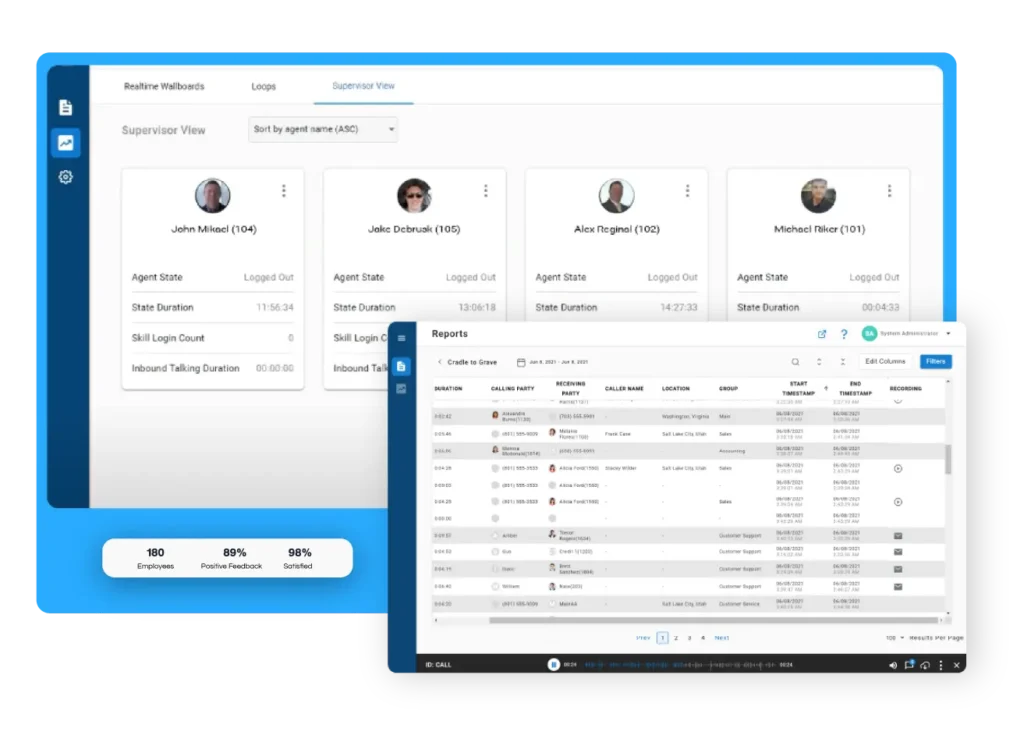
Platforms like Xima Software provide customizable dashboards and cradle-to-grave reporting, giving you real-time visibility into these critical metrics.
Actionable Strategies to Improve Your Contact Center Experience
Improving the contact center experience requires a dual focus: on your customers and on the agents who serve them.
Actionable Best Practices for the Customer Experience
Unify Your Channels into a Single Conversation: Allow customers to move fluidly between channels without losing context.
How to Implement: Map every customer touchpoint (website, social media, phone, email) and implement a platform like Xima that consolidates these channels into one unified agent view. This ensures agents see the full history of the customer’s journey.
Empower Customers with Intelligent Self-Service: Give customers fast answers to simple questions, 24/7.
How to Implement: Analyze your call data to identify your top 5-10 most frequent and simple queries. Build an intelligent IVR menu or an AI-powered chatbot to resolve these automatically, with a clear option to escalate to a live agent.
Leverage Data for Proactive Personalization: Show customers you know them by tailoring every interaction.
How to Implement: Integrate your contact center software with your CRM. This allows agents to greet customers by name, see their purchase history, and reference past interactions, creating a more personal and efficient conversation.
Establish a Closed-Loop Feedback System: Don’t just collect data—act on it to drive meaningful change.
How to Implement: Automate CSAT or NPS surveys after interactions. For any negative feedback, create a workflow that alerts a supervisor to follow up with the customer directly. This shows you’re listening and committed to improving.
How to improve agent performance with software solutions: 5 Actionable Tips
An excellent customer experience begins with a positive agent experience. Ignoring agent needs leads to high turnover and burnout—significant and costly risks to your business.
Invest in Continuous, Data-Informed Training: Move beyond initial onboarding to create a culture of constant improvement.
How to Implement: Use conversation analytics to identify common agent challenges, such as handling pricing objections or complex technical questions. Develop targeted micro-training sessions or role-playing exercises to address these specific skill gaps.
Give Agents a Single, Intuitive Workspace: Reduce stress and improve focus by eliminating the need to toggle between multiple applications.
How to Implement: Equip your team with an AI-powered cloud software solution that provides a “single pane of glass” view, integrating all communication channels and customer data into one intuitive interface.
Prioritize Agent Well-being to Reduce Burnout: Create a supportive environment that recognizes the demanding nature of contact center work.
How to Implement: Offer flexible scheduling options, provide access to mental health resources, and use analytics to monitor agent workload and prevent burnout before it happens. Foster a culture where feedback from agents is actively sought and valued.
Use AI for Real-Time Coaching and Support: Empower agents to solve problems faster and more confidently during live interactions.
How to Implement: Implement a platform with real-time agent assist features. These tools can automatically surface relevant knowledge base articles or provide next-best-action suggestions on the agent’s screen during a call, acting as a supportive co-pilot.
Create Clear Pathways for Recognition and Growth: Motivate your team by celebrating success and showing them a path forward.
How to Implement: Use performance data from your contact center platform to identify top performers. Acknowledge their achievements publicly and create a clear, tiered career path (e.g., Agent I, Agent II, Team Lead) with defined criteria for advancement.
Set Up for Contact Center Experience Success with Xima
A superior contact center experience is no longer just a goal—it’s a fundamental requirement for business growth and customer loyalty in 2026. By focusing on the interconnected experiences of both customers and agents and leveraging the right technology, you can build a contact center that drives satisfaction, retains top talent, and delivers measurable business results.
Ready to transform your contact center with powerful, intuitive software? See how Xima’s AI-powered CCaaS platform can help you master your customer experience.
Frequently Asked Questions (FAQs)
The contact center experience is the total quality of every interaction that takes place within your contact center — from the customer’s perspective and the agent’s. For customers, it includes every touchpoint from initial contact to final resolution across all channels. For agents, it covers the software, training, and workplace support they receive. A superior contact center experience improves customer retention and loyalty, boosts agent morale and performance, enhances brand reputation, drives operational efficiency, and creates a competitive advantage. In 2026, it is a fundamental requirement for business growth, not a nice-to-have.
An on-premise contact center requires physical servers and on-site hardware managed by your internal IT team. It is difficult and expensive to scale, limited in remote accessibility, and prone to technological obsolescence. A cloud-based contact center (CCaaS) is hosted by the vendor and accessible from anywhere with an internet connection. It offers easy scalability through a flexible operational expenditure model, continuous automatic updates (including AI features and security patches), and supports remote and global staffing. For most businesses in 2026, cloud-based solutions are the clear choice for long-term agility and cost-efficiency.
The most important contact center metrics to track are:
- First Contact Resolution (FCR): The percentage of issues resolved in a single interaction — a top indicator of efficiency and satisfaction.
- Customer Satisfaction (CSAT): Measures short-term happiness with a specific interaction via post-call surveys.
- Net Promoter Score (NPS): Gauges overall customer loyalty and brand health by measuring how likely customers are to recommend your company.
- Average Handle Time (AHT): The average duration of an interaction. Best used alongside CSAT and FCR to avoid incentivizing rushed service.
- Service Level and Abandonment Rate: Service level tracks the percentage of calls answered within a set timeframe; abandonment rate measures how many customers disconnect before reaching an agent.
- Quality Scores: Assesses agent performance against criteria like empathy, script adherence, and problem-solving.
Tracking these KPIs together on a customizable dashboard enables balanced, data-driven improvements.
AI improves contact center performance and customer experience in several key ways. Intelligent call routing and IVR systems direct customers to the best-suited agent, improving first contact resolution. AI-powered chatbots provide 24/7 self-service for common queries, freeing human agents for complex issues. Conversation intelligence analyzes calls and chats to surface customer sentiment, trends, and actionable insights. Real-time agent assist tools provide on-screen prompts, knowledge base articles, and next-best-action suggestions during live interactions. Omnichannel integration unifies phone, email, chat, and social media into a single platform so agents see full customer history and customers enjoy a frictionless journey. The key tradeoff to manage is avoiding over-automation of complex or emotional interactions, which can create a frustrating experience.
There are five actionable strategies to improve agent performance using software solutions. First, invest in continuous, data-informed training by using conversation analytics to identify skill gaps and develop targeted coaching sessions. Second, give agents a single, intuitive workspace that consolidates all channels and customer data into one interface, eliminating the need to toggle between applications. Third, prioritize agent well-being by offering flexible scheduling, monitoring workload through analytics, and providing mental health resources. Fourth, deploy AI-powered real-time coaching tools that surface relevant information and next-best-action suggestions during live calls. Fifth, use performance data to create clear pathways for recognition and career growth, motivating agents and reducing costly turnover.