
For small and mid-sized contact centers, every technology investment has to solve a real operational problem. That could mean reducing wait times, improving first contact resolution, helping supervisors coach agents more effectively, or giving managers better visibility into daily performance. The right AI features do all of those things without making your operation more complicated.
Key Takeaways
- Virtual assistants, Natural Language Processing (NLP), and real-time agent assist help reduce repetitive work and lower operational costs without increasing headcount.
- AI works best when it supports agents rather than replacing them. It handles repetitive tasks so agents can focus on conversations that require experience and empathy.
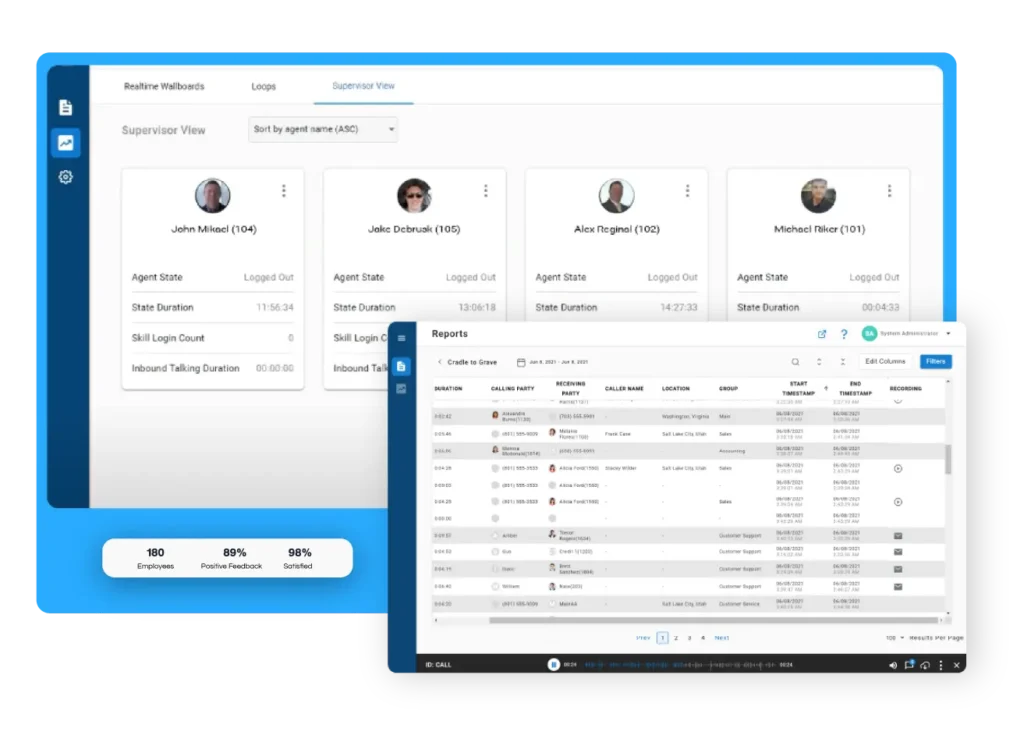
- Real-time dashboards give supervisors visibility while work is happening, making it possible to solve problems before service levels decline.
- Organizations using Cisco, Mitel, or Avaya can add AI-powered analytics without replacing their existing phone system.
- A strong AI-powered CCaaS platform offers flexible deployment, open integrations, actionable analytics, and practical tools that improve daily operations.
What Is AI-Powered CCaaS and How Is It Different?
Contact Center as a Service (CCaaS) delivers contact center capabilities through the cloud instead of relying on on-premise infrastructure. AI-powered CCaaS builds on that foundation by adding automation, analytics, and real-time intelligence that help teams work more efficiently.
Traditional contact centers often depend on manual routing, static reports, and disconnected communication channels. Supervisors typically review yesterday’s reports to understand what happened after the shift is already over.
An AI-powered environment changes that workflow. Instead of waiting for reports, supervisors receive live insights into queue performance, customer sentiment, agent activity, and service levels while calls are still in progress. Conversational AI, intelligent routing, and omnichannel experiences work together to reduce manual work while giving leaders the information they need to make better decisions throughout the day.
Core AI-Powered CCaaS Features Operations Leaders Should Prioritize
Not every AI feature delivers the same operational value. The most effective capabilities address specific problems in queue management, quality assurance, staffing, and customer experience.
- Virtual assistants and chatbots
Virtual assistants handle common customer requests like account lookups, appointment confirmations, business hours, and order status updates before a live agent becomes involved. By automating routine interactions, they reduce call volume while allowing agents to spend more time helping customers with complex issues. - Intelligent routing
Intelligent routing goes beyond sending calls to the next available representative. It considers agent skills, customer priority, sentiment, and interaction history to connect customers with the right person the first time. Better routing reduces transfers, improves first contact resolution, and shortens overall handle time. - Natural Language Processing (NLP) and intent detection
NLP helps the system understand what customers actually need by analyzing spoken or written language. Instead of relying only on IVR menu selections, AI can identify customer intent before an agent answers, improving routing decisions and providing valuable context before the conversation begins. - Real-time agent assist
During live conversations, AI can recommend knowledge base articles, next-best actions, and relevant customer information based on the discussion. Agents spend less time searching for answers and more time resolving issues, which naturally reduces handle time and after-call work. - Sentiment and intent monitoring
Customer sentiment changes throughout a conversation. AI continuously analyzes tone, language, and interaction patterns to identify conversations that may require supervisor attention. Managers can intervene while the interaction is still happening rather than discovering problems during quality reviews days later. - AI-powered workforce optimization
Workforce optimization becomes more effective when AI identifies trends across thousands of interactions instead of relying on manual observation. It highlights recurring coaching opportunities, staffing imbalances, schedule adherence issues, and quality exceptions that would otherwise be difficult to spot. - Predictive analytics dashboards
AI-powered dashboards do more than display historical metrics. They identify unusual patterns, forecast call volume, highlight the risk of repeat contact, and help leaders anticipate operational issues before they affect the customer experience.
How AI Transforms Analytics, Reporting, and Real-Time Visibility
For many contact centers, reporting has traditionally been reactive. Supervisors review yesterday’s metrics, identify what went wrong, and discuss improvements after the fact.
AI changes that process by delivering live operational visibility.
At two o’clock in the afternoon, a supervisor can immediately see that wait times are increasing, customer sentiment is declining, and one queue is receiving significantly more traffic than expected. Instead of waiting until tomorrow’s report, they can reassign agents, adjust priorities, or step in to coach before service levels suffer.
Traditional KPIs like Average Handle Time (AHT), First Contact Resolution (FCR), and abandonment rate still matter. AI simply adds another layer of intelligence by combining those metrics with customer intent, conversation sentiment, and predictive analytics. This creates a much clearer picture of why performance is changing instead of simply showing that it changed.
Traditional Reporting | AI-Enhanced Reporting |
Reviewed after the shift | Updated continuously throughout the day |
Historical KPIs only | KPIs combined with sentiment, intent, and behavioral insights |
Problems discovered after customers are affected | Issues identified while interactions are still happening |
Primarily used for reporting | Used for immediate operational decisions and coaching |
For small contact centers without dedicated analysts, this visibility is especially valuable. Managers spend less time pulling reports together and more time improving operations.
Business Benefits of AI in CCaaS for Small and Mid-Sized Contact Centers
When AI is implemented thoughtfully, the biggest improvements are operational rather than technological.
- Smarter routing and faster access to customer information improve customer satisfaction, Net Promoter Score, and first contact resolution because customers spend less time being transferred between agents.
- Real-time guidance and automated summaries reduce handle time without encouraging agents to rush customers through conversations. Agents simply have the information they need faster.
- AI-powered self-service extends customer support beyond live agent availability. Routine questions can be resolved without adding additional staff while agents remain available for higher-value conversations.
- Predictive dashboards make staffing decisions easier by identifying trends before queues become overloaded. Supervisors can respond proactively rather than react after service levels decline.
- Automated monitoring helps identify compliance risks, coaching opportunities, and recurring interaction patterns across every conversation, rather than relying on random quality-assurance samples.
- Operational efficiency improves because supervisors spend less time searching through recordings and reports. They can focus on coaching, resource planning, and improving customer outcomes.
Practical Use Cases: QA, Agent Coaching, and Compliance Monitoring
AI delivers the most value when it helps supervisors spend less time looking for problems and more time solving them. Instead of reviewing a small sample of interactions after the fact, managers can identify trends across every customer conversation.
Automated quality scoring
Reviewing calls manually takes time, so most contact centers evaluate only a small percentage of interactions. AI-powered quality management can score every conversation against predefined QA criteria, automatically flagging calls that deserve additional attention.
Instead of listening to dozens of recordings, supervisors can immediately focus on the interactions that actually need coaching or review.
Smarter coaching opportunities
Coaching becomes more effective when it is based on patterns instead of isolated examples.
If an agent consistently misses required disclosures, struggles with empathy in difficult conversations, or has unusually long hold times, AI can automatically identify those trends. Supervisors spend less time searching for examples and more time helping agents improve.
This creates more productive coaching sessions because feedback is supported by real interaction data rather than general observations.
Compliance monitoring at scale
Maintaining compliance becomes much easier when every conversation is monitored automatically.
AI-powered speech analytics can detect missing disclosures, required scripting, sensitive information, or other compliance concerns across thousands of interactions. Rather than relying entirely on random spot checks, supervisors receive alerts when conversations require additional review.
For organizations operating in regulated industries, this helps reduce risk while creating a more complete audit trail.
Emerging issue detection
Customers often tell you about operational problems before internal reports do.
AI can recognize when the same issue begins appearing repeatedly across conversations. Billing confusion, product defects, service outages, or confusing policies become visible much earlier because the platform identifies recurring customer intent across large numbers of interactions.
Instead of responding only after complaints escalate, operations teams can address issues while they are still developing.
Adding AI-Powered CCaaS to Cisco, Mitel, or Avaya Without Replacing Your System
One of the biggest concerns for many contact center leaders is whether adopting AI means replacing their existing phone system.
For most small and mid-sized organizations, that simply is not realistic. Many have already invested heavily in Cisco, Mitel, Avaya, or other on-premise telephony platforms.
Fortunately, modern AI capabilities do not always require a complete replacement.
Many organizations begin by adding AI-powered analytics, speech analytics, reporting, and quality management on top of their existing environment. This allows supervisors to gain better visibility and coaching tools while continuing to use the telephony infrastructure they already trust.
That phased approach also reduces implementation risk. Teams can introduce new capabilities gradually instead of asking agents to learn an entirely new platform overnight.
Traditional Upgrade Approach | Layered AI CCaaS Approach |
Replace existing phone system | Extend existing infrastructure |
Large upfront implementation | Gradual rollout by queue or department |
High operational disruption | Minimal disruption to daily operations |
Long deployment timeline | Faster access to AI analytics and reporting |
For many SMBs, this approach provides the best balance between innovation and operational stability.
What to Look for When Evaluating AI-Powered CCaaS Platforms
When evaluating AI-powered CCaaS platforms, look beyond the feature list.
- Conversational AI
Look for virtual assistants that understand natural customer language instead of relying entirely on rigid menu structures. Customers should feel like they are having a conversation rather than navigating a script. - Routing intelligence
Effective routing considers agent skills, customer priority, and interaction context. It should help customers reach the right person faster while reducing unnecessary transfers. - Real-time assistance
The most valuable AI works during the conversation, not just afterward. Live recommendations and contextual guidance help agents resolve issues faster while improving consistency. - Open integrations
Your CCaaS platform should work alongside your existing CRM, business intelligence tools, and communications infrastructure. Flexible APIs make future expansion much easier. - Detailed analytics
Summary reports only tell part of the story. Look for platforms that provide interaction-level visibility so supervisors can understand exactly what happened and why. - Security and compliance
AI should strengthen governance rather than create new risks. Look for strong security practices, compliance controls, and clear data management policies. - Flexible implementation
Every organization moves at a different pace. A platform that supports phased deployments allows teams to prove value before expanding across the entire operation. - Long-term partnership
Technology matters, but so does the team behind it. Strong onboarding, responsive support, and ongoing guidance often determine how successful an implementation becomes.
See AI-Powered CCaaS in Action with Xima
For contact center managers, AI is most valuable when it helps answer practical questions:
- Why are wait times increasing?
- Which conversations need immediate attention?
- Where are agents struggling?
- How can we improve service before customers notice a problem?
Instead of overwhelming supervisors with disconnected reports, Xima Insights helps identify root causes in seconds. Cradle-to-Grave Reporting provides a complete view of every customer interaction without manually stitching reports together. AI Speech Analytics and Auto QA automatically surface coaching opportunities across every interaction, allowing supervisors to spend more time improving performance instead of searching through recordings.
Combined with Skills-Based Routing, real-time visibility, and white-glove implementation, Xima helps contact centers improve service while giving managers greater confidence in every operational decision.
If you’re ready to see how AI-powered CCaaS can improve visibility, simplify coaching, and help your team work more efficiently, book a personalized Xima demo. We’ll build the demonstration around your contact center so you can see the features that matter most to your operation.
FAQs
Start with the features that have the biggest operational impact. Intelligent routing, virtual assistants, real-time speech analytics, and predictive dashboards typically deliver value quickly by reducing repetitive work and improving visibility for supervisors.
AI helps improve first contact resolution, customer satisfaction, operational efficiency, and workforce planning. It also reduces repetitive administrative work, making it easier for agents and supervisors to focus on higher-value activities.
Yes. Many organizations begin by adding AI-powered reporting, speech analytics, quality management, and other cloud capabilities alongside their existing telephony platform. This phased approach minimizes disruption while allowing teams to modernize over time.
Traditional reports explain what happened after the shift ends. AI-powered analytics provide real-time operational visibility by combining performance metrics with customer intent, sentiment, and predictive insights, enabling supervisors to respond while work is still in progress.
Traditional CCaaS centralizes communication channels and cloud infrastructure. AI-powered CCaaS builds on that foundation by adding automation, intelligent routing, speech analytics, predictive insights, and real-time decision support that help contact centers improve both operational efficiency and customer experience.