
Somewhere in your contact center right now, an agent is toggling between three different screens to answer a single customer question. The customer has already explained their issue twice—once on chat, once on the phone—and frustration is building on both ends.
This scenario plays out thousands of times daily in contact centers still running on legacy infrastructure. Next-generation contact center technology exists to eliminate exactly this kind of friction, bringing voice, chat, AI, and automation into a single unified platform. Xima Software helps contact center teams move beyond fragmented tools to deliver faster, more consistent customer experiences.
This article breaks down what next-generation contact centers actually look like, how the core technologies work together, and what changes when you make the switch.
Key Takeaways: How Next-Generation Contact Center Technology Works
- Next-generation contact centers unify voice, chat, email, SMS, and social media into one platform for consistent customer experiences.
- AI-powered features like speech analytics, sentiment analysis, and auto-QA score 100% of interactions instead of manual sampling.
- Omnichannel routing connects customers to the right agent based on skills, history, and real-time availability across all channels.
- Xima Software delivers enterprise-grade contact center capabilities designed specifically for SMB teams without enterprise complexity.
- Real-time dashboards and cradle-to-grave reporting give supervisors immediate visibility into every customer interaction.
What Is Next-Generation Contact Center Technology?
Next-generation contact center technology refers to modern platforms that combine multiple communication channels, artificial intelligence, and automation into a unified system. Unlike traditional call centers that handle phone calls in isolation, these platforms connect every touchpoint a customer uses—voice, chat, email, SMS, and social media—into one continuous conversation thread.
The core difference is integration. When a customer starts on chat and moves to a phone call, the agent sees the full history. When an AI-powered chatbot handles a routine question, the handoff to a human agent includes complete context.
This matters because customer expectations have changed. People expect the company to know who they are regardless of how they reach out. Next-generation platforms make that possible without requiring agents to dig through multiple systems.
How Do Voice, Chat, and AI Work Together in Modern Contact Centers?
Voice remains the backbone of customer support—complex issues still require human conversation. But modern platforms enhance voice with intelligent routing, real-time transcription, and AI-assisted guidance that helps agents resolve issues faster.
Chat and messaging channels handle high volumes of straightforward requests. AI-powered chatbots field common questions like order status, account balances, and appointment scheduling. When conversations require human attention, they route to agents with full context intact.
The AI layer ties everything together. Speech analytics and sentiment analysis monitor interactions in real time, flagging calls where customers express frustration or where compliance language gets skipped. Xima Software’s AI-powered QA scores every interaction automatically, replacing the old model of reviewing 1-3% of calls manually.
Skills-Based Routing and Queue Management
Not every agent handles every type of call equally well. Skills-based routing matches incoming contacts to agents based on expertise, language abilities, and past performance. A billing dispute goes to someone trained in billing. A technical question goes to someone with product knowledge.
Queue callback eliminates hold time frustration. Instead of waiting on the line, customers receive a callback when an agent becomes available. This reduces abandonment rates and keeps customer satisfaction scores from tanking during high-volume periods.
What Makes Omnichannel Different From Multichannel Contact Centers?
Multichannel means you offer phone, email, and chat as separate options. Omnichannel means those channels share data and context, creating one unified customer journey.
Here’s the operational difference: In a multichannel setup, a customer who emails Monday and calls Tuesday has two separate tickets. The agent on the phone has no idea an email exists. The customer repeats everything.
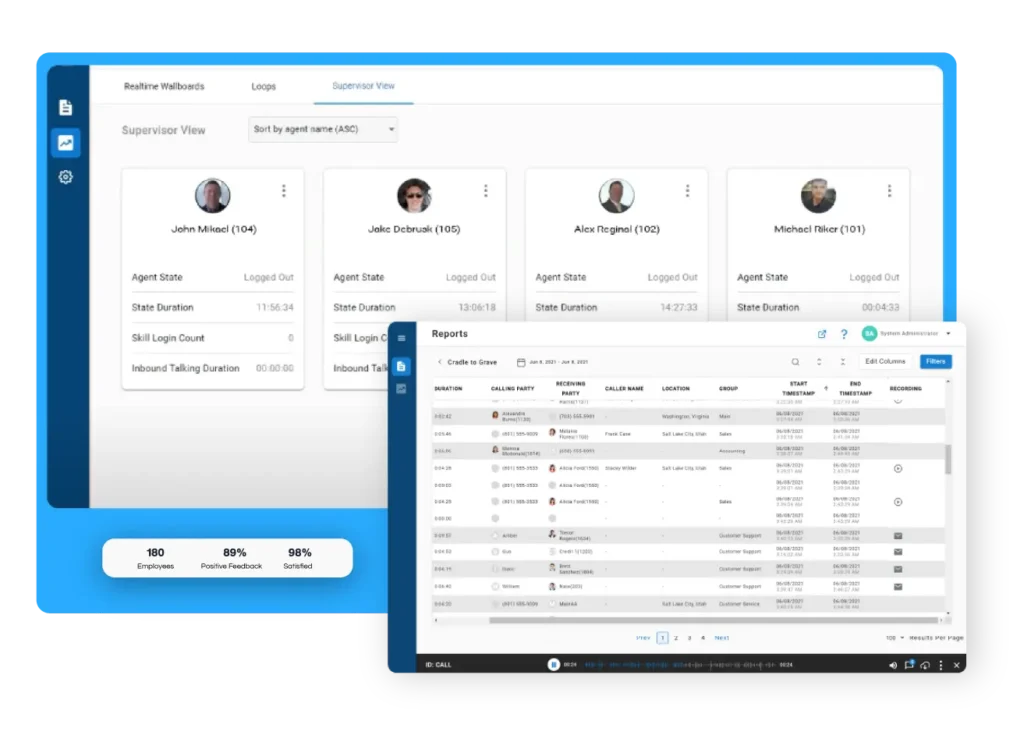
In an omnichannel environment, that email and phone call link together automatically. The agent sees the email, the response, and any follow-up—all in one view. Xima Software’s cradle-to-grave reporting captures this complete interaction lifecycle from first touch to resolution.
Channel Integration and CRM Connectivity
True omnichannel requires tight integration with your CRM and business systems. When a customer calls, the agent should see their account information, purchase history, and previous interactions without navigating to a separate screen.
Xima Software connects with popular CRMs, Microsoft Teams, and over 70 EHR systems for healthcare organizations. This bi-directional integration means updates in the contact center platform sync back to the CRM, and vice versa.
How Does Contact Center AI Improve Quality Assurance?
Traditional QA involves supervisors manually listening to a small sample of calls—typically 1-5% of total volume. This means 95-99% of interactions happen with zero oversight. Problems only surface if they happen to land in that tiny reviewed sample.
AI-powered quality assurance changes the math entirely. Speech-to-text transcription, sentiment analysis, and automated scoring evaluate every single interaction. You get visibility into 100% of what’s happening instead of hoping your random sample catches issues.
This isn’t about replacing human judgment. It’s about directing human attention to conversations that actually need it. When AI flags a call where sentiment dropped or required disclosures got skipped, supervisors can review it immediately rather than discovering the problem weeks later during a random audit.
Real-Time Dashboards and Wallboards
Contact center managers need to see what’s happening right now, not what happened yesterday. Real-time wallboards display queue status, agent availability, average handle times, and service levels as they happen.
This visibility enables proactive management. When call volume spikes unexpectedly, supervisors spot it immediately and can pull in additional agents or activate callback queues before wait times spiral. Xima Software’s wallboards give supervisors real-time visibility into the metrics that matter most for their specific operation.
What Are the Benefits of Cloud-Based Contact Center Platforms?
Cloud deployment means your contact center infrastructure runs in secure data centers rather than on servers in your building. Agents can work from anywhere with an internet connection. Scaling up or down happens without purchasing hardware.
For SMB teams especially, cloud platforms eliminate the capital investment and IT burden of on-premise systems. You get access to features that used to require enterprise budgets—AI-powered analytics, omnichannel routing, real-time reporting—at a predictable monthly cost.
Disaster recovery improves dramatically. If your office loses power, agents can log in from home and customers never know the difference. This resilience proved essential for contact centers during unexpected disruptions when teams had to shift to remote work overnight.
When On-Premise Deployment Makes Sense
Cloud isn’t the answer for every organization. Highly regulated industries sometimes require data to stay on company-controlled servers. Organizations with existing phone system investments may want to add capabilities without ripping out infrastructure.
Xima Software offers both cloud and on-premise deployment options, letting you choose based on your compliance requirements and existing technology stack rather than forcing a one-size-fits-all approach.
How Do You Evaluate Contact Center Technology Vendors?
Ask vendors to show you the complete lifecycle of a single customer interaction—from queue entry through wrap-up—in one view. Not a summary. Not a demo script. A real interaction with all the data an agent and supervisor would actually see.
Request a demonstration of their reporting and analytics. Can supervisors build custom reports without IT involvement? How quickly does data refresh? What happens when you need a historical report for a compliance audit?
Understand the integration requirements. Will the platform connect to your existing phone system, CRM, and business applications? Does that integration require third-party middleware or professional services, or does it work natively?
In Conclusion: Choosing the Right Contact Center Technology for Your Team
Next-generation contact center technology combines voice, chat, AI, and omnichannel automation into platforms that match how customers actually want to communicate. The technical capabilities—skills-based routing, real-time analytics, automated QA, unified interaction histories—exist to solve operational problems contact center managers deal with every day.
The question isn’t whether these capabilities would help your operation. The question is whether your current systems are giving you the visibility and efficiency you need, or whether you’re managing around limitations instead of eliminating them.
Xima Software delivers enterprise-grade contact center features without the enterprise complexity, purpose-built for SMB teams who need powerful capabilities without massive implementation projects or overwhelming costs. Ready to see what modern contact center technology looks like for your operation? Request a demo to see Xima CCaaS in action.
FAQs About Next-Generation Contact Center Technology
What is contact center technology?
Contact center technology includes the software and systems that manage customer communications across voice, chat, email, and other channels. Modern platforms combine routing, analytics, AI, and automation to help agents resolve customer issues faster.
Xima Software’s contact center solutions include real-time reporting, skills-based routing, and AI-powered quality assurance to give your team complete visibility into every customer interaction.
How does AI improve contact center operations?
AI automates tasks that previously required manual effort—transcribing calls, scoring interactions for quality, analyzing sentiment, and routing contacts to appropriate agents. This frees supervisors to focus on coaching and exception handling instead of administrative work.
Xima Software’s AI-powered auto-QA evaluates 100% of interactions automatically, replacing the old model of manually reviewing a small sample of calls.
What is omnichannel contact center software?
Omnichannel software unifies all customer communication channels—phone, chat, email, SMS, social media—into a single platform with shared data. When customers switch channels, agents see complete interaction history without asking customers to repeat themselves.
Xima Software’s omnichannel platform connects all channels with cradle-to-grave reporting that tracks every interaction from start to finish.
Can small businesses afford modern contact center technology?
Yes. Cloud-based platforms eliminated the massive upfront hardware and software investments that once limited advanced features to enterprise organizations. SMB teams now access the same capabilities at predictable monthly costs.
Xima Software specifically designs for SMB contact centers, delivering enterprise-grade features with transparent pricing and fast implementation.
How long does it take to implement a new contact center platform?
Implementation timelines vary based on complexity, integrations, and customization requirements. Simple deployments can go live in weeks. Larger implementations with CRM integrations and custom reporting may take a few months.
Xima Software’s white-glove onboarding approach accelerates implementation with dedicated support throughout the process.