
Somewhere in your contact center right now, an agent is on a call. Maybe they’re handling a complaint. Maybe they’re walking a customer through a complex issue. The interaction ends, the agent moves on to the next call, and nobody reviews what just happened. That call—along with hundreds of others—becomes invisible.
This is the operational reality most contact centers face. You record calls, but recording is not the same as reviewing. And reviewing a handful of interactions each week doesn’t give you a real picture of agent performance, customer sentiment, or coaching opportunities.
Speech analytics changes that equation. Instead of sampling a fraction of calls, you can analyze every single conversation automatically. Xima Software gives contact center supervisors the ability to evaluate 100% of interactions with AI-powered Auto QA—turning unreviewed volume into actionable coaching insights.
This guide walks you through everything you need to know about using speech analytics for quality assurance and agent coaching. You’ll learn how speech analytics works, why traditional QA approaches fall short, and how to build practical workflows that improve agent performance without drowning supervisors in manual review.
Key Takeaways: How to Use Speech Analytics for QA and Coaching
- Speech analytics uses AI to transcribe, analyze, and score 100% of your contact center interactions automatically—eliminating the blind spots in traditional manual QA.
- Traditional QA programs review only 1-5% of calls, which means supervisors coach based on incomplete data and miss patterns across the unreviewed volume.
- Xima Software provides AI-powered Auto QA and real-time sentiment analysis so you can identify coaching opportunities the moment they happen.
- Effective agent coaching requires specific, timely feedback—speech analytics closes the gap between an interaction and the coaching conversation.
- Building a speech analytics program starts with defining scoring criteria, training supervisors on new workflows, and measuring outcomes over time.
What Is Speech Analytics and How Does It Work?
Speech analytics is technology that converts spoken conversations into structured data you can search, score, and analyze. At its core, speech analytics combines automatic speech recognition (ASR) with natural language processing (NLP) to understand what’s being said on your calls—and how it’s being said.
Xima’s speech analytics applies the transcription and keyword review described here.
Here’s what happens when a call goes through a speech analytics system:
Step 1: Audio Capture and Transcription
The system records the call (or pulls from your existing recording platform) and transcribes the audio into text. Modern speech-to-text engines can handle multiple speakers, accents, and industry-specific terminology with high accuracy.
The transcription creates a searchable record of every word spoken during the interaction. This means you can find specific calls based on what was discussed—not just metadata like handle time or agent ID.
Step 2: Speaker Separation and Sentiment Detection
Speech analytics separates the agent’s voice from the customer’s voice, allowing you to analyze each party independently. The system then applies sentiment analysis to detect emotional tone—is the customer frustrated, confused, or satisfied? Is the agent calm, rushed, or disengaged?
This sentiment data becomes a powerful signal for QA scoring and coaching prioritization. A call where customer sentiment drops sharply mid-conversation tells you something went wrong—even if the call technically met all your checklist requirements.
Step 3: Keyword and Phrase Detection
You can configure speech analytics to flag specific keywords, phrases, or topics that matter to your operation. Compliance-sensitive language, competitor mentions, escalation requests, or positive buying signals—all become searchable and reportable.
For example, if an agent is required to read a disclosure statement, speech analytics can verify whether that phrase appeared in the call. If a customer mentions canceling their account, the system can flag that interaction for retention follow-up.
Step 4: Automated QA Scoring
This is where speech analytics transforms QA from a sampling exercise into a coverage exercise. Instead of supervisors manually scoring a handful of calls per agent each week, the system applies your QA criteria to every interaction automatically.
Xima Software’s AI-powered Auto QA evaluates calls against your defined scorecard—measuring factors like script adherence, required disclosures, greeting and closing quality, and customer sentiment outcomes. Supervisors receive scored calls ready for review, with specific moments flagged for attention.
Why Traditional QA Programs Fall Short
Most contact center QA programs operate on a sampling model. A supervisor listens to a few calls per agent each week, scores them against a checklist, and delivers feedback. On paper, this sounds reasonable. In practice, it creates structural blind spots that undermine the entire program.
The Coverage Problem
Here’s the math that most QA programs are built on. An average agent handles 50-70 calls per day. Your supervisor reviews maybe 3-5 calls per agent per week. That’s a review rate of roughly 1-3% of total volume.
Fill in your own numbers below:
- Agents in your contact center: _____
- Average calls per agent per day: _____
- Calls reviewed per agent per week: _____
- Your QA coverage rate: _____
Write that last number down somewhere visible. That percentage represents your visibility into what’s actually happening on your phones. Everything else is assumption.
The Timing Problem
Even when supervisors do review calls, the feedback often arrives too late to be useful. By the time a supervisor listens to a call from last Tuesday and schedules a coaching session, the agent has handled hundreds of additional interactions.
Delayed feedback is weak feedback. The agent may not even remember the specific call. The coaching conversation becomes abstract rather than concrete. And the problematic behavior continues repeating across all those unreviewed interactions.
The Selection Bias Problem
When supervisors manually select calls to review, bias creeps into the sample. They might choose calls based on handle time (too long or too short), customer survey scores, or random selection. None of these methods guarantee you’re seeing representative interactions.
Worse, the calls that really matter—the ones where something went wrong, where a coaching opportunity exists, where a customer was on the verge of churning—often don’t surface unless someone happened to review them.
How Speech Analytics Solves the QA Coverage Gap
Speech analytics doesn’t replace human judgment in quality assurance. It extends your supervisors’ reach so they can focus their attention where it matters most.
From Sampling to Full Coverage
With speech analytics, every call gets scored automatically. That 1-3% visibility rate becomes 100%. Supervisors no longer wonder what’s happening in the unreviewed volume—they have data on every interaction.
This changes the QA conversation fundamentally. Instead of asking “Did this agent perform well on the calls I happened to review?” you can ask “How is this agent performing across all their calls, and what patterns am I seeing?”
From Delayed Feedback to Real-Time Alerts
Modern speech analytics platforms can flag interactions in real-time or near-real-time. When customer sentiment drops below a threshold, when a required phrase is missing, or when specific keywords appear—supervisors can be notified immediately.
Xima Software gives you real-time dashboards and alerts so coaching conversations can happen while the interaction is still fresh. An agent struggling with a difficult call can receive support the same day, not the following week.
From Gut Instinct to Data-Driven Prioritization
Speech analytics surfaces the calls that need supervisor attention. Instead of random sampling, you’re reviewing interactions where the AI detected issues—low sentiment scores, missing compliance language, extended silence periods, or other quality indicators.
This means your supervisors spend less time searching for coaching opportunities and more time actually coaching.
Building a Speech Analytics QA Scorecard
The effectiveness of your speech analytics program depends on how well you define what “good” looks like. Your QA scorecard becomes the ruleset that the AI applies to every interaction.
Categories to Include in Your Scorecard
A well-structured QA scorecard typically covers several key areas:
Opening and Greeting: Did the agent properly identify themselves and the company? Did they verify the customer’s identity when required? Did they set expectations for the call?
Active Listening and Acknowledgment: Did the agent demonstrate understanding of the customer’s issue? Did they use acknowledgment phrases? Did they avoid interrupting the customer?
Product and Process Knowledge: Did the agent provide accurate information? Did they follow the correct procedures? Were they able to resolve the customer’s issue?
Compliance and Required Disclosures: Did the agent read required legal or regulatory language? Did they follow authentication protocols? Did they document the interaction properly?
Closing and Resolution: Did the agent confirm the customer’s issue was resolved? Did they offer additional assistance? Did they close the call professionally?
Weighting Your Scoring Criteria
Not every scorecard element carries equal weight. Compliance failures are typically more serious than greeting variations. Customer-impacting errors matter more than minor script deviations.
Work with your team to assign point values that reflect your priorities. A scorecard might look like this:
- Compliance and disclosures: 30 points
- Issue resolution accuracy: 25 points
- Customer communication quality: 20 points
- Opening and closing adherence: 15 points
- Documentation completeness: 10 points
Your speech analytics platform should allow you to configure these weights so automated scoring reflects your business priorities.
Using Speech Analytics for Agent Coaching
QA scoring tells you how an agent is performing. Coaching is how you help them improve. Speech analytics enhances both sides of this equation by giving you better data and more targeted coaching opportunities.
Scoring and coaching workflows run through Xima’s quality management capabilities.
Moving from Score-Based to Behavior-Based Coaching
Traditional coaching often focuses on scores. “You scored 82% this week. Let’s get that up to 90%.” But scores are outcomes, not actions. An agent can’t directly improve a number—they can only change specific behaviors.
Speech analytics helps you identify the specific behaviors driving the scores. Maybe the agent consistently skips the verification step. Maybe they tend to interrupt customers when explaining solutions. Maybe their closing statements are rushed.
When you can show an agent the exact moments where behavior changed outcomes, coaching becomes concrete rather than abstract.
Using Call Recordings as Coaching Tools
With speech analytics transcription and timestamping, you can jump directly to the moments that matter during a coaching session. Instead of listening to an entire 15-minute call, you can pull up the specific segment where the issue occurred.
Some coaching best practices with speech analytics:
- Start with positive examples before addressing improvement areas
- Let the agent listen to their own calls and identify issues before you point them out
- Compare successful calls to struggling calls from the same agent
- Use peer examples (anonymized) to demonstrate alternative approaches
- Focus on one or two improvement areas at a time, not everything at once
Building Coaching Cadence Around Analytics Data
Speech analytics data should inform your coaching schedule. Agents with declining sentiment scores or increasing compliance misses need more frequent attention. Agents performing consistently well may benefit from periodic check-ins and recognition rather than intensive coaching.
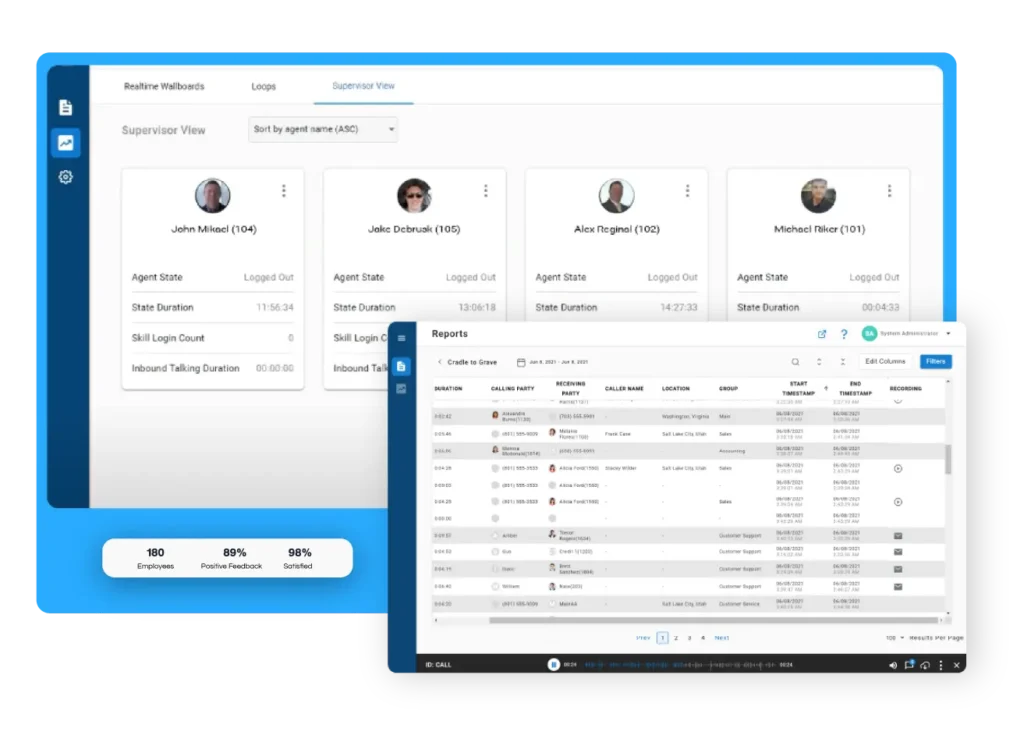
Xima Software’s cradle-to-grave reporting captures every interaction from start to finish, giving supervisors the complete picture they need to prioritize coaching conversations effectively.
Key Metrics to Track with Speech Analytics
Speech analytics generates a wealth of data. Knowing which metrics matter—and how to act on them—separates effective programs from data overload.
Quality Score Trends
Track individual agent scores over time, not just point-in-time snapshots. Is performance improving, declining, or flat? Are there patterns around specific days, shift times, or call types?
Team-level trends matter too. If multiple agents are struggling with the same scorecard element, you may have a training gap rather than individual performance issues.
Customer Sentiment Analysis
Sentiment scores reveal the emotional arc of your customer interactions. High-performing contact centers track not just average sentiment, but sentiment trajectory—did the customer’s mood improve during the call?
Calls where sentiment declines sharply are priority coaching opportunities. Something happened during that interaction that made the customer’s experience worse, and identifying what went wrong helps prevent recurrence.
First Call Resolution and Repeat Contacts
Speech analytics can help identify calls that lead to repeat contacts. When a customer calls back about the same issue, speech analytics can connect those interactions and reveal what was missing from the first contact.
This data helps you coach toward root-cause resolution rather than just handling the immediate question.
Compliance and Risk Indicators
For regulated industries, speech analytics provides audit-trail documentation that manual QA cannot match. You can report on compliance phrase delivery rates, authentication completion rates, and disclosure accuracy across your entire call volume—not just a sample.
Talk Time and Silence Analysis
Extended silence periods on calls often indicate agent uncertainty or system delays. High agent talk-time ratios may suggest agents aren’t listening enough. These metrics can surface training and process improvement opportunities.
Implementing Speech Analytics: A Step-by-Step Approach
Rolling out speech analytics requires planning beyond just installing software. Here’s a practical implementation path for contact center managers.
Step 1: Define Your Objectives
Start by clarifying what you want to accomplish. Common objectives include:
- Expanding QA coverage from sampling to full interaction review
- Reducing time spent on manual call listening
Improving agent performance through data-driven coaching - Strengthening compliance documentation and audit readiness
- Identifying customer experience improvement opportunities
Your objectives will shape how you configure the platform and measure success.
Step 2: Build Your Initial Scorecard
Work with QA supervisors, compliance teams, and operations leaders to define your scoring criteria. Start with your existing QA form as a baseline, then adapt it for automated evaluation.
Be specific about what counts as a pass or fail for each element. Vague criteria like “professional tone” need to be translated into measurable indicators like sentiment scores, specific phrase usage, or absence of negative language.
Step 3: Train Your Team on New Workflows
Speech analytics changes how supervisors spend their time. Instead of listening to calls looking for issues, they’re reviewing pre-scored interactions and flagged moments. This requires workflow adjustments.
Plan training sessions that cover:
- How to interpret automated QA scores
- How to use the platform to find coaching opportunities
- How to pull relevant call segments for coaching sessions
- How to track improvement over time using analytics dashboards
Step 4: Run a Pilot Period
Before rolling out across your entire contact center, run a pilot with a subset of agents and supervisors. Use this period to:
Validate that your scorecard accurately reflects quality
Refine keyword lists and phrase detection rules
Identify gaps between automated scoring and human judgment
Adjust thresholds for alerts and prioritization
Step 5: Measure and Refine
Track both process metrics (QA coverage, coaching session frequency, time spent on review) and outcome metrics (agent performance trends, customer satisfaction, compliance rates). Use this data to continuously improve your program.
Speech analytics is not set-and-forget. As your business evolves, your scorecard, keywords, and workflows should evolve with it.
Common Speech Analytics Mistakes to Avoid
Organizations implementing speech analytics often encounter predictable pitfalls. Here’s what to watch for.
Overcomplicating the Initial Scorecard
It’s tempting to build an exhaustive scorecard covering every possible quality dimension. Resist this urge. Complex scorecards are harder to maintain, harder for agents to understand, and generate noise that obscures the most important signals.
Start with a focused scorecard and expand thoughtfully based on actual needs.
Treating Speech Analytics as Surveillance
If agents perceive speech analytics as a tool for catching mistakes and punishing performance, adoption will suffer. Position the technology as a coaching and development resource—a way to give agents more specific feedback and help them improve faster.
Share positive findings, celebrate improvements, and involve agents in understanding how the scoring works.
Ignoring the Human Review Layer
Automated scoring is powerful but not infallible. Speech-to-text has accuracy limits. Sentiment detection can misread sarcasm or cultural communication patterns. Context matters in ways algorithms don’t fully capture.
Build human review into your workflow. Supervisors should regularly calibrate automated scores against their own assessment to maintain accuracy.
Collecting Data Without Acting on It
Speech analytics generates tremendous insight. That insight has no value if it doesn’t drive action. Make sure your team has clear processes for turning analytics findings into coaching conversations, training updates, and process improvements.
Speech Analytics and AI: What’s Changing in 2026
AI capabilities in speech analytics are advancing rapidly. Contact center managers should understand where the technology is heading.
Real-Time Agent Assistance
Next-generation speech analytics doesn’t just analyze calls after the fact—it can guide agents during live conversations. Real-time prompts can suggest responses, surface relevant knowledge base articles, or alert agents when a call is going off-track.
Predictive Quality Scoring
AI models are becoming better at predicting which agents are likely to struggle and which interactions are likely to escalate. This enables proactive coaching and supervisor intervention before problems compound.
Deeper Sentiment and Intent Understanding
Early sentiment analysis was relatively blunt—positive, negative, or neutral. Modern systems understand nuance: frustration versus confusion, urgency versus casual inquiry, satisfaction with resolution versus resignation.
This deeper understanding enables more sophisticated routing, coaching, and customer experience optimization.
What to Look for in a Speech Analytics Platform
If you’re evaluating speech analytics for your contact center, here are the capabilities that matter most.
Transcription Accuracy and Language Support
The foundation of speech analytics is transcription quality. Ask vendors about accuracy rates, how the system handles accents and industry jargon, and whether multiple languages are supported if relevant to your operation.
Customizable Scorecard Configuration
Your QA requirements are unique. The platform should allow you to define scoring criteria, weight elements appropriately, and adjust rules without requiring vendor intervention.
Integration with Existing Systems
Speech analytics should connect to your call recording platform, CRM, workforce management system, and reporting infrastructure. Siloed analytics data limits its value. Xima Software offers native integrations with popular CRMs and over 70 EHR systems for healthcare contact centers, ensuring your speech analytics data connects to the systems you already use.
Supervisor Dashboard and Workflow Tools
Your supervisors need an intuitive interface for reviewing scored calls, drilling into specific moments, and tracking agent performance. Clunky tools create adoption barriers.
Scalability and Reliability
Speech analytics processes large volumes of audio data. Verify that the platform can handle your call volumes without performance degradation and that the vendor has a track record of reliability.
Measuring Speech Analytics ROI
Quantifying the return on speech analytics investment requires measuring improvements across several dimensions.
Supervisor Time Savings
Calculate how many hours your supervisors currently spend manually listening to and scoring calls. With speech analytics handling the initial review and scoring, much of that time can be redirected to actual coaching.
Agent Performance Improvements
Track quality scores, customer satisfaction metrics, and first-call resolution rates before and after implementation. Improvements in these metrics directly impact customer retention and operational efficiency.
Compliance Risk Reduction
For regulated industries, speech analytics provides documentation that manual QA cannot match. The ability to demonstrate compliance across 100% of interactions—rather than a sample—reduces audit risk and potential penalty exposure.
Training Program Optimization
Speech analytics data reveals which skills and knowledge areas need the most training attention. Targeted training is more efficient than generic refresher courses.
In Conclusion: Taking the Next Step with Speech Analytics
Speech analytics transforms contact center quality assurance from a sampling exercise into a coverage exercise. Instead of reviewing 1-5% of interactions and hoping that sample represents reality, you can analyze every conversation and surface the coaching opportunities that actually matter.
The technology has matured significantly. AI-powered transcription and sentiment analysis are accurate enough for production use. Automated QA scoring can handle the heavy lifting while supervisors focus on human-centered coaching conversations.
The question isn’t whether your contact center would benefit from speech analytics. The question is how long you’re willing to operate with blind spots in your unreviewed volume—and what that’s costing you in agent performance, customer experience, and compliance risk every day.
Xima Software gives contact centers the tools to close that gap: AI-powered Auto QA covering 100% of interactions, real-time sentiment analysis, cradle-to-grave reporting, and actionable dashboards that turn data into coaching conversations. See what full visibility looks like for your contact center.
FAQs About Speech Analytics for QA and Coaching
What is speech analytics in a contact center?
Speech analytics is technology that automatically transcribes, analyzes, and scores customer-agent conversations. It uses AI to detect keywords, measure sentiment, and evaluate quality against your scorecard—giving you visibility into 100% of your interactions instead of just a sample.
How does speech analytics improve quality assurance?
Traditional QA reviews only 1-5% of calls manually. Speech analytics scores every interaction automatically, surfaces the calls that need attention, and eliminates the blind spots where quality issues go undetected.
Xima Software’s Auto QA evaluates 100% of interactions against your defined criteria, so supervisors spend less time searching for problems and more time coaching agents to improve.
Can speech analytics help with agent coaching?
Absolutely. Speech analytics identifies specific coaching opportunities—exact moments where an agent struggled, patterns across multiple calls, or behaviors that correlate with customer satisfaction.
Xima Software’s cradle-to-grave reporting lets supervisors pull up specific call segments instantly, making coaching conversations concrete rather than abstract.
What metrics should I track with speech analytics?
Key metrics include quality score trends over time, customer sentiment scores, first-call resolution rates, compliance phrase delivery rates, and talk-to-listen ratios. Track both individual agent performance and team-wide patterns to identify training needs.
How accurate is speech-to-text transcription?
Modern speech recognition accuracy typically ranges from 85-95% depending on audio quality, accents, and industry terminology. Most platforms allow you to train the system on your specific vocabulary to improve accuracy over time.
Is speech analytics only for large contact centers?
No. While enterprise contact centers were early adopters, speech analytics is now accessible to smaller operations. Xima Software delivers AI-powered analytics with the same capabilities large organizations use—without the enterprise complexity or cost.
How long does it take to implement speech analytics?
Basic implementation can happen in weeks, but building an effective program takes longer. Plan for time to configure your scorecard, train supervisors on new workflows, run a pilot period, and refine based on results. Most organizations see meaningful value within the first quarter.
Does speech analytics work with remote agents?
Yes. Cloud-based speech analytics platforms analyze calls regardless of where agents are located. As long as calls are being recorded, they can be processed and scored—making speech analytics valuable for distributed and hybrid contact center teams.
What’s the difference between speech analytics and call recording?
Call recording captures audio. Speech analytics turns that audio into structured, searchable, scorable data. Recording without analytics is raw material. Speech analytics transforms recordings into actionable intelligence you can use for QA, coaching, and compliance documentation.
How does Xima Software approach speech analytics?
Xima Software combines AI-powered Auto QA with real-time sentiment analysis and cradle-to-grave interaction reporting. You get 100% coverage of your call volume, automated scoring against your custom QA criteria, and actionable dashboards that help supervisors identify coaching priorities—without the complexity of enterprise platforms.