
Somewhere in your contact center right now, an agent is on a call with a member who has a question about a disputed charge. The call is being recorded. But is anyone reviewing it? Is the required disclosure happening on every single interaction? And if a regulator asked you to produce a complete audit trail of that member’s communications over the past 90 days, how long would it take?
These are the questions that define modern financial services contact centers. They’re not just about answering phones anymore—they’re about managing compliance risk, integrating data across systems, and making real-time decisions that affect both customer satisfaction and regulatory standing. Xima Software helps financial services contact centers close these operational gaps with cradle-to-grave reporting, AI-powered quality assurance, and native CRM integrations that give you visibility into every interaction.
This guide covers everything you need to know about running a financial services contact center in 2026—from the foundational concepts to the specific technologies and workflows that separate compliant, high-performing operations from those operating with dangerous blind spots.
Key Takeaways: Financial Services Contact Centers in 2026
- Financial services contact centers must balance customer experience with strict regulatory compliance requirements including PCI DSS and consumer protection laws.
- CRM integration enables agents to access complete member histories instantly, reducing handle time and improving first-call resolution rates.
- Real-time analytics and wallboards give supervisors immediate visibility into queue performance, compliance adherence, and agent activity.
- Xima Software gives financial services teams AI-powered QA that scores 100% of interactions—not just the 1-3% that manual review catches.
- Skills-based routing and queue callback features directly reduce abandonment rates and improve member satisfaction in high-volume environments.
What Is a Financial Services Contact Center?
A financial services contact center is a specialized operation that handles customer communications for banks, credit unions, insurance companies, investment firms, and other financial institutions. Unlike general customer service departments, these centers operate under strict regulatory oversight and must document every member interaction.
Xima’s contact center software for financial services covers the deployment requirements described here.
The core function goes beyond answering questions. Your contact center is often the primary touchpoint between your institution and your members. It handles account inquiries, loan applications, dispute resolutions, fraud alerts, and payment processing—each with its own compliance requirements.
How Financial Services Contact Centers Differ from General Customer Service
Three elements distinguish financial services contact centers from other industries. First, regulatory exposure is constant. Every call involving payment information, account details, or financial advice carries compliance risk.
Second, the documentation burden is significantly higher. You’re not just tracking call volume and handle time. You need audit trails that can survive examiner scrutiny—complete records of what was said, when disclosures were made, and how disputes were handled.
Third, the integration requirements are more demanding. Your agents need real-time access to core banking systems, CRM data, and member histories to resolve issues efficiently. A disconnected tech stack creates both compliance risk and customer frustration.
Why Compliance Matters More Than Ever in Financial Services Contact Centers
Compliance isn’t a checkbox exercise. It’s an operational reality with measurable costs that compound every week your contact center operates without proper visibility.
Here’s the math that most compliance programs in this industry are built on: your supervisors review somewhere between 1% and 5% of total call volume. An average agent handles 60 calls a day. If you have 20 agents, that’s 1,200 interactions daily. At a 3% review rate, supervisors are evaluating 36 calls. The other 1,164 are unreviewed.
That gap is where compliance failures happen. Not because your agents are careless, but because structural coverage limitations mean problems go undetected until an examiner finds them.
Key Compliance Regulations Affecting Financial Services Contact Centers
Several regulatory frameworks directly impact how you operate your contact center. Understanding each one helps you design workflows that protect both your members and your institution.
Requirements like these are handled through Xima’s contact center compliance capabilities.
PCI DSS Requirements
If your agents handle payment card information—credit card numbers, CVVs, or account credentials—you’re subject to Payment Card Industry Data Security Standards. This affects call recording, screen capture, and how payment data is transmitted.
The challenge is practical: you need to record calls for quality and compliance purposes, but you also need to mask or pause recording when payment information is spoken. Manual processes for this create inconsistent compliance.
Consumer Financial Protection Regulations
The Consumer Financial Protection Bureau (CFPB) enforces regulations around fair lending, debt collection, and consumer disclosures. Your contact center agents must deliver required disclosures consistently, and you need documentation proving they did.
This creates a quality assurance burden that manual review can’t adequately address. When examiners ask for evidence that disclosures were made across a sample of calls, “we train our agents to do it” isn’t sufficient documentation.
State-Level Privacy and Recording Laws
Recording laws vary by state. Some require single-party consent, others require all-party consent. If your contact center handles calls from multiple states, you need systems that can apply the correct recording disclosure based on caller location.
Getting this wrong creates legal exposure beyond regulatory penalties. Improperly recorded calls may be inadmissible as evidence in disputes and could generate litigation risk.
The Real Cost of Compliance Gaps
Before any examiner shows up, compliance gaps are costing you in ways that don’t appear on budget line items. Consider the time your supervisors spend on manual call reviews—listening to recordings, filling out evaluation forms, and documenting findings.
Every hour a supervisor spends on manual compliance work is an hour they’re not spending coaching agents, identifying performance gaps, or improving the operation they’re responsible for. That’s not a soft cost. That’s a real one, and it compounds every week.
Fill in your numbers here: if you have ___ supervisors spending ___ hours per week on manual QA, that’s ___ hours annually that could be redirected to activities that actually improve performance.
CRM Integration: The Foundation of Effective Financial Services Contact Centers
Your agents can only help members as quickly as they can access the information they need. Disconnected systems force agents to toggle between screens, copy data manually, and ask members to repeat information they’ve already provided.
Native CRM integration changes this dynamic entirely. When your contact center software connects directly to your customer relationship management system, agents see complete member histories the moment a call connects.
What Effective CRM Integration Looks Like
True integration isn’t just about displaying CRM data in a popup window. It’s bi-directional—meaning actions taken in the contact center automatically update the CRM record, and CRM data informs how calls are routed and handled.
Xima Software connects natively with popular CRMs, enabling this kind of data flow without requiring third-party middleware or custom development. This means your agents work in one interface while your CRM stays current with every interaction.
Consider what this looks like in practice: a member calls about a recent transaction. Before the agent says hello, they see the member’s account status, recent interactions, open issues, and relationship history. The agent can resolve the inquiry without asking the member to repeat their account number or explain why they’re calling.
How CRM Integration Improves Compliance Documentation
Integration also addresses compliance documentation challenges. When every interaction is automatically logged to the member’s CRM record—including call recordings, disposition codes, and agent notes—you create an audit trail without requiring manual data entry.
This cradle-to-grave approach captures the complete lifecycle of each member interaction. When an examiner asks to review the history of a specific member’s communications, you can produce a complete record from a single system instead of piecing together data from multiple sources.
Skills-Based Routing and CRM Data
CRM integration also enables smarter call routing. Skills-based routing directs calls to agents with the specific expertise needed to handle them—but that routing becomes more powerful when it factors in CRM data.
A member calling about a mortgage application can be routed directly to an agent who handles mortgage inquiries and has access to the relevant application details. A high-value member with a complex portfolio can be routed to a senior agent with the authority to resolve their issue without escalation.
This reduces transfers, shortens handle time, and improves first-call resolution—all metrics that directly impact both customer satisfaction and operational efficiency.
Real-Time Analytics: Making Data Actionable in Financial Services Contact Centers
Historical reporting tells you what happened yesterday. Real-time analytics tell you what’s happening right now—while you can still do something about it.
For financial services contact centers, this distinction matters enormously. A queue that’s backing up during a morning rush becomes visible immediately, not in tomorrow’s report. An agent who’s struggling with a difficult call shows up on the dashboard before the interaction escalates.
Essential Real-Time Metrics for Financial Services Contact Centers
The metrics that matter most depend on your specific operation, but several indicators are universally relevant for financial services environments:
Service level measures the percentage of calls answered within your target time threshold. For most financial services contact centers, this means answering 80% of calls within 20 or 30 seconds. Real-time visibility lets supervisors rebalance resources before service level degrades.
Queue depth shows how many callers are waiting at any moment. Sudden spikes—whether from a marketing campaign, a system outage, or an external event—become visible immediately so you can respond appropriately.
Abandonment rate tracks how many callers hang up before reaching an agent. In financial services, abandoned calls often represent members with urgent issues who will call back frustrated—or worse, take their business elsewhere.
Handle time by interaction type helps identify whether certain call categories are taking longer than expected, potentially indicating training gaps or process issues.
Using Wallboards for Supervisor Visibility
Real-time wallboards display key metrics on screens visible to supervisors and agents. This creates shared awareness of operational status and helps teams self-regulate during busy periods.
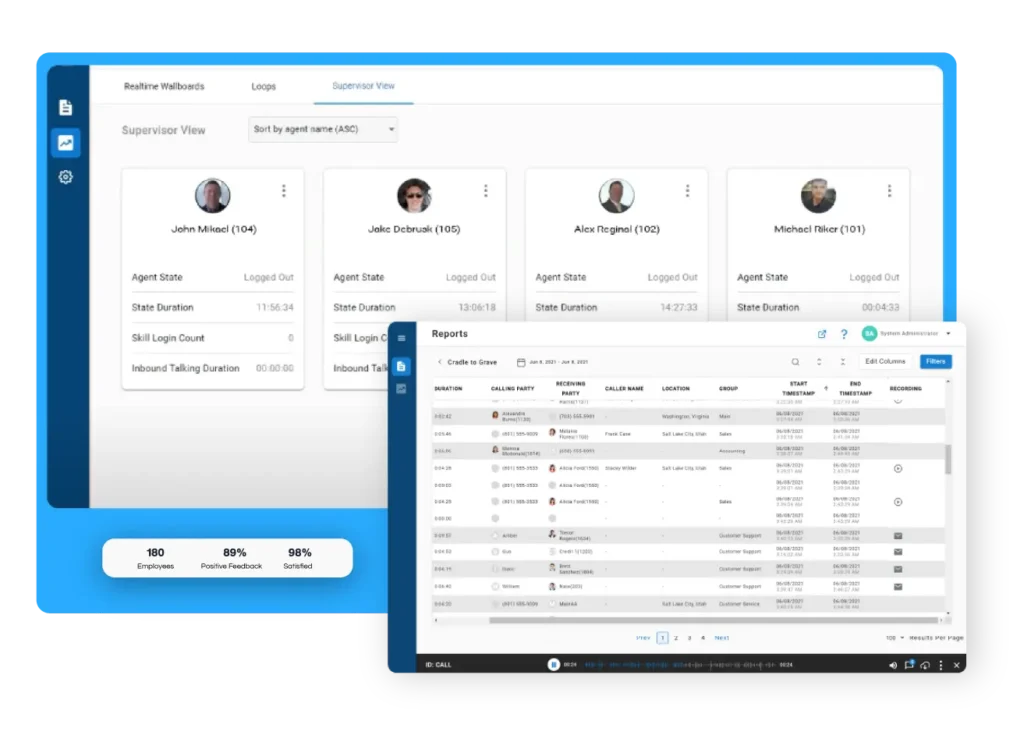
Xima Software delivers real-time wallboards and customizable dashboards that give supervisors immediate insight into queue performance, agent status, and service levels. When everyone can see that the queue is backing up, agents naturally move more efficiently between calls.
Effective wallboards are customizable. Your contact center’s priorities aren’t identical to every other financial services operation, so the metrics you display should reflect your specific service level agreements and compliance requirements.
From Real-Time Data to Real-Time Decisions
Data visibility only matters if it enables better decisions. Real-time analytics should trigger specific actions:
When queue depth exceeds threshold, supervisors can activate callback options, pull agents from offline tasks, or adjust IVR messaging to set caller expectations.
When an agent’s handle time spikes on a specific call, supervisors can monitor the interaction and coaching or intervention if needed.
When abandonment rates increase during specific time windows, you have data to support staffing adjustments or schedule changes.
The goal isn’t just to see what’s happening—it’s to respond before small problems become big ones.
AI-Powered Quality Assurance in Financial Services Contact Centers
Manual quality assurance has two problems that don’t get discussed honestly enough in financial services compliance conversations.
The first is coverage. At 1% to 5% review rates, you’re making assumptions about the other 95-99% of interactions. You’re assuming the calls you review are representative. You’re assuming problems that exist in unreviewed calls are similar to problems you catch in reviewed calls. Those are big assumptions when regulatory exposure is involved.
The second problem is timing. By the time a supervisor reviews a call from two weeks ago and delivers feedback, the agent has handled hundreds more interactions. The coaching moment has passed. If the agent was making the same mistake repeatedly, that mistake has been repeated dozens of times before anyone noticed.
How AI Changes the Quality Assurance Equation
AI-powered quality assurance addresses both problems simultaneously. Instead of reviewing a small sample, AI can score 100% of interactions automatically—every call, every chat, every email.
Xima Software offers AI-powered Auto QA and speech analytics that evaluate every interaction against your compliance criteria and quality standards. This means you know immediately when required disclosures weren’t made, when agents deviated from scripts, or when customer sentiment indicated dissatisfaction.
This isn’t about replacing human judgment. It’s about giving human supervisors the information they need to focus their attention where it matters most. Instead of randomly sampling calls, supervisors can review the specific interactions that AI flagged as concerning.
Speech Analytics and Sentiment Analysis
Beyond compliance scoring, AI-powered speech analytics extract insights from the content of conversations. What topics are members asking about most frequently? What competitor names are appearing in calls? What phrases correlate with successful resolutions versus escalations?
Sentiment analysis tracks emotional indicators throughout interactions. A call that starts positive but turns negative signals a problem worth reviewing. Patterns of negative sentiment on specific call types or with specific agents indicate systemic issues requiring attention.
This turns your call recordings from compliance documentation into operational intelligence. The calls are already happening—AI helps you extract actionable insights from them.
Building an Audit-Ready Quality Assurance Program
Examiners don’t just want to see that you have a QA program. They want evidence that your program actually catches and addresses problems. An AI-powered approach creates documentation that demonstrates systematic coverage.
When you can show that 100% of interactions are scored against compliance criteria, and that flagged interactions receive supervisory review and documented follow-up, you’ve built an audit trail that demonstrates genuine oversight—not just policy on paper.
Omnichannel Support in Financial Services Contact Centers
Your members don’t think in channels. They start a conversation on chat, continue it on the phone, and follow up via email. They expect your agents to understand the complete context regardless of how they choose to communicate.
True omnichannel support means unifying voice, chat, email, SMS, and social media interactions into a single platform where agents see the complete picture.
Why Channel Silos Create Problems
When channels operate independently, members repeat themselves constantly. The agent handling the phone call doesn’t see the chat conversation from yesterday. The email response doesn’t reference the phone call from this morning.
This creates frustration for members and inefficiency for agents. It also creates compliance gaps—if interactions are documented in separate systems, producing a complete audit trail for a specific member requires manual consolidation.
Implementing Unified Omnichannel Support
Xima CCaaS unifies voice, chat, email, SMS, and social media into a single platform. This means agents work from one interface, members experience continuity across channels, and compliance documentation captures the complete interaction history.
The practical impact is significant. A member who initiated a loan inquiry via chat can call back and speak to an agent who already knows where the conversation left off. Documentation for that member shows the complete journey—from initial inquiry through resolution—regardless of how many channels were involved.
Queue Callback: Reducing Abandonment and Improving Member Experience
Hold time is one of the primary drivers of call abandonment in financial services contact centers. Members calling about urgent matters—fraud alerts, payment issues, account access problems—often can’t wait indefinitely.
Queue callback offers an alternative. Instead of waiting on hold, members receive a callback when an agent becomes available. They keep their place in line without keeping the phone to their ear.
How Queue Callback Works
When queue wait times exceed a threshold, callers are offered the option to receive a callback. The system records their phone number and queue position, then calls them back when an agent is available.
This simple feature has measurable impact on key metrics. Abandonment rates drop because members aren’t forced to choose between waiting and hanging up. Customer satisfaction improves because members can continue with their day instead of listening to hold music.
Queue Callback in Financial Services Contexts
For financial services specifically, queue callback also addresses compliance considerations. A member calling about a time-sensitive issue—like a disputed charge or a potential fraud alert—may abandon the call if hold times are too long, then take action that creates further complications.
By offering callback, you maintain contact with that member and ensure their issue gets addressed, even during peak volume periods. This is both a customer service improvement and a risk management strategy.
Workforce Optimization for Financial Services Contact Centers
Your contact center’s effectiveness depends on having the right number of agents with the right skills available at the right times. This sounds simple, but achieving it requires data, planning, and flexibility.
Forecasting Call Volume Accurately
Historical data is the foundation for staffing decisions. What time of day do calls peak? What day of the week has the highest volume? How do external events—statement cycles, rate announcements, regulatory changes—affect call patterns?
Accurate forecasting prevents both understaffing (which creates long wait times and abandonment) and overstaffing (which wastes payroll). The more granular your historical data, the more precisely you can plan.
Scheduling Against Forecasted Demand
With accurate forecasts, you can build schedules that match staffing to expected volume. This includes planning for breaks, lunches, and offline time so that coverage remains consistent throughout the day.
The challenge is flexibility. Schedules built weeks in advance can’t anticipate every variation in actual volume. Real-time visibility helps supervisors make intraday adjustments—pulling agents from offline tasks when queues back up, or shifting breaks when volume drops.
Agent Performance Management
Workforce optimization also includes developing agent skills and managing performance. This means identifying which agents handle which call types most effectively, creating targeted coaching based on QA findings, and building career development paths that retain your top performers.
Xima Software gives supervisors actionable insights for agent coaching with detailed analytics on individual performance, call outcomes, and skill development opportunities. When supervisors know specifically where each agent needs support, coaching becomes more effective than generic training.
How to Evaluate Financial Services Contact Center Technology
Not all contact center platforms are built for financial services requirements. When evaluating technology, focus on the specific capabilities that address your compliance, integration, and operational needs.
Questions to Ask During Vendor Demos
Use these questions in every demo. They’re designed to reveal actual capabilities rather than marketing claims:
Compliance and documentation: Show me how your system documents that required disclosures were made on a specific call. Walk me through pulling the complete audit trail for a single member’s interactions over the past 90 days.
CRM integration: Demonstrate the bi-directional sync with our CRM. Show me what happens in the CRM record when an agent completes a call. Show me what the agent sees when a known member calls in.
Quality assurance: What percentage of interactions can your system evaluate automatically? Show me the scoring criteria and how supervisors review flagged interactions.
Real-time visibility: Show me the real-time dashboard. Walk me through what happens when a supervisor sees a metric exceeding threshold—what actions can they take directly from the interface?
Reporting: Show me the pre-built reports for compliance documentation. How long does it take to generate an audit-ready report for a specific time period?
If a vendor pivots away from any of these questions or redirects you to a different part of the demo, that’s your answer.
Implementation and Support Considerations
Beyond features, consider the implementation process and ongoing support model. How long does deployment take? What resources are required from your team? What happens when you need help after go-live?
Xima Software offers white-glove support and fast onboarding designed to minimize disruption and accelerate time to value. This consultative approach means you’re not left to figure things out on your own after signing a contract.
Building a Compliant Contact Center: Step-by-Step Implementation
Moving from current state to a fully compliant, well-integrated financial services contact center requires planning and phased execution. Here’s how to approach it:
Step 1: Document Your Current Compliance Gaps
Before selecting technology or changing processes, understand where you stand today. Answer these questions honestly:
What percentage of member interactions are reviewed for quality and compliance? _____
How long would it take to produce a complete audit trail for a specific member’s communications over the past 90 days? _____
How many systems do agents access during a typical call? _____
What required disclosures must agents deliver, and how do you verify they’re delivered consistently? _____
Write down your answers. They establish your baseline and help prioritize which gaps to address first.
Step 2: Define Your Target State
Based on your compliance requirements and operational goals, define what success looks like. This should include specific, measurable targets:
100% of interactions evaluated against compliance criteria automatically.
Complete audit trail producible for any member in under five minutes.
Agent access to complete member history from a single interface.
Real-time visibility into queue performance and agent status.
These targets become your requirements for technology evaluation and implementation planning.
Step 3: Select Technology Partners
Evaluate contact center platforms against your specific requirements, using the questions outlined earlier. Focus on platforms designed for regulated industries with native compliance capabilities.
Consider both cloud and on-premises deployment options based on your security requirements and infrastructure preferences. Xima Software offers both cloud and on-premises deployment, giving you flexibility to choose the model that fits your organization.
Step 4: Plan Integration and Migration
CRM integration, phone system connectivity, and data migration all require careful planning. Work with your technology partner to understand dependencies, timeline, and resource requirements.
Native integrations—where the contact center platform connects directly to your CRM and phone system without third-party middleware—typically deploy faster and create fewer ongoing maintenance issues than custom integrations.
Step 5: Train and Launch
Agent training should cover not just system functionality but the compliance workflows and documentation requirements built into the new platform. Supervisors need training on real-time dashboards, QA tools, and reporting.
Plan for a parallel operation period if possible, running old and new systems simultaneously until you’re confident in the new platform’s performance.
Step 6: Monitor and Optimize
After launch, use the real-time analytics and reporting capabilities to identify issues and opportunities. Compliance coverage should be measurable immediately. Service level improvements should follow as agents become proficient with the new tools.
Schedule regular reviews of QA findings, operational metrics, and compliance documentation to ensure the system is delivering the expected results.
The Future of Financial Services Contact Centers
Financial services contact centers will continue evolving as technology capabilities expand and member expectations increase. Several trends are shaping where the industry is heading.
AI Moving from Automation to Augmentation
Early AI applications focused on automating simple tasks—chatbots handling routine inquiries, IVR systems routing calls. The next phase emphasizes augmentation: AI that makes human agents more effective rather than replacing them.
This includes real-time coaching prompts during calls, automatic retrieval of relevant information based on conversation context, and predictive analytics that help agents anticipate member needs.
Proactive Service Models
Instead of waiting for members to call with problems, leading contact centers are moving toward proactive outreach. This means identifying issues before members notice them and reaching out with solutions.
Real-time analytics and CRM integration enable this shift. When you have visibility into member activity patterns and the ability to initiate contact across channels, you can address problems before they escalate.
Increasing Regulatory Scrutiny
Regulatory expectations for documentation and oversight continue to increase. Contact centers that rely on manual processes and sample-based QA will face growing compliance risk as examiners expect more systematic coverage.
Building audit-ready operations now—with complete interaction documentation and AI-powered compliance monitoring—positions you for regulatory requirements that will only become more demanding.
In Conclusion: Building a Financial Services Contact Center That Works
The financial services contact center you need in 2026 isn’t just a call-handling operation. It’s a compliance engine, a CRM integration hub, and a real-time decision-making center that directly impacts member experience and regulatory standing.
The structural gaps in most financial services contact centers—limited QA coverage, disconnected systems, delayed visibility—aren’t individual failures. They’re industry-wide challenges that stem from technology limitations and resource constraints. The good news is that modern contact center platforms address these challenges directly.
Xima Software helps financial services contact centers move from reactive operations to proactive compliance, from disconnected systems to unified member experiences, and from manual QA to AI-powered visibility into every interaction. The question isn’t whether you need these capabilities. The question is how long you’re willing to operate without them—and who finds out first.
Ready to see what audit-ready looks like for your contact center? Book a demo to see how Xima’s cradle-to-grave reporting, real-time analytics, and AI-powered QA can close the compliance gaps in your operation.
FAQs about Financial Services Contact Centers in 2026
What is a financial services contact center?
A financial services contact center is a specialized customer communication operation for banks, credit unions, insurance companies, and investment firms. These centers handle account inquiries, loan applications, dispute resolutions, and payment processing while maintaining compliance with financial regulations.
Unlike general customer service operations, financial services contact centers must document every interaction and follow strict regulatory requirements around disclosures, recording, and data security.
What compliance requirements affect financial services contact centers?
Financial services contact centers must comply with PCI DSS for payment card data, CFPB regulations for consumer protections and disclosures, state-level recording consent laws, and industry-specific requirements like those from banking regulators.
Xima Software helps financial services teams meet these requirements with AI-powered QA that monitors 100% of interactions for compliance adherence, plus cradle-to-grave reporting that creates complete audit trails automatically.
How does CRM integration benefit financial services contact centers?
CRM integration gives agents immediate access to complete member histories when calls connect. This reduces handle time, improves first-call resolution, and eliminates the frustration of members repeating information.
Bi-directional integration also creates automatic documentation—every interaction updates the member’s CRM record, building compliance audit trails without manual data entry. Xima Software connects natively with popular CRMs for this kind of integration.
What real-time analytics matter most for financial services contact centers?
Service level, queue depth, abandonment rate, and handle time by interaction type are the most critical real-time metrics. These indicators show whether you’re meeting member expectations and where operational adjustments are needed.
Xima’s real-time wallboards and customizable dashboards give supervisors immediate visibility into these metrics, enabling faster response to emerging issues.
How does AI improve quality assurance in financial services contact centers?
AI-powered quality assurance evaluates 100% of interactions automatically, compared to the 1-5% coverage of manual review. This closes the compliance gap where most problems actually occur—in the unreviewed volume.
AI also offers immediate feedback rather than delayed coaching from calls reviewed weeks later. Xima’s Auto QA and speech analytics give supervisors actionable insights from every interaction.
What is queue callback and why does it matter?
Queue callback lets members receive a return call when an agent becomes available instead of waiting on hold. This reduces abandonment rates, improves member satisfaction, and ensures urgent issues get addressed even during peak volume periods.
For financial services specifically, queue callback prevents members with time-sensitive concerns from abandoning calls and potentially taking actions that create further complications.
What should I look for when evaluating contact center technology for financial services?
Focus on compliance documentation capabilities, native CRM integration, AI-powered quality assurance, real-time analytics, and reporting for audit preparation. Ask vendors to demonstrate these capabilities with your specific use cases, not just marketing slides.
Also consider implementation support, deployment options (cloud versus on-premises), and the vendor’s experience with regulated industries. Xima Software offers both deployment models and white-glove support designed for financial services requirements.