
Somewhere in your contact center today, an agent is handling a call while your on-premise system quietly ages out of vendor support. The phone works. The recordings exist. But the data you need to make decisions? That’s scattered across systems that don’t talk to each other.
Moving your contact center to the cloud isn’t about chasing trends—it’s about closing the visibility gap that’s costing you supervisor hours, compliance risk, and customer satisfaction every single week. This guide walks you through every phase of cloud contact center migration: planning, integration, compliance, and proving ROI once you’re live.
Xima Software helps SMB contact center teams move to the cloud without the complexity that enterprise vendors assume you can absorb. By the end of this guide, you’ll have a concrete framework for evaluating your current state, building a migration plan, and measuring success.
Key Takeaways: How to Migrate to a Cloud Contact Center in 2026
- Start your cloud migration with an infrastructure audit that documents every integration, workflow, and compliance requirement before evaluating vendors.
- Phased rollout reduces risk—pilot with a small team, validate your reporting, and expand only when you’ve confirmed business continuity.
- Integration depth matters more than feature count; your CRM and EHR connections must be bi-directional and real-time.
- Xima CCaaS gives SMB teams enterprise-grade reporting and AI-powered QA without the implementation complexity or long-term contract lock-in.
- Track ROI through specific metrics: average handle time reduction, first-call resolution improvement, and supervisor hours reclaimed from manual QA.
What Is Cloud Contact Center Migration?
Cloud contact center migration means moving your customer communication infrastructure from on-premise hardware to a cloud-based platform. Your phone system, call routing, recording, reporting, and quality assurance tools all shift from local servers to hosted software accessed through the internet.
This isn’t a simple “lift and shift” operation. You’re re-architecting how your contact center captures, routes, and analyzes every customer interaction. The goal is to replace siloed, aging infrastructure with a unified platform that gives you real-time visibility into what’s actually happening on every call.
For SMB contact centers, migration also means gaining access to capabilities—AI-powered speech analytics, omnichannel routing, cradle-to-grave reporting—that were previously reserved for organizations with dedicated IT teams and six-figure budgets.
Why SMBs Are Moving to Cloud Contact Centers in 2026
On-Premise Limitations Are Becoming Operational Liabilities
On-premise contact center systems require hardware maintenance, software updates, and dedicated IT support. When your PBX vendor announces end-of-life, you’re left choosing between expensive upgrades or operating on unsupported infrastructure.
The bigger problem isn’t the hardware—it’s the data. On-premise systems often trap your interaction data in formats that can’t be easily exported, analyzed, or integrated with modern business tools. Your supervisors spend hours pulling manual reports instead of coaching agents.
Remote and Hybrid Work Demands Flexibility
Cloud contact centers let your agents work from anywhere with an internet connection. You’re not provisioning VPN access or shipping hardware. Scaling up during peak seasons means adding licenses, not installing phone lines.
This flexibility also applies to disaster recovery. When your physical office experiences an outage, cloud infrastructure keeps your contact center operational without scrambling for backup plans.
Customer Expectations Have Outpaced Legacy Capabilities
Your customers expect to reach you through voice, chat, email, and SMS—and they expect you to know their history regardless of which channel they use. On-premise systems weren’t designed for omnichannel service. Each channel operates as a separate silo with separate reporting.
Cloud platforms unify these channels into a single interaction record. An agent can see that a customer emailed yesterday, chatted this morning, and is now calling—all in one view, without switching systems.
How to Assess Your Current Contact Center Infrastructure
Document Your Existing Technology Stack
Before evaluating cloud vendors, you need a complete inventory of what you’re currently running. List every system that touches customer interactions: your PBX, ACD, IVR, call recording platform, workforce management tool, CRM, and any industry-specific systems like EHR or EMR for healthcare.
For each system, document the integration method (API, database connection, file transfer), data flows (what information moves between systems and how often), and dependencies (which processes break if this system goes down).
Identify Your Compliance Requirements
If you’re in healthcare, financial services, or any regulated industry, your migration plan must account for HIPAA, PCI DSS, or other compliance frameworks. This means understanding where your call recordings are stored, who has access, how long you’re required to retain them, and how you’ll demonstrate compliance to auditors.
Document your current compliance posture honestly. Many contact centers have policies on paper that don’t match operational reality. A cloud migration is an opportunity to close that gap—but only if you acknowledge it exists.
Calculate Your Current Operational Costs
Fill in your real numbers below. You’ll need these to calculate ROI after migration.
- Annual maintenance contracts for on-premise hardware: $______
- IT staff hours spent on contact center system maintenance per month: ______ hours
- Supervisor hours spent on manual QA and reporting per week: ______ hours
- Number of systems agents must access during a single call: ______
- Average time to produce a compliance report when requested: ______
Write that last number down somewhere visible. If it’s more than five minutes, you have a structural visibility problem that a cloud platform with unified reporting can solve.
What to Look for in a Cloud Contact Center Platform
Integration Depth Over Feature Count
Every cloud vendor will show you a long feature list. The question that matters is: how deeply does this platform integrate with the systems you already use?
For healthcare contact centers, that means native, bi-directional integration with your EHR. Xima CCaaS connects with over 70 EHR systems, pulling patient context into the agent screen and pushing interaction data back to the patient record automatically—no middleware required.
For financial services, it means CRM integration that captures every interaction in your customer record without manual data entry. Ask vendors to demonstrate this live, not in a slide deck.
Reporting That Captures the Complete Interaction
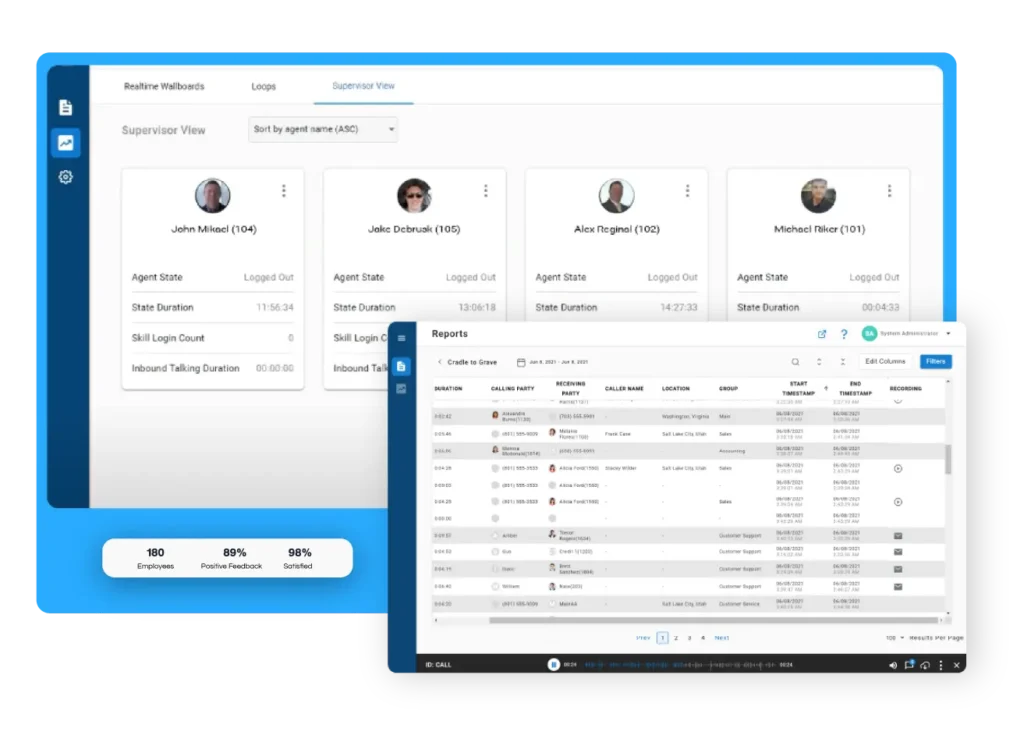
Cradle-to-grave reporting means tracking every interaction from the moment it enters your contact center until it’s fully resolved—including transfers, holds, callbacks, and follow-up contacts. Most on-premise systems lose visibility when a call transfers between agents or departments.
Xima Software’s reporting captures the complete customer journey across every touchpoint. Your supervisors see exactly how long customers waited, how many times they were transferred, and what happened at each step. That’s the data you need to identify process breakdowns and coaching opportunities.
AI-Powered Quality Assurance at Scale
Manual QA has two problems that don’t get discussed honestly enough. First, coverage: most contact centers review 1-3% of interactions. Second, timing: by the time a supervisor reviews a call from two weeks ago, the agent has handled hundreds more calls using the same approach.
AI-powered auto QA and speech analytics score 100% of interactions in real time. You’re not sampling—you’re seeing patterns across your entire operation. Xima CCaaS includes speech-to-text transcription and sentiment analysis that flag coaching opportunities as they happen, not weeks later.
Transparent Pricing Without Long-Term Lock-In
Ask vendors to break down every cost: per-seat licensing, implementation fees, integration charges, training, and ongoing support. Ask about contract terms and exit clauses.
Xima Software offers flexible concurrent licensing and transparent, all-in pricing. You know exactly what you’re paying before you sign, and you’re not locked into multi-year agreements with hidden escalation clauses.
How to Plan a Phased Cloud Migration
Phase 1: Discovery and Requirements Gathering (Weeks 1-4)
Use your infrastructure audit to create a detailed requirements document. This should include technical requirements (integrations, security, compliance), operational requirements (call routing logic, queue configurations, IVR flows), and reporting requirements (what dashboards and reports your supervisors need on day one).
Don’t skip this phase. The most common migration failure is discovering mid-implementation that a critical workflow wasn’t documented and the new platform can’t replicate it.
Phase 2: Vendor Selection and Contract Negotiation (Weeks 5-8)
Narrow your vendor list to 2-3 finalists. Schedule live demonstrations that focus on your specific use cases, not generic feature tours. Use these questions in every demo:
- Show me the complete lifecycle of a single interaction in one view, from queue entry to wrap-up.
- How does your platform handle call transfers without losing reporting continuity?
- Demonstrate your integration with [your specific CRM/EHR]. Show me data flowing both directions in real time.
- What does implementation support look like? Who is my point of contact after go-live?
If a vendor pivots away from any of these or redirects you to a different part of the demo, that’s your answer.
Phase 3: Pilot Deployment (Weeks 9-14)
Deploy the cloud platform with a small team first—ideally one queue or department. Run parallel operations with your legacy system for 2-4 weeks. This lets you validate:
- Call quality and reliability under real conditions
- Integration accuracy (does data flow correctly between systems?)
- Reporting completeness (can supervisors see what they need?)
- Agent experience (can they handle calls without friction?)
Document every issue that surfaces during the pilot. This is your punch list for full deployment.
Phase 4: Full Deployment and Cutover (Weeks 15-18)
Once your pilot team is stable, expand to the full contact center in waves. Plan your cutover for a low-volume period—not your busiest season. Have rollback procedures documented in case of critical issues.
Xima Software’s white-glove implementation support means you’re not navigating this alone. Your implementation team stays engaged through go-live and beyond, not just through contract signing.
Phase 5: Optimization and Stabilization (Weeks 19-26)
Migration isn’t finished when the phones work. Spend the first 90 days post-migration optimizing call flows, building dashboards, training supervisors on new reporting capabilities, and establishing baseline metrics for ROI measurement.
This is where the real value of cloud migration becomes visible. You’re not just running the same operation on different infrastructure—you’re gaining visibility into data that was previously invisible.
How to Handle Data Migration and Compliance
What Data Needs to Move
Not all your legacy data needs to migrate to the new platform. Prioritize:
- Active customer records: Current customer information that agents need during calls
- Historical interaction data: Call recordings and transcripts you’re required to retain for compliance
- Configuration data: IVR scripts, routing rules, agent skill assignments, and queue configurations
For compliance-sensitive data like call recordings, understand your retention requirements. You may need to maintain access to legacy recordings for several years even after migration.
Ensuring HIPAA and PCI Compliance During Migration
Data in motion is data at risk. Your migration plan must include encryption requirements for data transfer, access controls during the transition period, and audit logging of who accessed what data and when.
Xima Software’s cloud platform meets HIPAA and PCI DSS requirements with built-in security controls. But compliance is a shared responsibility—your internal processes for handling sensitive data during migration matter as much as the platform’s technical controls.
Testing Data Integrity Post-Migration
After data migration, run validation checks. Can agents access historical customer information? Do transferred call recordings play correctly? Are compliance reports generating accurate data?
Build a testing checklist that covers every data type you migrated. Don’t assume success—verify it.
Common Cloud Contact Center Migration Challenges and Solutions
Challenge: Integration Complexity with Legacy Systems
Not every legacy system has modern API capabilities. Some integrations require custom development or middleware.
Approach: During vendor selection, require live demonstrations of your specific integrations. Ask about the vendor’s experience with your CRM, EHR, or other critical systems. Xima CCaaS offers native integrations with popular CRMs, Microsoft Teams, and over 70 EHRs—which reduces the custom development burden for most SMB contact centers.
Challenge: Agent Adoption and Training
A new platform only works if your agents use it correctly. Resistance to change is real, especially from tenured staff comfortable with existing systems.
Approach: Involve frontline agents in pilot testing. Their feedback improves the deployment plan and creates internal champions. Xima’s user-friendly interface minimizes the learning curve—agents aren’t spending weeks in training before they can handle calls effectively.
Challenge: Maintaining Service Levels During Transition
Downtime during migration directly impacts customer experience and revenue.
Approach: Plan for parallel operations during the pilot phase. Have a documented rollback procedure. Schedule cutover during low-volume periods. Test your disaster recovery procedures before you need them.
Challenge: Unexpected Costs and Scope Creep
Migration budgets often underestimate the true cost of implementation, integration, and change management.
Approach: Require all-in pricing from vendors. Build contingency into your budget for unexpected requirements. Xima Software’s transparent pricing model means you know your costs upfront—there aren’t surprise charges appearing after the contract is signed.
How to Measure Cloud Migration ROI
Establish Baseline Metrics Before Migration
You can’t prove ROI if you don’t know where you started. Before go-live, document your current performance across these dimensions:
- Average handle time (AHT): How long does a typical call take from answer to wrap-up?
- First-call resolution (FCR): What percentage of issues are resolved on the first contact?
- Call abandonment rate: How many customers hang up before reaching an agent?
- Supervisor QA hours: How many hours per week do supervisors spend on manual call review?
- Report generation time: How long does it take to produce a compliance or performance report?
Track Post-Migration Improvements
After 90 days on the new platform, measure the same metrics. Cloud contact centers with real-time reporting and AI-powered QA typically show improvements across every category.
The hours matter most. Every hour a supervisor saves on manual QA is an hour they can spend coaching agents, analyzing trends, or improving processes. That’s not a soft cost—it’s real productivity you’re reclaiming.
Calculate Total Cost of Ownership
Compare your total cloud costs (licensing, implementation, ongoing support) against your legacy costs (hardware maintenance, IT support hours, upgrade expenses, productivity losses from manual processes).
Most SMB contact centers find that cloud TCO is lower than maintaining on-premise infrastructure—even before accounting for the value of improved visibility, faster reporting, and reduced compliance risk.
Questions to Ask During Your Cloud Contact Center Vendor Evaluation
Use these questions in every vendor demo. They’re designed to surface capability gaps that marketing materials won’t reveal.
On Integration
- Show me a live integration with [your CRM/EHR]. I want to see data flowing in both directions.
- What happens to interaction data if the integration temporarily fails?
- Do you require middleware for CRM integrations, or is it native?
On Reporting
- Show me the complete lifecycle of a single call from queue entry to wrap-up, including any transfers.
- Can supervisors build custom reports without IT involvement?
- What’s the latency on real-time dashboards?
On Compliance
- Where is call recording data stored? What’s your data residency policy?
- How do you handle HIPAA/PCI compliance? Can you provide documentation?
- What does your audit trail capture? Can you produce a complete access log for a specific recording?
On Support
- Who is my point of contact after implementation? Is that person still involved post-go-live?
- What does your support structure look like? Am I reaching your team or a third party?
- What’s your average response time for critical issues?
Your 30-Day Cloud Migration Readiness Plan
You don’t need to overhaul your contact center in a month. But you do need to start building the foundation. Here’s where to begin:
Week 1: Infrastructure Audit
Document every system in your contact center stack. Map integrations and data flows. Identify compliance requirements and current gaps.
Week 2: Requirements Definition
Create a detailed requirements document covering technical, operational, and reporting needs. Involve supervisors and frontline agents in identifying pain points with current systems.
Week 3: Vendor Research
Create a shortlist of 3-5 vendors based on your requirements. Request detailed information on integration capabilities, pricing, and implementation timelines.
Week 4: Demo Scheduling
Schedule live demonstrations with your top 2-3 vendors. Prepare your specific use cases and evaluation questions. Include both supervisors and agents in the demo sessions.
By the end of 30 days, you’ll have a clear picture of your current state, your requirements, and which vendors can actually meet them. That’s the foundation for a migration that delivers real value, not just new infrastructure.
In Conclusion: Building a Cloud Migration Plan That Delivers Results
Cloud contact center migration isn’t a technology project—it’s an operational transformation. Done well, it gives you visibility into data that was previously invisible, flexibility to scale with demand, and tools to improve customer experience across every channel.
The question isn’t whether cloud migration makes sense for your contact center. The question is how long you’re willing to operate with the blind spots, manual processes, and compliance risks that your current infrastructure creates.
Xima Software helps SMB contact center teams make this transition without enterprise complexity or multi-year lock-in commitments. Our cloud contact center platform combines the reporting depth and AI-powered capabilities you need with the implementation support that actually gets you to go-live.
Ready to see what migration looks like for your contact center? Book a demo and we’ll walk through your specific requirements.
FAQs About Cloud Contact Center Migration
How long does a typical cloud contact center migration take?
Most SMB contact center migrations take 4-6 months from planning to full deployment. This includes discovery, vendor selection, pilot testing, and phased rollout. Xima Software’s streamlined implementation process and white-glove support help teams move faster without cutting corners on testing or training.
What’s the difference between cloud contact center and on-premise systems?
On-premise systems run on hardware in your physical location, requiring IT maintenance and capital investment. Cloud contact centers are hosted infrastructure accessed through the internet, offering faster deployment, easier scaling, and reduced maintenance burden. Xima CCaaS gives you cloud flexibility with the reporting depth traditionally found only in enterprise on-premise systems.
How do I ensure compliance during cloud migration?
Start by documenting your current compliance requirements and gaps. Choose a cloud vendor with built-in HIPAA, PCI DSS, or other relevant certifications. Plan data migration with encryption and access controls. Xima Software’s platform meets healthcare and financial services compliance requirements with audit-ready reporting and secure call recording storage.
Can I keep my existing phone numbers during migration?
Yes. Number porting is standard practice in cloud contact center migration. Your vendor will coordinate with carriers to transfer your existing numbers to the new platform with minimal disruption. Xima CCaaS supports easy integration without requiring you to change your existing phones or numbers.
What ROI should I expect from cloud contact center migration?
ROI varies by organization, but common improvements include reduced average handle time, higher first-call resolution rates, and significant supervisor time savings from automated QA. Xima Software customers frequently report service level improvements from 50-70% to 90%, along with meaningful reductions in call abandonment and agent burnout.
How does AI improve cloud contact center operations?
AI-powered features like speech analytics and automated QA score every interaction—not just a sample. This means supervisors identify coaching opportunities in real time instead of weeks later. Xima CCaaS includes AI-powered auto QA and sentiment analysis that covers 100% of interactions, giving you complete visibility into agent performance and customer experience.
What integrations matter most for cloud contact center success?
CRM integration is essential for unified customer data. Healthcare contact centers need EHR connectivity. Beyond that, look for Microsoft Teams integration if that’s your collaboration platform, and workforce management tools if you’re scheduling across multiple shifts. Xima CCaaS offers native integrations with popular CRMs, Microsoft Teams, and over 70 EHR systems without requiring third-party middleware.