
Somewhere in your contact center today, someone is asking the question that keeps IT leaders up at night: what happens to customer service when we move to the cloud?
Cloud contact center migration is one of the biggest operational shifts your team will face. Done right, it unlocks flexibility, scalability, and real-time analytics. Done poorly, it means dropped calls, frustrated customers, and supervisors scrambling to restore service. Xima Software helps organizations navigate this transition with clear planning frameworks and phased deployment options that minimize disruption.
This guide breaks down the real risks of cloud contact center migration—and the practical steps you can take to protect service continuity before, during, and after the switch.
Key Takeaways: Understanding Cloud Contact Center Migration Risks
- Downtime during migration often stems from poor planning, not technical failures—testing and phased rollouts reduce exposure.
- Integration gaps between your CRM, phone system, and cloud platform create blind spots that delay agent workflows.
- Data migration requires careful mapping to preserve historical reporting, call records, and compliance documentation.
- Xima Software offers both cloud and on-premises deployment options, giving you flexibility to control migration timing.
- A clear cutover plan with defined rollback triggers protects service levels when something unexpected occurs.
What Is Cloud Contact Center Migration?
Cloud contact center migration is the process of moving your customer service operations from on-premises hardware to a cloud-based platform. This shift replaces physical phone systems and local servers with hosted infrastructure managed through the internet.
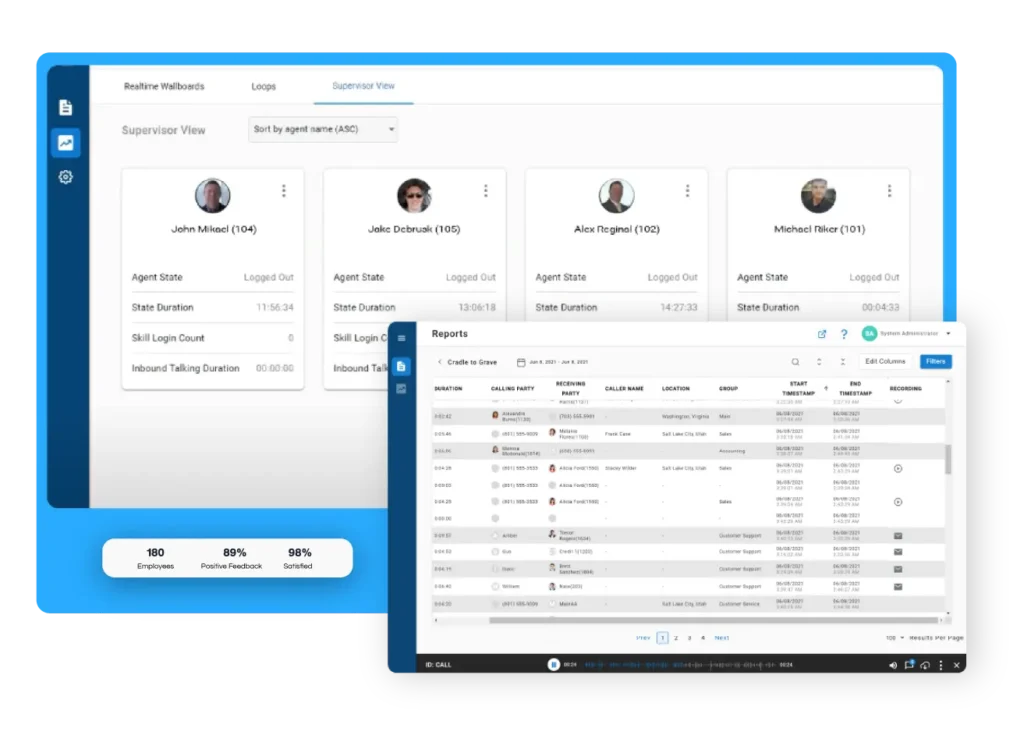
Xima’s cloud contact center software is the destination platform in a migration.
The goal is straightforward: gain access to features like skills-based routing, omnichannel support, and real-time dashboards without maintaining expensive hardware. But the path from legacy systems to cloud deployment involves more than flipping a switch.
Migration includes moving call routing logic, IVR configurations, agent permissions, historical data, and integrations with CRMs or EHR systems. Each component carries its own risk if not handled carefully.
Why Do Cloud Migrations Fail?
Most cloud contact center migrations don’t fail because the technology breaks. They fail because the planning didn’t account for operational reality.
Here’s what actually happens: teams underestimate how long data migration takes. They discover mid-cutover that a critical CRM integration wasn’t tested. Supervisors lose access to historical reports they need for compliance. Agents can’t find customer records because field mappings were incomplete.
The result is downtime—not the dramatic, system-down kind, but the slow bleed of agents fumbling through workarounds while customers wait on hold.
Teams that need to keep call processing on site can compare Xima’s on-premises contact center. Teams that need to keep call processing on site can compare Xima’s on-premises contact center.
What Are the Main Risks of Cloud Contact Center Migration?
Service Downtime During Cutover
The cutover moment—when you switch from old to new—is the highest-risk window. If routing rules aren’t configured correctly, calls go nowhere. If DNS propagation is slow, some customers reach the old system while others hit the new one.
A study from AT&T Business notes that proper planning around migration timing is critical to realizing the operational benefits of cloud platforms. Rushed cutovers create gaps that take days to diagnose.
Integration Failures with CRM and EHR Systems
Your cloud contact center doesn’t operate in isolation. It needs to talk to your CRM, your ticketing system, your electronic health records, and possibly dozens of other applications.
Each integration is a potential failure point. If call data doesn’t sync to Salesforce, agents lose context. If patient records don’t surface in healthcare environments, compliance gaps emerge. Xima Software addresses this with native, bi-directional CRM integrations that connect without third-party middleware—reducing the number of handoffs that can break during migration.
Data Loss or Corruption
Historical call recordings, agent performance data, and compliance records represent months or years of operational intelligence. Migrating this data incorrectly can mean losing access to information required for audits or quality assurance.
The risk isn’t just deletion. It’s corruption—timestamps that don’t align, call transcripts attached to the wrong accounts, or reporting gaps where data existed in the old system but didn’t map cleanly to the new one.
Agent Productivity Drops
Even a successful technical migration can tank productivity if agents aren’t ready. New interfaces, different workflows, and unfamiliar dashboards slow response times. Hold times increase. Handle times stretch. Customer satisfaction drops.
This is the hidden cost that doesn’t show up in the project plan but shows up in your service level metrics for weeks after go-live.
How Can You Reduce Migration Risk?
Start with a Phased Rollout
Don’t move everything at once. A phased rollout lets you migrate one team, one queue, or one channel before committing the entire operation. You’ll catch configuration issues at smaller scale and build institutional knowledge before the full cutover.
Xima Software supports this approach with flexible deployment options—you can run cloud and on-premises systems simultaneously during transition, giving supervisors time to validate that reporting and integrations work as expected.
Test Integrations Before Cutover
Every integration needs to be tested with real data, not just a sandbox confirmation that the API responds. Run calls through your test environment. Pull reports. Confirm that agent screens populate correctly.
Build a checklist of every system your contact center touches—CRM, workforce management, quality assurance tools, compliance recording—and verify each one independently before scheduling the production cutover.
Map Your Data Migration Carefully
Document every field that needs to move: call recordings, agent metrics, customer interaction history, IVR configurations, and routing rules. Create a mapping document that shows source fields, destination fields, and any transformations required.
Run test migrations and spot-check the results. Verify that a call recorded on the old system can be retrieved and played on the new one. Confirm that historical dashboards still display accurate numbers.
Define Rollback Triggers
Before you go live, establish clear criteria for when you’ll roll back to the old system. What call abandonment rate triggers a rollback? How many failed integrations? What’s the maximum acceptable downtime?
Having these triggers documented in advance removes emotion from the decision. If the cutover hits a defined threshold, you roll back—no debate, no heroics.
How Long Does Cloud Contact Center Migration Take?
Timeline depends on complexity. A straightforward migration for a 20-agent contact center with basic CRM integration might take 4-8 weeks from planning to go-live. Larger operations with multiple queues, complex IVRs, and custom integrations can require 3-6 months.
The planning phase often takes longer than the technical work. Rushing through requirements gathering creates downstream problems that extend the overall timeline.
Xima Software’s implementation team supports fast onboarding—many customers complete deployment in weeks, not months—because the platform is designed to integrate with existing phone systems without requiring you to change numbers or hardware.
What Should You Ask Your Vendor Before Migration?
Use these questions in every evaluation. If a vendor pivots away from direct answers, that tells you something about their migration experience.
- How do you handle data migration for historical call recordings and compliance records?
- Can you demonstrate the CRM integration with our specific platform, not just a generic demo?
- What’s your typical downtime window during cutover, and how do you minimize it?
- Do you support parallel operation of old and new systems during transition?
- What rollback options exist if we encounter critical issues post-launch?
These questions separate vendors who’ve done migrations from vendors who talk about migrations.
In Conclusion: Plan Your Cloud Migration Before You Execute It
Cloud contact center migration carries real risk—but it’s risk you can manage with the right preparation. Phased rollouts, integration testing, careful data mapping, and defined rollback triggers protect your operation from the downtime and disruption that derail too many projects.
The question isn’t whether cloud contact center migration is worth pursuing. The question is whether you’re willing to invest the planning time to do it right—or discover the gaps when customers are already on hold.
Xima Software gives contact center managers enterprise-grade capabilities with a migration path designed for operational reality. Cloud or on-premises, you control the timeline. Ready to see what a smooth transition looks like? Request a demo and talk through your specific migration scenario.
FAQs About Cloud Contact Center Migration Risks
What causes downtime during cloud contact center migration?
Downtime typically results from routing misconfigurations, incomplete integration testing, or DNS propagation delays during cutover. Phased rollouts and pre-production testing reduce these risks significantly.
How do I protect historical call data during migration?
Create detailed field mappings between source and destination systems. Run test migrations and verify recordings, timestamps, and associated metadata transfer correctly. Xima Software preserves cradle-to-grave reporting data throughout the migration process.
Can I run my old and new contact center systems at the same time?
Yes. Parallel operation during transition is a recommended practice. Xima Software supports both cloud and on-premises deployment simultaneously, letting you validate the new environment before full cutover.
How long does a typical cloud contact center migration take?
Simple deployments take 4-8 weeks. Complex environments with custom integrations may require 3-6 months. Xima Software’s efficient implementation process helps many customers go live faster than traditional enterprise platforms.
What integrations should I test before going live?
Test every system your contact center touches: CRM, workforce management, quality assurance, compliance recording, and ticketing. Xima Software offers native integrations with popular CRMs and over 70 EHRs, reducing the integration complexity that causes migration failures.