
The reality is that effective coaching is no longer just a management skill—it’s a critical driver of contact center performance. Today’s highest-performing call centers use structured coaching programs to create more confident agents, improve customer interactions, and build long-term operational consistency. Rather than relying on occasional call reviews or generalized feedback, successful managers use data-driven coaching strategies that continuously support agent growth and accountability.
This guide serves as a practical playbook for call center managers looking to build a more effective coaching framework. We’ll cover the fundamentals of call center coaching, common challenges that prevent coaching programs from succeeding, key performance metrics to monitor, and actionable strategies for delivering more impactful feedback. You’ll also learn how AI-powered coaching and performance management tools can help managers scale coaching efforts, identify trends faster, and create more personalized development opportunities across their teams.
Key Takeaways
- Call center coaching is an ongoing performance development process focused on improving real customer interactions, while onboarding and classroom training are designed to teach foundational knowledge and procedures.
- Supervisors should use a mix of real-time coaching, one-on-one feedback sessions, peer coaching, and performance-based coaching depending on agent experience levels, skill gaps, and customer interaction trends.
- Managers can strengthen coaching programs immediately by using performance analytics, reviewing more customer interactions, tracking KPIs consistently, and delivering targeted, data-driven feedback tied to measurable outcomes.
What Is Call Center Coaching?
Call center coaching is the ongoing process of improving agent performance through individualized feedback, performance analysis, and guided development based on real customer interactions. Unlike one-time onboarding or classroom training, coaching is continuous, performance-based, and tailored to each agent’s strengths, challenges, and goals.
While coaching and quality assurance (QA) often work together, they serve different purposes. QA monitoring identifies what happened during a customer interaction by scoring calls against predefined standards, while coaching focuses on helping agents improve those behaviors over time. Coaching uses real calls, recordings, metrics, and performance trends to create actionable development opportunities that improve communication, efficiency, compliance, and customer experience.
As contact centers grow and customer interactions become more complex, structured coaching becomes increasingly important. Managers need better visibility into performance trends across larger teams and multiple communication channels. Consistent coaching supported by analytics, reporting, and call monitoring tools helps supervisors deliver more objective feedback, improve operational consistency, and support long-term performance improvement at scale.
Benefits of a Structured Call Center Coaching Program
A structured call center coaching program delivers measurable operational and financial benefits that extend far beyond individual agent performance. When coaching becomes a consistent part of contact center operations, organizations gain greater visibility into performance trends, improve workforce engagement, and create a more reliable customer experience across every interaction. For managers seeking executive buy-in, coaching is not simply a developmental initiative—it is a direct contributor to efficiency, retention, compliance, and long-term business performance.
Reduced Agent Turnover
High agent turnover remains one of the most expensive challenges in contact center operations. Frequent hiring, onboarding, and retraining cycles place strain on managers while reducing overall team productivity. Structured coaching helps address this issue by giving agents consistent support, clear expectations, and visible opportunities for professional growth.
When employees receive regular feedback and feel invested in, they are more likely to remain engaged and motivated in their roles. Coaching also helps supervisors identify burnout risks, skill gaps, and performance frustrations earlier before they lead to disengagement or attrition. Over time, this creates a stronger workplace culture centered around accountability, communication, and continuous development.
Improved Key Performance Indicators
One of the most significant advantages of structured coaching is its direct impact on core contact center metrics. Targeted feedback based on real customer interactions allows managers to address specific behaviors that influence operational performance.
For example, coaching agents on active listening, issue resolution, and workflow efficiency can improve First Call Resolution (FCR) rates while reducing Average Handle Time (AHT). Likewise, reinforcing communication skills, empathy, and consistency can positively influence Customer Satisfaction (CSAT) scores. Since coaching focuses on measurable behaviors tied to business outcomes, managers can track progress more effectively and adjust strategies using performance data instead of assumptions.
Many organizations also strengthen these efforts by combining coaching programs with dedicated quality management platforms that centralize call evaluations, analytics, and reporting. Learn more about how structured quality management supports contact center performance here: Xima Quality Management
Types of Call Center Coaching and When to Use Each
Different coaching situations require different approaches. The most effective contact centers combine multiple coaching styles to address performance gaps, support agent development, and maintain operational consistency at scale. Understanding when to use each coaching type helps supervisors create more targeted and effective development strategies while balancing team size, call complexity, and available technology.
Real-Time Coaching
Real-time coaching provides agents with live guidance during active customer interactions. This often includes whisper coaching, where supervisors can speak directly to agents without the customer hearing the conversation, or real-time prompts delivered through integrated systems.
This approach is especially valuable during high-risk or high-complexity interactions, such as escalations, compliance-sensitive conversations, or onboarding periods for new agents. Real-time support allows supervisors to correct issues immediately, reinforce best practices in the moment, and help agents navigate difficult situations without interrupting the customer experience.
Post-Call Coaching
Post-call coaching focuses on reviewing completed customer interactions using call recordings, QA evaluations, transcripts, and performance analytics. Supervisors and agents analyze specific conversations together to identify strengths, opportunities for improvement, and recurring patterns.
Post-call coaching works particularly well for improving communication techniques, compliance adherence, workflow accuracy, and problem-solving skills. Because discussions are based on real interactions instead of hypothetical scenarios, agents often gain clearer context around how their behaviors affect customer outcomes and operational metrics.
One-on-One Coaching
One-on-one coaching sessions provide individualized development opportunities tailored to each agent’s performance trends, goals, and challenges. These meetings typically involve reviewing KPIs, discussing recent customer interactions, setting improvement targets, and creating action plans.
This format is most effective when managers need to address specific behavioral patterns, support career development, or build stronger accountability with individual team members. One-on-one coaching also creates space for more personalized conversations around motivation, confidence, and long-term growth.
Group Coaching
Group coaching allows supervisors to address shared challenges or recurring trends across multiple agents at once. These sessions often focus on topics such as handling objections, improving soft skills, navigating new workflows, or reinforcing compliance updates.
This approach is useful for scaling coaching efforts efficiently while promoting team-wide consistency. Group sessions also encourage collaborative learning by allowing agents to hear different perspectives, discuss common challenges, and share successful strategies with one another.
Peer-to-Peer Coaching
Peer-to-peer coaching encourages agents to learn directly from colleagues through collaboration, mentorship, and shared feedback. High-performing agents may review calls with peers, demonstrate successful communication techniques, or provide practical guidance based on firsthand experience.
Peer coaching can be particularly effective for improving team culture, increasing engagement, and accelerating knowledge sharing across departments. Many contact centers use this approach alongside formal supervisor coaching to create a more collaborative and supportive learning environment.
Automated and AI-Assisted Coaching
Automated coaching uses analytics, conversation intelligence, and AI-driven insights to identify coaching opportunities at scale. Instead of relying solely on manual call reviews, automated systems can analyze large volumes of interactions, surface performance trends, flag compliance risks, and recommend targeted coaching actions.
This approach is especially valuable for larger operations where supervisors may struggle to review enough interactions manually. AI-assisted coaching improves consistency, reduces subjectivity, and helps managers prioritize the agents or behaviors that require immediate attention. Rather than replacing human coaching, automation strengthens it by giving supervisors better visibility into performance data and actionable insights.
Choosing the Right Coaching Mix
No single coaching method works for every contact center. The most effective coaching programs combine multiple approaches based on operational goals, team maturity, staffing levels, and available technology. Smaller teams may rely more heavily on one-on-one coaching, while larger operations often benefit from blending group sessions, AI-assisted analytics, and post-call reviews to maintain consistency at scale.
As contact centers become more data-driven, supervisors increasingly use analytics, recording tools, and AI-powered insights to support more proactive coaching strategies. Combining human expertise with operational visibility allows managers to deliver coaching that is both scalable and highly personalized.
Call Center Coaching Best Practices You Can Implement Now
Building a more effective coaching program does not require a complete operational overhaul. Many contact centers can significantly improve coaching outcomes by creating more structure, consistency, and accountability around existing processes. The most successful coaching programs rely on real interaction data, measurable goals, and ongoing follow-through rather than occasional feedback conversations or generalized advice.
- Establish a consistent coaching cadence tied to your QA program and performance reviews. Regular coaching sessions help supervisors address issues proactively instead of reacting only when metrics decline. Whether meetings occur weekly, biweekly, or monthly, consistency creates stronger accountability and clearer expectations for agents.
- Define clear coaching goals using measurable KPIs and quality standards. Supervisors should align coaching objectives with metrics such as First Call Resolution (FCR), Customer Satisfaction (CSAT), Average Handle Time (AHT), adherence scores, or compliance benchmarks. Shared goals make coaching conversations more objective and easier to track over time.
- Use real interactions, recordings, and call monitoring data to support feedback discussions. Agents respond more effectively when coaching is tied directly to actual customer conversations instead of hypothetical examples. Reviewing recordings and dashboards together also improves transparency while reducing subjectivity in evaluations.
- Deliver balanced, specific feedback that reinforces both strengths and improvement opportunities. Effective coaching should recognize positive behaviors while clearly explaining what needs adjustment and why it matters. Specific examples tied to customer outcomes or operational metrics help agents better understand the impact of their performance.
- Document coaching conversations, action plans, and follow-up milestones consistently. Tracking progress over time helps supervisors measure improvement, identify recurring trends, and maintain accountability across the team. Documentation also creates valuable performance records that support long-term development planning.
- Incorporate role-playing exercises and knowledge-sharing sessions between formal coaching meetings. Practicing difficult customer scenarios, escalation handling, or compliance workflows allows agents to reinforce skills in a lower-pressure environment before applying them during live interactions.
- Leverage AI-powered tools and reporting platforms to improve coaching visibility and consistency. Analytics solutions can help supervisors identify performance patterns faster, surface coaching opportunities automatically, and reduce the limitations of manually reviewing only a small percentage of calls.
- Align coaching efforts with broader workforce management (WFM) strategies. Scheduling, staffing levels, and operational forecasting all influence agent performance and burnout risk. Integrating coaching insights with workforce planning creates a more balanced and sustainable approach to performance management.
Building a Scalable Coaching Program with Real-Time Analytics
As contact centers grow, supervisors need better visibility into performance trends and coaching priorities. A scalable coaching program combines real-time monitoring, historical reporting, and QA data to help managers identify who needs coaching, what behaviors need improvement, and how urgently action is required.
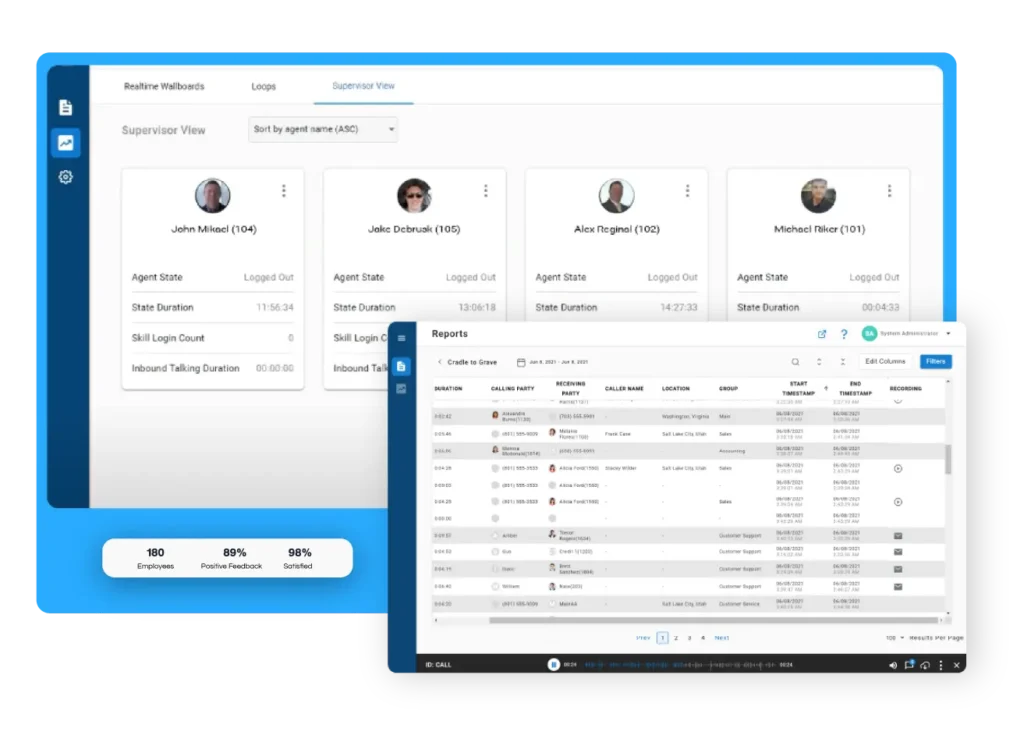
Real-time dashboards, alerts, and live monitoring tools help supervisors spot coaching opportunities as they happen. Managers can quickly identify issues like rising call times, missed compliance steps, or repeated escalations and intervene before performance declines further. Tools such as Real-Time Wallboards help provide immediate operational visibility across teams.
Historical reports, QA evaluations, and call recordings also help managers identify recurring performance trends and segment agents based on coaching needs. Instead of using a one-size-fits-all approach, supervisors can deliver more targeted coaching supported by measurable data. Learn more about these capabilities here: Reporting and Analytics and Reports Features
Many contact centers also struggle with fragmented data across systems like Cisco, Mitel, and Avaya. Platforms like Xima Software help centralize reporting, recordings, and performance insights into a single coaching view without heavy IT complexity.
To maintain consistency, organizations should standardize scorecards, evaluation forms, and coaching templates across teams. Combined with proper documentation, governance policies, and call recording tools, this creates a more consistent and audit-ready coaching process. Explore Xima’s recording capabilities here: Live Agent Call Recording
Optimizing Agent Performance with Xima Software
Modern coaching programs depend on accurate, centralized performance data. Without unified visibility across calls, reports, and customer interactions, supervisors often struggle to coach consistently or identify issues early enough to improve outcomes.
Xima Software helps contact centers streamline coaching with real-time analytics, live wallboards, call recording, and centralized reporting tools. These capabilities give managers the visibility needed to monitor KPIs, identify coaching opportunities faster, and deliver more objective feedback based on real interactions.
By combining CCaaS capabilities with reporting and quality management tools, Xima supports a more scalable, data-driven approach to agent development and performance optimization.
Ready to improve coaching workflows and gain better visibility into team performance? Schedule a demo to explore how Xima can support your contact center operations: Get a Demo
Call Center Coaching FAQs
Most contact centers benefit from weekly or biweekly coaching sessions combined with ongoing feedback tied to QA reviews and performance trends.
Key coaching KPIs typically include First Call Resolution (FCR), Customer Satisfaction (CSAT), Average Handle Time (AHT), QA scores, compliance rates, and agent adherence.
Managers can use analytics, QA scorecards, call recordings, AI-powered insights, and performance dashboards to identify trends and prioritize high-impact coaching opportunities.
QA identifies performance issues by evaluating customer interactions, while coaching focuses on helping agents improve behaviors and performance over time.
Large contact centers often benefit from combining post-call reviews, group coaching, and AI-assisted coaching to maintain consistency and scale coaching efforts efficiently.
Real-time coaching allows supervisors to guide agents during live interactions, helping resolve issues immediately and improving customer experience during high-risk or complex calls.