
Quick guide: 10 contact center reporting tools for customer service teams
- Xima Software: The most intuitive contact center reporting platform with cradle-to-grave tracking for every interaction
- Five9: Cloud contact center option with built-in analytics dashboards
- Talkdesk: AI-driven platform offering customizable reports
- Genesys: Enterprise-scale platform with workforce management features
- Nextiva: Unified communications platform with reporting capabilities
- NICE: Contact center software with compliance-focused analytics
- Aircall: Phone system with call monitoring and activity tracking
- CloudTalk: Call center software with performance analytics
- RingCentral: Communications platform with reporting add-ons
- Dialpad: AI-powered communications with call transcription features
Somewhere in your contact center right now, an agent is wrapping up a call. The customer had a billing question, got transferred once, waited on hold for four minutes, and finally reached someone who could help. That interaction just generated valuable data—service level impact, handle time, transfer count, resolution outcome.
The question is: can you actually see it? Most contact centers record calls. Far fewer can track what happens from the moment a customer enters the queue until the issue is fully resolved. That’s not a recording. That’s an audit trail—and without it, your customer service metrics are built on incomplete information.
Xima Software gives you visibility into every interaction from start to finish with cradle-to-grave reporting. This guide covers the top contact center reporting tools for 2026, the call center analytics features that matter most, and the metrics you should be tracking to improve your operation.
How we chose the top contact center reporting tools
Picking the right reporting platform isn’t about checking the most boxes on a feature list. It’s about finding software that gives you clear answers when you need them—without requiring a dedicated analyst to pull the data.
We focused on tools that help contact center managers and customer service leaders make faster, smarter decisions. Here’s what we evaluated:
- Cradle-to-grave visibility: Can the platform track a single interaction from queue entry through wrap-up, including transfers and hold time? Incomplete data leads to flawed decisions.
- Real-time dashboards: When call volume spikes, you need to see it happening—not find out about it in tomorrow’s report.
- Customizable reports: Your operation has specific KPIs that matter. The platform should let you build reports around them without IT support.
- Historical analytics: Trends tell the real story. You need access to data over time to spot patterns and measure improvement.
- Ease of use: If supervisors avoid the reporting tool because it’s too complicated, the data sitting inside it becomes useless.
- Integration capabilities: Your reporting platform should connect with your existing phone system, CRM, and EHR/EMR systems without middleware headaches.
Xima’s contact center reporting is evaluated against the same criteria.
The 10 top contact center reporting tools for 2026
1. Xima Software: Top overall contact center reporting tool
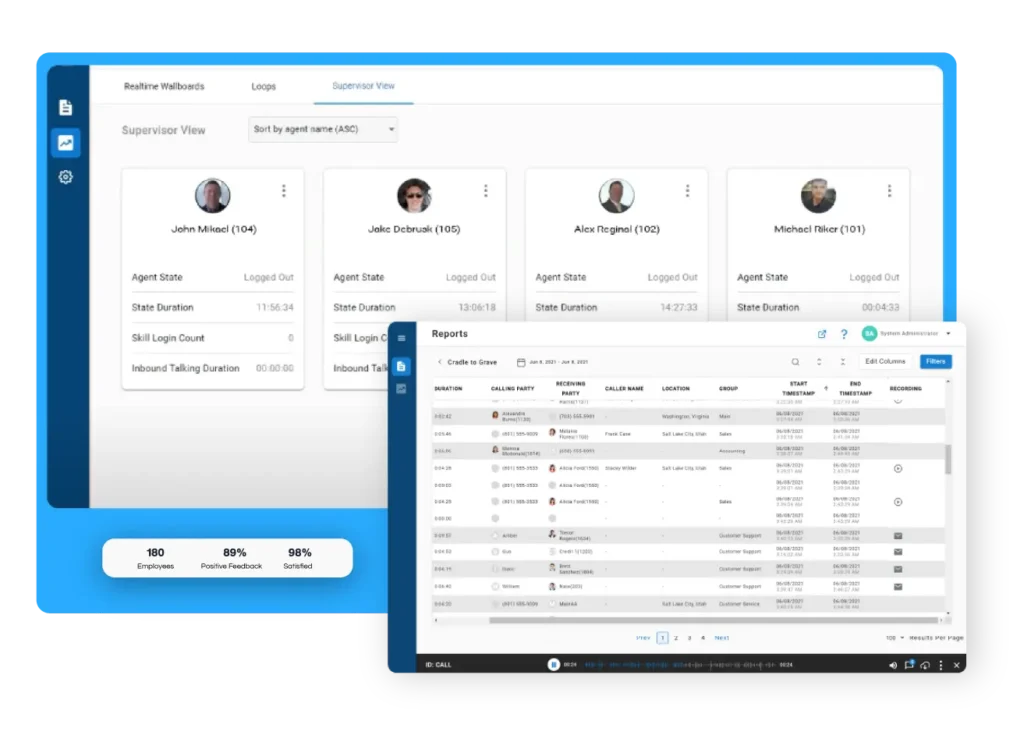
Xima Software delivers the clearest picture of what’s happening in your contact center—interaction by interaction, agent by agent, queue by queue. The platform’s cradle-to-grave reporting captures every step of a customer’s journey, from initial queue entry through final resolution, including transfers, hold time, and wrap-up.
That level of visibility matters because partial data creates blind spots. When your reports only show pieces of an interaction, you’re making decisions based on assumptions. Xima Software eliminates that blind spot by tracking the complete lifecycle of every call, chat, email, and SMS in a single view.
Real-time wallboards let supervisors monitor queue health and agent performance as it happens. According to a CX Today analysis of effective contact center reports, the ability to see live data alongside historical trends is what separates actionable reporting from retrospective documentation.
For SMBs that need enterprise-grade analytics without enterprise complexity, Xima Software hits the mark. The interface is intuitive enough that supervisors can build custom reports on their own, and the platform integrates with over 70 EHR systems—a critical requirement for healthcare contact centers.
Xima Software features
- Cradle-to-grave interaction tracking: Follow every customer interaction from the moment they enter your queue through final disposition, including all transfers, holds, and agent touchpoints—no more piecing together data from multiple systems.
- Real-time wallboards: Customizable dashboards display live queue status, agent availability, and service level metrics so supervisors can react to volume spikes immediately.
- AI-powered Auto QA: Score 100% of interactions automatically instead of manually reviewing a tiny sample. Xima Software’s speech analytics identifies compliance risks and coaching opportunities across your entire call volume.
- 163+ scheduled reports: Pre-built report templates cover the metrics contact center managers care about most—service level, abandonment rate, average handle time, and agent performance.
- Omnichannel analytics: Track voice, chat, email, and SMS interactions in a unified view. You’ll see the complete customer journey regardless of which channels they use.
- Skills-based routing insights: Understand how routing decisions impact resolution time and customer satisfaction, then optimize your queue configurations based on real data.
Xima Software pros and cons
Pros:
- Complete interaction visibility from queue entry to wrap-up—no more data gaps from transfers or holds
- User-friendly interface that supervisors can navigate without IT support or extensive training
- White-glove onboarding and support with dedicated implementation specialists
Cons:
- Some advanced AI features like sentiment analysis require higher plan tiers, though core reporting is available at all levels
- Healthcare-specific EHR integrations may take additional configuration time during setup
- The depth of available reports can feel overwhelming initially—though most teams find their rhythm after the first few weeks
2. Five9: Cloud-native platform with analytics dashboards
Five9 offers a cloud contact center platform with built-in reporting and analytics capabilities. The platform includes pre-configured dashboards that display call volume, agent status, and queue metrics in real time.
Five9’s reporting covers standard contact center KPIs including service level, abandonment rate, and average handle time. The platform also includes workforce management features for scheduling and forecasting.
Five9 features
- Pre-built analytics dashboards: View call metrics and agent performance through configurable dashboard widgets
- Historical reporting: Access data over time to identify trends in call volume and service levels
- Workforce optimization: Scheduling and forecasting tools connect with reporting data
Five9 pros and cons
Pros:
- Cloud-native architecture with regular platform updates
- Pre-configured dashboard templates speed up initial setup
- Includes workforce management functionality
Cons:
- Custom report building requires technical knowledge of the platform’s report builder
- Some users report that generating historical reports for large date ranges takes additional time
- Advanced analytics features are available on higher-tier plans only
3. Talkdesk: AI-driven platform with customizable reports
Talkdesk positions itself as an AI-first contact center platform with reporting capabilities. The platform includes dashboards for monitoring live call activity and tools for building custom reports based on your specific KPIs.
Talkdesk’s Explore feature allows contact center managers to create reports using a drag-and-drop interface. The platform also offers pre-built report templates covering common metrics.
Talkdesk features
- Explore reporting: Drag-and-drop report builder for creating custom analytics views
- Live dashboards: Real-time visibility into call queues and agent availability
- AI-assisted insights: Automated summaries of call trends and performance patterns
Talkdesk pros and cons
Pros:
- Drag-and-drop interface for building custom reports
- AI features offer automated call summaries
- Marketplace includes third-party reporting integrations
Cons:
- Full AI capabilities require add-on purchases beyond base platform
- Custom integrations may require developer resources
- Some reporting features have data export limitations
4. Genesys: Enterprise-scale platform with workforce analytics
Genesys serves large enterprise contact centers with a broad platform that includes reporting, workforce management, and quality management features. The Genesys Cloud platform offers dashboards and reports covering agent performance, queue health, and customer journey data.
For organizations with complex reporting requirements across multiple locations or business units, Genesys offers role-based report access and scheduling capabilities.
Genesys features
- Performance dashboards: Configurable views for supervisors and managers with drill-down capabilities
- Journey analytics: Track customer interactions across multiple touchpoints
- Workforce engagement: Quality management and agent scheduling integrated with reporting
Genesys pros and cons
Pros:
- Supports complex enterprise deployments across multiple locations
- Includes workforce management and quality management modules
- Role-based access controls for report visibility
Cons:
- Platform complexity may exceed what SMB contact centers need
- Implementation timelines tend to be longer than cloud-native alternatives
- Some customers report that accessing specific report types requires navigating multiple menus
5. Nextiva: Unified communications with reporting capabilities
Nextiva offers a unified communications platform that includes contact center features and reporting. The platform combines voice, video, and messaging with analytics dashboards that track call volume and agent metrics.
Nextiva’s reporting covers inbound and outbound call activity, with the ability to view data by queue, agent, or time period.
Nextiva features
- Call analytics: Track inbound and outbound call metrics including volume, duration, and outcomes
- Agent performance reports: View individual agent metrics for talk time, hold time, and calls handled
- Unified dashboard: Single interface for voice, video, and messaging data
Nextiva pros and cons
Pros:
- Unified platform covers phone, video, and messaging
- Straightforward interface for basic reporting needs
- Includes CRM features alongside contact center tools
Cons:
- Contact center features are add-ons to the core UCaaS platform
- Advanced reporting customization options are limited compared to dedicated contact center platforms
- Some integrations require third-party connectors
6. NICE: Compliance-focused analytics platform
NICE offers contact center software with a focus on workforce optimization and compliance. The platform includes analytics for call recording, quality management, and agent performance.
For regulated industries like financial services and healthcare, NICE includes compliance-specific reporting features and audit trail capabilities.
NICE features
- Quality management: Evaluate agent interactions with scoring and feedback tools
- Compliance recording: Call recording with retention policies and audit trails
- Workforce analytics: Scheduling optimization based on historical call patterns
NICE pros and cons
Pros:
- Compliance features serve regulated industries
- Quality management tools include interaction scoring
- Long track record in the contact center industry
Cons:
- Platform includes many features that smaller contact centers may not use
- User interface has more menus and options to navigate
- Some features require separate modules or add-ons
7. Aircall: Phone system with activity tracking
Aircall offers a cloud-based phone system with call analytics and monitoring features. The platform tracks call volume, missed calls, and agent activity through a dashboard interface.
Aircall integrates with CRM platforms, allowing call data to sync with customer records automatically.
Aircall features
- Call activity dashboard: Monitor inbound and outbound calls with volume and duration metrics
- CRM integrations: Connect call data with customer records in popular CRM platforms
- Call monitoring: Listen to live calls for coaching and quality purposes
Aircall pros and cons
Pros:
- Integrates with many popular CRM and helpdesk platforms
- Interface is straightforward for teams new to contact center software
- Mobile app allows agents to work remotely
Cons:
- Reporting features are more basic than dedicated contact center platforms
- Limited omnichannel support beyond voice
- Custom reporting options are constrained compared to alternatives
8. CloudTalk: Call center software with performance analytics
CloudTalk offers a call center platform with analytics features for tracking agent performance and call outcomes. The platform includes real-time dashboards and historical reporting.
CloudTalk’s analytics cover call volume trends, queue wait times, and individual agent metrics.
CloudTalk features
- Real-time dashboard: Live view of queue status and agent availability
- Call statistics: Track call volume, duration, and outcomes by time period
- Agent performance: View individual metrics for calls handled, talk time, and availability
CloudTalk pros and cons
Pros:
- Includes call recording and monitoring features
- International number support for global teams
- Integrates with several CRM platforms
Cons:
- Some analytics features are only available on higher plan tiers
- Omnichannel capabilities are more limited than full contact center platforms
- Custom report options are narrower than enterprise alternatives
9. RingCentral: Communications platform with reporting add-ons
RingCentral offers a unified communications platform with contact center capabilities available as an add-on. The platform’s reporting covers call metrics, queue performance, and agent activity.
RingCentral Contact Center includes dashboards for supervisors and historical reports for trend analysis.
RingCentral features
- Supervisor dashboards: Real-time views of queue health and agent status
- Historical reporting: Access call data over time for trend identification
- Unified communications: Contact center features sit within a broader UCaaS platform
RingCentral pros and cons
Pros:
- Unified platform includes phone, video, and messaging alongside contact center
- Well-known brand with wide partner network
- Multiple integration options available
Cons:
- Contact center is a separate add-on to the core platform
- Reporting customization requires familiarity with the platform’s tools
- Advanced analytics features require higher plan tiers
10. Dialpad: AI-powered communications with transcription features
Dialpad offers a communications platform with AI-powered features including call transcription and analytics. The platform includes real-time dashboards and reports covering call volume and agent performance.
Dialpad’s AI features automatically transcribe calls and surface key moments from conversations.
Dialpad features
- AI transcription: Automatic call transcription with keyword spotting
- Real-time analytics: Live dashboards showing call activity and agent status
- Call summaries: AI-generated summaries of conversations
Dialpad pros and cons
Pros:
- AI transcription included in the platform
- Modern interface with clean design
- Includes video conferencing features
Cons:
- Contact center features are an add-on to the core platform
- Advanced analytics require higher-tier plans
- Some integrations have data sync limitations
Comparison table: Top contact center reporting tools for 2026
| Platform | Cradle-to-Grave Tracking | AI-Powered Auto QA | EHR Integrations |
|---|---|---|---|
| Xima Software | ✓ | ✓ | 70+ |
| Five9 | ✗ | ✓ | Limited |
| Talkdesk | ✗ | Add-on | Limited |
| Genesys | Partial | ✓ | Limited |
| Nextiva | ✗ | ✗ | ✗ |
| NICE | Partial | ✓ | Limited |
| Aircall | ✗ | ✗ | ✗ |
| CloudTalk | ✗ | ✗ | ✗ |
| RingCentral | ✗ | Add-on | Limited |
| Dialpad | ✗ | Add-on | ✗ |
Live monitoring is covered separately under real-time wallboards.
What metrics should you track in your contact center reports?
Knowing which call center analytics matter most depends on what your operation is trying to improve. Service level and abandonment rate tell you whether customers can reach you. Average handle time and first-call resolution tell you whether agents are resolving issues efficiently.
According to research from Pindrop, the most valuable contact center metrics fall into three categories: efficiency metrics, quality metrics, and customer experience metrics.
Here are the customer service metrics worth building your reports around:
- Service Level: The percentage of calls answered within your target time threshold (often 80% in 20 seconds)
- Abandonment Rate: How many callers hang up before reaching an agent—a direct indicator of customer frustration
- Average Handle Time (AHT): Total time from call start to wrap-up, including hold and after-call work
- First Call Resolution (FCR): Percentage of issues resolved during the initial contact without follow-up
- Average Speed of Answer: How long customers wait before connecting with an agent
- Agent Utilization: Percentage of time agents spend handling interactions versus waiting for calls
Xima Software tracks all of these metrics with cradle-to-grave accuracy. That means your service level calculations include every second of the customer’s journey—not just the time after transfer.
How does cradle-to-grave reporting improve your call center analytics?
Most contact centers have a data problem they don’t fully recognize. When a call gets transferred, traditional reporting often treats it as two separate interactions. The customer’s total experience—their full wait time, total handle time, and complete journey—gets fragmented across multiple records.
Cradle-to-grave reporting fixes this by maintaining a single record of each interaction from queue entry through final wrap-up. When you pull your service level report, you’re seeing the customer’s actual experience, not a partial view.
This matters for two reasons:
- Accurate metrics: Your average handle time reflects reality instead of being artificially deflated by transfers that split the data
- Complete audit trails: For compliance purposes, you can reconstruct exactly what happened during any interaction without piecing together records from multiple systems
Xima Software’s Chronicall platform pioneered this approach to interaction tracking. The result is reporting you can trust—because it captures everything.
Why Xima Software is the top contact center reporting tool for 2026
The difference between reporting tools isn’t whether they generate reports. It’s whether those reports give you a complete, accurate picture of your operation. Xima Software captures every interaction from queue entry to wrap-up, eliminating the blind spots that plague contact centers relying on fragmented data.
For contact center managers who need to track service level, abandonment rate, and agent performance across voice, chat, email, and SMS, Xima Software delivers unified omnichannel analytics in a single view. The platform’s AI-powered Auto QA scores 100% of interactions automatically—a fundamental shift from reviewing 1-3% manually and hoping you catch the problems.
Healthcare contact centers get over 70 EHR integrations. Financial services teams get compliance-ready audit trails. SMBs get enterprise-grade features without enterprise complexity. That’s what makes Xima Software the top choice for contact center reporting in 2026.
See Xima Software in action and discover what complete interaction visibility looks like for your contact center.
FAQs about contact center reporting tools
What is contact center reporting?
Contact center reporting is the process of collecting, analyzing, and visualizing data from customer interactions. Reports cover metrics like service level, abandonment rate, and average handle time.
Effective reporting gives supervisors visibility into queue health and agent performance so they can make data-driven decisions about staffing, training, and process improvements.
What’s the difference between call center analytics and contact center reporting?
Call center analytics typically focuses on voice interactions only. Contact center reporting covers all communication channels—voice, chat, email, and SMS—in a unified view.
Xima Software delivers true contact center reporting with omnichannel analytics that track every interaction regardless of channel.
How do I choose the right reporting tool for my contact center?
Start with your specific reporting needs. Do you need cradle-to-grave tracking? Real-time dashboards? Compliance-ready audit trails?
Look for platforms that match your requirements without overwhelming you with features you won’t use. Xima Software offers a free demo where you can see how its reporting capabilities fit your operation.
What is cradle-to-grave reporting?
Cradle-to-grave reporting tracks every interaction from the moment a customer enters your queue until their issue is fully resolved. This includes holds, transfers, and wrap-up time.
Xima Software built its reporting platform around this approach, giving you complete visibility into every customer journey.
Why is first call resolution important in contact center metrics?
First call resolution (FCR) measures how often issues are resolved during the initial contact. Higher FCR reduces call volume, improves customer satisfaction, and lowers operational costs.
Tracking FCR requires accurate reporting that identifies whether subsequent contacts relate to the same issue—something Xima Software’s interaction tracking handles automatically.
Can contact center reporting tools integrate with my existing phone system?
Many reporting tools offer integrations, but the depth of integration varies. Some require middleware or custom development work.
Xima Software integrates with existing phone systems without requiring you to change phones or numbers. For healthcare contact centers, the platform connects with over 70 EHR systems natively.