
Key Takeaways: What Is a Cloud Contact Center for SMBs in 2026
- A cloud contact center is hosted software that centralizes voice, chat, email, and SMS conversations in one platform accessible from anywhere.
- Omnichannel support connects all customer touchpoints so your agents see the full conversation history—no channel silos or blind spots.
- Xima Software delivers enterprise-grade cloud contact center features sized specifically for SMB teams, including real-time dashboards and cradle-to-grave reporting.
- Cloud deployment removes the hardware burden from your IT team while improving scalability during demand spikes and unexpected disruptions.
- Real-time analytics and skills-based routing help you reduce wait times, improve first-contact resolution, and boost agent productivity.
Smaller teams can start with Xima’s contact center solutions for small businesses.
What Is a Cloud Contact Center?
A cloud contact center is customer service software hosted on remote servers rather than installed on equipment in your building. You access everything through the internet—call routing, agent dashboards, reporting, and recordings—without maintaining physical phone systems or servers.
For SMB contact center leaders, this means you can add agents, open new locations, or enable remote work without ripping out infrastructure. Your team logs in from a browser and starts handling calls, chats, and emails immediately.
That’s not just a convenience. It’s a structural shift in how smaller teams compete with larger operations.
How Does a Cloud Contact Center Differ from an On-Premise System?
On-premise systems require hardware in your building, IT staff to maintain them, and capital expenditure for upgrades. When call volume spikes, you’re limited by the capacity you already purchased.
Cloud contact centers flip that model. You pay for what you use, scale up during busy seasons, and scale back when things slow down. Upgrades happen automatically on the vendor’s end.
The operational reality for most SMBs: on-premise systems create fixed costs and maintenance burdens that pull supervisors away from coaching agents. Cloud systems free up that time and budget.
What Is Omnichannel Support and Why Does It Matter?
Omnichannel support connects every customer touchpoint—voice, chat, email, SMS, and social media—into a single view. When a customer emails in the morning and calls back that afternoon, your agent sees both interactions on one screen.
Here’s what changes: no more asking customers to repeat themselves. No more agents digging through separate systems to piece together a conversation history. The full interaction lifecycle shows up automatically.
For SMB teams running lean, this visibility eliminates the operational blind spots that lead to missed context, repeated questions, and frustrated customers.
The Cost of Channel Silos
When your phone system, chat tool, and email inbox don’t talk to each other, your agents spend time switching between screens and manually logging information. That’s time not spent helping customers.
Customers notice the disconnect too. According to research from Salesforce, most customers expect agents to have context from their previous interactions—regardless of which channel they used.
What Features Should SMBs Look for in Cloud Contact Center Software?
Not every cloud contact center is built for smaller teams. Here’s where to focus your evaluation:
Skills-Based Routing
Route calls to agents based on their expertise, not just availability. A billing question goes to someone trained on billing. A technical issue goes to technical support. First-contact resolution improves when the right agent handles the right call.
Queue Callback
Instead of holding customers hostage on hold, queue callback lets them request a return call when an agent becomes available. Wait times feel shorter even when your team is slammed.
Real-Time Dashboards and Wallboards
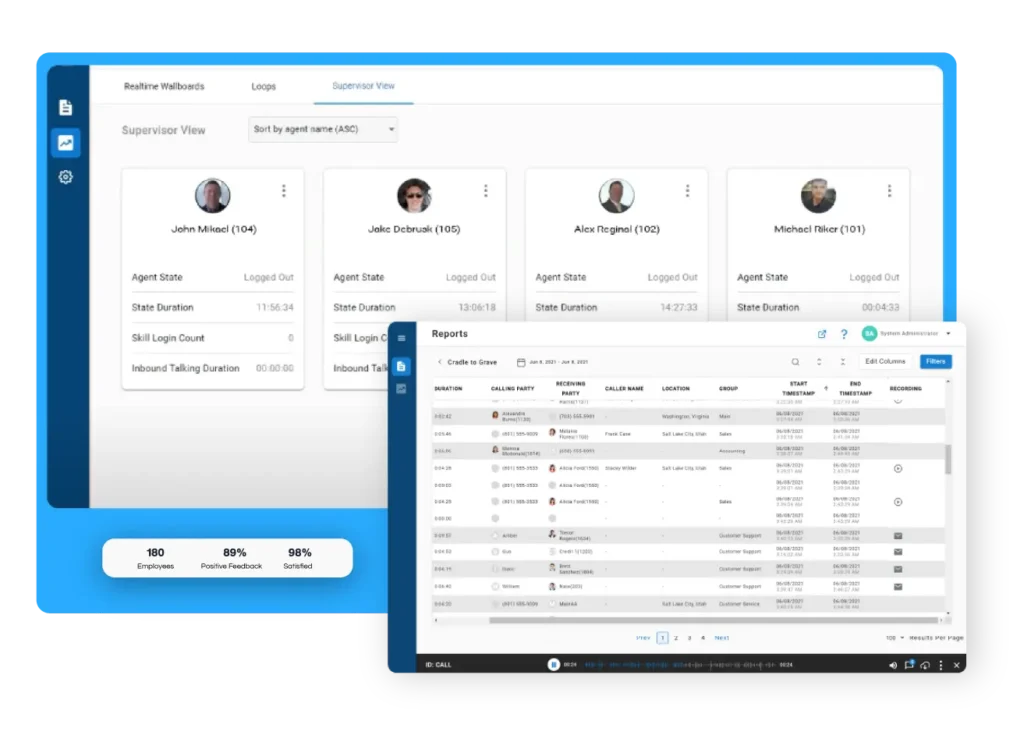
Supervisors need visibility into what’s happening right now—calls in queue, average handle time, agent availability. Xima Software’s real-time wallboards display these metrics instantly so you can make staffing decisions while the situation is still developing.
Cradle-to-Grave Reporting
Track every interaction from the moment it enters your queue until wrap-up. This complete audit trail eliminates the guesswork about what happened during a call and gives you data for coaching, compliance, and performance reviews.
CRM and EHR Integrations
Your contact center doesn’t operate in isolation. Native integrations with your CRM or—for healthcare teams—your EHR system mean agents see customer records without switching applications.
How Do Cloud Contact Centers Improve Visibility and Responsiveness?
Most SMB contact centers operate with blind spots. Supervisors review a small sample of calls, sometimes weeks after they happened. By then, the agent has handled hundreds more interactions, and any coaching feedback arrives too late to matter.
Cloud contact centers with AI-powered analytics change that timeline. Xima Software’s speech analytics and auto-QA capabilities score 100% of interactions—not just the random 1-5% selected for manual review. Patterns emerge faster. Problems get caught sooner.
Responsiveness improves when supervisors can see real-time sentiment analysis and intervene during a call that’s going sideways, not days later.
What Are the Benefits of Cloud Contact Centers for SMB Customer Service Teams?
Lower Barrier to Entry
You don’t need enterprise budgets to access enterprise-grade features. Cloud contact centers give SMBs real-time reporting, omnichannel support, and AI-powered tools that were previously available only to large organizations with dedicated IT departments.
Faster Onboarding
Without hardware to install, your timeline from contract to go-live shrinks dramatically. Some teams are up and running in days, not months.
Scalability Without Overbuying
Add agents when you need them. Remove them when you don’t. Cloud pricing models let you match capacity to demand instead of guessing at peak volume and buying fixed infrastructure.
Business Continuity
When your contact center lives in the cloud, a power outage at your office doesn’t shut down customer service. Agents can log in from home, a backup location, or anywhere with internet access.
How Does Xima Software Support SMB Contact Centers?
Xima Software builds cloud contact center solutions specifically for SMB operations—teams that need powerful features without enterprise complexity or enterprise price tags.
Xima CCaaS combines omnichannel support, AI-powered analytics, skills-based routing, queue callback, and real-time wallboards into a unified platform. You get cradle-to-grave reporting that captures every interaction, plus native integrations with popular CRMs and over 70 EHR systems for healthcare teams.
The onboarding experience is white-glove: hands-on support to get you running quickly, not a self-service portal and a knowledge base.
What Questions Should You Ask When Evaluating Cloud Contact Center Vendors?
Use these in every demo:
- Show me the complete lifecycle of a single interaction in one view, from queue entry to wrap-up. Not a summary—the actual data.
- How long does typical implementation take for a team my size?
- What integrations are native versus requiring third-party middleware?
- Can I add and remove agents month-to-month, or am I locked into annual seat commitments?
- How does your pricing work? What’s included versus billed separately?
If a vendor pivots away from any of these or redirects you to a different part of the demo, that’s your answer.
In Conclusion: Making Cloud Contact Centers Work for Your SMB Team
A cloud contact center centralizes your customer conversations, eliminates channel silos, and gives supervisors real-time visibility into what’s happening across your operation. For SMB teams, that means competing on customer experience without the cost and complexity of traditional enterprise systems.
The question isn’t whether cloud contact centers are right for small and mid-sized businesses. The question is how long you’re willing to operate without the visibility, responsiveness, and efficiency they deliver.
FAQs About Cloud Contact Centers for SMBs
What is a cloud contact center?
A cloud contact center is customer service software hosted remotely and accessed via the internet. You manage calls, chats, emails, and SMS from any location without maintaining on-site hardware.
Xima Software’s cloud contact center platform gives SMBs enterprise-grade features—real-time dashboards, omnichannel routing, and AI-powered analytics—without the infrastructure burden.
What is the difference between a cloud contact center and a call center?
A traditional call center handles voice calls only. A cloud contact center supports multiple channels—voice, chat, email, SMS, and social media—in one unified platform.
This omnichannel approach lets your agents see the full conversation history regardless of how customers reach you.
How does omnichannel support improve customer service?
Omnichannel support connects all your customer touchpoints so agents see every interaction in one view. Customers don’t repeat themselves. Agents don’t waste time hunting for context.
Xima Software unifies voice, chat, email, and SMS into a single agent interface with cradle-to-grave tracking.
Is a cloud contact center secure enough for regulated industries?
Cloud contact centers can meet strict compliance requirements when built with security in mind. Look for HIPAA compliance for healthcare, PCI DSS for payment handling, and SOC 2 certification.
Xima Software supports HIPAA and PCI compliance with governed AI, data encryption, and audit trails for every interaction.
How quickly can an SMB implement a cloud contact center?
Implementation timelines vary, but cloud deployment is significantly faster than on-premise systems. Without hardware to install, some teams go live in days rather than months.
Xima Software offers white-glove onboarding to get your team operational quickly with hands-on support throughout the process.
What is skills-based routing in a contact center?
Skills-based routing directs incoming interactions to agents based on their expertise and training—not just availability. Billing questions go to billing specialists. Technical issues go to technical support.
This improves first-contact resolution and reduces the time customers spend being transferred between agents.