
If you’re evaluating cloud contact center solutions for your team, you already know the stakes. The right CCaaS platform connects every channel, routes every interaction to the right agent, and gives you the analytics to prove it’s working.
This guide breaks down the leading platforms across the features that matter most: omnichannel capabilities, intelligent routing, analytics depth, integrations, and pricing transparency. Use it to shortlist the solutions that fit your operation — and skip the ones that don’t.
What to Look For in a Cloud Contact Center Solution
Before diving into specific platforms, here’s a quick framework for evaluating any CCaaS provider. These are the criteria contact center managers and ops leaders should prioritize:
Omnichannel support. True omnichannel means more than offering voice, chat, and email. It means unifying those channels so agents see the full conversation history regardless of how a customer reaches out. Look for platforms that preserve context across channel switches — not just ones that list supported channels on a features page.
Intelligent routing. Skills-based routing connects customers with the agent best equipped to resolve their issue on the first try. The best platforms use a combination of IVR data, CRM context, and real-time queue conditions to make routing decisions automatically. This directly improves first call resolution (FCR) and reduces handle time.
Analytics and reporting. Surface-level dashboards aren’t enough. You need real-time wallboards for in-the-moment decisions, historical reporting for trend analysis, and interaction-level detail (sometimes called cradle-to-grave reporting) to diagnose what’s actually happening in individual conversations.
Integrations. Your CCaaS platform needs to work with your existing CRM, helpdesk, and workforce management tools. Pre-built integrations with Salesforce, HubSpot, ServiceNow, and Microsoft Teams are table stakes for most operations.
Pricing clarity. CCaaS pricing models vary widely — per-seat, per-concurrent-user, per-interaction, and bundled tiers all exist. Hidden fees for telephony, AI features, or premium support can inflate costs quickly. Transparent pricing helps you forecast accurately and avoid surprises. Xima’s cloud contact center software is assessed against the same criteria.
8 Cloud Contact Center Solutions Compared
1. Xima Software
Best for: Mid-size contact centers that need enterprise-grade analytics without enterprise complexity or cost.
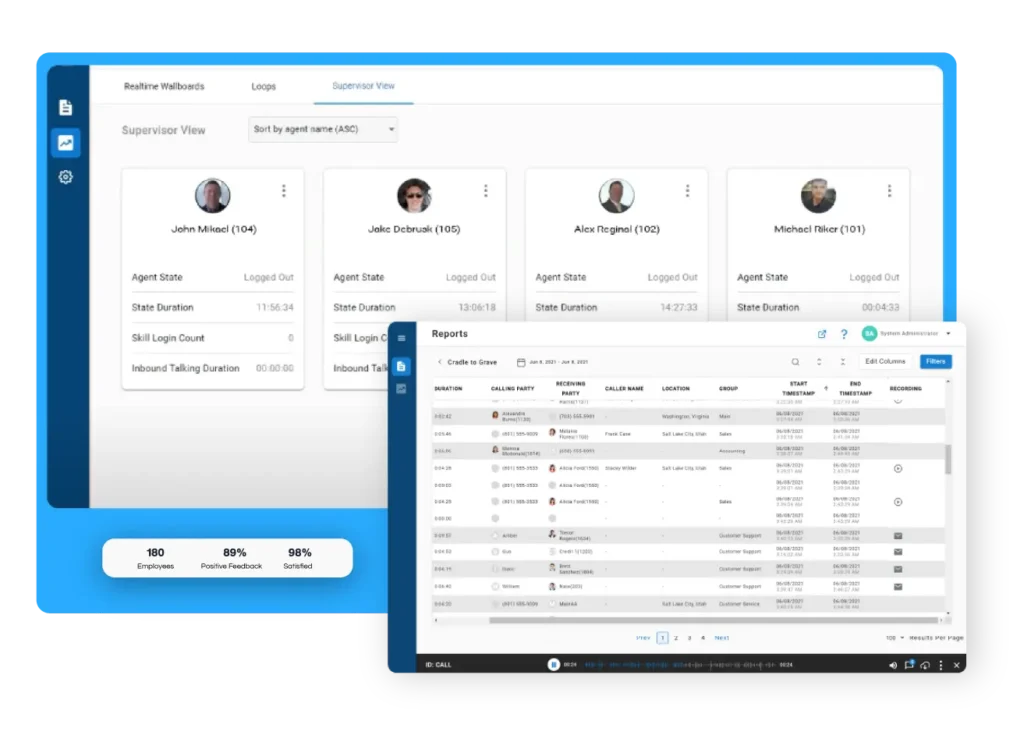
Xima delivers a full CCaaS platform built around deep reporting and ease of use. Its cradle-to-grave reporting traces every interaction second by second, giving supervisors complete visibility into what happened — and why. Skills-based routing uses IVR selections and CRM data to connect customers with the right agent pool, improving FCR rates.
The platform includes AI-powered speech analytics, automated QA scoring with sentiment analysis, real-time wallboards, and over 200 standard reports. It supports voice, email, chat, and SMS from a unified agent interface. Deployment is fast, with minimal IT overhead.
Routing: Skills-based routing driven by IVR data and CRM integration. Analytics: Cradle-to-grave reporting, real-time dashboards, AI sentiment analysis, automated QA. Integrations: CRM integrations, open API. Pricing: Concurrent-seat licensing — you pay only for simultaneous users. No thidden fees.
Why it stands out: Xima combines the depth of analytics you’d expect from an enterprise tool with a pricing model and deployment experience designed for mid-size teams. If your team has outgrown basic phone system reporting but doesn’t need (or want to pay for) the complexity of a Genesys or NICE, Xima fills that gap.
2. Genesys Cloud CX
Best for: Large enterprises with complex, multi-channel environments requiring deep customization.
Genesys Cloud CX is consistently recognized as a market leader in CCaaS. The platform supports voice, chat, email, social, and messaging channels with AI-powered predictive routing that matches customers to agents based on predicted outcomes — not just availability. Workforce engagement management (WEM), quality management, and speech analytics are built in.
Routing: Predictive routing using AI and machine learning. Analytics: Real-time and historical dashboards, speech and text analytics, workforce optimization. Integrations: Deep integrations with Salesforce, ServiceNow, Microsoft, and an extensive app marketplace. Pricing: Tiered subscription (Genesys Cloud 1, 2, 3, and higher). Pricing scales with feature access — advanced AI and WEM tools require premium tiers.
Considerations: The breadth of the platform means a steeper learning curve and higher total cost of ownership. Best suited for organizations with dedicated admin resources to manage configuration and customization.
3. NICE CXone (Mpower)
Best for: Data-driven contact centers focused on workforce optimization and compliance at scale.
NICE CXone offers one of the broadest feature sets in CCaaS, combining omnichannel routing, workforce management, quality management, and analytics in a single platform. Its auto-QA capabilities can evaluate 100% of interactions, and its workforce optimization tools provide detailed staffing forecasts, agent scheduling, and performance analytics.
Routing: Omnichannel ACD with skills-based and AI-driven routing. Analytics: Interaction analytics, automated quality management, WFM forecasting. Integrations: CRM connectors (Salesforce, ServiceNow, Zendesk), UCaaS integrations. Pricing: Ranges from roughly $110/user/month for the Omnichannel Suite to $249/user/month for the Ultimate Suite. AI sessions incur an additional per-session charge.
Considerations: Full value requires commitment to the NICE ecosystem across multiple modules. Higher total cost of ownership may put it out of reach for smaller contact centers, and organizations using non-NICE systems may find integration flexibility limited.
4. Five9
Best for: Mid-market and enterprise contact centers that want strong AI capabilities with broad CRM integration.
Five9 delivers a cloud-native platform with AI layered across quality management, routing, and self-service. Its Intelligent Virtual Agents handle routine inquiries, while Agent Assist provides real-time guidance during live conversations. The platform integrates with major CRM systems and supports voice, chat, email, SMS, and social channels.
Routing: Intelligent routing with AI-powered skills matching. Analytics: Interaction analytics, agentic QM with automated evaluations, real-time dashboards. Integrations: Pre-built integrations with Salesforce, ServiceNow, Microsoft Dynamics, Zendesk, and Oracle. Google Cloud partnership for expanded AI. Pricing: Custom pricing based on bundle and feature set.
Considerations: Pricing can be opaque — you’ll need to go through a sales process to get specifics. Five9 is in a leadership transition with a new CEO effective early 2026, so roadmap stability is worth asking about in evaluations.
5. RingCentral (RingCX)
Best for: Organizations that want a unified UCaaS and CCaaS platform from a single vendor.
RingCentral’s RingCX combines contact center capabilities with its established business communications platform. This gives you omnichannel customer engagement (voice, chat, email, social), outbound dialing, workforce engagement management, and AI-powered quality management alongside internal calling, messaging, and meetings — all from one provider.
Routing: Omnichannel routing with skills-based distribution. Analytics: AI interaction analytics, quality management dashboards, WEM reporting. Integrations: Native integration with RingCentral’s UCaaS suite, plus CRM connectors and an app gallery. Pricing: Bundled UCaaS + CCaaS pricing. Contact RingCentral for specifics.
Considerations: The unified approach is a strength if you want to consolidate vendors, but the contact center capabilities may not match the depth of a specialist CCaaS provider for complex routing or advanced analytics use cases.
6. Talkdesk
Best for: Enterprises in regulated industries (healthcare, financial services) that need rapid deployment and vertical-specific features.
Talkdesk offers AI-powered automation, deep analytics, and industry-specific packages for healthcare, financial services, and retail. The platform supports voice, chat, email, SMS, and social channels with intelligent routing and real-time agent assistance.
Routing: AI-driven intelligent routing. Analytics: Real-time dashboards, speech analytics, customer journey tracking. Integrations: Broad app marketplace, CRM integrations, healthcare EHR connectors. Pricing: Tiered plans.
Considerations: Advanced analytics features may require a premium tier. Some users report a learning curve around customization. Strongest when you need compliance-ready, vertical-specific workflows out of the box.
7. 8×8
Best for: Growing SMBs that want integrated UCaaS and CCaaS at a competitive price.
8×8 combines unified communications with contact center capabilities, delivering voice, video, messaging, and omnichannel routing in a single platform. It’s a practical choice for organizations that need an affordable all-in-one solution without managing multiple vendors.
Routing: Omnichannel routing with skills-based matching. Analytics: Built-in analytics, CRM integrations, native UCaaS reporting. Integrations: CRM integrations, Microsoft Teams, native UCaaS. Pricing: Ranges from approximately $80–$110/user/month with bundled options.
Considerations: Feature depth lags behind top-tier specialists like Genesys or NICE. The mobile UI is less robust than desktop. Best for teams that prioritize value and simplicity over deep customization.
8. Nextiva
Best for: SMBs that need an affordable all-in-one CX platform with built-in CRM.
Nextiva helps small and mid-size businesses manage customer interactions, call routing, and team collaboration in a single platform. Its built-in CRM tracks customer interaction history so agents have context before they pick up the phone. The platform supports voice, chat, email, SMS, and social channels.
Routing: Intelligent routing with IVR. Analytics: Centralized reporting, customer sentiment insights, AI-driven performance metrics. Integrations: Built-in CRM, plus third-party integrations. Pricing: Published per-user pricing tiers. Generally positioned as affordable for smaller teams.
Considerations: Designed primarily for the SMB market. Larger or more complex operations may outgrow its capabilities and need a more specialized CCaaS tool.
Quick Comparison: Features at a Glance
Platform | Omnichannel | Routing | Analytics Depth | Pricing Model | Best Fit |
|---|---|---|---|---|---|
Xima Software | Voice, email, chat, SMS, social | Skills-based (IVR + CRM) | Cradle-to-grave, AI QA, 200+ reports | Concurrent seat, no hidden fees | Mid-size teams wanting depth + simplicity |
Genesys Cloud CX | Voice, chat, email, social, messaging | AI predictive routing | Full WEM, speech/text analytics | Tiered subscription | Large enterprises |
NICE CXone | Voice, chat, email, social | AI + skills-based ACD | Auto-QA, WFM, interaction analytics | $110–$249/user/mo + AI fees | Data-driven enterprise ops |
Five9 | Voice, chat, email, SMS, social | AI skills matching | Agentic QM, IVA, real-time dashboards | Custom/quote-based | Mid-market to enterprise |
RingCentral (RingCX) | Voice, chat, email, social | Skills-based omnichannel | AI interaction analytics, WEM | Bundled UCaaS + CCaaS | Teams consolidating vendors |
Talkdesk | Voice, chat, email, SMS, social | AI-driven | Speech analytics, journey tracking | Tiered, quote-based | Regulated industries |
8×8 | Voice, chat, email, social | Skills-based | Integrated analytics | $80–$110/user/mo | Budget-conscious SMBs |
Nextiva | Voice, chat, email, SMS, social | IVR + intelligent routing | Centralized reporting, sentiment | Per-user tiers | SMBs needing built-in CRM |
Channel coverage is detailed under multi-channel communications.
How to Choose the Right Platform for Your Team
There’s no single “best” CCaaS platform — only the best fit for your operation. Here’s how to narrow it down:
Start with your team size and growth trajectory. Enterprise platforms like Genesys and NICE offer enormous depth but come with proportional complexity and cost. Mid-size teams often find better value in platforms like Xima that deliver enterprise-grade analytics without requiring a dedicated admin team to manage them.
Map your channel requirements. If your customers primarily call in, voice-first platforms with strong IVR and routing will serve you best. If you’re handling heavy chat, email, and social volume, make sure the platform treats those channels as first-class — not add-ons.
Evaluate analytics against how you actually use data. Real-time wallboards are critical if your supervisors actively manage queues throughout the day. Cradle-to-grave reporting matters when you need to trace individual interactions for coaching or compliance. Automated QA with AI scoring saves time if you’re currently reviewing only a small fraction of calls manually.
Test the integration story. Ask specifically about your CRM, your helpdesk, and your workforce management tools. Pre-built connectors save months of development time.
Get pricing in writing. Ask about per-seat vs. concurrent licensing, telephony charges, AI feature costs, and what’s included in each tier. The most transparent vendors will give you a clear total cost of ownership — not just a base price.
The Bottom Line
The CCaaS market offers more capable platforms than ever, but more options also means more noise. Focus on what actually impacts your operation: how well the platform routes interactions, how deeply it reports on them, how smoothly it integrates with your stack, and how predictably it’s priced.
If you’re a mid-size team looking for a platform that delivers real analytics depth with straightforward pricing and fast deployment, Xima Software is worth a closer look.
Ready to see it in action? Request a demo and see how Xima can power your omnichannel contact center.