
In reality, enterprise systems are typically built for organizations operating massive contact centers with hundreds or thousands of agents. These platforms often include complex configuration layers, extensive infrastructure requirements, and administrative controls designed for large operational teams. While these features may be essential for enterprise-scale environments, they can introduce unnecessary complexity for smaller teams that simply need reliable, structured tools to manage customer interactions, often alongside pricing models designed for much larger deployments.
This guide compares Xima vs enterprise contact center platforms to help SMB leaders better understand these differences. By examining pricing models, implementation effort, and ongoing management requirements, small teams can determine whether enterprise systems truly fit their operational needs—or whether a platform designed specifically for structured small-team operations offers a more practical and efficient solution.
Key Takeaways for Small Support Teams
- Enterprise contact center platforms are built for scale. These systems are typically designed to support large agent populations, global routing structures, and complex automation layers that help enterprises manage massive customer support operations.
- Small teams often face unnecessary configuration overhead. When SMBs adopt enterprise platforms, they may encounter additional setup requirements, administrative complexity, and ongoing system management that smaller teams rarely need.
- Xima is designed around structured operations for growing teams. Rather than emphasizing enterprise-scale customization, Xima focuses on predictable queue management and clear supervisor visibility so managers can easily monitor performance and support agents.
- Choosing the right platform often comes down to complexity tolerance. Some organizations are willing to manage highly customizable systems, while others prioritize operational clarity and straightforward management.
- “Enterprise-grade” does not always mean enterprise-appropriate. For many SMB contact centers, a platform designed specifically for smaller teams can deliver the capabilities they need without introducing unnecessary operational complexity.
- Enterprise pricing models are often built around large-scale deployments, which may not align with SMB budgets or growth patterns.
Why Small Teams Consider Enterprise Platforms
Many SMB leaders begin their contact center software search by looking at enterprise solutions. On the surface, these platforms appear to offer the most advanced capabilities available, promising long-term scalability, AI-powered automation, and the flexibility to support complex workflows as the business grows.
This appeal is largely psychological. Decision-makers want to avoid selecting a system they may outgrow, so enterprise platforms are often viewed as a way to “future-proof” the contact center. Features such as advanced automation, extensive integrations, and deep customization options can create the perception that enterprise tools provide the most comprehensive solution.
However, the key question is not whether enterprise platforms offer more configurability—it’s whether an organization actually needs that level of complexity today. For many small support teams, the immediate priorities are clear reporting, manageable queues, and consistent visibility into agent performance. These operational fundamentals are often easier to achieve with platforms designed specifically for smaller, structured environments, without requiring SMBs to adopt the cost structure of enterprise-scale systems.
What Defines an Enterprise Contact Center Platform?
Enterprise contact center platforms are engineered to support extremely large service environments. These systems are typically designed for organizations managing thousands of agents across multiple regions, departments, and customer service channels.
To support this scale, enterprise platforms often include advanced orchestration engines capable of managing complex interaction routing across global networks. They also provide deep customization layers that allow organizations to configure workflows, automation rules, and integrations to fit highly specialized operational requirements.
Common characteristics of enterprise contact center systems include:
- High configuration depth, allowing organizations to customize routing, workflows, and automation at a granular level
- Multi-region routing capabilities, supporting global contact center operations across time zones and locations
- Dedicated IT or administrative oversight, often required to maintain configuration, integrations, and ongoing system management
- Large-scale workforce management modules, designed to coordinate scheduling, forecasting, and performance tracking across large agent populations
These capabilities are essential for enterprises with highly complex service environments. For smaller teams, however, this level of configurability can introduce additional setup time, administrative overhead, and operational complexity that may not provide proportional value, particularly when pricing is tied to capabilities designed for much larger organizations.
Xima’s Fit for Structured Small-Team Operations
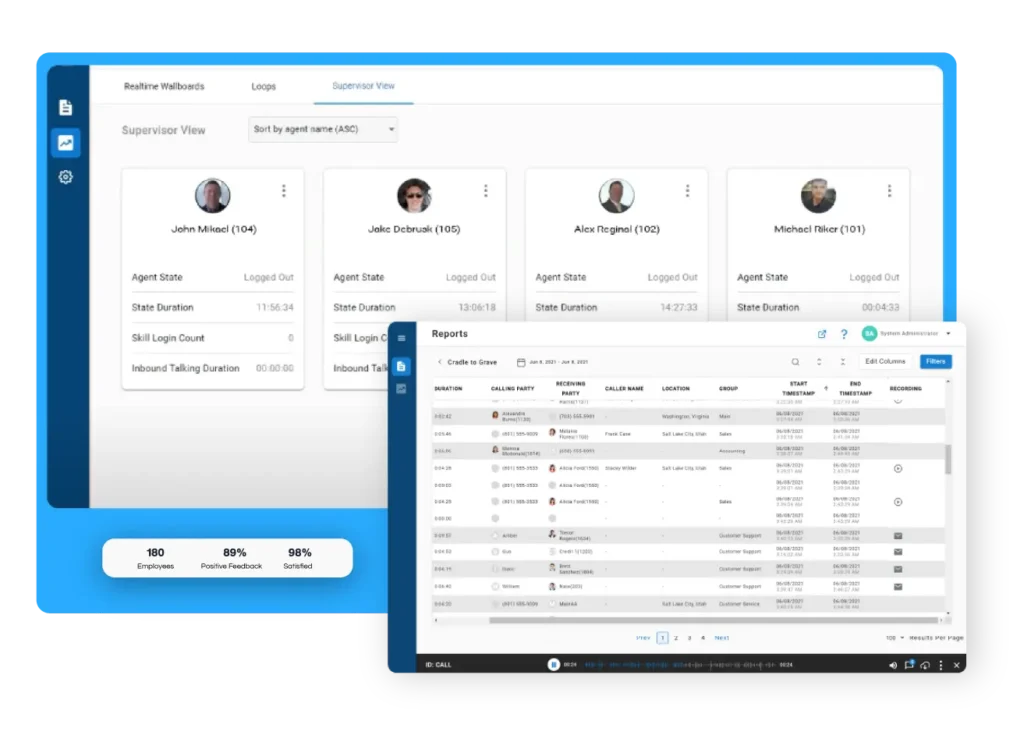
While enterprise platforms focus heavily on customization and infrastructure flexibility, Xima is built around operational clarity for smaller support teams. The platform emphasizes predictable queue management, consistent reporting, and real-time visibility that allows supervisors to quickly understand how the contact center is performing, without requiring additional modules or enterprise-tier upgrades to unlock core functionality, without requiring additional modules or enterprise-tier upgrades to unlock core functionality
For call-centric teams, these operational fundamentals are critical. Managers need to know how many calls are waiting, how agents are performing, and whether service levels are being met. Xima structures these insights into intuitive dashboards and reporting tools that support daily decision-making without requiring extensive configuration.
This approach allows organizations to formalize service levels, track performance metrics, and maintain consistent oversight as their teams grow. Instead of navigating multiple configuration layers, supervisors can focus on managing queues, supporting agents, and improving customer interactions.
This allows growing teams to scale their operations in a way that keeps both management effort and costs aligned with actual support needs.
Enterprise platforms optimize for maximum flexibility. Contact center-focused platforms optimize for predictable day-to-day performance. As teams grow steadily, clarity often outweighs configurability.
Where Enterprise Platforms Can Create Friction for SMBs
Enterprise contact center platforms are designed to support large-scale operations with complex infrastructure and highly customizable workflows. While these capabilities are valuable for organizations managing thousands of agents across multiple locations, they can sometimes introduce operational friction for smaller teams.
One common challenge is longer implementation timelines. Enterprise systems often require extensive configuration, integrations, and testing before deployment. This process may involve weeks or months of setup, which can delay the time it takes for SMB teams to begin improving their customer support operations.
Another factor is the learning curve associated with enterprise software. These platforms typically include layered configuration environments and advanced administrative controls that require training and ongoing management. For teams without dedicated technical administrators, this complexity can make day-to-day management more difficult.
Enterprise tools can also introduce higher administrative overhead. Maintaining routing rules, integrations, and reporting structures may require continuous oversight, especially as the system evolves.
Finally, pricing models are often aligned with large deployments. Enterprise platforms frequently structure their pricing tiers around high agent counts, extensive feature sets, and large-scale usage, which can make costs less predictable for SMB teams operating smaller contact centers.
Key Features of Enterprise Contact Center Platforms
Enterprise contact center platforms are built to support large organizations with complex service environments. These systems prioritize scale, customization, and infrastructure flexibility so enterprises can manage large volumes of interactions across multiple locations and channels.
Common characteristics of enterprise-grade contact center systems include:
- High agent capacity with global or multi-region routing:
Enterprise platforms are designed to support large agent populations across multiple locations. Routing systems can direct interactions across regions, departments, or business units. - Deep workflow customization and orchestration engines:
Advanced configuration layers allow organizations to build complex interaction flows, routing rules, and automation sequences tailored to specific operational requirements. - AI-driven automation and customer journey mapping:
Many enterprise systems include AI-powered tools that automate workflows, deploy conversational bots, and manage customer journeys across multiple support channels. - Integrated workforce management and quality monitoring modules:
Enterprise deployments often include forecasting, scheduling, call evaluation, and performance scoring systems designed to coordinate large support teams. - Dedicated administrative oversight:
Because of their configuration depth, enterprise platforms frequently require specialized administrators or IT teams to manage routing logic, integrations, and ongoing system maintenance.
These capabilities provide powerful control for organizations operating at large scale. However, smaller teams may not require this level of customization to run an efficient contact center.
Signs Your Team May Not Need Enterprise Complexity
Enterprise contact center platforms provide powerful capabilities, but those capabilities deliver the most value when an organization’s operational structure actually requires them. For many small support teams, enterprise-grade systems can introduce layers of configuration, cost, and administrative management that may not align with how the team currently operates.
It’s common for SMB leaders to assume they need maximum scalability from the start. In reality, many contact centers grow gradually and operate effectively with structured queues, clear reporting, and straightforward routing logic. When operations remain relatively simple, highly configurable enterprise platforms may add more complexity than necessary.
Some indicators that enterprise-level systems may exceed your current operational needs include:
- Agent count remains relatively small and centralized:
If your support team consists of a limited number of agents working from a single department or location, enterprise-scale infrastructure may not provide meaningful advantages. - Support operations are limited to a single region or time zone:
Global routing and multi-region infrastructure are valuable for large organizations, but smaller teams operating within one geographic area typically do not require these capabilities. - Channel complexity is focused primarily on voice:
If customer support interactions are largely call-based, advanced cross-channel orchestration and automation layers may not be necessary. - No dedicated IT or platform administrator manages the system:
Enterprise platforms often require specialized administrative oversight. Teams without dedicated technical support may benefit from solutions designed for easier day-to-day management. - Routing logic and service levels remain straightforward and predictable:
When call flows, queue structures, and service levels are relatively simple, smaller teams can often operate more efficiently with platforms that emphasize clarity and operational visibility.
Enterprise platforms are highly valuable for organizations with complex, distributed service environments. However, when operational scale and complexity remain moderate, solutions built specifically for structured SMB contact centers can often provide the capabilities teams need without introducing unnecessary configuration or management overhead.
Xima Is Built for Structured SMB Contact Centers
As small and mid-sized businesses grow, their contact center operations tend to evolve in predictable ways. Call volumes increase, queues become more structured, and supervisors begin tracking performance metrics more closely. Teams that once handled customer calls informally often begin formalizing service levels, reporting processes, and queue management practices to maintain consistent support quality.
Xima is designed specifically for this stage of operational maturity. Rather than emphasizing complex configuration layers, the platform focuses on predictable queue management, reliable reporting, and real-time supervisor visibility. This approach allows managers to monitor contact center activity clearly and make operational decisions quickly without requiring enterprise-scale administration or specialized technical oversight.
For growing support teams, operational clarity becomes increasingly important. Supervisors need immediate insight into queue activity, agent availability, and performance trends so they can maintain service levels during busy periods. Xima provides this visibility through intuitive dashboards and reporting tools that allow teams to track contact center performance without navigating complex configuration environments.
This design aligns particularly well with the realities many SMB contact centers face, including:
- Call-heavy inbound environments where queue performance and response times directly affect customer experience
- Teams formalizing service levels and queue structures as their support operations grow
- Supervisors who rely on live performance dashboards to monitor agent activity and manage queues in real time
- SMBs prioritizing operational clarity and control rather than maximum system customization
By focusing on practical management tools and predictable operational visibility, Xima helps growing teams maintain control over their contact center performance as support operations expand.
Operational Comparison: Enterprise Systems vs Xima
When evaluating Xima vs enterprise contact center platforms, the most helpful comparison is not simply the number of features each system offers. Instead, SMB teams benefit from understanding how each platform impacts day-to-day operations—how quickly it can be implemented, how easily supervisors can manage queues, and how much administrative effort is required to maintain the system.
The table below highlights key operational differences from a small-team perspective.
Operational Area | Enterprise Contact Center Platforms | Xima |
Implementation Effort | Often requires structured onboarding, configuration planning, and technical setup to support complex workflows. | Designed for faster configuration centered on queues, reporting, and supervisor access. |
Administrative Overhead | Typically involves ongoing configuration management and dedicated admin oversight. | Structured for small teams to manage without layered administrative roles. |
Queue & Routing Complexity | Supports highly customizable routing logic and multi-layered orchestration. | Focused on predictable queue behavior suited to structured SMB environments. |
Supervisor Visibility | Advanced dashboards and analytics designed for large-scale oversight. | Real-time visibility tailored to daily queue management and team performance. |
Feature Depth vs Necessity | Broad feature sets built to support enterprise-scale operations. | Features aligned to core contact center needs without excessive configuration layers. |
Scalability Model | Built for high agent counts, multi-region deployments, and global routing. | Built for steady SMB growth in agent count and call volume. |
Pricing Alignment | Pricing tiers are often structured around enterprise-scale deployments. | Pricing aligned to contact center usage and SMB team size. |
For small support teams, the most important consideration is often manageability rather than maximum capability. Enterprise platforms offer powerful customization and scalability, but those advantages are most valuable when operational complexity demands them. SMB teams evaluating Xima vs enterprise contact center platforms should consider how easily each system supports daily queue management, supervisor oversight, and steady team growth.
Choosing Between Enterprise Flexibility and Operational Clarity
Selecting a contact center platform ultimately comes down to operational priorities. Enterprise contact center systems are designed to maximize flexibility, offering deep customization, advanced orchestration engines, and infrastructure capable of supporting extremely large and complex deployments. For organizations operating at a global scale, these capabilities can be essential.
For many small and mid-sized businesses, however, the primary challenge is not managing global complexity—it’s maintaining clear visibility and control as call volumes increase and support teams grow. Structured queues, reliable reporting, and real-time supervisor insight often matter more than highly configurable routing layers or enterprise-scale infrastructure.
This is where Xima stands apart. Rather than focusing on maximum platform customization, Xima is built around operational clarity for SMB contact centers. The platform prioritizes predictable queue management, reliable performance reporting, and live supervisor dashboards that allow teams to monitor activity and maintain service levels without requiring complex configuration or dedicated system administrators.
The decision between Xima vs enterprise contact center platforms is not about which solution is more powerful—it’s about which one aligns with the complexity of your operations today. When support environments require extensive customization and global scale, enterprise systems can provide that flexibility. But for many growing SMB teams, a platform like Xima delivers the structure, visibility, and manageability needed to run an efficient contact center while continuing to scale steadily over time.
FAQs
Small teams can choose enterprise contact center software, but it is often more complex than necessary. Enterprise systems are built for large organizations with extensive routing, automation, and administrative needs. Many SMB teams operate more efficiently with platforms designed specifically for smaller support environments.
Enterprise software may be too complex when support teams are small, centralized, and operating with straightforward call flows. In these cases, the added configuration layers and administrative requirements may not provide meaningful operational benefits.
In the comparison of Xima vs enterprise contact center platforms, enterprise tools emphasize deep customization and large-scale infrastructure. Xima focuses on predictable queue management, clear reporting, and real-time supervisor visibility for SMB contact centers.
Overbuying software can lead to higher costs, longer setup times, and unnecessary system complexity. SMB teams may end up managing features and configuration layers they do not actually need.
SMBs should choose platforms that support gradual growth in agents and call volume without requiring enterprise-level infrastructure. Solutions designed for SMB contact centers often scale effectively as operations expand, allowing teams to grow without adopting enterprise-level pricing or infrastructure prematurely.