
Ever wish you could be a fly on the wall for every customer conversation? Imagine knowing exactly why customers are calling, what makes them happy, and what causes friction—not just from a small sample, but from every single interaction. In April 2026, this level of insight is no longer a wish; it’s a reality made possible by contact center speech analytics.
This powerful AI technology automatically listens to, transcribes, and analyzes 100% of your voice interactions to uncover valuable, actionable insights. It transforms raw conversations into a goldmine of data you can use to elevate your entire customer experience (CX)—the overall perception a customer has of your company. In this guide, we will break down the technical process of how speech analytics works and explore the concrete ways it empowers your team to deliver superior service. It’s time to boost customer insight with AI speech analytics today.
What Exactly Is Contact Center Speech Analytics?
At its core, speech analytics is the process of using Artificial Intelligence (AI) to analyze spoken conversations, turning unstructured audio from phone calls into structured, searchable data that you can report on and act upon [6]. It’s about moving beyond just words to understand the meaning, intent, and emotion behind them.
The technology works through a sophisticated, multi-stage process:
Acquisition & Transcription: The system captures call audio and uses advanced Automatic Speech Recognition (ASR) engines to create a highly accurate written transcript of the conversation. Modern systems often achieve over 95% accuracy [2].
Analysis: AI, specifically Natural Language Processing (NLP), then sifts through the transcript to perform topic modeling, identify keywords, and determine customer sentiment (e.g., positive, negative, neutral).
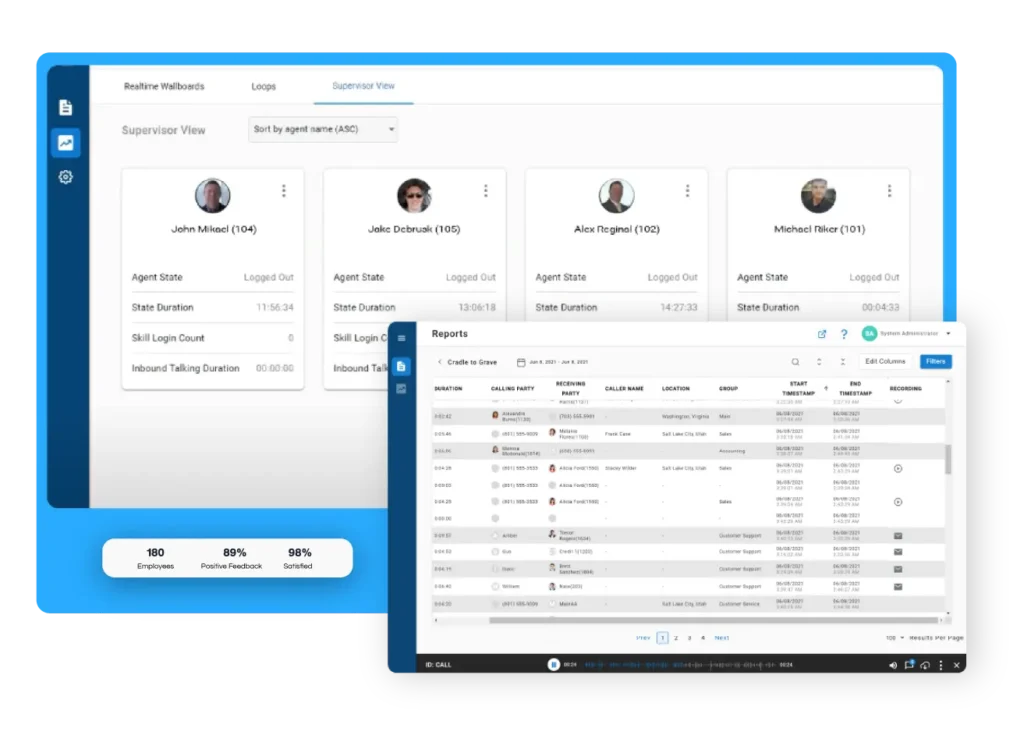
Reporting & Visualization: Finally, these insights are organized and presented in easy-to-understand dashboards and reports, allowing supervisors and CX leaders to quickly spot trends and drill down into specific interactions.
This capability transforms your contact center from a cost center into a strategic source of business intelligence. You can explore the full process in our complete contact center speech analytics guide.
Speech Analytics vs. Voice Analytics: What’s the Difference?
While often used interchangeably, these terms refer to distinct yet complementary analyses:
Speech Analytics analyzes what is being said—the words, phrases, and topics discussed (the lexical content).
Voice Analytics analyzes how it’s being said—the tone, pitch, volume, and emotional inflections in the speaker’s voice (the acoustic content).
Leading platforms, including Xima Software, combine both to provide a complete, nuanced picture. This tells you not only that a customer used the word “frustrated” but also that their tone of voice confirmed that emotion. To learn more, explore our complete guide to voice analytics.
How Does Speech Analytics Turn Conversations into Actionable Insights?
The true power of speech analytics lies in its ability to process information at a scale and depth that humans simply cannot match. It goes beyond simple transcription to deliver deep, strategic business intelligence.
Analyzing 100% of Interactions—Not Just a Fraction
In the past, quality assurance (QA) managers could only manually review a tiny fraction of calls—typically just 2-3%. This small sample size often led to biased or incomplete conclusions. Modern speech analytics changes the game by automatically analyzing 100% of interactions, giving you a statistically significant dataset [3].
This comprehensive approach offers several key advantages:
An Unbiased View: You get a complete and accurate picture of performance and sentiment across all agents and customer segments, free from the blind spots of random sampling.
Trend Spotting: By analyzing every call, including the use of historical transcription, you can spot long-term patterns and emerging issues you would otherwise miss entirely.
Data-Driven Certainty: A robust platform like Xima structures these insights so you see clear trends and receive actionable alerts, turning a potential data flood into focused business intelligence.
Uncovering Customer Sentiment and Root Causes
Knowing what customers are saying is useful, but knowing why is transformative. Speech analytics uses NLP models to detect customer sentiment by identifying emotionally charged words (e.g., “furious,” “disappointed,” “excellent”) and analyzing vocal tone.
This allows you to pinpoint the exact moments where a customer becomes frustrated or delighted. By aggregating this data across thousands of calls, you can perform a root cause analysis to identify the source of customer dissatisfaction. Is it a confusing IVR menu? A broken product feature? A gap in agent knowledge? Analytics gives you the data to stop guessing and start fixing the core issues that lead to frustrated customers. By understanding these friction points, you can boost insight and cut abandon rates effectively.
3 Tangible Ways Speech Analytics Improves Your CX
So, how does this technology translate into a better experience for your customers? Here are three concrete ways contact center speech analytics drives meaningful, measurable improvements.
1. Elevate Agent Performance with Data-Driven Coaching
Hypothesis: By providing objective, comprehensive feedback, speech analytics will significantly improve agent performance and streamline quality management.
Evidence: Speech analytics revolutionizes agent training by automating tedious tasks and providing clear, data-backed insights.
Automate Quality Management: Instead of manually scoring a few calls, you can automatically score 100% of them against your specific criteria. This can cut manual QA review time by up to 80%, freeing supervisors to focus on high-impact coaching.
Identify Targeted Coaching Opportunities: The system pinpoints the exact moments where agents struggle or excel. By providing objective scoring, it also helps standardize supervisor feedback, boosting calibration accuracy from 78% to over 94% in some cases [1].
Enable Real-Time Assistance: Advanced systems can leverage real-time analytics to provide agents with on-screen suggestions during a live call, helping them find the right information or de-escalate a tense situation before it worsens.
The impact is tangible. As client stories show, businesses using these tools can dramatically accelerate coaching and reduce manual QA efforts, leading to real-world results with Auto QA.
2. Directly Boost Customer Satisfaction and Loyalty
Hypothesis: By identifying and eliminating points of friction in the customer journey, speech analytics will lead to measurable increases in customer satisfaction and loyalty.
Evidence: Happier, more effective agents lead directly to happier customers. Organizations using these tools can see up to a 10% uplift in customer satisfaction scores [2].
Improve Key Metrics: Insights from analytics help you improve scores like CSAT (Customer Satisfaction), NPS (Net Promoter Score), and CES (Customer Effort Score). When you systematically identify and eliminate points of customer frustration, these scores naturally rise.
Increase First-Call Resolution (FCR): FCR measures the percentage of calls resolved on the first attempt. By analyzing calls that were successfully resolved, you can identify what works and replicate those best practices across your team, reducing frustrating repeat calls.
Optimize the Customer Journey: Customers often tell you exactly where your processes are broken. Analytics helps you hear it by flagging mentions of issues like a “confusing checkout process” or a “broken website link,” giving other departments valuable, direct feedback for process improvement.
3. Ensure Compliance and Reduce Business Risk
Hypothesis: Automated monitoring via speech analytics will drastically reduce compliance violations and mitigate business risk.
Evidence: In regulated industries, a single compliance mistake can be costly. Speech analytics acts as an automated, always-on safety net.
Automated Compliance Monitoring: The system can automatically flag every call where a mandatory disclosure was missed or where sensitive data like credit card numbers were handled improperly. One study found that speech analytics helped a company reduce PCI compliance violations from 4.2% to just 1.1% in 30 days [1].
Proactive Risk Mitigation: You can set up instant alerts for calls containing high negative sentiment or mentions of legal keywords like “lawyer” or “sue.” This allows a supervisor to intervene immediately, de-escalating a situation before it becomes a major liability. The technology can also automatically redact personally identifiable information (PII) from both audio and transcripts to protect customer privacy [7].
This automated monitoring transforms compliance from a manual spot-check into a comprehensive, always-on risk management tool.
Putting It All Together with Xima Speech Analytics
Understanding the “what” and “why” of speech analytics is the first step. The next is having the right tool to put those insights into action. This is where Xima’s contact center speech analytics platform comes in. We make this powerful technology accessible and actionable for businesses of all sizes, so you can maximize CX with AI.
With Xima, you can:
Get a Unified Interaction View: Xima brings all your conversational data into one place, providing a single source of truth with transcripts, sentiment scores, and summaries for every interaction.
Leverage Accurate, AI-Powered Transcription: Our platform accurately transcribes and analyzes 100% of your calls, ensuring you never miss a critical insight from a single customer.
Automate QA and Agent Scoring: Build custom scorecards in Xima to automatically evaluate every agent on every call. This frees up supervisors from tedious manual reviews so they can focus on high-impact coaching.
Use Actionable Dashboards: Xima’s intuitive dashboards make it easy to spot sentiment trends, identify keyword mentions, and drill down into specific calls, turning complex data into clear direction.
Our Speech Analytics feature is designed to deliver not just data, but genuine business intelligence that drives real results.
From Listening to Leading with Speech Analytics
In 2026, competing on customer experience is no longer optional. Speech analytics has become an essential tool for any modern contact center that wants to move beyond guesswork and make truly data-driven decisions.
Here are the key takeaways:
Speech analytics empowers you to understand your customers by analyzing 100% of conversations.
The core benefits are clear: improved agent performance, higher customer satisfaction, and reduced business risk.
Platforms like Xima make this powerful AI-powered analytics technology accessible, turning complex data into clear, actionable insights that drive real business results.
Stop just listening to your customers and start truly understanding them. It’s time to take control of your customer experience with data-driven decisions.
Ready to see how AI-powered analytics can transform your contact center? Request a Demo of Xima Speech Analytics Today!