
Finding the right cloud contact center solution can feel overwhelming when every vendor claims to offer “omnichannel support.” The truth is, not all CCaaS platforms deliver the same depth of channel integration, reporting capabilities, or ease of use.
This guide breaks down six CCaaS platforms worth considering if you’re managing customer interactions across voice, chat, email, SMS, and social media. Xima Software gives you enterprise-grade features with an interface that won’t require weeks of training. You’ll see how each platform stacks up on the features that matter most to contact center operations.
By the end, you’ll have a clear picture of which solution fits your needs—and which ones might create more headaches than they solve.
Quick guide: 6 best CCaaS platforms for omnichannel contact centers
- Xima Software: The best CCaaS platform for omnichannel support with cradle-to-grave reporting and AI-powered analytics
- Genesys Cloud CX: An enterprise-focused platform with workforce optimization tools
- Five9: A cloud-based option with AI automation capabilities
- Talkdesk: A CCaaS platform with industry-specific solutions
- NICE CXone: A scalable option with workforce management features
- Nextiva: A unified communications platform with contact center capabilities
How we chose the best CCaaS platforms for omnichannel support
Selecting a CCaaS platform isn’t just about checking feature boxes. You need a solution that fits how your team actually works—and one that won’t become obsolete as customer expectations evolve.
We evaluated each platform based on criteria that directly impact your daily operations and customer experience:
- Channel unification: Can your agents view and respond to voice, chat, email, SMS, and social interactions from a single workspace without switching between tools?
- Reporting depth: Does the platform track every interaction from start to finish, giving you actionable data rather than surface-level metrics?
- Skills-based routing: Can you connect customers to the right agent on the first try, reducing transfers and improving first-call resolution?
- AI and automation: Does the platform include AI-powered quality assurance, sentiment analysis, or automated callbacks that reduce manual work?
- Ease of deployment: Can your team get up and running quickly without extensive IT involvement or months of implementation?
- Pricing transparency: Are costs clear upfront, or will you discover unexpected fees after signing?
- Compliance readiness: Does the platform support HIPAA, PCI DSS, and other regulatory requirements for industries like healthcare and finance?
Xima’s cloud contact center software is assessed against the same criteria.
The 6 best CCaaS platforms for omnichannel contact centers
1. Xima Software: Best overall CCaaS platform for omnichannel support
Xima Software delivers a cloud-based contact center platform built for teams that need powerful analytics without the complexity that comes with enterprise solutions. The platform combines voice, chat, email, SMS, and social media into a unified agent workspace.
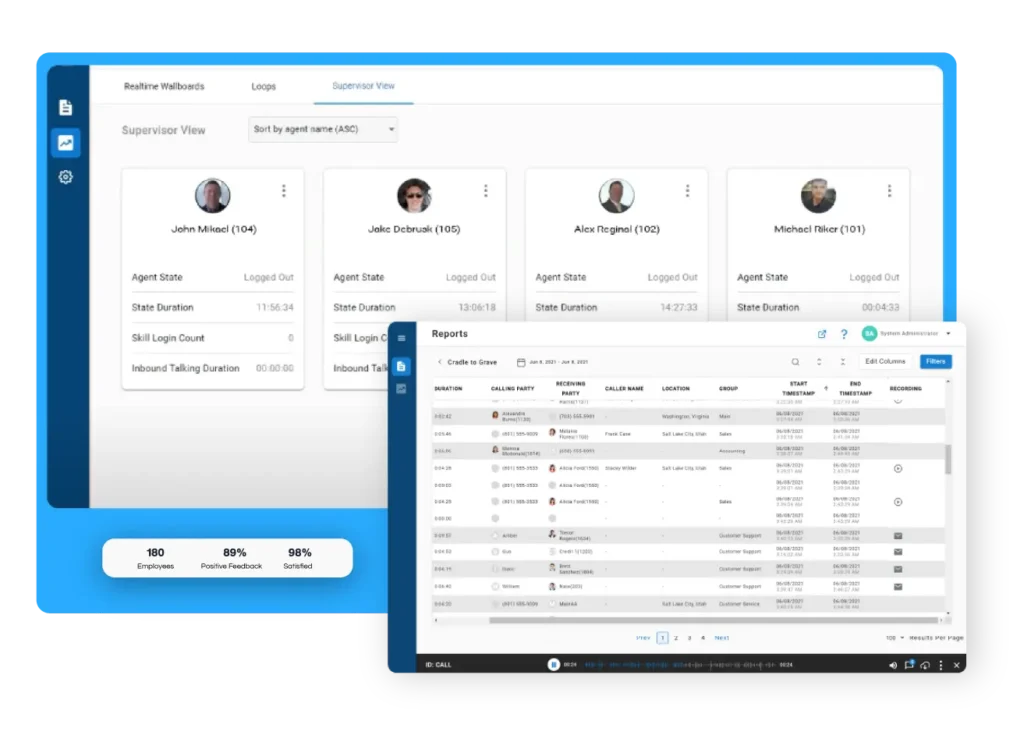
What sets Xima Software apart is its cradle-to-grave reporting. Every customer interaction gets tracked from the moment it enters your system until resolution. This means you can see exactly where calls get transferred, how long each step takes, and where bottlenecks occur.
Xima Software makes AI-powered quality assurance accessible for smaller teams. The platform automatically scores 100% of interactions using speech analytics and sentiment analysis. Your supervisors don’t have to manually review random samples—they can focus on coaching moments that actually move the needle.
The concurrent licensing model deserves attention too. Instead of paying per-agent regardless of shift patterns, you pay based on how many agents are active simultaneously. For teams with variable schedules or seasonal peaks, this approach often reduces costs significantly.
Xima Software features
- Cradle-to-grave reporting: Track every interaction from initial contact through resolution, capturing transfer history, hold times, and agent touchpoints in one complete view
- AI-powered Auto QA: Automatically score every call and chat interaction using speech analytics, eliminating the need to manually sample conversations for quality reviews
- Skills-based routing: Connect customers to the most qualified agent on the first try based on language, product expertise, or issue type
- Queue callback: Give customers the option to receive a callback instead of waiting on hold, reducing abandonment rates and improving satisfaction
- Real-time wallboards: Display live metrics and agent status on customizable dashboards so supervisors can spot issues before they become problems
- Multi-channel support: Handle voice, web chat, email, SMS, and social messaging from a single interface without switching between applications
Xima Software pros and cons
Pros:
- Cradle-to-grave reporting captures every detail of the customer journey, giving you complete visibility into interaction flow
- Concurrent licensing keeps costs predictable for teams with variable schedules or seasonal volume changes
- White-glove onboarding and support means you’re not left figuring things out on your own after implementation
Cons:
- The depth of reporting options may take time to fully explore—though the support team helps with custom report setup
- Some advanced AI features are available as add-ons, allowing you to start simple and expand as needed
- On-premise deployment requires additional planning, but the cloud option offers faster time-to-value
2. Genesys Cloud CX: An enterprise platform with workforce optimization
Genesys Cloud CX targets large contact centers that need advanced workforce engagement tools alongside omnichannel routing. The platform includes AI-powered features like predictive routing and virtual agents across voice and digital channels.
For enterprise-scale operations, Genesys offers workforce optimization capabilities including scheduling, forecasting, and quality management. The platform integrates with CRM systems and supports multiple deployment options.
Genesys Cloud CX features
- Omnichannel routing: Route voice, chat, email, and social interactions through a unified system
- Workforce engagement management: Access scheduling, forecasting, and performance management tools
- Virtual agents: Deploy AI-powered bots for self-service across voice and digital channels
Genesys Cloud CX pros and cons
Pros:
- Includes native workforce management tools for scheduling and forecasting
- Offers multiple licensing options including hourly and concurrent models
- Has an established ecosystem of integrations and partners
Cons:
- Implementation timelines can extend several months for complex deployments
- The platform’s breadth of features requires significant training investment
- Smaller teams may find the feature set more extensive than their operational needs
3. Five9: A cloud-based platform with AI automation
Five9 offers a cloud contact center platform with blended inbound and outbound capabilities. The platform includes AI-powered features like automated summaries and live transcription across voice and digital channels.
The platform’s intelligent routing connects customers to agents based on configurable criteria. Five9 also includes workforce engagement tools and integrations with major CRM systems.
Five9 features
- AI summaries: Automatically generate interaction summaries to reduce after-call work
- Blended inbound/outbound: Manage both incoming support calls and outbound campaigns from one platform
- CRM integrations: Connect with Salesforce, Microsoft Dynamics, and other CRM systems
Five9 pros and cons
Pros:
- Includes AI-powered transcription and summaries in core plans
- Offers both digital-only and full omnichannel licensing options
- Has geo-redundant infrastructure for reliability
Cons:
- Advanced AI features like knowledge management require higher-tier plans
- Workforce engagement tools are available as add-ons rather than included
- Integration depth varies depending on the CRM platform you use
4. Talkdesk: A CCaaS platform with industry-specific solutions
Talkdesk has built cloud-specific solutions for industries including healthcare, financial services, and retail. The platform offers AI-powered automation for both customer self-service and agent assistance.
The company’s Experience Clouds package industry-specific workflows and compliance features. Talkdesk also offers a smaller-business focused option called Talkdesk Express with streamlined features.
Talkdesk features
- Industry clouds: Access pre-built workflows designed for healthcare, banking, insurance, and retail
- AI virtual agents: Deploy generative AI-powered bots for customer self-service
- Speech analytics: Analyze conversations for quality management and compliance
Talkdesk pros and cons
Pros:
- Industry-specific solutions include pre-configured compliance features
- Offers an SMB-focused option with simplified feature set
- Has a visual workflow builder for creating automation without coding
Cons:
- The full platform is geared toward enterprise operations and pricing reflects that
- Some advanced features require professional services for implementation
- Industry clouds are not available for all verticals
5. NICE CXone: A scalable platform with workforce management
NICE CXone combines contact center capabilities with workforce management tools on a cloud-native platform. The platform supports voice and digital channels with AI-powered routing and analytics.
NICE has invested in AI capabilities including virtual agents and real-time coaching. The platform is designed for larger operations that need forecasting and scheduling alongside customer engagement tools.
NICE CXone features
- Workforce management: Access forecasting, scheduling, and adherence monitoring tools
- AI-powered routing: Route interactions based on predicted outcomes and agent proficiency
- Quality management: Score interactions and track agent performance over time
NICE CXone pros and cons
Pros:
- Includes native workforce management capabilities
- Has a broad range of channel support including social messaging
- Offers analytics tools for tracking customer journey patterns
Cons:
- Implementation can require significant resources and planning
- The platform’s feature depth may exceed what smaller operations need
- Configuration complexity requires dedicated administrator time
6. Nextiva: A unified communications platform with contact center features
Nextiva combines business communications (voice, video, messaging) with contact center capabilities on a single platform. This approach works for organizations that want to consolidate their communications tools.
The platform includes AI features across its pricing tiers and integrates CRM-like customer journey tracking. Nextiva positions itself as an option for mid-sized organizations that need both UCaaS and CCaaS capabilities.
Nextiva features
- Unified platform: Access business phone, video conferencing, and contact center from one system
- Customer journey tracking: View interaction history across channels in a built-in CRM-like interface
- AI-powered tools: Use AI features including transcription and sentiment analysis
Nextiva pros and cons
Pros:
- Consolidates UCaaS and CCaaS on a single platform
- Includes built-in customer data management features
- Offers flexible entry points for smaller operations
Cons:
- Contact center capabilities are newer compared to dedicated CCaaS vendors
- Some advanced features are only available on higher tiers
- Organizations with existing UCaaS investments may have redundant capabilities
Comparison table: The best CCaaS platforms for omnichannel support
Platform | Cradle-to-Grave Reporting | AI-Powered QA | Concurrent Licensing |
Xima Software | ✓ | ✓ | ✓ |
Genesys Cloud CX | ✗ | ✓ | ✓ |
Five9 | ✗ | Add-on | ✗ |
Talkdesk | ✗ | ✓ | ✗ |
NICE CXone | ✗ | ✓ | ✓ |
Nextiva | ✗ | ✓ | ✗ |
Channel coverage is detailed under multi-channel communications.
What should you look for in an omnichannel CCaaS platform?
Channel support is just the starting point. The real question is whether those channels connect into a unified view of each customer’s journey. According to research from 2025, 56% of customers say they have to repeat themselves during support interactions because agents lack context from previous conversations.
Look for platforms that maintain conversation history across all channels. When a customer moves from chat to phone, your agent should see what was already discussed. This context prevents the frustration of starting over and speeds up resolution times.
Reporting capabilities matter more than most buyers initially realize. Surface-level metrics like average handle time don’t tell you why calls are taking longer. Cradle-to-grave reporting shows you the complete path each interaction takes—including transfers, holds, and escalations—so you can identify specific bottlenecks.
How does skills-based routing improve omnichannel customer experience?
Skills-based routing matches customers to agents based on expertise, language proficiency, or product knowledge rather than simply sending them to whoever has been idle longest. This approach directly impacts first-call resolution, which research consistently identifies as the most important factor in customer satisfaction.
The impact compounds across channels. A customer who starts on chat and escalates to voice should reach an agent who can actually solve their problem—not just the next available person. This is where Xima Software delivers real value, connecting customers to the right agent regardless of which channel they use.
Consider the efficiency gains as well. When agents handle issues matching their expertise, resolution happens faster. Zendesk reports that unified omnichannel tools can reduce average handle time by 23% compared to disconnected systems.
Why Xima Software is the best CCaaS platform for omnichannel support
Most CCaaS platforms can route calls and display dashboards. What separates Xima Software is the depth of insight you get into every customer interaction. Cradle-to-grave reporting means you’re not guessing why calls take too long or where customers get frustrated—you can see the exact path each interaction takes.
Xima Software connects all your communication channels into a single agent workspace. Your team handles voice, chat, email, SMS, and social messages without switching between applications. This matters because every tool switch adds friction and increases the chance of losing context.
The AI-powered quality assurance eliminates the old approach of randomly sampling calls for review. Xima Software scores 100% of your interactions automatically, surfacing the specific coaching opportunities that will improve performance. Combined with transparent concurrent licensing and white-glove support, you get enterprise capabilities without enterprise complexity.
Ready to see how Xima Software can improve your contact center operations? Schedule a demo to explore the platform with your specific use cases in mind.
FAQs about CCaaS platforms for omnichannel support
What is omnichannel support in a contact center?
Omnichannel support means customers can reach you through any channel—voice, chat, email, SMS, or social media—and receive consistent service with full context. Xima Software unifies these channels so agents see the complete conversation history regardless of how customers make contact.
How is omnichannel different from multichannel?
Multichannel means you offer multiple ways to reach you. Omnichannel means those channels connect and share information. With omnichannel, a customer who starts on chat and calls later doesn’t have to repeat their issue because the agent already has the context.
What is cradle-to-grave reporting?
Cradle-to-grave reporting tracks every step of a customer interaction from initial contact through resolution. Xima Software captures transfers, hold times, agent touchpoints, and outcomes in a single view. This gives you the data to identify exactly where issues occur in your customer journey.
Why does concurrent licensing matter for contact centers?
Concurrent licensing charges based on how many agents are active simultaneously rather than total headcount. For contact centers with variable schedules, part-time staff, or seasonal peaks, this model often reduces costs significantly. Xima Software offers concurrent licensing as a core option.
How do I choose between cloud and on-premise CCaaS deployment?
Cloud deployment offers faster implementation, automatic updates, and lower upfront costs. On-premise gives you more control over data and can work better for organizations with strict compliance requirements. Xima Software supports both options, letting you choose based on your specific needs.
What compliance certifications should a CCaaS platform have?
Look for HIPAA compliance if you’re in healthcare and PCI DSS if you handle payment information. SOC 2 certification indicates security practices have been independently audited. Xima Software maintains compliance certifications for regulated industries including healthcare and finance.