
From looking in the rearview mirror to seeing the road ahead.
As a contact center manager, your goal is to lead a team that’s both efficient and effective. For years, this meant relying on historical reports—analyzing performance by looking at what happened yesterday or last week. But in today’s fast-paced environment, that’s like driving while looking only in the rearview mirror. You’re reacting to problems that have already impacted your customers and agents.
Real-time monitoring is the shift from reactive reporting to proactive command. It gives you the live, comprehensive view you need to navigate challenges as they happen. Let’s dive into how you can master this crucial function, transforming your contact center from a cost center into a strategic asset. We’ll cover what real-time monitoring is, how to implement it with actionable metrics and dashboards, and how to harness the power of predictive analytics to stay ahead of the curve.
What Is Real-Time Call Center Monitoring (And Why Does It Matter)?
Real-time monitoring is the continuous, live observation of agent activities, call queues, and customer interactions across all your channels. Think of it as a heartbeat monitor for your contact center, providing a constant stream of data on its health and performance [1]. This marks a fundamental shift away from simple post-call analysis and toward proactive, in-the-moment management [2].
Instead of waiting for an end-of-day report to learn about a spike in call abandonment, you can see it happening now and take immediate action. This capability is no longer a luxury—it’s a core component of a modern, customer-centric operation.
The strategic value of real-time monitoring is clear and measurable. Key benefits include [3]:
-
Immediate Problem Resolution: Instantly identify and address service-level drops, long wait times, technical glitches, or agents struggling with a difficult interaction.
-
Enhanced Agent Performance & Support: Provide live coaching through whisper features, balance workloads dynamically, and spot training opportunities on the fly rather than weeks later.
-
Improved Customer Experience (CX): Proactively manage the customer journey to reduce friction and increase satisfaction. The Customer Experience (CX) is the overall perception a customer has of your company based on all their interactions. Better management leads to better perceptions.
-
Boosted Operational Efficiency: Make data-driven decisions about staffing, agent allocation, and workflow optimization based on live demand, ensuring resources are used effectively.
How Do I Monitor Real-Time Call Center Performance?
To effectively monitor real-time performance, you need to combine the right metrics with the right visualization tools. This two-part approach ensures you’re not just collecting data, but are equipped to act on it decisively.
Start with What You Measure: Essential Real-Time Metrics
Effective monitoring begins with tracking the right Key Performance Indicators (KPIs). While historical reports are useful for long-term trends, real-time metrics provide the immediate feedback needed for operational control. A well-designed system, like the one offered by Xima Software, brings these critical KPIs to the forefront.
Here are the essential real-time metrics every manager should monitor:
-
Agent Status/Presence: See a live breakdown of what every agent is doing—who is available, on a call, in wrap-up, on a break, or in training.
-
Call/Queue Volume: Track the number of incoming interactions (calls, chats, emails) against the number of agents available to handle them.
-
Service Level & Wait Times: Monitor the percentage of interactions answered within a predefined threshold (e.g., 80% of calls answered in 20 seconds) and the current longest wait time in any queue.
-
Abandonment Rate: See how many customers disconnect before speaking to an agent. A sudden spike is an immediate red flag that requires attention.
-
Average Handle Time (AHT): Keep an eye on the average duration of interactions, including talk time, hold time, and wrap-up. This helps identify outliers who may need support.
With advanced platforms, you can also monitor experience metrics like CSAT (Customer Satisfaction) scores as feedback surveys are completed. CSAT measures customer happiness with a specific interaction, giving you a near-instant pulse on service quality. For a deeper dive into KPIs, expert resources like the “Mastering Call Center Dashboards eBook” are invaluable[1]. These metrics form the foundation of any robust contact center reporting strategy.
Implement Real-Time Dashboards for Actionable Insights
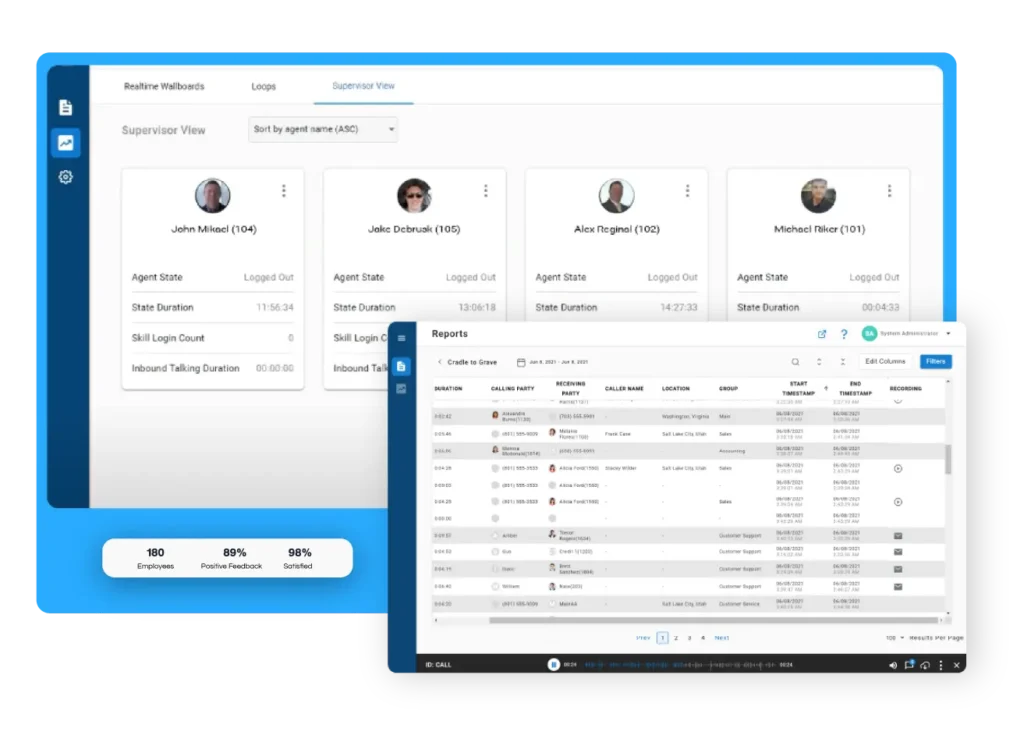
So, how do you implement real-time dashboards for call center metrics? The key is to choose a tool that translates raw data into a clear, visual story. Real-time dashboards are the command center, bringing all your essential KPIs onto a single, dynamic screen.
Modern Contact Center as a Service (CCaaS) platforms like Xima Software offer powerful dashboards designed specifically for managers and supervisors. These tools provide customizable, easy-to-read visualizations that turn complex data streams into actionable insights.
Here’s how you can use dashboards effectively to monitor performance:
-
Set customizable alerts and thresholds: Configure your dashboard to automatically notify you when a KPI breaches a set limit—for example, when the queue wait time exceeds 60 seconds or the abandonment rate climbs above 5%.
-
Use gamification and leaderboards: Motivate agents by displaying top performers for metrics like resolved cases or positive CSAT scores. This fosters healthy competition and recognizes achievement in real time.
-
Drill down from a high-level view: See a macro view of the entire contact center, then click to drill down into a specific queue, team, or even an individual agent’s performance to identify coaching opportunities.
Effective call center dashboards are more than just data displays; they are your primary tool for making informed, in-the-moment decisions.
See how Xima’s real-time dashboards can transform your call center. Request a Demo.
What Are the Best Predictive Analytics Tools for Contact Center Management?
While real-time monitoring helps you manage the present, predictive analytics helps you prepare for the future. Answering the question, “What are the best predictive analytics tools for contact center management?” requires looking at technologies that leverage AI to move beyond what is happening to what will happen.
Moving from Reactive to Proactive with AI
Predictive analytics uses historical data, statistical algorithms, and machine learning techniques to identify the likelihood of future outcomes [6]. In the contact center, this means forecasting everything from call volumes and customer intent to potential agent churn and customer dissatisfaction. It allows you to shift from reacting to fires to proactively preventing them.
The best predictive analytics tools share several key features [8]:
-
Real-time data processing and pattern recognition to identify emerging trends instantly.
-
AI-driven sentiment and emotion analysis to gauge customer mood during an interaction.
-
Predictive modeling for accurate staffing forecasts and call volume projections.
-
User-friendly interfaces and customizable reports that make complex predictions easy to understand.
Turning Data into Strategy with Xima’s AI-Powered Analytics
This level of foresight is no longer science fiction; it’s a core capability of leading CCaaS platforms. Xima’s platform fully integrates AI-powered analytics to help managers not just see data, but understand its implications.
For example, our solution can analyze past data to predict peak call times with incredible accuracy, allowing you to optimize schedules and avoid being understaffed. By analyzing language and tone, our speech analytics can flag interactions with a high probability of resulting in a negative CSAT score, allowing a supervisor to intervene before the call even ends.
This is the future of AI in customer service: turning massive volumes of contact center data into a strategic advantage and enabling truly data-driven improvements across your entire operation.
Best Practices for Real-Time Monitoring and Agent Support
Putting these powerful tools to work requires a thoughtful approach. Technology is only as effective as the strategy behind it. Here are some best practices for implementing a real-time monitoring program that empowers both managers and agents.
-
Coach in the Moment, Not Just in Reviews: Use monitoring to provide immediate, constructive feedback. Features like whisper coaching allow you to guide an agent during a live call without the customer hearing, turning a challenging interaction into a valuable training experience.
-
Focus on a Supportive Culture: Frame monitoring as a tool for support and growth, not micromanagement. When agents understand that the goal is to help them succeed, they are more likely to embrace the process [4].
-
Integrate Monitoring with Quality Assurance: Real-time data provides rich, specific examples for your call center quality assurance program. Instead of reviewing a random sample of calls, you can focus on the interactions that matter most.
-
Leverage Automation to Empower Agents: Use contact center automation to handle repetitive tasks, freeing up agents to focus on more complex and valuable customer interactions where their skills are most needed.
-
Connect Monitoring to Your Broader Digital CX Strategy: Remember that real-time monitoring is one piece of a larger puzzle. The insights gained should inform your overall digital customer experience strategy, ensuring a seamless and positive journey for every customer, on every channel.
Conclusion: From Monitoring to Mastering Your Contact Center
Mastering real-time call center monitoring is a journey. It starts with understanding the power of live data, progresses to using dashboards to take decisive action, and culminates in leveraging AI and predictive analytics to see around the corner. By embracing this evolution, you transform your role from a reactive manager to a proactive leader.
The ultimate benefits are profound: empowered and efficient agents, exceptional customer experiences, and long-term business success driven by customer loyalty and data-driven improvements. By investing in the right tools and strategies, you can take full command of your operations and deliver outstanding results.
Explore our webinars and other guides on our Resources page to continue your learning journey.
Ready to take command of your contact center with powerful, real-time insights? Get Your Free Demo Today and see how Xima can empower you to master your operations.