
Every abandoned call represents a frustrated customer and a missed opportunity. That silent dial tone is the sound of lost revenue and a damaged reputation. A call is considered “abandoned” when a caller hangs up before connecting with a live agent. It’s a critical metric that directly impacts customer satisfaction, loyalty, and your bottom line. High abandonment rates aren’t just a number; they are a symptom of deeper operational issues that are actively hurting your business.
This article will help you understand why customers abandon calls by diving into the five most common root causes. More importantly, we’ll provide clear, actionable fixes for each one. As a leader in contact center solutions, Xima Software helps businesses turn customer interaction data into powerful strategies for improvement. Let’s explore how you can turn this point of frustration into an opportunity for growth.
Cause #1: Are Your Wait Times Driving Customers Away?
The Root Cause: Impatience in the Queue
Long wait times are the single biggest reason customers hang up [1]. In a world where instant gratification is the norm, customer patience is a finite resource. Factors like understaffing during peak hours, inefficient agent scheduling, or unexpected spikes in call volume can lead to a backed-up queue that leaves customers feeling their time is being disrespected.
While industry benchmarks suggest an abandonment rate between 5-8% is average, top-performing contact centers aim for 2-5%. A rate consistently above that range is a clear sign that long waits are costing you customers.
The Fix: Respect Customer Time with Transparency and Options
To combat wait-time-related abandonment, you must give customers a sense of control and offer better alternatives than simply waiting.
Offering a callback instead of a hold is handled through queue callback.
Offer a Queue Callback: This is the most powerful solution for call abandonment reduction. A callback feature allows customers to hang up while keeping their place in line and receive a call from an agent when it’s their turn. This simple option dramatically improves the customer experience. To learn more, see how you can reduce abandoned calls with queue callback.
Communicate Estimated Wait Times: Transparency helps manage expectations and reduces frustration. Letting callers know their position in the queue or the estimated time until they speak with an agent gives them back a sense of control.
Optimize Staffing with Data: Stop guessing and start forecasting. Use historical call data and analytics to accurately predict call volumes and schedule agents more effectively. Modern platforms help you use AI contact center analytics to boost insight and cut abandon rates, ensuring you have the right number of staff at peak times.
Cause #2: Is Your IVR a Maze or a Map?
The Root Cause: A Confusing IVR Journey
An Interactive Voice Response (IVR) system should guide customers, but a poorly designed one can feel like a labyrinth. Customers quickly become frustrated when faced with a complex IVR menu that has too many options, irrelevant choices, or no clear path to a human agent. When customers feel trapped in an automated loop, they are highly likely to hang up before even entering an agent queue.
Menu structure is configured through Xima’s interactive voice response.
The Fix: Streamline and Simplify for Self-Service Success
Your IVR should be a helpful guide, not a frustrating barrier. The goal is to get customers the help they need as quickly as possible, whether through self-service or by connecting them to the right agent.
Simplify Your Menu: Audit your IVR menu tree. Ensure the most common inquiry options are presented first and limit the number of layers a customer must navigate.
Provide an “Agent” Escape Hatch: At every stage of the IVR, always offer a clear and easy option to connect with a live agent. A simple “To speak with a representative, press 0” can be the difference between a resolved issue and an abandoned call.
Leverage Self-Service: Design your IVR to resolve simple, common queries—like checking an order status or business hours—without needing an agent. This empowers customers and frees up agents for more complex issues. For more ideas, explore these tips for reducing your abandoned calls without hiring more staff.
Cause #3: Are Customers Getting Lost in “Transfer Limbo”?
The Root Cause: The Frustration of Repetition
Few things are more aggravating for a customer than being transferred from one department to another, forced to repeat their name, account number, and reason for calling each time. This experience signals that the organization is inefficient and uncoordinated, eroding confidence and patience. Each transfer dramatically increases the chance the customer will give up and abandon the call.
The Fix: Master the Art of First Call Resolution
The goal should always be to solve the customer’s issue on the first try with the first agent they speak to. This is known as First Call Resolution (FCR), a key driver of customer satisfaction.
Implement Skills-Based Routing: This technology is a game-changer. It automatically directs callers to the agent best equipped to handle their specific issue based on criteria like department, language, or expertise. This drastically reduces the need for transfers.
Focus on First Call Resolution (FCR): Make FCR a primary goal for your contact center. Empower agents with the training, knowledge, and tools they need to resolve issues on the first contact. With the right data, you can discover 7 ways to boost First Call Resolution in 2026 with Xima.
Unify Agent Information: Equip agents with software that provides a unified view of the customer’s history. When a transfer is unavoidable, the next agent can see all previous interactions, so the customer doesn’t have to start from scratch.
Cause #4: Is Calling the Only Way to Reach You?
The Root Cause: A Single Point of Failure
Today’s customers expect to interact with businesses on their preferred channels—whether that’s phone, live chat, email, or social media. If calling is the only option and the queue is long, customers who prefer other methods may simply give up rather than wait. They don’t just abandon the call; they abandon the channel entirely.
The Fix: Meet Customers Where They Are
Offering multiple support channels gives customers control and can significantly reduce the volume on your voice lines.
Embrace an Omnichannel Strategy: Offer and promote alternative support channels like live chat, email, and a self-service knowledge base. This provides a seamless and consistent Customer Experience (CX)—the overall perception a customer has of your company—no matter how they choose to connect. A key part of an effective strategy is to reduce call abandonment with expert tips that ensure all channels are integrated, not siloed.
Promote Your Self-Service Portal: Use your IVR messages and on-hold prompts to actively guide customers to your website’s FAQ or knowledge base. Many customers are happy to find answers themselves, which reduces call volume for everyone.
Integrate Your Channels: The risk of a multi-channel approach is a disjointed experience. Use a single platform to transform your business with AI contact center automation that ensures context follows the customer across all touchpoints.
Cause #5: Is Your On-Hold Experience a Deal-Breaker?
The Root Cause: Silence, Repetition, and Annoyance
It’s not just the length of the hold time that matters; the quality of the on-hold experience itself can cause customers to hang up. Dead silence can make callers think they’ve been disconnected, while a short, irritating music loop or the same generic “your call is important to us” message repeated endlessly can be just as frustrating as the wait itself [1].
The Fix: Turn Hold Time into a Productive Opportunity
Instead of treating hold time as dead air, view it as an opportunity to engage and inform your customers.
Use Informative On-Hold Messages: Replace generic platitudes with genuinely helpful content. Share useful product tips, answer frequently asked questions, or inform customers about new services.
Offer Music and Message Variety: If using hold music, ensure it’s pleasant and not overly repetitive. Mix it with different informational messages to keep the experience fresh and less monotonous.
Reiterate the Callback Option: The best on-hold experience is no hold time at all. Use your on-hold messages to remind callers they can request a callback and avoid waiting on the line.
How Xima Delivers Actionable Insights for Call Abandonment Reduction
Fixing abandoned calls isn’t about guesswork; it’s about using data to identify root causes and implement smart solutions. Xima’s cloud-based contact center platform provides the tools you need for effective call abandonment reduction.
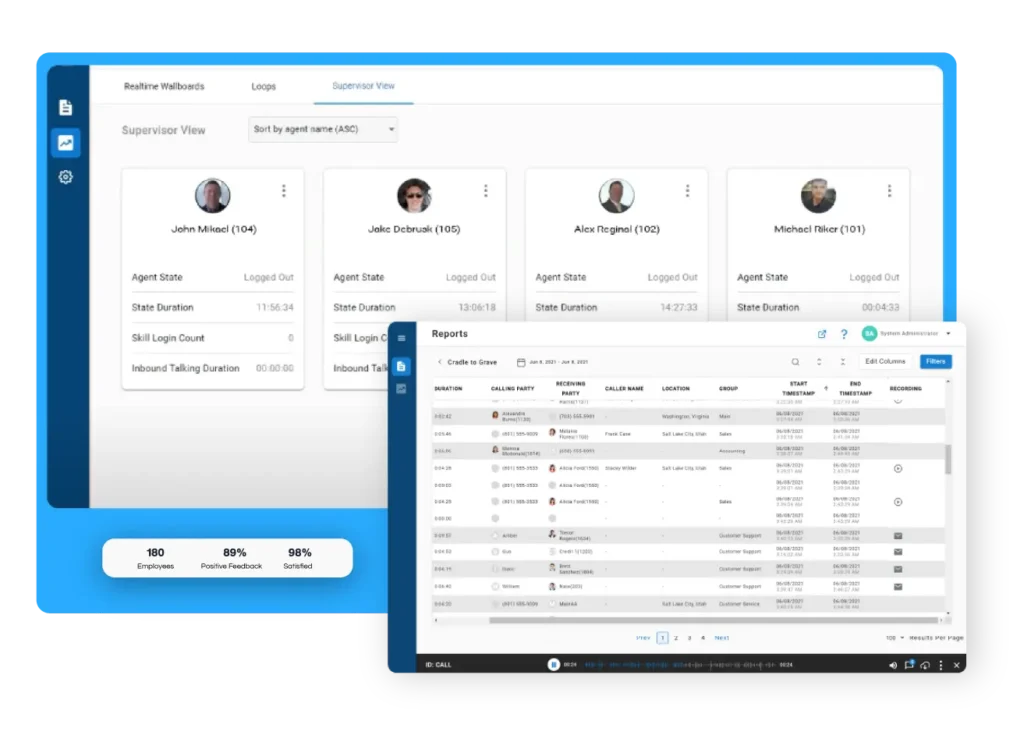
Track Every Key Metric in Real-Time: Xima provides customizable dashboards to monitor call abandonment rate, average wait time, and calls in queue. This allows you to spot problems as they happen and manage your team proactively. You’ll always have your eye on the top 5 real-time metrics every call center manager needs.
Uncover the “Why” with AI Analytics: Move beyond what is happening to why it’s happening. Xima’s AI-powered contact center analytics can analyze call data to pinpoint the root causes of abandonment, from inefficient IVR paths to specific times when you’re understaffed.
Implement Smart Solutions: The Xima platform enables critical fixes like skills-based routing and queue callback, allowing you to directly address the biggest drivers of abandoned calls and improve crucial metrics like SLA compliance in manufacturing.
Improve Overall Performance: By providing data-driven insights on agent performance, FCR, and Customer Satisfaction (CSAT)—a metric used to measure how happy customers are with a specific interaction—Xima empowers you to make continuous improvements and turn customer feedback into real-time action.
See how it works for yourself. Request a Demo today.
Conclusion
High call abandonment is a clear sign that customers are not getting the experience they expect. The primary causes—long waits, confusing IVRs, transfer limbo, lack of channel choice, and poor on-hold experiences—are all fixable problems.
Call abandonment reduction is not an insurmountable challenge. It’s about using the right data to understand customer behavior and making strategic, data-driven improvements to your processes and technology. By turning these insights into action, you can transform a point of customer frustration into an opportunity for loyalty and growth.
Ready to stop losing customers to the dial tone? Get a Demo Today and discover how Xima can help you build a better customer experience.