
In the competitive landscape of 2026, every customer interaction is a moment of truth. Your contact center is the epicenter of these interactions, handling thousands of conversations that hold a treasure trove of invaluable data: customer pain points, product feedback, agent performance markers, and emerging market trends. The challenge? Manually sifting through this mountain of audio to find insights is simply impossible.
This is where AI-powered speech analytics comes in. By leveraging artificial intelligence, contact centers can automatically transcribe and analyze 100% of their calls, transforming unstructured conversations into structured, actionable insights. This technology moves you from guessing what customers want to knowing, enabling data-driven decisions that enhance customer experience and boost operational efficiency.
This guide will explore how AI contact center analytics works, the immense benefits it delivers, and how you can implement it to unlock a new level of performance and customer understanding.
What Exactly is AI Speech Analytics?
The modern solution for understanding customer conversations at scale.
Contact center speech analytics is a technology that uses artificial intelligence (AI) to automatically analyze voice conversations between customers and agents. It captures call audio, converts it to text, and then uses Natural Language Processing (NLP) to identify keywords, topics, sentiment, and other critical data points.
Imagine a mid-sized contact center handling just 200 calls a day, with an average call length of five minutes. That team generates over 1,000 minutes of audio daily—totaling more than 30,000 minutes per month. No manager or quality assurance team could ever listen to it all. AI speech analytics solves this problem by processing every single word to give you a complete and unbiased view of your contact center’s performance. It turns millions of spoken words into clear, organized data that drives real improvement.
How Does the Technology Work? A Step-by-Step Breakdown
Understanding how speech analytics turns raw audio into strategic intelligence helps clarify its immense value. The process unfolds in three key stages, moving from raw conversation to actionable insight.
1. Capturing and Transcribing Conversations
The journey begins the moment a call starts. The AI-powered system listens to the conversation in real time or processes recorded calls, including historical archives. Using an automated speech to text for quality assurance engine, it accurately transcribes the dialogue into a searchable, machine-readable format. Modern systems can achieve up to 95% transcription accuracy, creating a reliable foundation for analysis. This capability isn’t just for live calls; it can also be used to analyze voicemails and previously recorded interactions, ensuring no customer feedback is lost.
2. Analyzing the Interaction
Once transcribed, the conversation is analyzed using Natural Language Processing (NLP) and machine learning. This goes far beyond simple keyword spotting. The system performs contact center sentiment analysis, gauging the emotional tone of both the customer and the agent by analyzing word choice, pace, and even periods of silence. It identifies recurring topics, flags compliance-related language, and categorizes the call’s intent.
It’s helpful to distinguish between two types of analysis:
Speech Analytics focuses on what was said (the words, topics, and phrases).
Voice Analytics focuses on how it was said (the tone, pitch, and emotion conveyed).
A comprehensive platform like Xima Software combines both to provide a holistic understanding of every single interaction.
3. Generating Actionable Insights
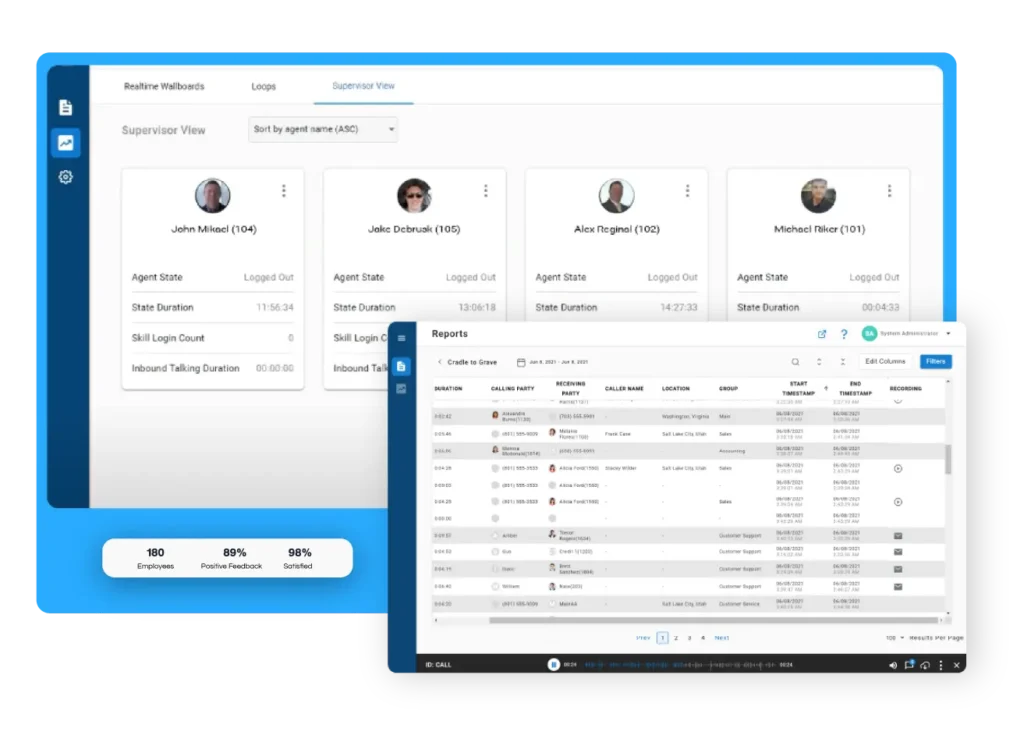
The final step is translating this complex data into clear, usable insights. Advanced analytics platforms present findings in intuitive dashboards and reports. Supervisors can see at a glance why customers are calling, whether sentiment is trending positive or negative, and if agents are adhering to scripts. With real-time analytics, managers can even receive alerts for live calls where a customer is frustrated, allowing for immediate intervention to save the interaction and the relationship.
How Does AI Improve Contact Center Performance and Customer Experience?
By systematically analyzing every call, you can drive significant improvements across your entire operation. The benefits are felt by customers, agents, and the business as a whole.
Dramatically Improved Agent Performance: By analyzing thousands of calls, you can identify the specific behaviors of your top-performing agents and turn them into a training curriculum for the entire team. AI helps pinpoint specific coaching opportunities with concrete examples, moving beyond generic feedback to data-driven performance management.
Enhanced Customer Experience (CX): Understanding why customers are frustrated allows you to fix the root cause. Are they confused by your website? Is a specific policy causing friction? Speech analytics uncovers these issues so you can resolve them, leading to higher Customer Satisfaction (CSAT), Net Promoter Score (NPS), and Customer Effort Score (CES).
Greater Operational Efficiency: Identify the most common call drivers and reasons for long handle times. This insight helps you streamline workflows, automate repetitive inquiries, and improve your First Call Resolution (FCR) rate. Features like AI-powered call summaries alone can save agents minutes of post-call wrap-up time on every interaction.
Automated Compliance and Risk Mitigation: Manually checking for compliance on a small fraction of calls is risky. Speech analytics automates this process by scanning 100% of interactions for required disclosures and sensitive data mentions (like credit card numbers), ensuring adherence to regulations like PCI-DSS and GDPR.
Valuable Business and Product Intelligence: Your customers are constantly telling you what they think about your products, services, and competitors. Speech analytics captures this “voice of the customer” data, providing your marketing and product teams with invaluable, unsolicited feedback that fuels innovation.
How Can I Implement Automated Quality Scoring for Calls?
Deploying speech analytics is a strategic initiative that, when done correctly, yields transformative results. Let’s walk through the key steps for a successful implementation.
1. Define Your Objectives
Before you evaluate any tool, start with your goals. What are you trying to achieve? Your objectives will guide your entire strategy and help measure success. Common goals include:
Reducing agent ramp-up time by 30%.
Improving CSAT scores by 10 points within six months.
Identifying the top five drivers of repeat calls this quarter.
Automating 100% of compliance checks for every agent.
2. Choose the Right Platform
Not all speech analytics solutions are created equal. When evaluating providers, ask these critical questions:
Accuracy: How precise is the transcription and sentiment analysis? Ask for a proof of concept with your own call data.
Ease of Use: Is the interface intuitive for supervisors and quality managers who need to build reports and review calls?
Integration: Does it connect seamlessly with your existing CRM and contact center platform?
Scalability: Will the solution grow with your business as call volumes increase?
A unified platform like Xima Software integrates powerful speech analytics directly into a complete Contact Center as a Service (CCaaS) solution, providing a single source of truth for all your interaction data without the headache of managing multiple vendors.
3. Train Your Team and Configure the AI
Successful adoption depends on people. Train your supervisors and QA teams not just on how to use the software, but on how to interpret the data and deliver effective, data-driven coaching. At the same time, you’ll “teach” the AI what’s important to your business by defining specific keywords, product names, competitor mentions, and call categories to track.
4. Analyze, Act, and Iterate
Collecting data is just the beginning. The real value comes from taking consistent, informed action.
Start small: Focus on one or two key goals first, like analyzing all calls with negative sentiment to find a common trend.
Establish a routine: Schedule regular meetings to review insights and trends with team leads and managers.
Create a feedback loop: Use the findings to update agent training, refine scripts, improve your knowledge base, and inform other departments like marketing and product development.
What Are the Risks and Tradeoffs to Consider?
While the benefits are compelling, adopting speech analytics requires a clear-eyed view of the potential challenges to ensure a successful deployment.
Implementation Costs and Complexity: Powerful software requires an investment. While traditional on-premise solutions can be costly and complex, modern cloud-based Software as a Service (SaaS) platforms like Xima Software significantly lower the barrier to entry with predictable subscription models and expert support.
Data Privacy and Security: You are analyzing conversations that often contain sensitive personal information. It is absolutely critical to partner with a provider that demonstrates a rigorous commitment to security with certifications like SOC 2, ISO 27001, and GDPR compliance. A data breach can erode customer trust in an instant.
Over-reliance on Automation: AI is a powerful tool to augment human intelligence, not replace it. The most effective quality programs use AI to flag calls for review and identify trends, but rely on human managers to provide the context, nuance, and personalized coaching that truly develops agents.
Understanding AI’s Limitations: No AI is perfect. Transcription engines can struggle with heavy accents, poor call quality, or industry-specific jargon. Sentiment analysis may misinterpret sarcasm or complex cultural expressions. Understanding these limitations helps you use the tool more effectively and cross-reference insights with other data points for a complete picture.
Unlock Your Conversational Data with Xima Software
AI-powered speech analytics is no longer a futuristic concept—it’s an essential tool for any business serious about understanding and serving its customers. By moving from manual spot-checks to comprehensive, automated analysis, you can improve agent performance, boost customer satisfaction, and uncover strategic insights that drive long-term business success.
Xima Software provides a complete, cloud-based contact center platform with AI speech analytics built into its core. We empower you to analyze every interaction, provide agents with the coaching they need to excel, and deliver the exceptional experiences your customers deserve.
Ready to see how contact center speech analytics can transform your operations? Request a Demo of Xima Software today.
Contact center speech analytics software uses artificial intelligence (AI) to capture, transcribe, and analyze voice interactions between customers and agents. It helps organizations uncover actionable insights related to customer sentiment, call trends, agent performance, and compliance to improve service and decision-making at scale.
AI improves performance by providing objective, data-driven insights from 100% of calls. This enables targeted agent coaching, identifies process inefficiencies, and reveals the root causes of customer dissatisfaction. By addressing these issues, businesses can reduce friction, personalize interactions, and ultimately deliver a better customer experience (CX).
Though often used interchangeably, they analyze different aspects of a conversation. Speech analytics focuses on what is said—the words, phrases, and topics discussed. Voice analytics analyzes how it is said—the speaker’s tone, pitch, and emotional state. A comprehensive solution integrates both for a complete picture.
Speech recognition first converts spoken audio into written text. Natural Language Processing (NLP) then analyzes that text to understand its meaning, context, and intent. NLP is what allows the system to identify topics, detect sentiment (positive, negative, neutral), and extract key information, turning a simple transcript into a rich source of business intelligence.