
Your customers expect answers now. Not after a five-minute hold. Not after being transferred three times. Right now. That expectation has pushed contact centers toward artificial intelligence as the operational backbone, not just a nice-to-have feature.
Xima gives contact center teams the AI-powered tools to meet those expectations without enterprise-level complexity. This guide breaks down what an AI contact center actually is, how automated call handling works, and what this technology means for your team’s daily operations in 2026.
Key Takeaways: What Is an AI Contact Center in 2026
- An AI contact center uses artificial intelligence to route calls, assist agents, and automate repetitive tasks across voice and digital channels.
- Automated call handling reduces wait times by instantly connecting customers to the right agent or self-service option.
- AI-powered quality assurance can score 100% of interactions, replacing manual sampling that covers only 1-3% of calls.
- Xima CCaaS delivers AI contact center capabilities built for SMB and mid-market teams without requiring enterprise budgets or IT overhead.
- Real-time analytics and sentiment analysis let supervisors identify issues as they happen, not days or weeks later.
What Is an AI Contact Center?
An AI contact center is a customer service operation that uses artificial intelligence to handle, route, analyze, and improve customer interactions across multiple channels. This includes voice calls, web chat, email, SMS, and social media.
Xima’s AI contact center capabilities are described on the product page.
The AI layer sits on top of your existing contact center infrastructure. It listens, learns, and acts—whether that means routing a caller to the right department, surfacing relevant knowledge articles for an agent mid-call, or flagging compliance risks in real time.
Traditional contact centers rely heavily on human decision-making for every step. AI contact centers automate the predictable parts so your agents can focus on the conversations that actually require human judgment.
How Does Automated Call Handling Work?
Automated call handling uses AI to manage inbound calls without requiring a human to answer every interaction. When a customer calls, the system identifies who they are, understands why they’re calling, and routes them accordingly.
Here’s what happens in practice: A customer calls about a billing question. The AI recognizes the caller’s phone number, pulls up their account history, and routes them directly to a billing specialist—skipping the generic “press 1 for sales” menu entirely.
If the question is straightforward (like checking an account balance), a virtual agent can handle the entire interaction. For complex issues, the AI passes the caller to a live agent along with full context about the call.
Skills-Based Routing and Queue Callback
Skills-based routing matches callers with agents who have the specific expertise to help them. A caller asking about a technical integration issue gets routed to an agent trained on integrations—not someone who primarily handles billing.
Queue callback eliminates hold time frustration. Instead of waiting on the line, customers request a callback when an agent becomes available. Xima CCaaS includes both skills-based routing and queue callback as core features, reducing average wait times and improving first-contact resolution rates.
What AI Technologies Power Modern Contact Centers?
Several AI technologies work together in a modern contact center. Understanding what each does helps you evaluate what your operation actually needs.
Speech Analytics and Natural Language Processing
Speech analytics converts spoken conversations into text and analyzes them for patterns. Natural language processing (NLP) helps the system understand intent—not just keywords.
When a customer says “I’m really frustrated with this,” the AI doesn’t just see words. It recognizes negative sentiment and can alert a supervisor or trigger specific workflows. Xima’s speech analytics and sentiment analysis capabilities give supervisors real-time visibility into call quality across every interaction.
AI-Powered Quality Assurance
Manual QA typically covers 1-3% of calls. Someone has to listen to recordings, fill out scorecards, and deliver feedback—often weeks after the interaction happened. By then, your agent has handled hundreds of other calls.
AI-powered QA scores 100% of interactions automatically. It flags compliance risks, identifies coaching opportunities, and surfaces patterns across your entire call volume. Xima’s Auto QA feature delivers this capability without requiring dedicated QA staff to manually review every call.
What Are the Core Benefits of AI in Customer Service?
AI in customer service delivers measurable operational improvements. Here’s what contact center managers can realistically expect.
Reduced Average Handle Time
When AI handles call routing, surfaces relevant information automatically, and completes routine tasks, agents spend less time on each interaction. They’re not hunting for customer history or manually logging call dispositions. The system does it for them.
Lower Call Abandonment Rates
Customers hang up when wait times exceed their patience. Automated call handling and queue callback features reduce abandonment by giving callers options other than sitting on hold. Data from Xima customers shows service levels improving from 50-70% to 90% after implementation.
Consistent Compliance and Quality
Every call gets the same level of scrutiny. AI doesn’t get tired, skip steps, or forget to check for required disclosures. For healthcare teams managing HIPAA requirements or financial services teams tracking PCI compliance, this consistency matters.
What Should SMB Contact Centers Look for in AI Solutions?
Enterprise solutions often come with enterprise complexity—and enterprise price tags. SMB and mid-market contact centers need AI capabilities that match their operational scale.
Implementation Without IT Overhead
Look for platforms designed for fast deployment. Xima CCaaS integrates with existing phone systems without requiring you to change numbers or replace hardware. The goal is getting operational quickly, not managing a six-month implementation project.
Transparent, Predictable Pricing
Evaluate platforms that offer clear pricing structures with flexible licensing. Concurrent licensing models let you pay for the capacity you actually use rather than per-seat costs that don’t reflect operational reality.
Real-Time Reporting and Dashboards
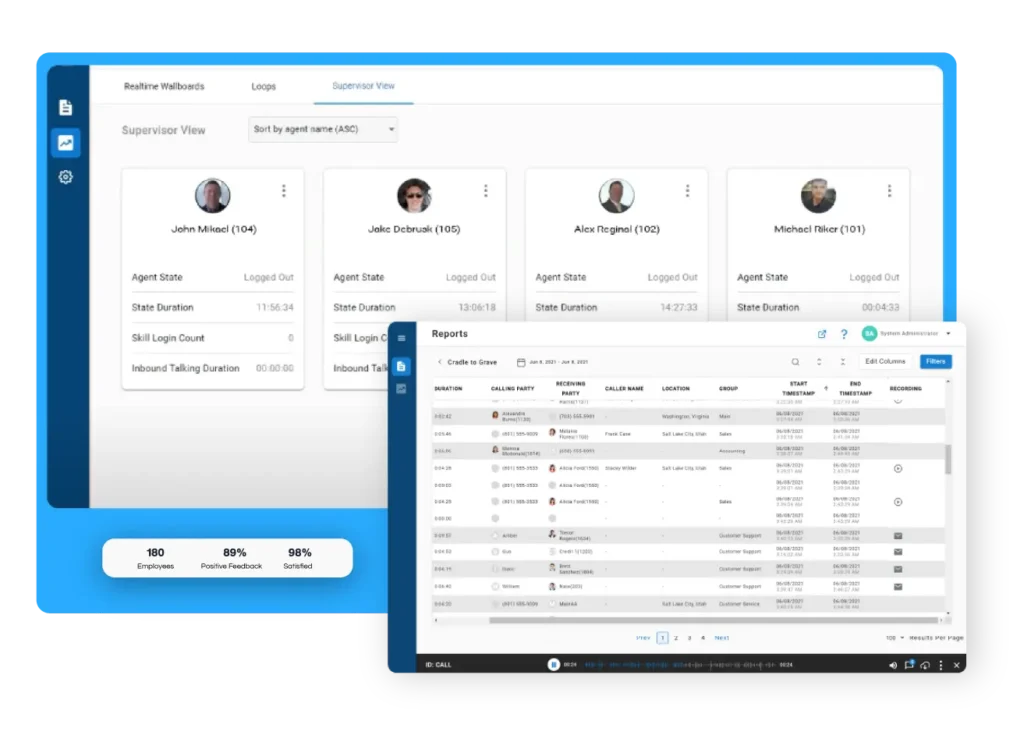
Your supervisors need to see what’s happening right now—not in a report generated overnight. Real-time wallboards and customizable dashboards turn raw data into immediate decisions. Xima’s reporting capabilities include cradle-to-grave tracking that captures every interaction from start to finish.
How AI Contact Centers Differ from Traditional Call Centers
The difference isn’t just technology—it’s operational philosophy. Traditional call centers react. AI contact centers anticipate.
In a traditional setup, a supervisor finds out about a problem call when a customer complains or when random QA sampling happens to catch it. In an AI contact center, the system flags the issue in real time. The supervisor can intervene during the call or follow up immediately after.
This shift from reactive to proactive changes everything from agent coaching to customer retention. You’re not waiting for problems to become patterns. You’re catching them as they happen.
What Does the Future Hold for AI in Contact Centers?
AI capabilities in contact centers will continue expanding. Predictive analytics will anticipate customer needs before they call. Generative AI will draft responses and suggest next-best actions for agents in real time.
The contact centers that thrive will be those that adopt AI as a tool for their agents—not a replacement. Automation handles the repetitive work. Humans handle the nuanced conversations that build customer relationships.
Xima’s approach focuses on giving SMB teams access to these capabilities without the complexity that traditionally came with enterprise contact center platforms. The technology exists. The question is whether your current setup lets you use it.
In Conclusion: Is an AI Contact Center Right for Your Team?
An AI contact center uses artificial intelligence to automate call handling, improve routing, analyze interactions, and give your supervisors real-time visibility. For SMB and mid-market teams, the technology is no longer out of reach.
The operational benefits are concrete: lower handle times, reduced abandonment, consistent compliance, and better coaching. What matters is finding a platform that delivers these capabilities without overwhelming your team or budget.
Ready to see what AI-powered contact center operations look like? Get a demo of Xima CCaaS and see how automated call handling and AI-powered QA work in practice.
FAQs About AI Contact Centers in 2026
What is the difference between a call center and an AI contact center?
A traditional call center relies primarily on human agents and manual processes. An AI contact center adds artificial intelligence to automate routing, analyze conversations, and assist agents in real time.
This means faster call handling, better routing accuracy, and consistent quality monitoring across every interaction—not just the small percentage that manual QA can cover.
How does Xima’s AI contact center solution work?
Xima CCaaS combines AI-powered features like speech analytics, automated quality assurance, and skills-based routing into a unified platform. The system integrates with your existing phone infrastructure, so you don’t need to replace hardware or change numbers.
Supervisors get real-time dashboards and wallboards. Agents get automated assistance. You get visibility into 100% of customer interactions.
Can small businesses afford AI contact center technology?
Yes. AI contact center capabilities are no longer exclusive to enterprise budgets. Xima CCaaS offers concurrent licensing and transparent pricing designed specifically for SMB and mid-market contact centers.
The key is finding platforms built for your operational scale—not stripped-down versions of enterprise tools.
What is automated call handling in a contact center?
Automated call handling uses AI to manage inbound calls—identifying callers, understanding intent, and routing them to the right destination. This includes virtual agents that handle simple requests and intelligent routing that connects complex issues to qualified agents.
Xima’s automated call handling features include queue callback, which lets customers request a callback instead of waiting on hold.
How does AI improve customer service quality?
AI improves quality by enabling consistent monitoring at scale. Instead of manually reviewing 1-3% of calls, AI-powered QA analyzes every interaction automatically.
Real-time sentiment analysis flags issues as they happen. Speech analytics identifies patterns across thousands of calls. Supervisors get actionable data instead of anecdotal samples.