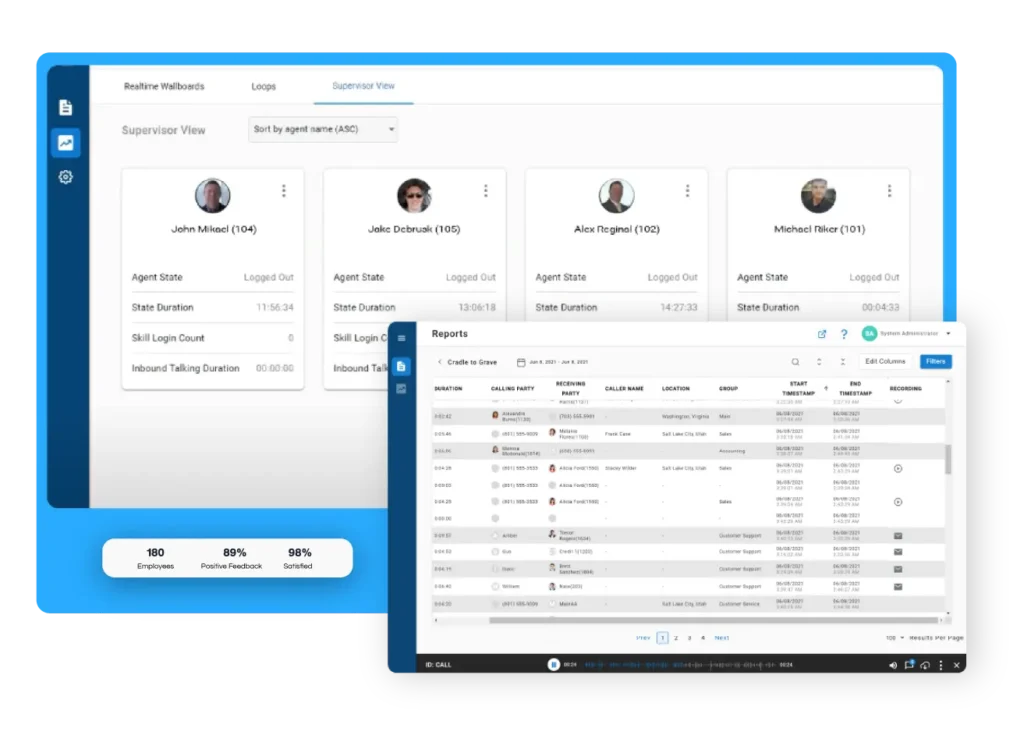
When your agents are fielding hundreds of patient calls every day, you need more than a phone system. You need real-time visibility into what’s happening right now—who’s waiting, how long they’ve been on hold, and which agents are available. That’s where real-time wallboards become essential for healthcare contact centers.
Xima Software gives healthcare contact centers the real-time wallboard visibility they need to manage patient interactions effectively while maintaining HIPAA compliance. This guide breaks down the cloud contact center tools that offer the strongest wallboard capabilities for compliance-driven teams.
Quick guide: 10 cloud contact center tools with real-time wallboards
- Xima Software: The top cloud contact center for healthcare teams needing real-time wallboards with HIPAA-ready analytics
- Genesys Cloud: An enterprise platform with customizable dashboards for large-scale operations
- Five9: A cloud option with agent performance monitoring for multi-site deployments
- Talkdesk: A platform offering real-time reporting for customer experience teams
- NICE CXone: An enterprise contact center with workforce management dashboards
- RingCentral Contact Center: A unified communications platform with supervisor monitoring
- Vonage Contact Center: A cloud platform with CRM-integrated wallboard displays
- 8×8 Contact Center: A unified platform with analytics dashboards for distributed teams
- Dialpad Contact Center: An AI-focused platform with real-time coaching features
- Nextiva Contact Center: A VoIP-based platform with call monitoring displays
How we chose the top cloud contact center tools for healthcare
For healthcare contact center leaders, choosing a CCaaS platform is about more than features. You’re balancing patient experience, regulatory requirements, and operational visibility every single day.
Xima’s real-time wallboards are covered in more detail on the feature page.
Here’s what we looked for when evaluating these platforms:
- Real-time wallboard capabilities: Can your supervisors see queue depths, wait times, and agent availability the moment something changes?
- HIPAA-readiness and compliance support: Does the platform support healthcare-specific security requirements out of the box?
- Ease of implementation: How quickly can your team get up and running without a six-month IT project?
- Reporting depth: Can you pull cradle-to-grave reports on every patient interaction?
- Integration flexibility: Does it connect with your EHR/EMR systems and existing phone infrastructure?
- Usability for supervisors: Can non-technical staff configure dashboards and wallboards themselves?
- Scalability: Will the platform grow with your contact center without requiring a complete rebuild?
The 10 top cloud contact center tools with real-time wallboards
1. Xima Software: Top cloud contact center for healthcare teams
Xima Software delivers real-time wallboard visibility that healthcare contact centers actually need—not bloated enterprise features you’ll never use. The platform shows your supervisors exactly what’s happening across every queue, every agent, and every patient interaction as it unfolds.
For healthcare operations specifically, Xima Software supports HIPAA compliance requirements while integrating with over 70 EHR systems. That means your patient data stays protected while your supervisors gain the operational awareness to make smarter decisions in the moment.
The real difference? Xima Software’s wallboards are configurable by non-technical staff. Your supervisors can build custom displays showing the metrics that matter to their specific workflows—without submitting IT tickets or waiting weeks for changes.
Xima Software features
- Real-time wallboards: Live displays showing queue status, agent availability, wait times, and service levels updated in real-time so supervisors can respond immediately when volumes spike
- Cradle-to-grave reporting: Track every patient interaction from first ring to final wrap-up, giving you complete audit trails for compliance documentation
- AI-powered quality assurance: Automated QA scoring that reviews 100% of calls—not the 1-3% that manual processes catch
- Skills-based routing: Route patient calls to agents with specific certifications or language skills, improving first-call resolution
- Queue callback: Let patients request a callback instead of waiting on hold, reducing abandonment rates and improving satisfaction
- EHR integrations: Native connections with over 70 healthcare systems, so patient information flows where your agents need it
Xima Software pros and cons
| Pros | Cons |
|---|---|
| Real-time wallboards configurable without IT support | Primarily focused on North American market |
| HIPAA-ready platform with healthcare-specific integrations | May require initial consultation to optimize EHR workflows |
| White-glove onboarding reduces implementation time | Advanced AI features available on higher service tiers |
2. Genesys Cloud: Enterprise dashboards for large-scale operations
Genesys Cloud offers a contact center platform with customizable dashboards designed for enterprise-level operations. The platform includes workforce engagement tools and omnichannel support across voice, chat, email, and social channels.
For organizations with dedicated IT resources, Genesys provides extensive configuration options. The platform’s reporting capabilities include historical and real-time views, though setup typically requires technical expertise.
Genesys Cloud features
- Customizable dashboards: Build supervisor views showing KPIs across multiple channels and queues
- Workforce engagement management: Scheduling and forecasting tools for large contact center teams
- Omnichannel routing: Handle voice, chat, email, and social interactions from one platform
Genesys Cloud pros and cons
| Pros | Cons |
|---|---|
| Extensive customization options for enterprise needs | Implementation typically requires dedicated IT resources |
| Broad omnichannel capabilities | Configuration complexity increases with feature depth |
| Workforce management tools included | Dashboard customization often requires technical training |
3. Five9: Agent monitoring for multi-site deployments
Five9 offers a cloud contact center with agent performance monitoring and real-time reporting dashboards. The platform supports distributed teams across multiple locations with centralized supervisor visibility.
The platform includes workforce optimization features and integrations with common CRM systems. Five9’s dashboards display agent status, queue metrics, and performance data for supervisors managing remote or hybrid teams.
Five9 features
- Real-time dashboards: Supervisor views showing agent status and queue metrics across locations
- Workforce optimization: Scheduling, forecasting, and quality management tools
- CRM integrations: Connections with Salesforce, ServiceNow, and other platforms
Five9 pros and cons
| Pros | Cons |
|---|---|
| Multi-site visibility from centralized dashboards | Some advanced features require additional modules |
| CRM integrations available out of the box | Reporting customization may require professional services |
| Supports remote and hybrid agent teams | Healthcare-specific integrations not as extensive |
4. Talkdesk: Real-time reporting for CX teams
Talkdesk offers a cloud contact center platform with real-time reporting and AI-assisted features. The platform includes pre-built dashboards and customizable reporting for customer experience teams.
Talkdesk’s interface emphasizes usability with drag-and-drop dashboard builders. The platform includes speech analytics and quality management capabilities for organizations focused on improving customer interactions.
Talkdesk features
- Real-time reporting: Pre-built and customizable dashboards showing live contact center metrics
- AI-assisted tools: Speech analytics and automated quality scoring capabilities
- Drag-and-drop builder: Dashboard configuration without coding requirements
Talkdesk pros and cons
| Pros | Cons |
|---|---|
| User-friendly dashboard configuration | AI features may require separate licensing |
| Pre-built reports available immediately | Healthcare-specific compliance features vary by tier |
| Speech analytics included on higher tiers | Custom integrations may require development work |
5. NICE CXone: Workforce management for enterprise contact centers
NICE CXone offers an enterprise contact center platform with workforce management dashboards and analytics capabilities. The platform supports large-scale operations with forecasting, scheduling, and real-time adherence monitoring.
The platform includes extensive reporting options and AI-powered analytics. NICE CXone’s dashboards focus on workforce performance metrics for organizations with dedicated workforce management teams.
NICE CXone features
- Workforce management: Forecasting, scheduling, and real-time adherence tracking
- Analytics platform: Historical and real-time reporting with AI-powered insights
- Quality management: Call recording, evaluation, and coaching tools
NICE CXone pros and cons
| Pros | Cons |
|---|---|
| Extensive workforce management capabilities | Platform complexity requires significant training |
| Advanced analytics and AI features | Implementation timelines often extend multiple months |
| Scales for large enterprise deployments | Configuration typically requires dedicated administrators |
6. RingCentral Contact Center: Unified communications with supervisor monitoring
RingCentral Contact Center combines unified communications with contact center functionality, offering supervisor monitoring dashboards and omnichannel support. The platform integrates with RingCentral’s broader communication suite.
The platform includes real-time dashboards showing agent status, queue metrics, and call activity. RingCentral’s unified approach works for organizations already using their phone system who want to add contact center capabilities.
RingCentral Contact Center features
- Supervisor dashboards: Real-time views of agent status, queue depths, and performance metrics
- Unified communications: Integration with RingCentral’s phone and video platform
- Omnichannel support: Voice, chat, email, and social channel management
RingCentral Contact Center pros and cons
| Pros | Cons |
|---|---|
| Integrates with existing RingCentral deployments | Contact center features separate from core UCaaS |
| Unified platform for communications and contact center | Healthcare-specific features less developed |
| Familiar interface for RingCentral users | Advanced wallboard customization may require add-ons |
7. Vonage Contact Center: CRM-integrated wallboard displays
Vonage Contact Center offers a cloud platform with CRM-integrated dashboards, particularly focused on Salesforce connectivity. The platform displays customer data alongside contact center metrics for agents and supervisors.
The platform’s wallboards pull data from CRM systems to show customer context alongside queue information. Vonage works for organizations where CRM integration is a primary requirement for their contact center operations.
Vonage Contact Center features
- CRM integration: Native Salesforce connectivity with embedded agent tools
- Real-time dashboards: Displays combining contact center and CRM metrics
- Conversation analyzer: Speech analytics for call review and coaching
Vonage Contact Center pros and cons
| Pros | Cons |
|---|---|
| Deep Salesforce integration | CRM-first approach may not fit all workflows |
| Customer context displayed alongside metrics | Non-Salesforce integrations vary in depth |
| Speech analytics available | Healthcare EHR integrations limited |
8. 8×8 Contact Center: Analytics dashboards for distributed teams
8×8 Contact Center offers a unified platform combining voice, video, and contact center capabilities with analytics dashboards. The platform supports distributed teams with centralized reporting and supervisor tools.
The platform includes real-time and historical reporting with customizable dashboards. 8×8’s unified approach integrates contact center metrics with broader communication analytics for organizations using their full platform.
8×8 Contact Center features
- Unified analytics: Combined reporting across voice, video, and contact center
- Real-time dashboards: Supervisor views of queue status and agent performance
- Quality management: Call recording and evaluation tools
8×8 Contact Center pros and cons
| Pros | Cons |
|---|---|
| Unified platform for communications and contact center | Advanced features require higher service tiers |
| Global reach with international support | Dashboard customization options vary by plan |
| Supports distributed and remote teams | Healthcare-specific integrations not a primary focus |
9. Dialpad Contact Center: AI-focused platform with real-time coaching
Dialpad Contact Center offers an AI-focused platform with real-time coaching features and voice intelligence. The platform displays live transcriptions and suggested responses during calls for agents and supervisors.
The platform’s dashboards incorporate AI-generated insights alongside traditional contact center metrics. Dialpad’s approach emphasizes in-call assistance and post-call analytics for organizations prioritizing AI-driven improvements.
Dialpad Contact Center features
- Real-time coaching: AI-powered suggestions displayed during live calls
- Voice intelligence: Live transcription and sentiment analysis
- AI-powered dashboards: Metrics combined with AI-generated insights
Dialpad Contact Center pros and cons
| Pros | Cons |
|---|---|
| Real-time AI coaching during calls | AI accuracy varies with industry terminology |
| Live transcription included | Traditional wallboard features less emphasized |
| Modern interface design | Healthcare compliance features developing |
10. Nextiva Contact Center: VoIP-based platform with call monitoring
Nextiva Contact Center offers a VoIP-based platform with call monitoring displays and supervisor tools. The platform builds on Nextiva’s business phone system to add contact center capabilities.
The platform includes real-time dashboards showing call volume, agent status, and queue metrics. Nextiva’s approach works for organizations using their phone system who want contact center features without switching platforms.
Nextiva Contact Center features
- Call monitoring: Real-time displays of call activity and agent status
- VoIP integration: Built on Nextiva’s business phone platform
- Supervisor tools: Queue management and agent monitoring capabilities
Nextiva Contact Center pros and cons
| Pros | Cons |
|---|---|
| Integrates with existing Nextiva phone systems | Contact center features less mature than dedicated platforms |
| Familiar interface for Nextiva users | Wallboard customization options more limited |
| Single vendor for phone and contact center | Healthcare-specific features not a primary focus |
Comparison table: Cloud contact center tools with wallboards for healthcare
| Platform | Healthcare EHR Integrations | No-Code Wallboard Configuration | AI-Powered QA | Queue Callback |
|---|---|---|---|---|
| Xima Software | 70+ EHR systems | ✓ | ✓ | ✓ |
| Genesys Cloud | Via third-party | ✗ | ✓ | ✓ |
| Five9 | Via third-party | ✗ | ✓ | ✓ |
| Talkdesk | Limited | ✓ | ✓ | ✓ |
| NICE CXone | Via third-party | ✗ | ✓ | ✓ |
| RingCentral | Limited | ✗ | Add-on | ✓ |
| Vonage | Limited | ✗ | Add-on | ✓ |
| 8×8 | Limited | ✗ | ✓ | ✓ |
| Dialpad | Limited | ✗ | ✓ | Add-on |
| Nextiva | Limited | ✗ | Add-on | ✓ |
Xima’s cloud contact center software includes the wallboard capabilities compared here.
What should you look for in a healthcare contact center wallboard?
Real-time wallboards do more than display numbers on a screen. For healthcare contact centers, the right wallboard gives supervisors the operational awareness they need to maintain service levels while protecting patient information.
Here’s what actually matters when you’re evaluating wallboard capabilities:
- Instant updates: Your wallboard should refresh in seconds, not minutes. When call volumes spike, you need to see it immediately—not after patients have already been waiting.
- Configurable displays: Different supervisors need different views. Your morning shift lead might focus on wait times. Your compliance manager might prioritize callback rates. The platform should let each person build what they need.
- HIPAA-appropriate data handling: Even your wallboard data needs to be protected. Make sure the platform doesn’t expose patient identifiers on public displays.
- Historical context: Real-time data tells you what’s happening now. But you also need to see how today compares to yesterday, last week, and last month.
How do real-time wallboards improve healthcare contact center performance?
The operational reality for most healthcare contact centers is this: supervisors can’t be everywhere at once. Real-time wallboards extend their visibility across the entire operation.
When a wallboard shows queue depth climbing past acceptable thresholds, supervisors can redirect resources before patients start abandoning calls. When average handle times spike for a specific queue, supervisors can investigate before the backlog compounds.
Xima Software customers report measurable improvements after implementing real-time wallboards. Healthcare organizations using Xima’s wallboards have improved service levels from 50-70% to 90% by giving supervisors the visibility to respond immediately when conditions change.
That’s not an abstract benefit. That’s fewer patients waiting on hold and more time for your agents to focus on actually helping people.
Why Xima Software is the top cloud contact center for healthcare teams
For healthcare contact center leaders, the question isn’t whether you need real-time visibility. The question is whether your current platform gives you enough of it—and whether you can actually configure it without submitting IT tickets.
Xima Software addresses the specific operational realities healthcare contact centers face every day. Native EHR integrations with over 70 systems mean patient data flows where your agents need it. HIPAA-ready infrastructure means you’re not scrambling to prove compliance when auditors arrive. Real-time wallboards configurable by supervisors—not IT—mean your team can adapt displays as operational priorities shift.
The difference between Xima Software and enterprise contact center platforms isn’t just features. It’s usability. Your supervisors can build custom wallboards showing exactly what they need without technical training. Your compliance team gets complete audit trails for every patient interaction. Your agents get the context they need to help patients faster.
Request a demo to see how Xima Software’s real-time wallboards give healthcare contact centers the visibility they actually need.
FAQs about cloud contact center tools with wallboards
What is a contact center wallboard?
A contact center wallboard is a real-time display showing live operational metrics like queue depth, wait times, agent availability, and service levels. Supervisors use wallboards to monitor contact center performance and respond quickly when conditions change.
Xima Software’s wallboards update in real-time and can be configured by non-technical staff to show the specific metrics each supervisor needs.
Why do healthcare contact centers need real-time wallboards?
Healthcare contact centers handle high-stakes patient communications where delays directly impact satisfaction and outcomes. Real-time wallboards give supervisors immediate visibility into queue conditions so they can reallocate resources before patients start abandoning calls.
Xima Software’s wallboards help healthcare teams maintain service levels while protecting patient information under HIPAA requirements.
What metrics should appear on a contact center wallboard?
Essential wallboard metrics include queue depth, average wait time, service level percentage, agents available, and calls in progress. Healthcare contact centers often add metrics like callback requests and patient callback completion rates.
Xima Software lets supervisors configure custom wallboard displays showing exactly the metrics relevant to their specific workflows and compliance requirements.
How does Xima Software handle HIPAA compliance for contact centers?
Xima Software supports HIPAA compliance through encrypted data handling, role-based access controls, complete audit trails for every interaction, and integrations with over 70 EHR systems. The platform is designed for healthcare operations where patient data protection is a core requirement.
Can supervisors configure Xima Software wallboards without IT support?
Yes. Xima Software’s wallboards are designed for non-technical users. Supervisors can create custom displays, add or remove metrics, and adjust thresholds without coding or IT assistance. This means your team can adapt wallboard configurations as operational priorities change.
What EHR systems does Xima Software integrate with?
Xima Software integrates with over 70 EHR/EMR systems, enabling patient information to flow directly into agent screens during interactions. These native integrations eliminate the need for agents to switch between systems while helping patients.