
What Is Call Center Compliance?
It applies to a wide range of operations, including sales, customer service, collections, and SMS messaging, and focuses on maintaining clear customer consent, transparency, and secure handling of sensitive information. In practice, compliance is about more than avoiding fines or legal risk—it directly impacts customer trust, brand reputation, and revenue by helping businesses deliver consistent, secure, and professional experiences. As contact centers handle increasing volumes of voice and digital interactions, real-time visibility through analytics, monitoring, and reporting tools has become essential for identifying risks early, maintaining policy adherence, and ensuring compliance across every customer touchpoint.
Key Call Center Regulations and Standards You Need to Know
Modern contact centers operate under a growing mix of federal, state, global, and industry-specific regulations that govern how businesses communicate with customers, store data, record conversations, and process sensitive information. These rules affect everything from outbound dialing practices and SMS campaigns to payment processing and customer data retention. Since many organizations manage both inbound and outbound interactions across multiple channels, maintaining compliance often requires a combination of clear internal policies, employee training, secure technology, and ongoing monitoring.
Xima’s contact center compliance capabilities address the standards listed here.
TCPA and TSR Requirements for Outbound Calls
The Telephone Consumer Protection Act (TCPA) and Telemarketing Sales Rule (TSR) establish strict rules for outbound calling and messaging activities. These regulations govern how businesses obtain and document customer consent, when calls or texts can legally be placed, and how autodialers, prerecorded messages, AI-generated voices, and robocalls can be used. They also require organizations to comply with National Do Not Call (DNC) lists and provide clear disclosures during sales interactions. Operationally, this means contact centers need reliable processes for consent tracking, call monitoring, campaign reporting, and suppression list management to reduce compliance risk.
Recording and retention are handled through Xima’s call recording.
Data Privacy Regulations (GDPR, CCPA, CPRA)
Data privacy laws such as GDPR in Europe and CCPA/CPRA in California focus on how businesses collect, store, share, and protect customer information. For contact centers, these regulations directly impact call recording practices, transcript storage, customer consent notifications, and data retention policies. Organizations must ensure customers understand when calls are being recorded, how their data is being used, and what rights they have regarding access or deletion requests. As more centers adopt AI-powered analytics, transcription, and cloud-based communication tools, maintaining visibility into data access and storage has become increasingly important for privacy compliance.
Payment and Industry-Specific Standards (PCI DSS, HIPAA, FDCPA)
Contact centers that process payments or operate in regulated industries face additional compliance obligations. PCI DSS establishes strict standards for handling payment card information during customer calls, including preventing sensitive card details such as CVV numbers and full payment data from being stored in recordings or transcripts. Healthcare organizations must also comply with HIPAA requirements for protecting patient health information, while collections teams must follow FDCPA regulations governing debt collection communications and consumer protections. In many cases, contact centers must comply with several overlapping regulations simultaneously, making centralized reporting, secure recordings, real-time monitoring, and layered compliance controls essential for reducing operational risk.
Common Call Center Compliance Challenges
Maintaining compliance in a modern contact center is becoming increasingly difficult as organizations manage growing volumes of customer interactions across voice, SMS, email, and digital channels. Many contact centers operate under multiple overlapping regulations at once, and even small gaps in policy enforcement or monitoring can create significant legal, financial, and reputational risks. As communication technologies evolve, businesses need stronger visibility into customer interactions and agent activity to consistently maintain compliance standards.
Managing Consent and Customer Data
One of the biggest compliance challenges for contact centers is obtaining, managing, and documenting customer consent across multiple communication channels and systems. Organizations must track permission for outbound calls, SMS campaigns, prerecorded messages, AI-generated voice interactions, and call recordings while maintaining accurate records that can be referenced during audits or disputes. At the same time, contact centers must carefully manage how customer data, recordings, and transcripts are stored to avoid exposing sensitive information such as payment details or protected personal data.
Monitoring Agent Behavior at Scale
As contact centers grow, it becomes harder to consistently monitor agent performance and ensure compliance across every customer interaction. Agents may unintentionally skip required disclosures, mishandle sensitive information, or deviate from approved scripts during high-volume periods. Traditional manual quality assurance processes only review a small percentage of interactions, which increases the risk of compliance issues going unnoticed. Real-time monitoring, speech analytics, and centralized reporting tools help supervisors identify risky behaviors faster and improve coaching efforts before issues escalate.
Keeping Up With Evolving Regulations
Compliance requirements continue to change rapidly, particularly around AI technology, automated dialing systems, robocalls, consumer privacy, and digital communications. Regulations such as TCPA, GDPR, CCPA/CPRA, HIPAA, and FDCPA are frequently updated or interpreted differently across regions and industries, making it difficult for businesses to keep internal policies aligned. Contact centers also face ongoing challenges around one-party versus two-party consent laws for call recording, as well as maintaining secure access controls for recordings, transcripts, and customer records. To reduce risk, organizations need flexible compliance processes supported by reporting and analytics tools that can quickly surface issues and adapt to changing regulatory requirements.
Risks and Business Impact of Non-Compliance
Failing to maintain call center compliance can expose organizations to serious legal and financial consequences. Regulations such as TCPA, TSR, GDPR, HIPAA, and PCI DSS carry significant penalties for violations involving unauthorized calls, improper consent management, insecure handling of customer data, or unlawful recording practices. In some cases, businesses may also face lawsuits, regulatory investigations, or mandatory audits that increase operational pressure and create long-term compliance obligations. Beyond direct fines, non-compliance often forces contact centers to dedicate substantial IT, legal, and operational resources toward remediation efforts, delaying other strategic initiatives and increasing internal oversight requirements.
The business impact extends far beyond regulatory penalties alone. Compliance failures can damage customer trust, increase churn, and make it harder to win new business or maintain partnerships with security-conscious clients. Organizations may also face restrictions on outbound campaigns, tighter approval processes, or reduced flexibility for agents and supervisors while corrective measures are implemented. For operations and business leaders, reducing compliance risk is closely tied to measurable performance metrics such as fewer customer complaints, fewer disputes, improved QA scores, stronger customer satisfaction, and more consistent operational performance across teams.
Best Practices to Strengthen Call Center Compliance
Establish Clear Compliance Policies
Strong compliance programs begin with clear, documented policies that outline how agents, supervisors, and administrators should handle customer interactions, recordings, consent, and sensitive data. These policies should directly map regulations such as TCPA, GDPR, HIPAA, FDCPA, and PCI DSS to practical day-to-day procedures so teams understand exactly what is expected during inbound and outbound communications. Clear documentation also helps standardize processes across departments and provides a consistent framework for audits, onboarding, and ongoing compliance management.
Train Agents and Supervisors Regularly
Ongoing training is essential because compliance requirements, customer expectations, and communication technologies continue to evolve. Contact centers should provide role-specific training for agents, supervisors, QA teams, and system administrators that includes real-world examples of compliant and non-compliant behavior. Regular refreshers help reinforce critical areas such as consent collection, required disclosures, payment handling, and secure customer authentication procedures. Consistent coaching also reduces the likelihood of accidental violations caused by process gaps or inconsistent interpretation of policies.
Standardize Scripts and Disclosures
Using approved scripts, disclosures, and consent language helps contact centers maintain consistency across customer interactions while reducing compliance risk. Standardized messaging ensures agents deliver required disclosures correctly during sales calls, collections conversations, outbound campaigns, and recorded interactions. Organizations should also maintain version-controlled documentation so updates to legal language, policies, or regulations can be deployed quickly across teams. This becomes especially important when regulations around AI-generated voices, robocalls, and customer privacy requirements change.
Secure Call Recording and Data Handling
Call recordings, transcripts, and customer records often contain sensitive personal and financial information, making secure data handling a critical part of compliance. Contact centers should use compliant communication platforms that support encrypted storage, role-based access controls, retention management, and secure integrations with existing business systems. For organizations handling payment information, tools that automatically pause or redact recordings during payment collection can help reduce PCI DSS risk exposure. Maintaining strong security controls also improves visibility into who can access recordings, transcripts, and customer data across the organization.
Monitor Performance and Conduct QA Reviews
Continuous monitoring and quality assurance help contact centers identify compliance issues before they become larger operational or legal problems. Many organizations still rely on manual QA processes that only review a small percentage of calls, which creates significant blind spots and increases risk exposure. Solutions like Xima’s Auto QA help contact centers evaluate 100% of interactions using automated scoring, speech analytics, and compliance monitoring tools, giving supervisors far greater visibility into agent performance and potential policy violations. Combined with scorecards, targeted coaching, and real-time reporting, automated QA processes make it easier to detect recurring issues early and improve compliance consistency across teams.
Perform Regular Audits and Reviews
Regular audits help validate that documented policies match actual day-to-day operations. Contact centers should periodically review call recordings, consent records, scripts, access controls, retention policies, and reporting workflows to identify gaps or outdated processes. Collaborating with internal legal teams, compliance officers, or external advisors can also help organizations stay aligned with changing regulations and industry standards. Ongoing reviews create opportunities to strengthen policies proactively instead of reacting after complaints, violations, or audit findings occur.
Using Analytics and Reporting to Prove and Improve Compliance
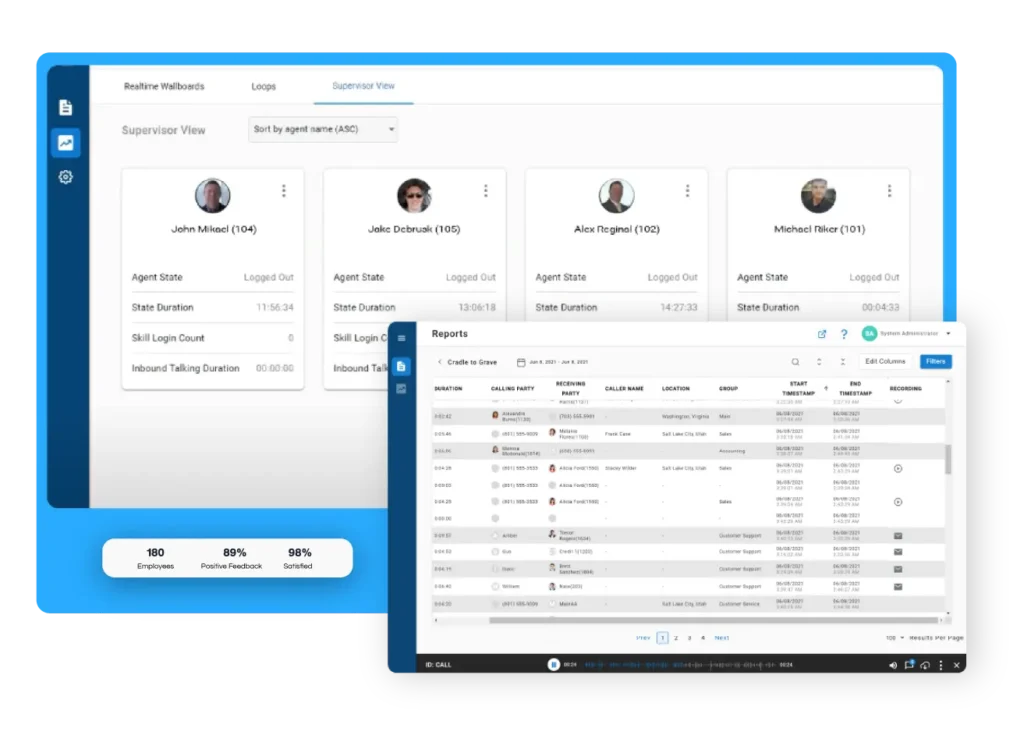
Modern contact centers generate enormous amounts of operational and customer interaction data every day, but without the right reporting and analytics tools, it can be difficult to identify compliance risks before they become larger problems. Real-time dashboards and centralized reporting give supervisors, compliance teams, and business leaders greater visibility into agent activity, customer interactions, and operational trends so they can detect issues earlier and respond more confidently. Instead of relying on reactive investigations after complaints or violations occur, organizations can use data to proactively strengthen compliance performance across teams and communication channels.
Real-time monitoring tools help surface risky behaviors as they happen, making it easier to address issues before they escalate. Supervisors can identify patterns such as agents skipping required disclosures, exceeding approved calling windows, mishandling opt-out requests, or overusing certain call dispositions that may indicate compliance concerns. This level of visibility allows managers to intervene quickly, provide targeted coaching, and improve operational consistency without waiting for manual audits or customer complaints to reveal problems.
Call recording, transcription, and speech analytics also play a critical role in verifying compliance requirements and improving quality assurance efforts. Speech analytics tools can automatically identify required consent language, detect prohibited phrases, flag high-risk conversations, and uncover recurring compliance trends across large volumes of interactions. Combined with automated QA solutions like Xima’s Auto QA, contact centers can evaluate 100% of calls instead of manually reviewing only a small sample of interactions. This creates a far more accurate picture of compliance performance while helping supervisors prioritize coaching and corrective action more effectively.
Standardized reporting further simplifies audits and documentation by creating consistent records of customer interactions, consent management, and campaign activity. Organizations can generate reports showing proof of consent, outbound call activity, DNC compliance, opt-out handling, recording access history, and other operational data needed for regulatory reviews or internal audits. Integrations with major telephony and contact center platforms such as Cisco, Mitel, and Avaya also help centralize visibility across distributed teams, locations, and communication systems, reducing the complexity of managing compliance across the organization.
With the right analytics and reporting strategy, compliance becomes more than a reactive obligation—it becomes an ongoing, data-driven operational program. Improved visibility helps organizations reduce risk, strengthen accountability, simplify documentation, and make faster, more informed decisions across operations and IT teams. Platforms like Xima give contact centers the tools to monitor performance in real time, automate QA processes, and maintain audit-ready reporting that supports both operational efficiency and regulatory compliance. For organizations looking to simplify compliance management and reduce risk exposure, exploring Xima’s analytics capabilities or requesting a demo can provide a clearer path toward more proactive compliance operations.
Call Center Compliance FAQs
Call center compliance refers to following the laws, regulations, and internal policies that govern customer communications, call recordings, data handling, consent management, and outbound calling practices. It applies across voice, SMS, and digital interactions and helps organizations reduce legal risk while protecting customer trust and data security.
Non-compliance can lead to regulatory fines, lawsuits, customer complaints, operational disruptions, and reputational damage. Organizations may also face audits, increased oversight, restrictions on outbound campaigns, and higher operational costs related to remediation and legal support.
Yes. Small call centers are generally required to follow the same regulations as larger organizations, including rules related to customer consent, data privacy, call recording, and payment security. The specific requirements may vary depending on industry, location, and communication channels, but business size does not eliminate compliance obligations.
Call centers typically track customer consent through CRM systems, call recordings, SMS opt-in records, web forms, and integrated reporting tools. Many organizations also use analytics and audit logs to document when consent was collected, what customers agreed to, and how that information is stored for compliance purposes.
Yes. Modern call center software can support compliance through features such as call recording, speech analytics, automated QA, consent tracking, secure data storage, reporting dashboards, and role-based access controls. These tools help organizations monitor interactions more effectively, identify risks earlier, and maintain audit-ready documentation across teams and communication channels.