
Key Takeaways
- AI speech analytics lets supervisors monitor 100% of calls for coaching opportunities instead of relying on random spot-checks.
- Sentiment and intent signals surface in real time, so supervisors can intervene during a call, not just after it.
- Pattern detection across agents, queues, and time periods replaces gut-feel coaching with objective, repeatable feedback.
- Small contact centers on Cisco, Mitel, or Avaya can add AI speech analytics without replacing their existing infrastructure.
Why Call Visibility Is the Biggest Gap for Small Business Supervisors
Most small business contact center supervisors simply do not have enough visibility into what happens on the majority of customer calls. A typical day is spent balancing schedules, answering agent questions, monitoring queues, and responding to issues as they arise. That leaves very little time to review recordings or evaluate conversations one by one.
As a result, coaching often depends on a small sample of interactions rather than the full picture. Quality assurance reviews become inconsistent, recurring customer issues go unnoticed, and trends across agents or shifts can take weeks to surface. By the time a performance issue shows up in service levels or customer feedback, the opportunity to correct it may already have passed.
For many teams, the challenge is not collecting more data. It is finding a practical way to turn every conversation into something that supports better coaching, stronger quality assurance, and more informed operational decisions.
What AI Speech Analytics Gives Supervisors That Manual Review Can’t
Manual call reviews have always been a valuable part of quality assurance, but they simply do not scale. A supervisor can only review a limited number of conversations each day, which means important coaching opportunities often go unnoticed.
AI-powered speech analytics changes that by automatically capturing, transcribing, and analyzing every customer conversation. Instead of relying on random spot checks, supervisors gain visibility into every interaction and can quickly identify where agents need support, where customers are becoming frustrated, and where processes create unnecessary friction. Xima’s speech analytics is documented on the channel page.
The technology behind AI speech analytics includes automatic speech recognition (ASR), Natural Language Processing (NLP), and machine learning. Supervisors do not need to understand how those technologies work behind the scenes. What matters is the outcome. Instead of spending hours listening to recordings, they receive meaningful insights that help them prioritize coaching, improve quality, and respond to problems sooner.
This broader visibility also changes the way supervisors approach performance management. Rather than asking which calls should be reviewed, they can focus on why certain interactions stand out. They can identify which call types consistently create challenges, where scripts begin to break down, and how customer sentiment changes over time.
Organizations investing in artificial intelligence in the call center are finding that AI is most valuable when it helps supervisors make faster, more confident decisions. It removes much of the manual effort involved in reviewing conversations while giving managers a clearer understanding of what is happening across the contact center every day.
Spotting Coaching Opportunities Across Every Call
One of the biggest advantages of AI speech analytics is that it helps supervisors spend less time searching for coaching opportunities and more time acting on them. Instead of reviewing calls at random, the system continuously identifies conversations that deserve attention.
- Automated call scoring
AI can evaluate every interaction against your existing quality assurance criteria and automatically flag calls that fall short of expectations. Supervisors no longer have to guess which conversations should be reviewed first because the highest-priority interactions are already surfaced. - Performance patterns across multiple conversations
One difficult call rarely tells the full story. AI speech analytics highlights repeated behaviors across an agent’s conversations, whether that is missing required disclosures, struggling with objection handling, or ending calls before fully resolving the customer’s issue. Those patterns create much stronger coaching opportunities than isolated examples. - Comparisons across agents and teams
Supervisors can also identify broader performance trends rather than focusing solely on individuals. If multiple agents are experiencing similar challenges, the issue may point to a training gap, a confusing process, or outdated knowledge resources rather than individual performance. - Objective coaching supported by data
Coaching conversations become more productive when they are backed by measurable information. Instead of relying on impressions, supervisors can show agents recurring trends, explain how those behaviors affect customer outcomes, and measure improvement over time.
AI-powered speech analytics does not replace supervisor experience. It gives supervisors a more complete picture so they can spend their time where it has the greatest impact.
Real-Time Sentiment and Intent: What Supervisors Can See During a Call
Traditional reporting tells supervisors what happened after the interaction has already ended. AI speech analytics adds another layer by showing how conversations are evolving in real time.
Within a live dashboard, supervisors can see sentiment signals that indicate whether a conversation is moving in a positive or negative direction. A noticeable change in tone, increasing frustration, repeated interruptions, or long periods of silence may all suggest that the interaction needs attention before it escalates.
Intent detection provides another valuable layer of context. Customers do not always explain their needs clearly, but AI can identify common themes and recognize what they are trying to accomplish based on the conversation itself. That helps supervisors understand why customers are calling and whether existing routing, training, or self-service options are working as intended.
Combined with reporting and analytics, these real-time insights allow supervisors to respond much earlier. They can quietly coach an agent during a difficult conversation, step into a call when necessary, or identify operational issues before they begin to affect broader performance metrics.
Surfacing Trends Before They Become Problems
A single difficult call can happen to any agent. The real value of AI speech analytics comes from recognizing when the same issue appears repeatedly across dozens or even hundreds of conversations.
Instead of waiting for customer complaints or declining service levels to highlight a problem, supervisors can identify trends as they develop. This shifts the focus from reacting to individual calls to improving the overall operation.
Repeated customer questions are one of the first indicators. If customers continue to ask about billing, product changes, or a confusing policy, that often points to a larger issue beyond agent performance. Those insights can help teams update internal documentation, improve IVR menus, or adjust customer communications before call volume continues to climb.
Agent performance trends also become much easier to identify. Rather than reviewing isolated quality scores, supervisors can see how performance changes over days or weeks. That makes it easier to determine whether coaching is working or whether an agent needs additional support.
Queue-level analysis provides another layer of visibility. Supervisors can quickly identify which queues consistently generate longer handle times, lower quality scores, or more escalations. Those patterns often reveal workflow or staffing challenges that individual call reviews would never uncover.
When combined with contact center reporting and key metrics, these conversation trends provide a much clearer picture of overall performance. Reporting shows where key metrics are changing, while AI speech analytics explains the customer interactions driving those results.
Those insights also support better workforce management decisions. Supervisors can adjust staffing, prioritize coaching, and plan schedules based on actual customer demand rather than assumptions.
Leading AI Speech Analytics Providers: How to Orient Yourself
As more contact centers adopt AI-powered speech analytics, buyers are finding a wide range of speech analytics platforms. Some are built into larger Contact Center as a Service (CCaaS) suites, while others focus specifically on conversation intelligence and analytics.
Large enterprise platforms often combine speech analytics with a broad collection of contact center capabilities. Standalone analytics platforms typically prioritize deeper conversation analysis and transcription. SMB-focused platforms emphasize ease of deployment, practical reporting, and operational visibility without requiring organizations to replace existing infrastructure.
Accuracy, real-time visibility, reporting depth, deployment flexibility, and pricing will often have a greater impact than an extensive feature list.
Provider | Type | Key Strength | Best Fit |
|---|---|---|---|
NICE CXone | CCaaS suite with built-in analytics | Enterprise-scale analytics across voice and digital channels | Large organizations with complex contact center environments |
Genesys Cloud CX | CCaaS suite with built-in analytics | Broad AI capabilities with workforce engagement tools | Mid-sized and enterprise teams already using Genesys |
Talkdesk | CCaaS suite with built-in analytics | Fast deployment and growing AI capabilities | Mid-market and enterprise organizations looking for an all-in-one cloud platform |
CallMiner Eureka | Standalone analytics specialist | Deep conversation intelligence and transcription | Organizations prioritizing advanced analytics |
Gong | Standalone analytics specialist | Revenue-focused conversation analysis | Sales organizations and outbound teams |
Xima Software | SMB-focused analytics platform | Real-time visibility, QA workflows, and actionable analytics designed for lean teams | Small and mid-sized contact centers looking for an all-in-one cloud platform |
Many SMBs are not looking for a complete platform replacement. They simply want better visibility into customer conversations. That is where an analytics-first approach can provide meaningful improvements without creating unnecessary operational disruption.
If your organization already relies on Cisco, Mitel, Avaya, or another established phone system, look for platforms that can build on your existing investment rather than requiring a complete migration. For many teams, on-premises solutions remain the right fit because of security requirements, legacy integrations, or internal infrastructure. Modern AI speech analytics can complement those environments by adding deeper reporting, conversation intelligence, and quality management without disrupting day-to-day operations.
How Xima Gives Supervisors the Visibility They’re Missing
Supervisors should not have to spend hours reviewing recordings just to understand what happened during the day.
Xima helps solve that challenge by bringing together real-time visibility, conversation analytics, and quality management into a single workflow designed for contact center operations.
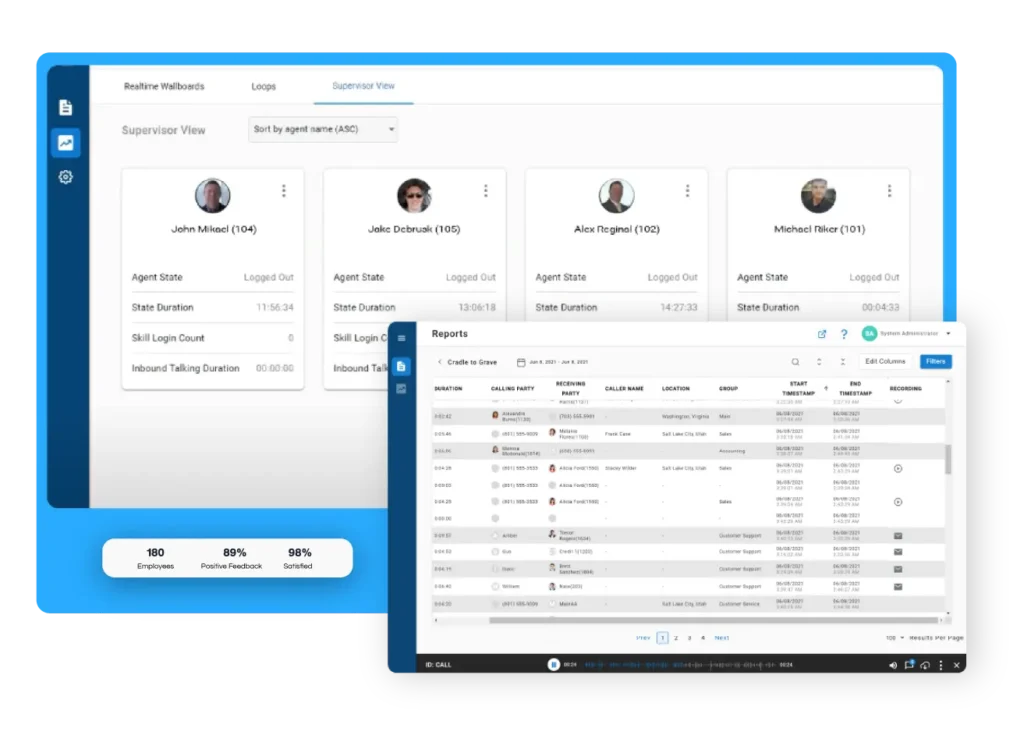
With Reporting and Analytics, supervisors can move beyond static reports and understand performance as it changes throughout the day. Live dashboards, custom reports, and historical trends make it easier to identify operational issues before they affect service levels.
Cradle-to-Grave Reporting provides complete visibility into every interaction, allowing supervisors to understand the full customer journey rather than reviewing isolated moments in a conversation. That context helps uncover the root cause of recurring issues much faster.
AI Speech Analytics and Auto QA extend that visibility even further by identifying coaching opportunities, surfacing sentiment changes, and automatically highlighting conversations that warrant additional review. Instead of manually searching through recordings, supervisors receive actionable insights that help them focus on improving agent performance.
Together, these capabilities give small and mid-sized contact centers the same level of operational intelligence often associated with much larger organizations, while remaining practical to deploy and easy to use.
If you’re ready to see how AI speech analytics can improve coaching, reporting, and operational visibility, explore contact center solutions for SMBs or request a personalized demo to see how Xima fits your environment.
FAQs
AI speech analytics highlights patterns that are difficult to identify through manual reviews alone. Supervisors can see customer sentiment, recurring conversation topics, coaching opportunities, compliance concerns, and quality trends across every interaction, rather than reviewing only a small sample of calls.
Call recording stores conversations for later review. AI speech analytics automatically analyzes those conversations, identifying trends, scoring interactions, detecting customer sentiment, and surfacing coaching opportunities without requiring supervisors to listen to every recording.
Yes, many organizations add AI speech analytics alongside their existing communications infrastructure rather than replacing it entirely. This approach allows teams to improve reporting and coaching while continuing to use their current phone system.
Instead of relying on random quality reviews, supervisors receive consistent coaching opportunities based on actual performance patterns across many interactions. That makes coaching more objective, more focused, and easier to measure over time.
Changes in tone, increasing frustration, repeated interruptions, extended silence, and recurring negative language often indicate that a conversation is moving in the wrong direction. Recognizing those signals early allows supervisors to provide support before the interaction escalates.