
There’s a version of compliance that lives in your legal department. It shows up in annual audits, gets handed to a specialist, and mostly stays out of your way.
And then there’s the version that lives in your contact center.
Every call your agents handle, every account number a customer reads out loud, every consent form discussed over the phone, every service record tied to an address or a medical file: that’s all data. And in 2026, regulators, auditors, and customers are paying a lot more attention to what happens to it.
Contact Center Pipeline’s May issue put it plainly: security and compliance have become front-line priorities, not back-office ones. AI-driven interactions, cloud platforms, and distributed workforces have made contact centers one of the most data-dense environments in any organization. And most contact center managers are running on tools that were built before that was true.
The visibility problem most teams don’t know they have
Here’s a question worth sitting with: if a compliance issue surfaced in a call from three weeks ago, how long would it take you to find it?
For a lot of teams, the honest answer is “a while.” Manual call reviews cover somewhere between 2 and 5 percent of total volume. The rest goes unreviewed. That means if an agent missed a required disclosure, handled sensitive data incorrectly, or deviated from a compliance script, there’s a very good chance no one caught it.
That’s not a staffing problem. It’s a visibility problem. And it shows up differently depending on what industry you’re in.
Financial services and credit unions
In financial services, the stakes around a missed disclosure or an improperly handled account interaction aren’t just operational. They’re regulatory. GLBA, PCI DSS, and an expanding set of state-level requirements mean that consent logging, data handling, and interaction records are all fair game in an audit.
The contact center is where a lot of that compliance either holds or breaks down. Agents are having real conversations with real customers about sensitive financial matters, often without supervisors listening. When something goes wrong, the question is always the same: do you have a record of what actually happened?
Modern AI-powered QA tools change that. Instead of sampling a handful of calls, they evaluate every interaction, flag missed disclosures in real time, and automatically log the data supervisors need to respond to audits confidently. It’s the difference between hoping nothing slipped through and knowing. Xima’s contact center software for financial services covers these requirements.
Healthcare
Healthcare contact centers operate under HIPAA, which means every call that touches patient information carries risk if it’s handled incorrectly. A misrouted call, an agent who didn’t pause the recording before a patient read out sensitive information, a consent conversation that wasn’t documented: any of these can create liability.
The complexity is compounded by the fact that patients are increasingly reaching out through multiple channels. Voice, web chat, email, text. Compliance has to hold across all of them, not just the ones that are easiest to monitor.
Speech analytics designed for healthcare environments can automatically flag calls where protected health information may have been handled outside protocol. That means faster review, faster correction, and a much cleaner audit trail when it’s needed.
Manufacturing and energy
At first pass, manufacturing and energy don’t look like compliance-heavy industries. You build things, you deliver things, you support customers when something goes wrong.
But look closer. Payment data comes through service lines. Addresses and account details are exchanged on order calls. If you’re in defense contracting, ITAR may apply. And increasingly, warranty and service records are tied to digital systems that create their own data footprint.
The compliance exposure in a manufacturing or energy contact center isn’t as visible as in healthcare or finance, but it’s real. And the same tools that help financial services teams lock down sensitive interactions, automated QA, real-time monitoring, cradle-to-grave call records, serve manufacturers just as well.
What the right platform actually changes
The gap between a compliant contact center and a reactive one usually isn’t intent. Most teams know what they’re supposed to do. The gap is visibility.
When you can see 100 percent of your interactions, score them against compliance benchmarks automatically, and pull a complete record of any call from any date in seconds, compliance stops being something you scramble for during audits. It becomes something your operation produces naturally.
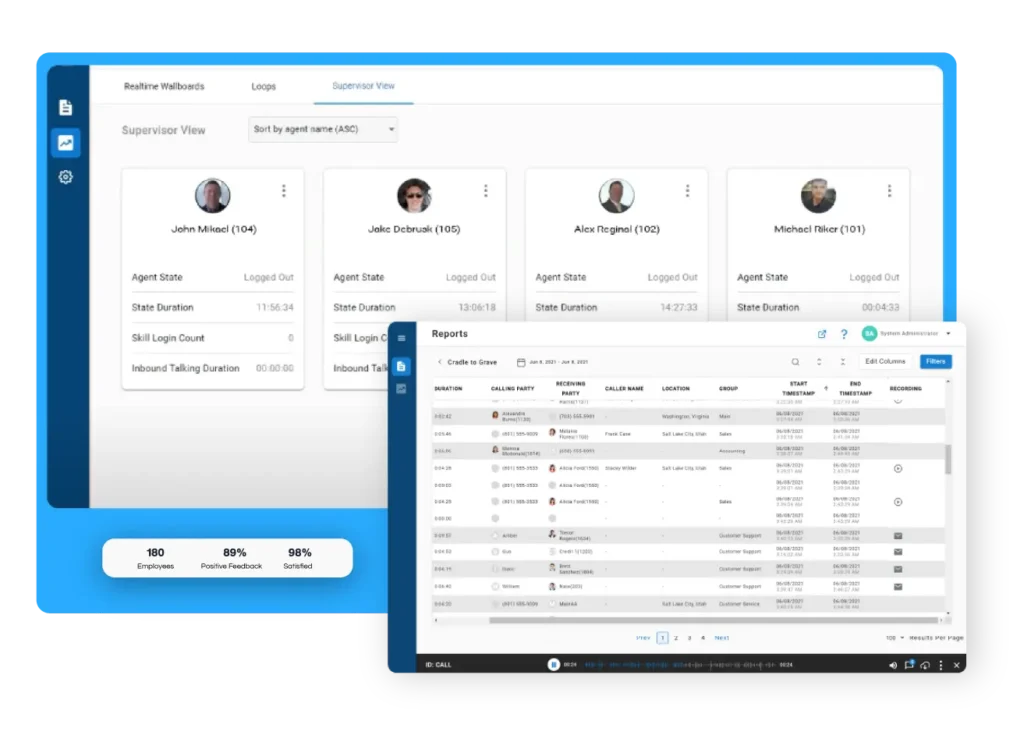
That’s what Cradle-to-Grave reporting was built for. Every interaction, from the moment a call comes in to the moment it ends, captured in a single record. Combined with AI-powered quality management that evaluates every call, not just the ones a supervisor happened to listen to, it’s a meaningful shift in what you can actually prove.
Essential Credit Union put it simply: “The ease of reporting, the ability to build our own reports, and the real-time data has completely transformed how our call center operates.”
That’s not a compliance story. It’s a visibility story. Compliance is just one of the things you get when you can finally see everything.
The cost of not knowing
There’s a version of this that ends with an audit finding, a regulatory notice, or a customer complaint that turns into something larger. Those are the obvious risks.
But the less visible cost is the daily one. Supervisors spending hours on manual reviews that still only cover a fraction of calls. Managers making coaching decisions based on incomplete data. Teams that can’t demonstrate performance improvement because they don’t have the records to show it.
That’s not a compliance problem. That’s an operations problem. And it has a calculable cost.
If you want to see what that number looks like for your operation, the ROI ebook “Real Numbers, Real Customers” walks through five real organizations that finally did the math. The finding was consistent: the cost of staying put was higher than they thought. Xima’s contact center compliance capabilities address this exposure.