
If you run customer support at a small tech company, you already know the pressure. Your customers are technical. They expect fast answers, consistent experiences across channels, and they will absolutely notice when your tooling is behind where it should be.
The problem is that most cloud contact center software is built for massive enterprise teams or scaled down to the point where it can’t handle real volume. Neither fits.
SMEs now account for over 55% of the global CCaaS market, yet most platforms are still designed with enterprise budgets and enterprise IT departments in mind. This list covers seven platforms worth looking at in 2026 if you’re a small or mid-sized tech company that needs web chat, voice, analytics, AI, and compliance support that actually work together. We’ve included what each platform does well, where it falls short, and who it’s the best fit for, so you can narrow the field without wasting evaluation time.
What to look for before you start evaluating
Before jumping into the list, here are the features that matter most for tech company contact centers:
- Omnichannel routing: Voice, web chat, and email should all flow through one queue, not separate tools bolted together
- Voice analytics and AI: In 2026, these are largely the same thing. Look for transcription, sentiment detection, keyword spotting, and auto QA rather than treating AI as a separate feature category. If a vendor lists “AI” as a feature without explaining what it actually does, ask them to be specific
- Real-time wallboards: Live visibility into queue health, agent status, and SLAs for supervisors on the floor
- AI-assisted agent tools: Real-time guidance, call summaries, and suggested responses that help agents handle complex technical conversations without escalating everything
- Compliance and security: If your tech company handles regulated data, whether that’s health information, financial data, or personal data at scale, your contact center platform needs to support your compliance posture, not complicate it. Ask vendors specifically about their certifications and what documentation they can provide
- CRM integrations: Native connectors to Salesforce, HubSpot, or whatever your team already uses
- Scalability: Can it grow from 10 agents to 50 without a full re-implementation?
- Onboarding time: Complex tech stacks mean your team doesn’t have months to spend getting a contact center up and running
How the seven platforms compare
Here’s a quick look at how the seven platforms stack up on the features that matter most for small tech teams.
Platform | Best For | Omnichannel | Voice Analytics | Real-Time Wallboards | AI Capabilities | Compliance | SMB-Friendly Pricing |
Xima | SMB tech teams wanting full CC capabilities without enterprise complexity | Yes | Yes, built in | Yes, fully customizable | Speech analytics, Auto QA, sentiment, real-time AI reporting | SOC 2, ISO 27001, PCI DSS V4.0, HIPAA | Yes |
Five9 | Teams planning rapid headcount growth | Yes | Yes | Yes | Agent guidance, post-call summaries (higher tiers) | Standard | Scales up quickly |
Genesys Cloud CX | Complex routing with dedicated IT resources | Yes | Yes | Yes | Extensive, requires configuration | Enterprise-grade | High |
Dialpad | Real-time call transcription and agent coaching | Yes | Yes, AI-native | Limited | Real-time transcription, sentiment, live coaching | Standard | Moderate |
8×8 | Teams consolidating voice, video, and CC on one bill | Yes | Basic | Basic | Basic, improving | Standard | Moderate |
RingCentral | Teams already on RingCentral for business phone | Yes | Moderate | Moderate | Call summaries, limited depth | Standard | Moderate |
Talkdesk | Compliance-heavy tech companies (fintech, healthtech) | Yes | Yes | Yes | Workflow automation, compliance-focused (full features on higher tiers) | Strong | Higher, better fit at 30+ agents |
The 7 Platforms
- Xima Best for: Small and mid-sized tech companies that want enterprise-grade analytics, AI, and compliance without enterprise complexity
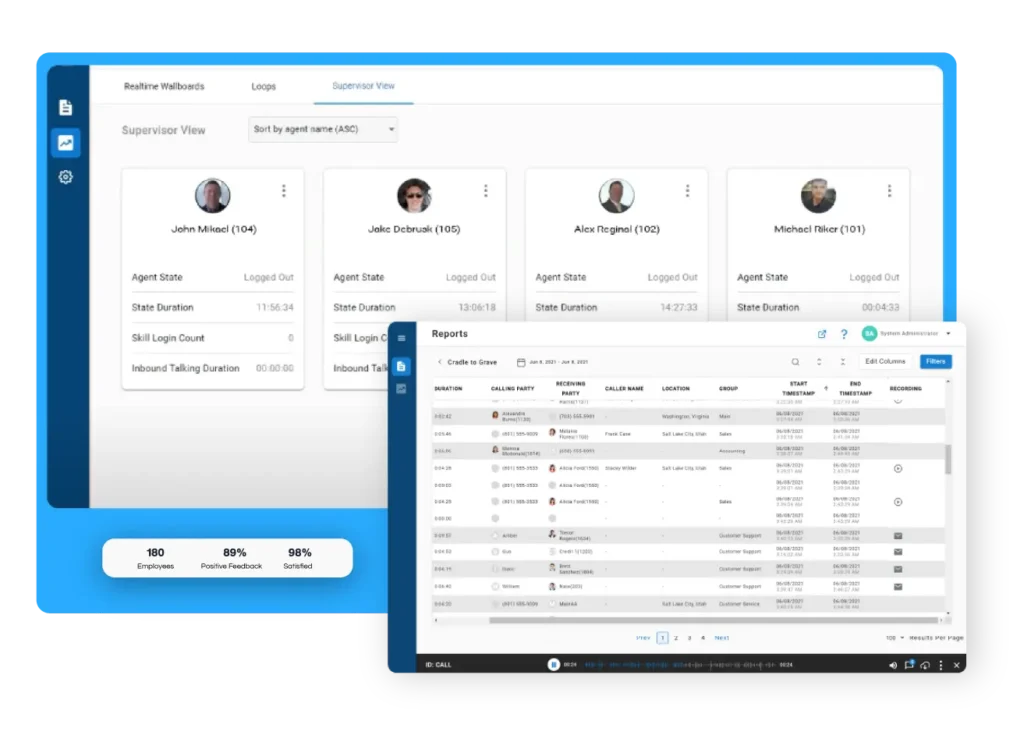
Xima is a CCaaS platform built for small and mid-sized businesses that need real contact center capabilities, not a watered-down version of them. It covers omnichannel routing (voice, web chat, SMS, and email), real-time wallboards, historical reporting, quality management, and AI in a single platform.
What makes it stand out for tech teams is the analytics and AI depth. The platform includes speech analytics and Auto QA built in, so you’re not paying for a separate tool to evaluate call quality or pull sentiment data from conversations. Supervisors get live visibility into every queue, agent, and channel. The reporting suite covers over 200 standard real-time and historical reports alongside customizable dashboards and cradle-to-grave interaction data.
The AI layer is practical rather than just a feature list. It analyzes 100% of interactions for sentiment, trends, and agent performance, which is meaningfully different from the industry norm of managers reviewing 2-3% of calls manually. When agents have full omnichannel customer context at the start of every interaction, partners report FCR improving from around 70% to 82% and handle time dropping by 15-20%.
For tech companies operating in regulated spaces, Xima’s compliance credentials are worth calling out directly. The platform holds SOC 2, ISO 27001:2022, PCI DSS V4.0, and HIPAA certifications, with full documentation available via Xima’s Trust Vault. If your procurement team or a prospective enterprise customer runs a vendor security review, you won’t be scrambling. That combination of certifications puts Xima ahead of most SMB-focused CCaaS platforms, which typically hold one or two at most.
CRM integrations with Salesforce and HubSpot are native, and the platform is designed to get teams live quickly with white-glove setup support included. That matters for a small tech team without a dedicated contact center admin.
Real customers using Xima: Privia Medical Group uses it for intelligent routing and real-time analytics. Essential Credit Union saw measurable service level improvements after switching. Suburban Propane manages 668 locations through a centralized Xima deployment.
Pricing: Transparent per-seat pricing with no minimum seat counts that price out smaller teams. Request a demo at ximasoftware.com.
Worth knowing: Xima is purpose-built for SMBs and mid-market. If you’re running a basic helpdesk, it’s more than you need. If you’re running a real contact center and want it to scale without moving to a new platform, it fits.
- Five9 Best for: Tech companies planning rapid agent headcount growth
Five9 is a cloud-native contact center platform that’s been in the market long enough to have mature omnichannel routing, solid workforce management tools, and deep CRM integrations with Salesforce and ServiceNow. It handles web chat, voice, email, and social channels in a unified queue, and the reporting layer is comprehensive for teams managing high interaction volumes. The platform has a strong track record with mid-market companies that need reliable inbound and outbound capabilities at scale. For tech companies expecting to grow their support team significantly over the next 12-24 months, Five9 has the infrastructure to support that.
Worth knowing: Pricing scales up quickly and requires a multi-year contract commitment, which can be a friction point for smaller teams still figuring out their volume. The platform is also contact-center-only, so if your team also needs internal communications tools you’ll be managing a separate vendor relationship alongside it. It’s generally a better fit once you’re past the early growth stage and have predictable headcount and volume.
- Genesys Cloud CX Best for: Tech companies with complex routing requirements and dedicated IT resources
Genesys is one of the most established names in enterprise contact center software, and the cloud version brings that depth to a subscription model. The platform handles omnichannel routing across voice, web chat, email, messaging, and social channels, with sophisticated skills-based and priority-based routing logic that can be configured to a high level of detail. Workforce engagement management is built in, covering quality management, scheduling, and performance coaching in the same environment. Salesforce and ServiceNow jointly invested $1.5 billion in Genesys in July 2025, which has deepened the CRM integration layer significantly and signals long-term investment in the platform.
Worth knowing: Pricing is tiered and rises steeply as you add channels and features, and the platform requires meaningful configuration work to get full value from it. For a small tech company without a dedicated contact center administrator, the setup curve is real and the ongoing management overhead can be significant. It’s a better fit for teams of 50+ agents that have the internal resources to treat the platform as a strategic investment rather than a plug-and-play tool.
- Dialpad Best for: Tech teams where real-time call transcription and agent coaching are the top priorities
Dialpad comes from a unified communications background and has built a contact center product on top of that foundation, with voice intelligence at the center of the experience. Real-time transcription, sentiment analysis, and live coaching prompts for agents during calls are baked into the core product rather than sold as add-ons, which is genuinely useful for tech companies where support conversations tend to be complex and benefit from detailed documentation. The platform supports web chat alongside voice, and integrates with Salesforce, HubSpot, and Zendesk. Deployment tends to be faster than most enterprise CCaaS platforms, which suits teams that want to get up and running without a lengthy implementation project.
Worth knowing: Dialpad does not include workforce management tools natively, so teams needing forecasting, scheduling, or adherence tracking will need a third-party tool on top. Teams that need deep wallboard customization, granular historical reporting, or detailed supervisor controls sometimes find the out-of-the-box options limited compared to dedicated CCaaS platforms. It works best when in-call transcription and coaching are your primary use case rather than broad operational visibility across a contact center.
- 8×8 Best for: Small tech companies that want voice, video, and contact center on one bill
8×8 combines UCaaS and CCaaS into a single platform, which is one of its clearest differentiators. If your team is also looking to consolidate internal phone, video, and messaging alongside customer-facing contact center capabilities, 8×8 removes the need for a separate vendor relationship. The contact center side covers omnichannel routing across voice, web chat, email, and SMS, with reporting and quality management basics included. The platform consistently earns strong customer satisfaction scores for ease of use and speed of deployment, particularly from teams that don’t have dedicated contact center administrators on staff.
Worth knowing: Teams with more serious contact center needs, particularly around analytics depth, supervisor tools, or wallboard customization, can find 8×8’s CC capabilities less developed than dedicated CCaaS platforms. If contact center performance management is your primary concern rather than communications consolidation, a purpose-built CCaaS platform is likely a better fit. Pricing is not published and requires a direct quote from the sales team.
- RingCentral Contact Center Best for: Teams already using RingCentral for business phone
RingCentral has been a long-standing name in business communications, and its contact center product is designed to sit alongside its UCaaS platform so internal and external communications run through the same environment. The platform covers inbound and outbound voice, web chat, email, and SMS, with CRM integrations for Salesforce, HubSpot, and Microsoft Dynamics. For teams already embedded in the RingCentral ecosystem, the familiarity of the interface and the consolidated billing are real practical benefits. The platform has improved meaningfully over the past couple of years and suits companies that want a stable, managed contact center without significant internal configuration overhead.
Worth knowing: Teams evaluating RingCentral Contact Center as a standalone contact center decision, rather than as an extension of an existing RingCentral deployment, often find that the analytics depth and supervisor tooling don’t quite match up against dedicated CCaaS platforms at a similar price point. If detailed reporting, wallboard customization, or advanced quality management are priorities, it’s worth comparing carefully before committing.
- Talkdesk Best for: Tech companies with heavy compliance requirements
Talkdesk has invested significantly in industry-specific compliance features and has built a reputation in regulated verticals including healthcare, financial services, and retail. The platform covers omnichannel routing across voice, digital, and messaging channels, with workforce management, quality management, and analytics included in the higher tiers. The visual workflow builder is a genuine strength, letting operations managers design and modify routing logic and automation without needing developer support, which matters for teams that need to iterate quickly. For tech companies in fintech or healthtech that need a contact center platform with compliance credentials and audit-ready documentation, Talkdesk is a credible option.
Worth knowing: Full-featured agent assist tools are locked to higher pricing tiers, so if that’s a core requirement, budget accordingly before you get to contract stage. The platform is generally a better fit at 30+ agents where the compliance features and workflow customization justify the investment. Smaller teams may find the cost-to-feature ratio harder to justify compared to purpose-built SMB platforms.
Evaluation checklist
Before you book demos, use this to make sure you’re asking the right questions:
- Does the platform handle voice, web chat, and email in a single unified queue, or does each channel require separate management?
- What does the wallboard configuration actually look like? Can supervisors customize in real time, or is it a fixed template?
- Is voice analytics built in, or is it an add-on cost? Does it include transcription, sentiment, and keyword spotting, or just call recordings?
- Where does AI actually show up in the product? Ask vendors to demo specific AI features rather than accepting a slide about their AI roadmap
- What compliance certifications does the vendor hold, and can they provide documentation? If you handle regulated data, ask specifically about SOC 2, ISO 27001, PCI DSS, and HIPAA capability
- What’s the CRM integration approach: native connector, Zapier, or custom API work?
- What does onboarding look like in practice? Who handles configuration, and how long does it take?
- Is workforce management (scheduling, forecasting, adherence) included, or do you need a separate tool?
- What happens when you need to add agents? Is it a self-serve change, or does it require a contract amendment?
- What’s the all-in cost at your current team size, and what does it look like at 2x?
Bottom line
There’s no shortage of cloud contact center platforms in 2026, but most of them were designed with either large enterprises or very basic teams in mind. Small tech companies land somewhere in the middle: real contact center needs, real budget constraints, and limited tolerance for multi-month implementation projects.
Only 3% of contact centers currently operate on a single, unified platform, while the average organization manages 3.9 different contact center technologies. The platforms that work best for small tech teams consolidate analytics, AI, routing, quality management, and compliance into one place, without requiring a dedicated admin to keep everything running.
If you want to see what a purpose-built SMB contact center platform looks like in practice, Xima is worth a demo. Request one here.