
There is a version of “fine” that costs you more than failing would.
Not because things are broken. Because nothing is broken enough to fix.
Your contact center is running. Calls are getting answered. Your team knows the system. Your metrics are… okay. And somewhere in the back of your mind, you know that okay isn’t where you wanted to be, but the gap between here and better has never felt urgent enough to close.
That’s the trap. And it’s an expensive one.
The rationalizations are the red flag
Most contact center managers who are stuck in a “good enough” posture aren’t lazy or uninformed. They’re busy, they’re resource-constrained, and they’ve learned to speak the language of waiting: the timing isn’t right, there’s no budget this cycle, we’re planning to look at it next quarter.
These aren’t bad reasons. But they’re reasons that compound.
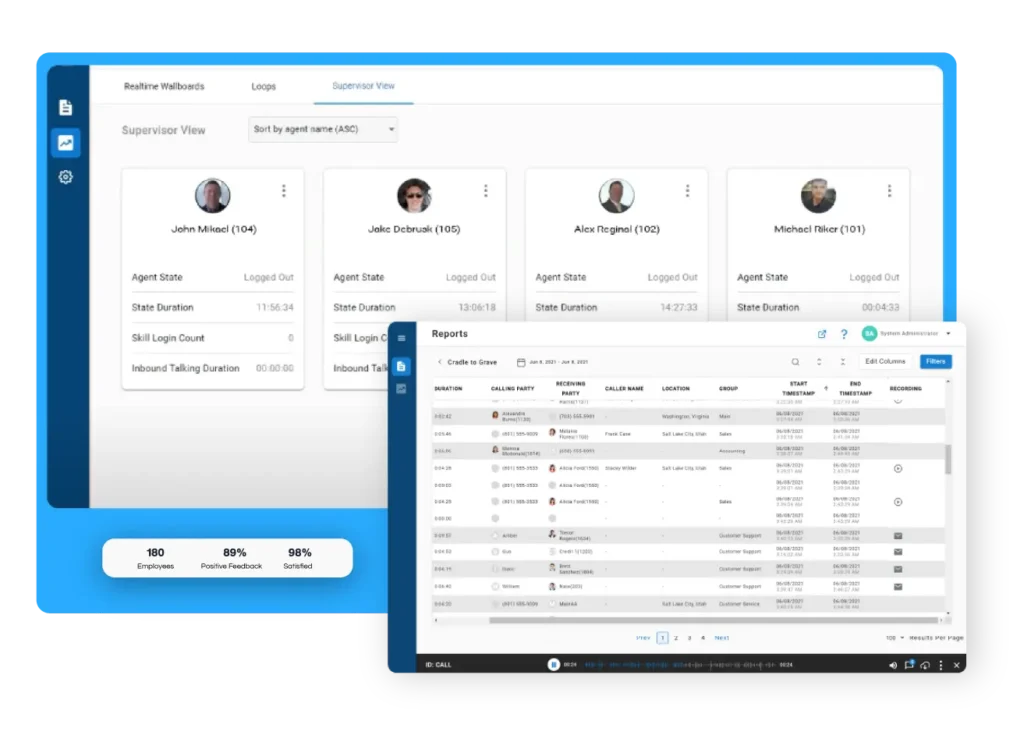
Every quarter you defer a QA modernization, you’re reviewing a fraction of your interactions manually, which means coaching decisions are based on incomplete data, which means agent performance doesn’t improve as fast as it could, which means customers are more likely to call back, which means your handle time and cost-per-contact creep up without a clean line item to point to. Visibility into what is actually happening comes from Xima’s contact center reporting.
The cost of inaction doesn’t show up as a charge on your invoice. It shows up in your metrics, slowly, over time, spread across enough categories that it never quite triggers a conversation.
What “fine” actually costs
The clearest place to see this is in agent turnover.
McKinsey research puts the true cost of replacing a contact center agent at between $10,000 and $20,000 per departure, when you account for recruiting, training, and the productivity gap while a new hire gets up to speed. Industry turnover averages 30 to 45% annually, meaning the full impact on a 100-agent center can reach $1 million or more every year.
Most contact center leaders know turnover is high. Fewer have done the math on what that actually costs at their specific headcount and attrition rate. It’s a number that tends to stay theoretical until someone puts it in a spreadsheet.
According to NICE’s 2025 CX Workforce Report, agent turnover in complex service environments remains above 30% annually, with tool sprawl and cognitive overload cited as primary contributors. That’s not just a staffing problem. It’s a technology and process problem wearing a staffing problem’s clothes. Current cost structures are outlined on Xima pricing.
Agents who are working with outdated tools, inconsistent coaching, and manual QA processes that only cover a slice of their actual interactions are not getting the feedback they need to improve or the support that would make them stay. When they leave, you start over. And the cycle costs you the same amount again.
The QA coverage gap is bigger than you think
Manual quality assurance, even well-run manual QA, typically covers somewhere between 1% and 5% of total interactions. That means 95 to 99% of your customer conversations are never reviewed.
That’s not a compliance risk in the abstract. It’s a specific risk: the agent who’s been handling a particular call type the wrong way for three months, the script adherence issue no one caught, the compliance exposure in an industry where one missed disclosure actually matters.
How AI-Powered Auto QA Is Transforming Contact Center Quality Management covers what the shift from manual to automated QA actually looks like in practice. The short version: teams that move to AI-assisted QA don’t just review more interactions. They catch things manual review was never going to find at scale.
The data you’re not using
According to Forrester, 74% of organizations say that real-time analytics is crucial to improving customer service and overall experience, and McKinsey reports that companies investing in real-time data analytics for customer service see efficiency gains of up to 25%.
Most contact centers have access to more data than they’re using. The issue isn’t usually collection. It’s interpretation and action. If your managers are still reviewing reports after the fact, reacting to patterns that showed up last week, you’re always one cycle behind.
Boost Agent Performance with AI-Powered Cloud Software gets into what changes when performance data is available in real time, not just in retrospect. And if you’re specifically evaluating speech analytics, the Contact Center Speech Analytics Guide is worth reading before you make any decisions.
The competitive math is shifting
Here’s the part that should make the timing conversation harder to defer.
Gartner predicts that by 2029, agentic AI will autonomously resolve 80% of common customer service issues without human intervention, leading to a 30% reduction in operational costs. Your competitors who are investing in AI-powered tooling now are not just getting a productivity bump. They are building a cost structure you will eventually have to compete against.
The teams that move first don’t just get better metrics. They get lower operating costs, which gives them room to price, hire, or invest in ways that create distance from the field.
This is also why the “we’ll look at it next quarter” approach carries more risk in 2026 than it did in 2023. The pace of change in what’s available, and what customers expect, has accelerated. What Contact Centers Should Plan for in 2026 covers the landscape in detail, including the planning assumptions most leadership teams are working from right now.
The question worth asking
If someone handed you a line item showing what your current setup is actually costing you, not just the obvious costs but the compounding ones, would it change the conversation?
Turnover that keeps running at the same rate because nothing in the coaching or tooling environment has changed. QA that’s covering a small fraction of interactions and missing patterns that are eroding your FCR. Analytics that are available in your system but not being used to drive daily decisions.
None of these are catastrophic in isolation. Together, they’re a budget problem that doesn’t look like one.
If you want to get into the specifics, our guide covers the cost categories most contact center leaders underestimate, along with a framework for figuring out where your operation actually stands.
Download The Essential Guide to Controlling Costs and Increasing Customer Success
“Good enough” is a choice. Just make sure you know what it’s costing you before you make it.