
Somewhere in your healthcare contact center today, an agent is fielding a call from a patient asking about prescription refills. The call comes through your on-premise system—the same one that’s been running for years. It works. But you’re also watching call abandonment creep up during peak hours, supervisors scrambling to pull compliance reports manually, and IT patching aging hardware instead of building for the future.
Moving to the cloud isn’t just a technology decision. It’s an operational shift that affects how your team handles patient calls, how you maintain HIPAA compliance, and how quickly you can adapt when patient volumes spike unexpectedly. Xima Software helps healthcare organizations make that transition with real-time analytics, EHR integrations, and deployment flexibility that keeps compliance at the center of every decision.
This guide walks you through the complete process—from building your business case to executing a phased rollout—so you can approach cloud contact center migration with a clear plan and measurable milestones.
Key Takeaways: Healthcare Cloud Contact Center Migration
- Cloud migration for healthcare contact centers requires a compliance-first approach that addresses HIPAA, audit trails, and patient data security from day one.
- Phased deployment reduces risk by allowing you to test integrations, train staff, and validate workflows before full cutover.
- Xima Software connects with over 70 EHR systems, giving your agents patient context without switching between applications.
- Real-time reporting and AI-powered quality assurance replace manual review processes that miss 95-99% of patient interactions.
- Successful migration depends on stakeholder alignment, realistic timelines, and clearly defined success metrics tied to patient experience.
Why Healthcare Contact Centers Are Moving to the Cloud in 2026
The shift isn’t happening because cloud is new. It’s happening because the operational pressures on healthcare contact centers have reached a breaking point that legacy systems can’t address.
Patient expectations have changed. They expect shorter hold times, callbacks instead of endless waiting, and agents who already know why they’re calling. Meeting those expectations requires technology that connects patient data, routes calls based on context, and gives supervisors real-time visibility into what’s happening across every queue.
Xima’s contact center software for healthcare supports the requirements covered in this section.
On-premise systems weren’t built for this. They were built for a time when phone calls were the only channel and scaling meant buying more hardware. Today, you need a platform that handles voice, chat, SMS, and email—and ties them together so a patient’s journey doesn’t restart every time they switch channels.
What’s Driving the Migration Timeline?
Several operational realities are accelerating cloud adoption in healthcare contact centers specifically:
Aging infrastructure costs. Every year your on-premise system runs past its lifecycle, you’re paying more for maintenance, patches, and workarounds. Those costs are often hidden across IT budgets and vendor contracts, but they compound.
Staffing challenges. Agent turnover in healthcare contact centers often exceeds 30% annually. Every new hire needs training, and legacy systems with complicated interfaces extend that ramp-up time significantly.
Compliance pressure. HIPAA requirements haven’t relaxed, but the scrutiny has intensified. Manual compliance processes that worked when call volumes were lower now create blind spots across thousands of patient interactions.
What Does Cloud Contact Center Migration Actually Involve?
Cloud contact center migration isn’t a single event. It’s a structured process that typically spans four to eight months for healthcare organizations, depending on complexity, integration requirements, and staffing for the project.
Teams evaluating platforms can review Xima’s cloud contact center software.
Here’s what the process actually looks like:
Phase 1: Assessment and Planning
Before you evaluate vendors or draft timelines, you need a complete picture of your current state. That means documenting your existing call flows, IVR configurations, integration points with EHR and CRM systems, reporting requirements, and compliance workflows.
Most healthcare contact center managers underestimate this phase. They assume the IT team has everything documented. In practice, tribal knowledge drives a significant portion of how on-premise systems actually operate—custom scripts, workarounds, and configurations that aren’t written down anywhere.
Answer these questions honestly before moving forward:
- How many call flows do you currently run, and which ones are patient-facing versus internal?
- What integrations exist between your contact center and EHR systems today?
- How do you currently handle compliance monitoring and call recording?
- What reporting do supervisors rely on daily, weekly, and monthly?
Phase 2: Vendor Evaluation and Selection
Healthcare contact centers have specific requirements that general-purpose cloud platforms don’t always address well. When evaluating vendors, focus on these criteria:
HIPAA compliance architecture. Don’t accept verbal assurances. Ask to see their Business Associate Agreement (BAA), data encryption standards, access controls, and audit logging capabilities. Ask how they handle PHI in call recordings and transcriptions.
EHR integration depth. Surface-level integrations that require agents to switch between screens defeat the purpose. Look for platforms like Xima CCaaS that offer native, bi-directional connections with major healthcare EHR systems—so patient context flows directly into the agent interface.
Real-time analytics and quality assurance. Manual QA processes can only review 1-5% of calls. AI-powered platforms can score 100% of interactions, flagging compliance risks and coaching opportunities automatically.
Phase 3: Migration Design and Testing
This is where many migrations fail. Teams rush to cutover without adequate testing, then spend months troubleshooting in production—with patient calls on the line.
A proper migration design includes:
- Detailed mapping of every call flow from the legacy system to the new platform
- Integration testing with your EHR, CRM, and workforce management systems
- User acceptance testing with actual agents handling simulated patient scenarios
- Fallback procedures if issues emerge during cutover
Xima Software approaches this with what they call white-glove onboarding—dedicated support throughout the migration process, not just documentation and a helpdesk ticket queue.
Phase 4: Phased Rollout and Optimization
Full cutover migrations are risky. A phased approach lets you validate the new platform with a subset of agents or call types before expanding.
Start with a pilot group—typically 10-20% of your agents—handling lower-complexity call types. Monitor key metrics: average handle time, first-call resolution, customer satisfaction, and any compliance flags. Only expand when the pilot group demonstrates stable performance.
How to Build a Business Case for Cloud Migration
Cloud migration requires investment—in licensing, implementation, training, and the operational time your team spends on the project. Building a credible business case means quantifying both the costs of staying on your current system and the measurable benefits of moving.
Calculating the True Cost of Your On-Premise System
Most healthcare contact center managers don’t have a single number that represents what their current system actually costs. The expenses are distributed across budgets: IT infrastructure, telecom charges, vendor support contracts, hardware maintenance, and the labor hours spent on manual reporting.
Fill in your real numbers below:
- Annual hardware maintenance and support contracts: $______
- Telecom charges (trunk lines, long-distance, toll-free): $______
- IT staff hours spent on system maintenance per month: ______ hours × hourly rate
- Supervisor hours spent on manual reporting per month: ______ hours × hourly rate
- Estimated cost of downtime events in the past year: $______
That total is what you’re paying to maintain the status quo. And it doesn’t account for opportunity costs—the capabilities you don’t have because your system wasn’t built for them.
Quantifying the Benefits of Cloud Migration
The benefits side of your business case should include:
Operational efficiency gains. Cloud platforms automate reporting, quality assurance, and agent scheduling. Supervisors who currently spend hours pulling reports can redirect that time to coaching and performance improvement.
Reduced call abandonment. Queue callback features—where patients receive a callback rather than waiting on hold—can reduce abandonment rates by 30% or more. For healthcare contact centers, that translates directly to patient satisfaction and fewer repeat calls.
Faster agent ramp-up. Intuitive interfaces reduce training time for new hires. When your annual turnover rate exceeds 30%, every week you save in training has measurable value.
Scalability without capital expense. Cloud platforms scale with demand. When flu season spikes call volumes, you can add capacity without purchasing and installing hardware.
HIPAA Compliance in Cloud Contact Center Migration
Compliance isn’t a feature you check off during vendor selection. It’s an operational reality that affects every aspect of your cloud contact center—from how calls are recorded to how agents access patient information.
What HIPAA Requires for Cloud Contact Centers
HIPAA’s Security Rule and Privacy Rule apply to any technology that handles protected health information (PHI). For cloud contact centers, that includes:
Call recordings and transcriptions. Any recording that contains PHI must be encrypted in transit and at rest, stored securely, and accessible only to authorized personnel with documented access controls.
Agent workstations. If agents can view patient records, their access must be logged and auditable. Multi-factor authentication and role-based access controls are baseline requirements.
Business Associate Agreements. Your cloud vendor is a business associate under HIPAA. They must sign a BAA that specifies their compliance obligations and liability.
Building Audit-Ready Operations
The operational reality is that most healthcare contact centers have policies for HIPAA compliance but limited ability to verify those policies are followed on every call.
Here’s the scenario that plays out more often than anyone in this industry likes to discuss openly: An agent handles a call, follows most of the required steps, but skips the identity verification protocol because the patient is frustrated and they’re trying to help quickly. That call gets recorded. Nobody reviews it. Six months later, an auditor asks to see your compliance verification process.
Xima CCaaS addresses this gap with AI-powered quality assurance that automatically scores every interaction against your compliance criteria. Instead of manually reviewing 1-3% of calls and hoping you catch violations, you get flagged exceptions that need attention—with the audit trail to prove your compliance process is working.
EHR Integration: The Foundation of Patient-Centered Service
Your contact center exists to serve patients. But if your agents don’t have patient context when they answer, every call starts from zero—forcing patients to repeat information they’ve already provided elsewhere in your organization.
What Effective EHR Integration Looks Like
Effective EHR integration means patient data flows into the agent’s screen before they pick up the phone. When a patient calls, the system identifies them (through caller ID matching or IVR authentication), pulls their record, and displays relevant context: recent appointments, open orders, prescription history, previous interactions.
This isn’t a nice-to-have. It’s what patients expect. And it directly impacts your operational metrics: agents who have context resolve calls faster, reducing average handle time and improving first-call resolution.
Integration Challenges in Healthcare
Healthcare EHR integration is harder than it sounds. Major platforms like Epic, Cerner, and Allscripts each have different APIs, authentication requirements, and data structures. Many cloud contact center vendors offer integrations that look good in demos but fall short in production.
When evaluating integration capabilities, ask these questions:
- Show me a live demo of the EHR integration with a system comparable to ours.
- How is patient data matched between the contact center and EHR?
- What happens when the EHR is unavailable? How do agents handle calls without patient context?
- Can agents update patient records from the contact center interface, or is it read-only?
Xima Software connects with over 70 EHR systems, including major platforms and specialty-specific solutions. The integration is bi-directional—agents see patient context and can update records without switching applications.
Phased Deployment: Reducing Risk Through Structured Rollout
The biggest risk in cloud migration isn’t the technology. It’s the operational disruption if something goes wrong during cutover. A phased deployment approach gives you checkpoints to validate performance before expanding.
How to Structure Your Migration Phases
Phase 1: Infrastructure and integrations. Stand up the cloud environment, configure integrations with your EHR, CRM, and workforce management systems, and validate that data flows correctly. No live calls at this stage.
Phase 2: Pilot group. Move a small team—typically 10-20 agents—to the new platform. Choose a call type that’s important enough to matter but not so critical that issues create major patient impact. Monitor metrics closely.
Phase 3: Expanded rollout. Based on pilot results, expand to additional teams and call types. Continue monitoring and refining configurations.
Phase 4: Full cutover. Migrate remaining agents and call types. Decommission or archive the legacy system.
What Success Metrics Should You Track?
Define your success metrics before migration begins. Typical metrics for healthcare contact centers include:
- Average handle time (AHT)
- First-call resolution (FCR)
- Call abandonment rate
- Patient satisfaction scores (if you’re capturing them)
- Compliance exception flags
- Agent satisfaction and system usability feedback
Compare these metrics between your pilot group on the new platform and a control group still on the legacy system. That data becomes your evidence for expanding the rollout—and your proof of value for stakeholders.
Training and Change Management for Your Team
Technology migrations fail when organizations focus on the platform and forget about the people who use it. Your agents and supervisors need to understand not just how to use the new system, but why the organization is making the change.
Agent Training Best Practices
Effective training goes beyond interface tutorials. Agents need to understand:
How their workflows will change. If the new platform changes how they handle transfers, access patient records, or document calls, they need hands-on practice before going live.
What the new capabilities enable. Agents often see system changes as more work, not better tools. Show them specifically how features like screen pops, knowledge bases, and queue callbacks make their jobs easier.
Where to get help. New systems generate questions. Make sure agents know who to ask and how to escalate issues without disrupting patient calls.
Supervisor and Manager Enablement
Supervisors face a different learning curve. They need to understand:
- How to access and interpret real-time dashboards and wallboards
- How to use new reporting tools to track team performance
- How the quality assurance process changes with AI-powered scoring
- How to coach agents using interaction data and transcriptions
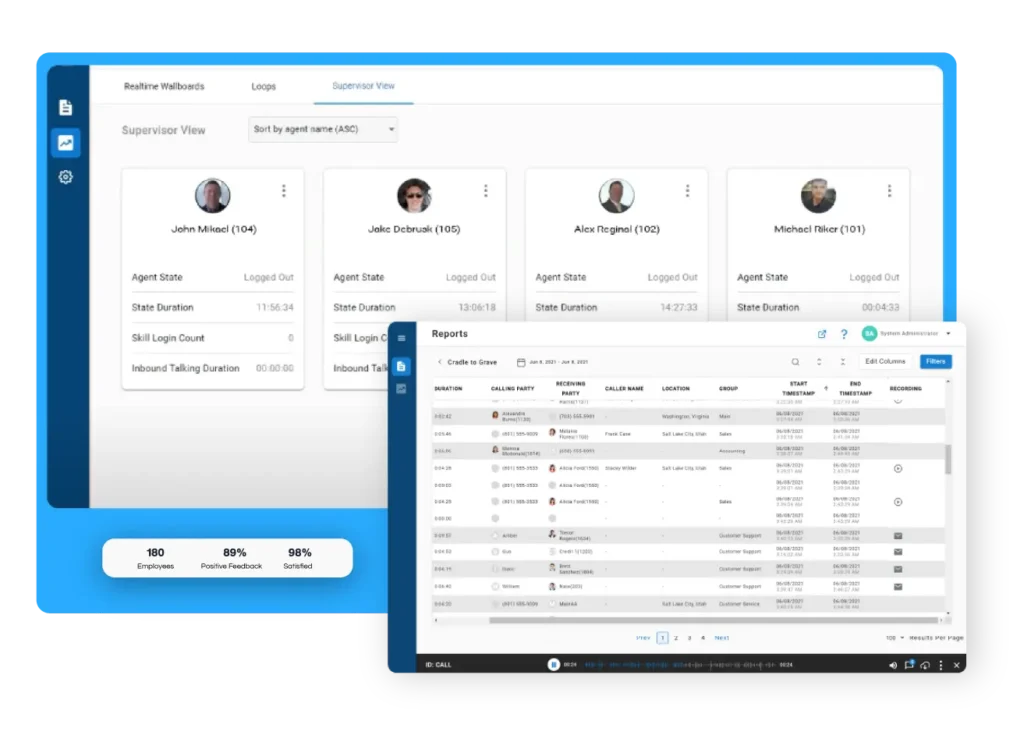
Xima CCaaS includes customizable dashboards that give supervisors the specific views they need—without requiring IT to build reports. Real-time wallboards display queue status, agent availability, and key metrics at a glance.
Common Migration Pitfalls and How to Avoid Them
Most cloud contact center migrations encounter predictable problems. Knowing them in advance lets you build safeguards into your plan.
Pitfall 1: Underestimating Integration Complexity
Vendors demonstrate integrations in controlled environments. Production is messier. Data doesn’t always match between systems. Edge cases that never appeared in testing show up on live calls.
Mitigation: Build extra time into your integration testing phase. Test with real data, not sanitized demo datasets. Involve agents in user acceptance testing—they’ll find the edge cases engineers miss.
Pitfall 2: Insufficient Change Management
Technology migrations often focus on go-live dates and forget that adoption happens over months. Agents who don’t understand or trust the new system will find workarounds that undermine your investment.
Mitigation: Start communicating about the migration early. Involve frontline agents in vendor selection and pilot testing. Celebrate early wins publicly.
Pitfall 3: Parallel Running Without Clear Exit Criteria
Some organizations plan to run both systems in parallel indefinitely “just in case.” That approach doubles operational complexity and never produces a clean cutover.
Mitigation: Define specific, measurable criteria for exiting parallel operation. When the new system meets those criteria for a defined period, commit to the cutover.
Pitfall 4: Ignoring Legacy Data Requirements
Your on-premise system contains years of call recordings, reports, and compliance documentation. What happens to that data after migration?
Mitigation: Plan your data migration and archival strategy early. Determine what data must be accessible in the new system versus archived for compliance purposes versus purged.
How Xima Software Supports Healthcare Cloud Migration
Xima Software built its cloud contact center platform with regulated industries in mind. That means HIPAA compliance isn’t an add-on—it’s foundational to how the platform handles patient data, call recordings, and access controls.
Healthcare-Specific Capabilities
Xima CCaaS includes capabilities that directly address healthcare contact center requirements:
Integrations with 70+ EHR systems. Native connections with Epic, Cerner, Allscripts, and dozens of other healthcare platforms. Patient context appears on the agent’s screen before they pick up.
AI-powered quality assurance. Automatic scoring of 100% of interactions against your compliance criteria. No more sampling 2% of calls and hoping you catch violations.
Queue callback. Patients receive a callback when an agent becomes available, rather than waiting on hold. This feature alone can reduce abandonment rates significantly while improving patient satisfaction.
Cradle-to-grave reporting. Every interaction is tracked from the moment it enters your system through resolution. That audit trail is exactly what you need when compliance questions arise.
Implementation Approach
Xima takes a white-glove approach to implementation. That means dedicated support throughout your migration—not a documentation portal and a ticket queue. Your team works with implementation specialists who understand healthcare contact center operations and can guide configuration decisions based on experience with similar organizations.
The platform also offers flexible deployment options. If your organization requires on-premise data residency for certain compliance reasons, Xima’s Chronicall platform delivers the same analytics and reporting capabilities without cloud migration. For most healthcare organizations, Xima CCaaS delivers the operational benefits of cloud with the compliance rigor your industry requires.
Building Your Migration Timeline: A Practical Framework
Every organization’s timeline will differ based on size, complexity, and internal resources. But a typical healthcare contact center migration follows this general framework:
Months 1-2: Assessment and Vendor Selection
- Document current state: call flows, integrations, reporting, compliance processes
- Define requirements and evaluation criteria
- Conduct vendor demonstrations and reference checks
- Select vendor and negotiate contract terms including BAA
Months 3-4: Design and Configuration
- Complete detailed migration design
- Configure cloud environment and integrations
- Develop training materials
- Conduct integration testing
Months 5-6: Pilot and Validation
- Deploy pilot group on new platform
- Monitor metrics and gather feedback
- Refine configurations based on pilot learnings
- Expand to additional teams
Months 7-8: Full Rollout and Optimization
- Complete migration of all agents and call types
- Decommission legacy system
- Conduct post-migration review
- Ongoing optimization and feature adoption
Questions to Ask Every Cloud Contact Center Vendor
When you’re evaluating cloud contact center vendors for your healthcare organization, these questions will help you distinguish between marketing claims and actual capabilities. Use these in every demo.
Compliance and Security
- Show me your standard Business Associate Agreement. What modifications do you typically accept?
- How is PHI encrypted in call recordings and transcriptions? Who can access that data?
- What audit logs do you maintain, and how long are they retained?
- Describe your incident response process if a security event occurs.
Integration Capabilities
- Show me a live demo of your integration with [our specific EHR system].
- What data flows between systems, and how is patient matching handled?
- How long does a typical EHR integration take to implement?
- What happens to agent workflows when the EHR is unavailable?
Implementation and Support
- Who manages our implementation—a dedicated team or a support queue?
- What does your typical implementation timeline look like for an organization our size?
- How is support handled after go-live? What are your response time commitments?
- Can you provide references from healthcare organizations similar to ours?
If a vendor pivots away from any of these questions or redirects you to a different part of the demo, that’s your answer about their capabilities.
In Conclusion: Planning Your Healthcare Cloud Contact Center Migration
Cloud migration for healthcare contact centers isn’t a technology project. It’s an operational transformation that affects how your team serves patients, maintains compliance, and adapts to changing demands.
The organizations that succeed approach migration with clear planning, realistic timelines, and measurable success criteria. They invest in change management alongside technology. They choose vendors who understand healthcare’s specific requirements—not platforms that treat compliance as an afterthought.
The question isn’t whether cloud migration makes sense for healthcare contact centers. The operational pressures are too significant, and the limitations of legacy systems are too constraining. The question is how you execute the migration in a way that reduces risk, maintains compliance, and delivers measurable value to your organization and your patients.
Xima Software has helped healthcare organizations navigate this transition with purpose-built capabilities for HIPAA compliance, EHR integration, and operational visibility. When you’re ready to see what that looks like for your contact center, request a demo and see how Xima CCaaS handles the specific requirements your organization faces.
FAQs About Healthcare Cloud Contact Center Migration
How long does a typical healthcare cloud contact center migration take?
Most healthcare contact center migrations take four to eight months from assessment through full rollout. The timeline depends on your organization’s size, integration complexity, and available resources for the project.
Phased approaches typically extend the timeline but reduce risk by validating performance before expanding to additional teams.
What are the biggest risks in cloud contact center migration?
Integration failures and inadequate change management create the most significant risks. Integration issues appear when production data doesn’t match testing assumptions, causing call handling problems.
Change management failures occur when agents don’t understand or trust the new system, leading to workarounds that undermine the investment.
How does Xima Software ensure HIPAA compliance for healthcare contact centers?
Xima CCaaS includes encryption for all call recordings and transcriptions, role-based access controls, comprehensive audit logging, and standard Business Associate Agreement support. The platform was built with regulated industries in mind, making compliance foundational rather than an add-on.
AI-powered quality assurance automatically scores 100% of interactions against your compliance criteria.
Can we migrate to the cloud if we have a complex EHR integration?
Yes. Xima Software integrates with over 70 EHR systems, including Epic, Cerner, Allscripts, and specialty-specific platforms. The integration is bi-directional, allowing agents to view patient context and update records without switching applications.
Complex integrations require additional testing time, which should be built into your migration timeline.
What happens to our historical call recordings during migration?
Historical call recordings can typically be migrated to the new platform, archived separately for compliance purposes, or a combination of both. Plan your data strategy early in the migration process.
Xima’s implementation team can guide decisions based on your specific compliance requirements and retention policies.
How do we measure success after cloud migration?
Define success metrics before migration begins. Typical metrics include average handle time, first-call resolution, call abandonment rate, and patient satisfaction scores. Compare pilot group performance against a control group to validate improvements.
Xima CCaaS delivers real-time dashboards and reporting that make these metrics visible immediately after go-live.
Does Xima support on-premise deployment if cloud isn’t right for us?
Yes. Xima’s Chronicall platform delivers the same analytics, reporting, and quality assurance capabilities in an on-premise deployment model. This option works for organizations with specific data residency requirements or compliance constraints that prevent cloud adoption.
Many healthcare organizations use Xima’s flexibility to choose the deployment model that fits their specific regulatory and operational requirements.