
Your customers expect fast, personalized service across every channel they use to reach you. Meeting that expectation requires more than traditional phone systems and manual processes. It requires contact center technology built for how people actually communicate today.
Next-generation contact center technology combines AI, automation, real-time analytics, and omnichannel capabilities into a unified platform. Xima Software helps SMB and mid-market contact centers access these capabilities without the complexity typically associated with enterprise systems.
This article explains what defines next-generation contact center technology, why it matters for your operation, and how to evaluate whether your current setup is keeping pace.
Key Takeaways: What Is Next-Generation Contact Center Technology
- Next-generation contact center technology unifies voice, chat, email, SMS, and social media into a single platform for consistent customer experiences.
- AI-powered quality assurance and speech analytics can review 100% of interactions—something manual processes can never achieve.
- Real-time analytics and wallboards give supervisors immediate visibility into queue performance, agent activity, and customer sentiment.
- Xima Software delivers enterprise-grade contact center features with an interface designed for teams that don’t have dedicated IT departments.
- Cloud-based deployment options offer flexibility and scalability without requiring significant infrastructure investment upfront.
What Does Next-Generation Contact Center Technology Mean?
Next-generation contact center technology refers to cloud-based platforms that integrate multiple communication channels, AI-driven automation, and real-time analytics into a single system. This differs from legacy setups where phone systems, chat tools, and reporting dashboards operate as separate, disconnected applications.
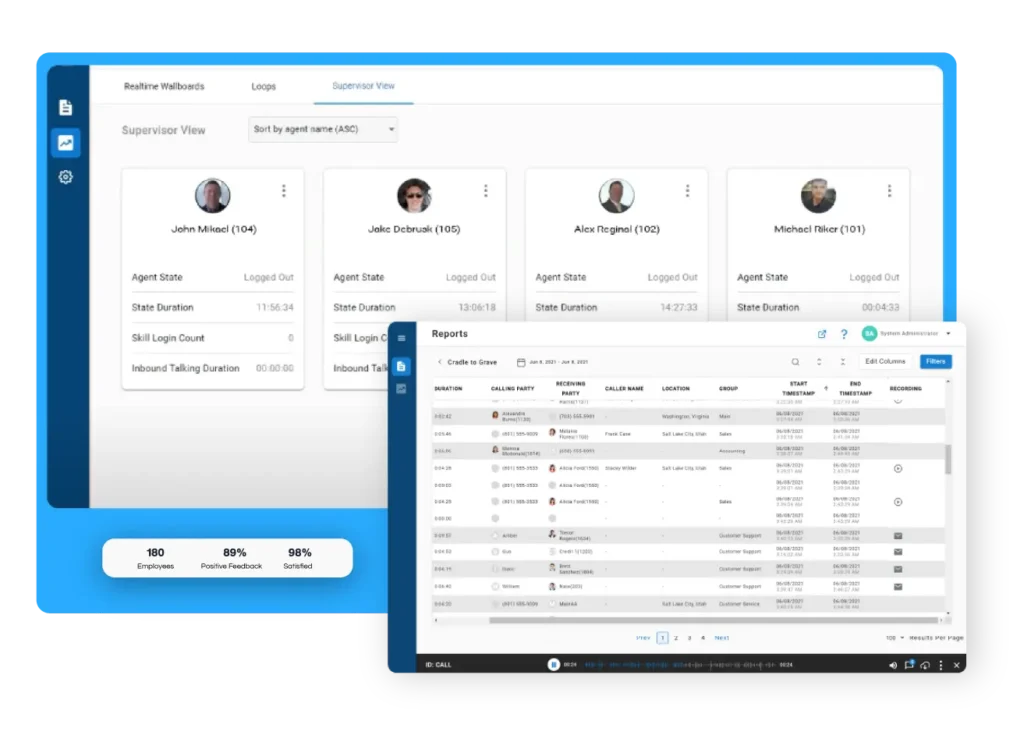
The defining characteristic is unification. Your agents handle voice calls, web chats, emails, and SMS messages from one interface. Your supervisors monitor all channels from one dashboard. Your reports capture the complete customer journey—what the industry calls cradle-to-grave reporting—from initial contact through resolution.
For SMB and mid-market contact centers, this matters because you get capabilities that were previously available only to large enterprises with dedicated IT teams and substantial technology budgets.
How Does AI Improve Contact Center Operations?
AI in contact centers takes several forms, but the most impactful applications for day-to-day operations fall into three categories: quality assurance automation, speech analytics, and intelligent routing.
AI-Powered Quality Assurance
Manual QA reviews typically cover 1% to 5% of interactions. The rest goes unreviewed. AI-powered auto QA changes that equation by scoring 100% of calls against your quality criteria automatically. This means you catch compliance issues, coaching opportunities, and customer experience problems that would otherwise remain invisible.
Xima CCaaS includes AI-powered auto QA and speech analytics that process every interaction. Your supervisors spend less time listening to random call samples and more time addressing specific, identified issues.
Speech Analytics and Sentiment Analysis
Speech-to-text transcription paired with sentiment analysis identifies calls where customers expressed frustration, confusion, or satisfaction. Instead of guessing which interactions need attention, you have data pointing you to specific conversations worth reviewing.
This capability also surfaces patterns across your entire call volume. You might discover that certain topics consistently generate negative sentiment, indicating a process problem or training gap that needs attention.
Skills-Based Routing
Intelligent routing matches incoming contacts to agents based on skills, availability, and historical performance. When a customer contacts you about a billing issue, they reach an agent who handles billing questions effectively—not whoever happens to be available.
What Role Does Real-Time Analytics Play?
Real-time analytics give supervisors visibility into what’s happening in your contact center right now—not what happened yesterday or last week. This immediate awareness enables faster decisions when queue volumes spike, hold times increase, or agent performance dips.
Wallboards display key metrics like current calls in queue, average wait time, service level percentage, and agent status across your team. When you see a developing problem, you can reallocate resources before customers experience long hold times.
Xima Software’s real-time reporting and customizable dashboards give supervisors the operational visibility that larger contact centers have relied on for years. According to McKinsey’s research on contact center operations, organizations that effectively balance human agents with AI capabilities see measurable improvements in both efficiency and customer satisfaction.
Why Does Omnichannel Support Matter?
Omnichannel support means your customers can reach you through their preferred channel—phone, chat, email, SMS, or social media—and receive consistent service regardless of which method they choose. More importantly, it means conversations can move between channels without losing context.
A customer who starts with a chat might need to continue the conversation by phone. With true omnichannel support, the agent answering that call sees the complete chat history. No one asks the customer to repeat information they already provided.
This continuity requires a unified platform, not separate tools stitched together. Xima CCaaS integrates voice, chat, email, and SMS into one system, so agents have complete visibility into each customer’s interaction history. According to IBM’s analysis of contact center experience, this kind of unified approach significantly reduces customer effort and improves satisfaction scores.
What Makes Cloud Contact Center Technology Different?
Cloud-based contact center platforms run on remote infrastructure rather than on-premises hardware. This deployment model offers several operational advantages for SMB and mid-market organizations.
You don’t need to purchase, install, or maintain physical servers. Updates and new features arrive automatically. Scaling up during busy periods or adding new agents doesn’t require hardware upgrades.
For organizations in regulated industries, cloud platforms can also simplify compliance. Xima Software supports HIPAA, PCI DSS, and other regulatory standards, with data protection built into the platform architecture rather than added as an afterthought.
Research from AT&T on cloud contact center migrations confirms that organizations moving to cloud platforms typically see faster deployment times, reduced maintenance burden, and improved disaster recovery capabilities.
How Should You Evaluate Contact Center Technology?
When assessing next-generation contact center platforms, focus on capabilities that address your specific operational challenges. Here are questions worth asking during any vendor evaluation:
Show me the complete lifecycle of a single interaction. Can you see the full journey from queue entry through wrap-up in one view? Not a summary—the actual detail.
How does your AI review quality? What percentage of interactions get scored automatically? What criteria can you customize?
What does supervisor visibility look like in real time? Ask to see the actual wallboards and dashboards supervisors would use daily.
How does pricing work? Get specifics on licensing models, implementation costs, and what’s included versus what costs extra. Transparent pricing matters.
If a vendor redirects these questions or can’t demonstrate the capabilities live, that tells you something important about what you’d actually receive.
In Conclusion: What Next-Generation Contact Center Technology Means for Your Team
Next-generation contact center technology isn’t a vague buzzword. It describes specific capabilities: unified omnichannel communication, AI-powered quality assurance, real-time analytics, and cloud-based deployment that scales with your needs.
The question isn’t whether your contact center needs these capabilities. Most SMB and mid-market operations already recognize the gap between what they have and what their customers expect. The question is whether you’re going to close that gap with enterprise-complexity platforms that require dedicated IT resources—or with something built for how your team actually operates.
Xima Software delivers the capabilities described in this article without the complexity traditionally associated with enterprise contact center platforms. Explore Xima CCaaS to see what next-generation contact center technology looks like when it’s designed for organizations like yours.
FAQs About Next-Generation Contact Center Technology
What is the difference between a call center and a contact center?
A call center handles voice calls only. A contact center manages multiple communication channels including voice, chat, email, SMS, and social media. Next-generation contact center technology unifies all these channels into one platform.
How does AI-powered QA differ from manual quality reviews?
Manual QA typically reviews 1% to 5% of interactions through random sampling. AI-powered QA scores 100% of interactions automatically. Xima CCaaS uses AI-powered auto QA to identify compliance issues and coaching opportunities across every customer conversation.
Can small contact centers benefit from next-generation technology?
Absolutely. Next-generation platforms make capabilities previously reserved for large enterprises accessible to SMB and mid-market teams. Xima Software specifically designs its interface and pricing for organizations that don’t have dedicated IT departments managing their contact center technology.
What does cradle-to-grave reporting mean?
Cradle-to-grave reporting captures every step of a customer interaction from initial contact through final resolution. Xima’s cradle-to-grave reporting tracks the complete journey across channels, so you understand exactly what happened during each customer touchpoint.
How long does it take to implement cloud contact center software?
Implementation timelines vary based on complexity, but cloud platforms typically deploy faster than on-premises systems. Xima Software offers white-glove onboarding and support to minimize disruption during the transition from legacy systems.
What compliance standards do next-generation contact centers support?
Reputable platforms support industry-specific regulations like HIPAA for healthcare and PCI DSS for payment processing. Xima CCaaS includes compliance features built into the platform architecture, helping regulated industries meet their security and privacy requirements.