
Somewhere in your contact center right now, an agent is on a call that’s taking too long. Maybe they’re searching three different systems for a customer’s history. Maybe they’re waiting for a supervisor who’s stuck in manual QA reviews. Meanwhile, the queue grows, customers abandon, and your team inches closer to burnout.
That’s not an accusation. It’s the structural reality facing most SMB and mid-market contact centers in 2026. The good news: AI contact center automation is no longer exclusive to enterprise operations with million-dollar budgets. Xima Software delivers enterprise-grade AI-powered QA, speech analytics, and real-time reporting to contact centers that need results without the complexity.
This guide breaks down exactly how AI contact center automation reduces average handle time (AHT) and agent burnout—with practical frameworks you can apply to your operation today.
Key Takeaways: How to Reduce AHT With AI Contact Centers in 2026
- AI contact centers cut average handle time by automating repetitive tasks, routing calls intelligently, and surfacing customer context instantly.
- Real-time analytics and wallboards give supervisors immediate visibility to address queue issues before they become service failures.
- 100% interaction QA coverage—made possible through AI-powered speech analytics—replaces manual sampling that misses most of your calls.
- Agent burnout drops when AI handles routine inquiries, eliminates system-switching, and delivers coaching feedback while it’s still relevant.
- Xima Software brings AI contact center capabilities to SMBs with user-friendly deployment, transparent pricing, and cradle-to-grave reporting.
What Is an AI Contact Center and Why Does It Matter in 2026?
An AI contact center uses artificial intelligence to automate, analyze, and optimize customer interactions across voice, chat, email, and SMS channels. Unlike traditional setups where agents manually handle tasks and supervisors sample a handful of calls, AI contact centers score every interaction, route customers intelligently, and surface insights in real time.
Xima’s AI contact center capabilities support the handle time work covered in this guide.
For SMB and mid-market operations, this shift matters because the performance gap between AI-enabled and manual contact centers is widening. According to McKinsey research, contact centers that combine human agents with AI automation see measurable improvements in resolution time and customer satisfaction—while those relying on legacy processes fall further behind. McKinsey’s analysis highlights that organizations deploying AI in customer service operations report faster handle times and reduced operational costs.
The question isn’t whether AI contact centers are the future. The question is how quickly you can close the gap between where you are now and where you need to be.
How Does Average Handle Time Actually Affect Your Operation?
Average handle time measures the total duration of a customer interaction—from the moment the call connects through post-call wrap-up. It’s one of the most closely watched metrics in contact center operations, but the real cost goes deeper than the number itself.
The Direct Cost of High AHT
Here’s the math. An average agent handles 50-60 calls per day. If your AHT is 8 minutes and you could reduce it to 6 minutes, that’s 2 minutes saved per call. Across 50 calls, that’s 100 minutes—over 1.5 hours of recovered capacity per agent, per day.
Multiply that by 15 agents, and you’re looking at more than 22 hours of recovered time daily. That translates directly into more calls answered, shorter queue times, and lower abandonment rates.
The Hidden Cost: Agent Burnout
High AHT rarely exists in isolation. When calls take too long, queues back up. Agents feel the pressure mounting with every incoming call. Supervisors spend their time firefighting instead of coaching. The structural strain shows up in turnover rates, sick days, and declining service quality.
That’s not a soft cost. It’s a real one, and it compounds every week.
What Causes High Average Handle Time in Contact Centers?
Before you can reduce AHT, you need to understand what’s driving it. Most contact centers share a few common patterns.
Fragmented Systems and Data Silos
When agents have to switch between three or four applications to find customer information, every call takes longer than it should. They’re searching CRMs, checking order systems, reviewing account notes—often while the customer waits on hold. Each system switch adds 15-30 seconds, and those seconds add up across hundreds of daily interactions.
Manual Call Routing and Queue Management
Without intelligent routing, customers often reach agents who aren’t equipped to handle their specific issue. The result: transfers, hold time, repeated explanations, and longer resolution paths. Skills-based routing solves this by matching customers to the right agent on the first attempt.
Getting the call to the right agent the first time is handled through skills-based routing.
Insufficient Real-Time Visibility
If supervisors can’t see queue status, agent availability, and call volumes in real time, they can’t intervene before problems escalate. Most contact centers have reporting—but it’s often delayed by hours or days, which means you’re always reacting to yesterday’s problems.
Manual Quality Assurance Practices
Traditional QA programs sample 1-5% of calls. That leaves 95-99% of your customer interactions unreviewed. When feedback finally reaches agents—often weeks after the call—the moment has passed. They’ve already handled hundreds more interactions using the same approach.
How AI Contact Center Automation Reduces Average Handle Time
AI doesn’t magically make calls shorter. It removes the friction points that extend them. Here’s where the real reductions happen.
Intelligent Call Routing Based on Skills and Intent
AI-powered routing analyzes incoming calls and matches them to agents based on skills, past interactions, and predicted issue type. Instead of customers explaining their situation multiple times after transfers, they reach the right agent immediately.
Xima CCaaS includes skills-based routing that ensures customers connect with agents who can resolve their issue on the first contact. This directly reduces AHT by eliminating unnecessary transfers and repeated explanations.
Real-Time Agent Assist and Knowledge Surfacing
AI can listen to calls in progress and surface relevant knowledge base articles, customer history, and suggested responses. Agents spend less time searching and more time resolving. The information arrives when they need it—not after they’ve already put the customer on hold.
Automated After-Call Work
Post-call documentation often adds 30-90 seconds to every interaction. AI transcription and auto-summarization capture the essential details automatically, reducing wrap-up time while maintaining complete records. This is where cradle-to-grave reporting becomes operational gold—every interaction is documented from queue entry through disposition without manual data entry.
Queue Callback to Reduce Customer Frustration
When wait times spike, queue callback gives customers the option to receive a call back instead of holding. This doesn’t directly reduce AHT, but it reduces the pressure on your queue, lowers abandonment rates, and improves the customer’s emotional state when they do connect—which often leads to faster resolution.
Xima Software’s queue callback feature has been highlighted by customers as one of the most impactful capabilities for reducing customer frustration and improving service levels.
How AI Reduces Agent Burnout and Improves Retention
Agent burnout isn’t just about workload volume. It’s about the type of work and the tools available to do it. AI automation addresses both.
Eliminating Repetitive, Low-Value Tasks
When AI handles routine inquiries—account balances, order status, appointment confirmations—agents can focus on complex issues that actually require human judgment. The work becomes more engaging, and agents feel like they’re adding value instead of processing transactions.
Reducing Tool Fragmentation
A unified omnichannel platform consolidates voice, chat, email, and SMS into a single interface. Agents stop switching between applications and start working with one system that shows the complete customer journey. That reduction in cognitive load makes a measurable difference in daily stress levels.
Xima CCaaS delivers this unified experience by combining all communication channels with real-time reporting and CRM integrations—without requiring agents to navigate multiple disconnected tools.
Timely, Relevant Coaching Feedback
When QA happens in real time instead of weeks later, agents receive coaching that’s still relevant. They remember the call. They can apply the feedback immediately. This closes the gap between identification and improvement that manual QA programs fail to bridge.
Predictable Workload Through Better Forecasting
AI analytics can predict call volumes based on historical patterns, seasonal trends, and external factors. Better forecasting means better scheduling—and agents aren’t constantly understaffed or overwhelmed during unexpected spikes.
How AI-Powered QA Transforms Contact Center Oversight
Quality assurance in most contact centers operates on a fundamental assumption: if you review enough samples, you’ll catch the problems. Here’s the issue with that assumption.
The 1% Problem
At a 1-5% review rate, you’re making compliance and quality decisions based on a fraction of what’s actually happening. Right now, somewhere in your unreviewed volume, there’s almost certainly an interaction where something went wrong. An agent skipped a required step. A customer expressed frustration that went unaddressed. A compliance risk went undocumented.
You don’t know because nobody reviewed it.
100% Interaction Coverage With AI Scoring
AI-powered speech analytics and auto QA score every single interaction against your quality criteria. Not 1%. Not 5%. Every call. This changes what’s possible for compliance, coaching, and performance management.
Xima Software’s AI-powered auto QA and speech analytics cover 100% of interactions, identifying patterns across your entire operation instead of relying on random sampling. Supervisors see which agents need coaching, which processes are breaking down, and which compliance requirements are being missed—across all calls, not just the handful they had time to review.
Sentiment Analysis and Real-Time Alerts
AI doesn’t just score calls after they end. Real-time sentiment analysis can flag calls where customer frustration is escalating, giving supervisors the opportunity to intervene before the situation becomes a complaint. This shifts QA from reactive documentation to proactive service recovery.
What Real-Time Reporting and Wallboards Actually Change
Most contact centers have dashboards. The question is whether those dashboards show what’s happening now—or what happened hours ago.
Immediate Visibility Into Queue Performance
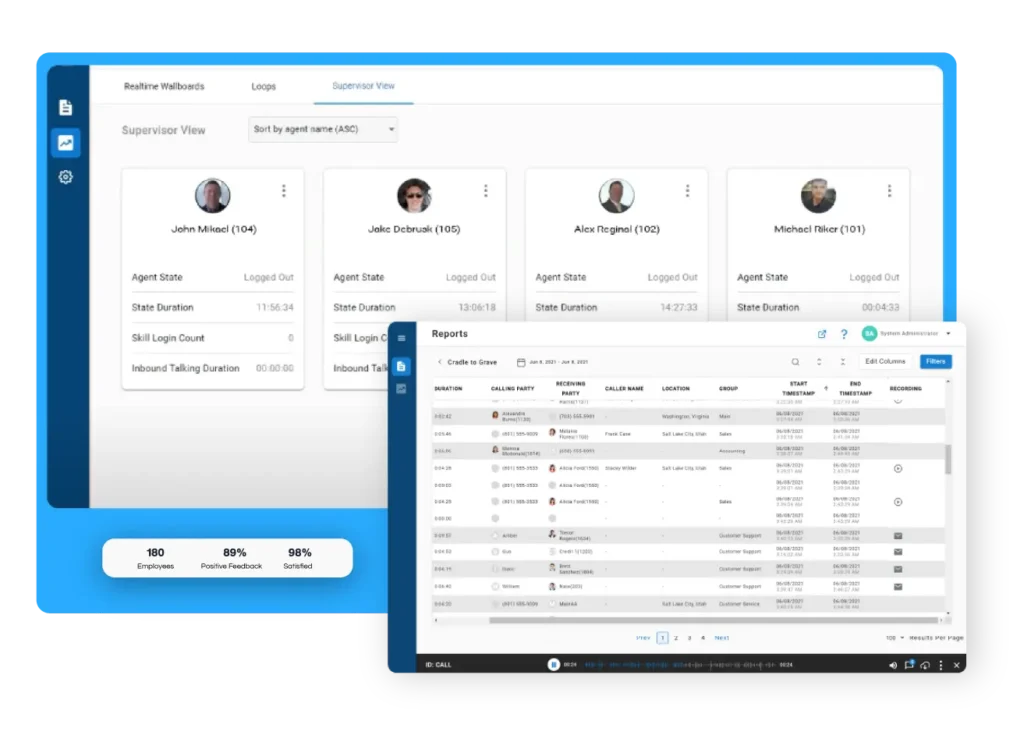
Real-time wallboards display current queue depth, wait times, agent status, and service level metrics as they happen. Supervisors can see a queue backing up before it becomes a service failure and redirect resources accordingly.
Xima Software delivers real-time wallboards that give supervisors actionable visibility into exactly what’s happening in their operation at any moment. Combined with customizable dashboards, this enables smarter, instant decisions based on current conditions instead of yesterday’s reports.
Cradle-to-Grave Interaction Tracking
Traditional reporting often loses track of calls that transfer between agents or queues. Cradle-to-grave reporting follows every interaction from the moment it enters the system through final resolution—regardless of transfers, holds, or channel switches. This eliminates the blind spots that make root cause analysis impossible.
Historical Trend Analysis for Ongoing Improvement
Real-time data becomes even more powerful when combined with historical analytics. You can identify patterns: which days have the highest AHT, which agent skills are in short supply, which customer issues take longest to resolve. Those patterns inform scheduling, training, and process improvements.
How to Choose the Right AI Contact Center Platform for Your Operation
Not all AI contact center platforms are built for the same audience. Enterprise solutions often come with enterprise complexity—and enterprise price tags. Here’s what SMB and mid-market contact center leaders should evaluate.
Questions to Ask During Every Demo
Use these in every vendor evaluation:
- Show me the complete lifecycle of a single interaction in one view, from queue entry to wrap-up. Not a summary. The actual data. If they can’t show cradle-to-grave tracking, you’ll have reporting gaps.
- How does your AI QA scoring work, and what percentage of interactions does it cover? If the answer is anything less than 100%, ask what happens to the uncovered volume.
- What does implementation actually look like for a team my size? Enterprise vendors may quote timelines that assume dedicated IT resources you don’t have.
- Can I see your real-time wallboards with live data? Static screenshots aren’t the same as functioning dashboards.
- What integrations are available for my current phone system and CRM? Ask specifically about your tools—not a generic list of supported platforms.
If a vendor pivots away from any of these or redirects you to a different part of the demo, that’s your answer.
Deployment Flexibility: Cloud, On-Premise, or Hybrid
Some organizations—particularly in healthcare and financial services—have compliance requirements that affect where data can be stored. Look for platforms that offer both cloud and on-premises deployment options without sacrificing core functionality.
Xima Software offers both cloud and on-premises deployment, giving contact center leaders the flexibility to meet compliance requirements while still accessing AI-powered features. This matters for regulated industries where data residency isn’t optional.
Transparent Pricing and Contract Terms
Enterprise contact center vendors often require long-term commitments and charge separately for features that should be standard. Look for transparent, all-in pricing that includes the AI features you actually need—without surprise charges for QA, analytics, or integrations.
A 30-Day Action Plan to Start Reducing AHT
You don’t need to overhaul your contact center in a week. But you do need to start closing the gap. Here’s where to begin.
Week 1: Assess Your Current State
Answer these questions honestly. Write your answers down.
- What is your current average handle time by queue and agent skill?
- What percentage of interactions did you review for quality last month?
- How many systems do agents access during a typical call?
- How long does it take your team to produce a complete audit trail for a single customer interaction?
Fill in your real numbers. The last row is what you’re actually working with.
Week 2: Identify Your Biggest AHT Drivers
Review call recordings and agent feedback to identify where time is being lost. Common patterns include system searches, call transfers, and extended wrap-up. Rank these by impact and frequency.
Week 3: Evaluate AI Contact Center Options
Schedule demos with vendors who serve your segment. Use the questions from the evaluation section. Pay attention to implementation timelines, pricing transparency, and feature coverage.
Week 4: Build Your Business Case
Calculate the potential impact of reducing AHT by 15-25%. Factor in recovered agent capacity, reduced abandonment rates, and supervisor time freed from manual QA. Present the numbers alongside your current-state assessment.
What Results Can You Expect From AI Contact Center Automation?
Contact centers implementing AI-powered automation and analytics typically see measurable improvements across several metrics.
AHT Reductions of 15-30%
The combination of intelligent routing, automated after-call work, and real-time agent assist consistently reduces average handle time. The exact reduction depends on your starting point and which automation features you implement.
Service Level Improvements
Contact centers using Xima Software have reported service level improvements from 50-70% to 90%—directly attributable to better queue management, real-time visibility, and queue callback features. When customers reach the right agent faster, everything downstream improves.
Reduced Agent Turnover
When agents have the right tools and aren’t constantly overwhelmed, they stay longer. The cost of recruiting and training replacement agents is substantial—often equivalent to months of salary. Reducing turnover by even a few percentage points delivers meaningful savings.
Faster Compliance Documentation
100% interaction coverage and cradle-to-grave reporting mean you can produce complete audit trails in minutes instead of hours. When an examiner asks for documentation, you’re ready—not scrambling.
FAQs About How to Reduce AHT With AI Contact Centers in 2026
What is a good average handle time benchmark for contact centers?
AHT benchmarks vary significantly by industry and interaction complexity. For general customer service, 4-6 minutes is common, while technical support often runs 8-12 minutes. Focus on improving your own baseline rather than chasing industry averages that may not match your customer needs.
How does AI reduce agent burnout in contact centers?
AI automation handles repetitive inquiries, eliminates system switching through unified platforms, and delivers timely coaching feedback. Xima Software’s AI-powered tools reduce the manual workload that contributes to agent stress while helping supervisors identify agents who need support before burnout leads to turnover.
What is cradle-to-grave reporting in a contact center?
Cradle-to-grave reporting tracks every customer interaction from initial queue entry through final resolution—including transfers, holds, and channel switches. Xima Software’s cradle-to-grave reporting captures the complete interaction lifecycle, eliminating data gaps that make traditional reporting unreliable.
Can small and mid-market contact centers afford AI automation?
Yes. AI contact center capabilities are no longer limited to enterprise budgets. Xima Software specifically serves SMB and mid-market contact centers with enterprise-grade AI features, transparent pricing, and flexible licensing that scales with your operation.
How long does it take to implement an AI contact center platform?
Implementation timelines vary based on integration complexity and deployment model. Xima Software’s white-glove onboarding and fast setup process minimizes vendor switching hassles, with many contact centers operational in weeks rather than months.
What is the difference between AI-powered QA and traditional quality assurance?
Traditional QA reviews 1-5% of interactions through manual sampling. AI-powered QA scores 100% of interactions automatically using speech analytics and sentiment analysis. Xima Software’s auto QA covers every call, giving supervisors complete visibility instead of assumptions based on limited samples.
Does AI contact center automation work with existing phone systems?
Most AI contact center platforms integrate with existing phone systems and CRMs. Xima Software offers easy integration without requiring you to change existing phones or numbers, plus native integrations with popular CRMs, Microsoft Teams, and over 70 EHR systems for healthcare contact centers.