
Your support team’s first interaction with a customer shapes their entire experience with your business. But when your contact center runs on outdated tools or siloed systems, those interactions fall apart—calls get dropped, agents scramble for information, and customers end up frustrated before they even explain their issue.
Finding the right cloud contact center software changes that equation entirely. Xima Software gives you enterprise-grade features built specifically for small and midsize teams, including skills-based routing that matches callers with the right agents and real-time wallboards that keep supervisors informed.
This guide breaks down eight cloud contact center tools that support SMB operations. You’ll find detailed feature comparisons, honest pros and cons, and clear guidance on what actually matters for your team size and budget.
Quick guide: 8 cloud contact center tools for SMB support teams
- Xima CCaaS: The best all-in-one cloud contact center platform for SMBs needing real-time analytics and skills-based routing
- Genesys Cloud: A feature-rich platform that works for organizations with dedicated IT resources
- Talkdesk: An option for companies focused on AI-driven customer engagement
- Five9: A cloud platform with workforce optimization features for mid-market teams
- NICE CXone: An enterprise-oriented platform with analytics capabilities
- RingCentral Contact Center: A unified communications platform with contact center features
- CloudTalk: A call center tool designed for sales and support teams
- Aircall: A phone system with call center features for smaller teams
How we chose the best cloud contact center software for small businesses
Small and midsize contact centers face different pressures than enterprise operations. You need tools that work on day one without requiring months of implementation or a dedicated IT team to manage them. That’s the lens we used when evaluating these platforms.
- Skills-based routing capabilities: Can the platform automatically match incoming calls with agents who have the right expertise to resolve them quickly?
- Real-time wallboards and dashboards: Do supervisors get immediate visibility into queue status, agent availability, and key performance metrics?
- AI-powered analytics: Does the platform offer speech analytics, sentiment analysis, or automated quality assurance that covers all interactions—not just a random sample?
- Multi-channel support: Can agents manage voice, chat, email, and SMS from a single interface?
- Ease of deployment: How quickly can you get up and running without changing existing phone systems or numbers?
- SMB-focused usability: Is the interface intuitive enough for non-technical staff to manage daily operations?
- Integration depth: Does the platform connect natively with CRMs, Microsoft Teams, and industry-specific systems like EHRs?
Xima’s contact center solutions for small businesses match the criteria used here.
The 8 best cloud contact center tools for SMB support teams
1. Xima CCaaS: Best overall cloud contact center for small businesses
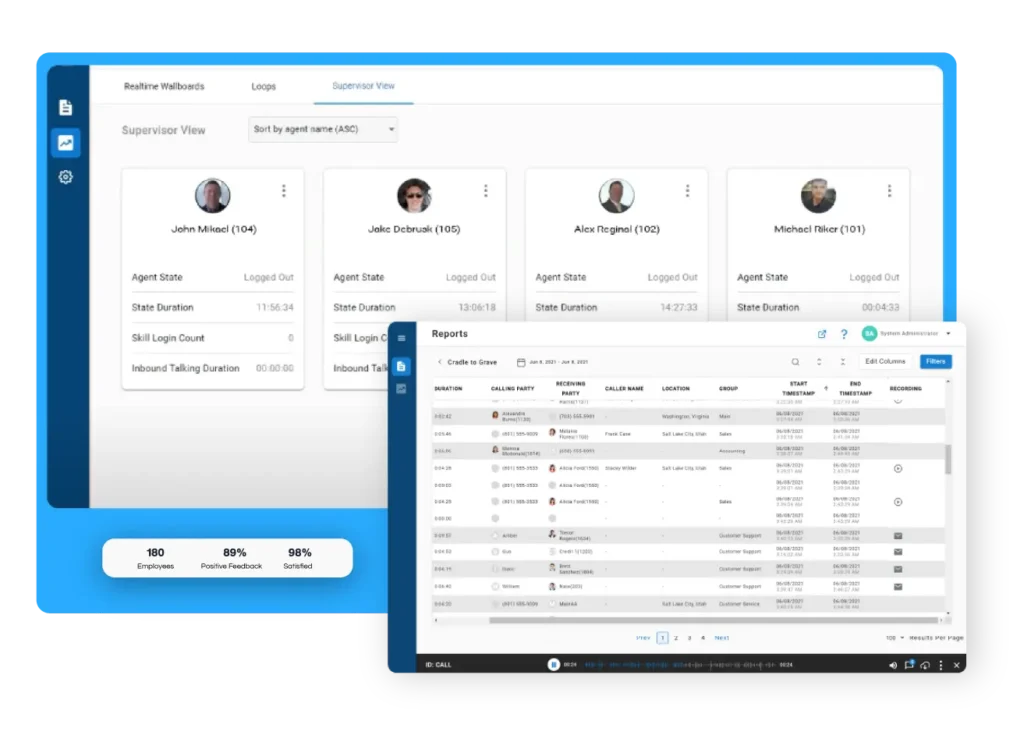
Xima CCaaS delivers the kind of reporting and analytics capabilities that used to be reserved for large enterprises—without the complexity or cost that came with them. The platform captures every interaction from start to finish with cradle-to-grave reporting, giving you complete visibility into what’s actually happening in your contact center.
What sets Xima apart for SMBs is the combination of powerful features and genuine usability. Your supervisors get real-time wallboards that show queue status, agent performance, and key metrics at a glance. Meanwhile, skills-based routing ensures callers reach agents who can actually help them, reducing transfers and improving first-call resolution.
Xima CCaaS also includes AI-powered auto QA and speech analytics that score 100% of your interactions—not just the 1-3% that manual review typically covers. This means you’re identifying coaching opportunities, compliance risks, and customer sentiment trends across your entire operation.
Xima CCaaS features
- Cradle-to-grave reporting: Track every interaction from the moment a customer enters your queue until the call wraps, including transfers, hold times, and outcomes
- Skills-based routing: Automatically direct calls to agents based on expertise, language proficiency, or customer history to improve resolution rates
- Real-time wallboards: Give supervisors instant visibility into queue depth, service levels, and agent status with customizable dashboards
- AI-powered quality assurance: Automatically score every call for compliance, sentiment, and agent performance without manual review
- Queue callback: Let customers request a callback instead of waiting on hold, reducing abandonment and improving satisfaction
- Omnichannel support: Manage voice, chat, email, and SMS interactions from a single unified platform
Xima CCaaS pros and cons
Pros:
- Transparent pricing with no hidden fees makes budgeting straightforward for SMBs
- White-glove onboarding and responsive support minimize the learning curve
- Integrates with popular CRMs, Microsoft Teams, and more without third-party middleware
Cons:
- Some advanced customization options require working with the support team rather than self-service configuration
- The depth of reporting options may take time to explore fully when you first start using the platform
- Organizations with complex legacy PBX environments may need additional setup coordination
2. Genesys Cloud: A platform for organizations with IT resources
Genesys Cloud offers a broad set of contact center capabilities including workforce engagement management and customer journey analytics. The platform is designed for organizations that have technical staff available to manage configuration and ongoing optimization.
The system includes AI-powered routing and predictive engagement tools. However, the breadth of features means you’ll spend time learning which ones apply to your operation and which don’t.
Genesys Cloud features
- Workforce engagement management: Tools for scheduling, forecasting, and quality management
- Predictive routing: Uses AI to match customers with agents based on predicted outcomes
- Speech and text analytics: Analyzes conversations for sentiment and compliance
Genesys Cloud pros and cons
Pros:
- Includes a wide range of workforce management tools in the platform
- Offers APIs and integrations for custom development projects
- Includes bots and automation capabilities for self-service scenarios
Cons:
- The platform’s complexity requires dedicated technical resources to manage effectively
- Implementation timelines tend to run longer than simpler alternatives
- Many features target enterprise use cases rather than SMB operational realities
3. Talkdesk: An option focused on AI-driven engagement
Talkdesk positions itself around AI capabilities including virtual agents, automated quality management, and customer experience analytics. The platform offers industry-specific packages for healthcare, financial services, and retail.
The emphasis on automation means you’ll find tools for deflecting routine inquiries to self-service channels. The tradeoff is that getting the most from these features requires configuration time upfront.
Talkdesk features
- Virtual agent: AI-powered chatbots and voice bots for handling routine inquiries
- Industry clouds: Pre-configured packages for specific verticals
- Automated quality management: AI scoring for agent interactions
Talkdesk pros and cons
Pros:
- Offers industry-specific configurations that include relevant compliance features
- Includes automation tools for reducing repetitive agent tasks
- The interface is designed with a modern look
Cons:
- AI features require training and tuning to match your specific customer interactions
- Some integrations require additional modules or fees
- The breadth of options can make initial setup decisions more complex
4. Five9: A cloud platform with workforce optimization features
Five9 offers contact center capabilities including outbound dialing, workforce management, and CRM integrations. The platform has been in the market for over two decades and targets mid-market and enterprise organizations.
The workforce optimization tools cover scheduling, forecasting, and performance management. Getting value from these features depends on having the operational maturity to define workflows and KPIs upfront.
Five9 features
- Intelligent virtual agent: Conversational AI for voice and digital channels
- Workforce optimization: Scheduling, forecasting, and quality management tools
- CRM integrations: Pre-built connectors for Salesforce and other platforms
Five9 pros and cons
Pros:
- Long track record in the contact center market
- Includes outbound dialing capabilities for sales teams
- Offers pre-built CRM integrations
Cons:
- Implementation can require significant planning and project management
- The interface design reflects the platform’s history rather than current UX trends
- Some customers report that support response times vary
5. NICE CXone: An enterprise-oriented analytics platform
NICE CXone (formerly inContact) targets larger contact center operations with workforce engagement, analytics, and AI capabilities. The platform includes interaction analytics that can identify trends across large call volumes.
The enterprise focus means many features assume you have dedicated administrators and analysts to interpret data and act on insights.
NICE CXone features
- Interaction analytics: Speech and text analysis across channels
- Workforce engagement: Quality management and performance tools
- Enlighten AI: AI models trained on contact center data
NICE CXone pros and cons
Pros:
- Includes analytics capabilities designed for large call volumes
- Offers workforce management features in the platform
- Has a broad partner ecosystem
Cons:
- The platform’s complexity often exceeds SMB requirements
- Getting value from analytics requires dedicated resources to interpret findings
- Implementation typically involves longer timelines
6. RingCentral Contact Center: Unified communications with contact center features
RingCentral combines its unified communications platform with contact center capabilities. The integration means agents can use the same system for internal collaboration and customer interactions.
The platform works well for organizations already using RingCentral for business communications who want to add contact center functionality without managing separate systems.
RingCentral Contact Center features
- Unified platform: Business phone, video, and contact center in one system
- Omnichannel routing: Voice, chat, email, and social channel support
- Workforce engagement: Quality management and scheduling tools
RingCentral Contact Center pros and cons
Pros:
- Works well for existing RingCentral customers adding contact center features
- Combines UC and contact center in a single platform
- Includes video meeting capabilities alongside voice
Cons:
- Contact center features may not match standalone specialist platforms
- Organizations not using RingCentral UC won’t benefit from the integration
- Advanced reporting options can require additional configuration
7. CloudTalk: A call center tool for sales and support teams
CloudTalk offers call center features with a focus on sales and support team workflows. The platform includes click-to-call capabilities and integrations with CRM and helpdesk systems.
The tool targets smaller teams that primarily handle voice interactions and want straightforward call management without the complexity of full omnichannel platforms.
CloudTalk features
- Click-to-call: Initiate calls directly from CRM records
- Call recording: Record and store calls for review
- IVR designer: Build phone trees and routing rules
CloudTalk pros and cons
Pros:
- Includes CRM integrations for common platforms
- The interface is designed for sales and support workflows
- Offers international numbers for global teams
Cons:
- Analytics and reporting are more basic than full contact center platforms
- Multi-channel capabilities are limited compared to omnichannel solutions
- Advanced routing scenarios may require workarounds
8. Aircall: A phone system with call center features
Aircall positions itself as a phone system built for sales and support teams. The platform includes call routing, IVR, and integrations with business applications.
The tool works for smaller teams that need basic call center functionality without the full scope of enterprise contact center features.
Aircall features
- Call routing: Direct calls based on rules and availability
- App integrations: Connects with CRM and helpdesk tools
- Call analytics: Basic reporting on call activity
Aircall pros and cons
Pros:
- Quick setup for teams new to dedicated call center tools
- Includes commonly-used integrations
- The interface is straightforward to learn
Cons:
- Advanced contact center features like workforce management are not included
- Reporting capabilities are more basic than full CCaaS platforms
- Skills-based routing options are more limited
Comparison table: Cloud contact center software for SMBs
| Platform | Cradle-to-Grave Reporting | AI-Powered Auto QA (100% Coverage) | Real-Time Wallboards | Native EHR Integrations |
|---|---|---|---|---|
| Xima CCaaS | ✓ | ✓ | ✓ | 70+ |
| Genesys Cloud | ✗ | ✗ | ✓ | Limited |
| Talkdesk | ✗ | Partial | ✓ | Healthcare Cloud |
| Five9 | ✗ | Partial | ✓ | Limited |
| NICE CXone | ✗ | ✗ | ✓ | Limited |
| RingCentral | ✗ | ✗ | ✓ | ✗ |
| CloudTalk | ✗ | ✗ | Basic | ✗ |
| Aircall | ✗ | ✗ | Basic | ✗ |
Xima’s cloud contact center software is one of the platforms compared below.
What should you look for in skills-based routing for a small business contact center?
Skills-based routing matches incoming calls with agents who have the specific expertise to handle them. When a customer calls about a billing dispute, they reach someone trained on billing systems—not a general agent who has to transfer them.
For SMBs, the key is finding routing that’s powerful enough to handle real scenarios but simple enough to configure without IT support. You should be able to define skills, assign them to agents, and create routing rules through a visual interface rather than code.
Look for platforms that let you route based on multiple factors: agent skills, availability, customer history, and time of day. Xima CCaaS includes skills-based routing that supervisors can configure directly, matching callers to the right agents and reducing transfers that frustrate customers.
How do real-time wallboards improve contact center performance?
Real-time wallboards give supervisors immediate visibility into what’s happening across your contact center. Instead of waiting for end-of-day reports, you see queue depth, wait times, and agent status as it unfolds.
This visibility matters most during peak periods or unexpected surges. When a supervisor sees queue times climbing, they can reassign agents, adjust routing rules, or escalate issues before customers start abandoning calls.
The most useful wallboards are customizable. You should be able to choose which metrics appear, set thresholds that trigger visual alerts, and create different views for different roles. Xima CCaaS includes configurable wallboards that track the KPIs your team cares about—service levels, abandonment rates, agent availability—without requiring a dashboard developer to set them up.
Why Xima CCaaS is the best cloud contact center software for SMBs
Small and midsize contact centers don’t need watered-down versions of enterprise tools or overly complex platforms that require dedicated IT staff. You need software that delivers real visibility and control without the implementation headaches.
Xima CCaaS bridges that gap. You get cradle-to-grave reporting that tracks every interaction from start to finish—not just summaries that hide what’s actually happening. Your supervisors get real-time wallboards they can customize themselves. Your agents get skills-based routing that connects them with customers they can actually help.
The AI-powered quality assurance means you’re reviewing 100% of interactions automatically, not the 1-3% that manual sampling covers. That’s the difference between catching problems after they’ve compounded and identifying them while you can still act.
Xima builds contact center software specifically for SMBs. Transparent pricing with no hidden fees. White-glove onboarding that gets you running quickly. Support that treats your questions as priorities, not tickets in a queue. Ready to see what that looks like for your team? Request a demo and see the platform in action.
FAQs about cloud contact center software for SMBs
What is cloud contact center software?
Cloud contact center software is a platform that manages customer interactions—calls, chats, emails, and messages—through internet-based servers rather than on-premise hardware. This means you can deploy and scale your contact center without purchasing physical equipment or managing server infrastructure.
How much does cloud contact center software cost for small businesses?
Costs vary based on the number of agents, features included, and whether you need specialized capabilities like AI analytics or workforce management. Xima CCaaS offers transparent pricing with no hidden fees, making it easier to budget accurately. Most platforms charge per-agent fees that scale with your team size.
Can small businesses benefit from AI-powered contact center features?
Yes. AI features like automated quality assurance and speech analytics help SMBs do more with limited supervisor time. Xima CCaaS includes AI-powered auto QA that scores 100% of interactions, identifying coaching opportunities and compliance issues that manual review would miss.
What’s the difference between skills-based routing and basic call routing?
Basic routing distributes calls based on availability or round-robin logic. Skills-based routing matches callers with agents who have specific expertise—like language proficiency, product knowledge, or compliance training. Xima CCaaS skills-based routing improves first-call resolution by connecting customers with agents who can actually resolve their issues.
How long does it take to implement cloud contact center software?
Implementation timelines vary significantly. Enterprise platforms often require months of planning, configuration, and training. Xima CCaaS focuses on fast onboarding with white-glove support, getting SMBs up and running without lengthy implementation projects. Many teams see value in their first weeks rather than their first quarter.
Do I need to change my existing phone system to use cloud contact center software?
Not necessarily. Many cloud platforms integrate with existing phone systems and numbers. Xima CCaaS connects without requiring you to replace your current infrastructure—you keep your numbers and add contact center capabilities on top of what you already have.