
When you’re running a contact center, the gap between a platform that looks impressive in a demo and one that actually changes how your team operates day to day is significant. AI contact center platforms have matured a lot in recent years, but not every feature delivers equal value. Some are genuinely useful. Others are noise.
This list covers the 10 features that make the biggest difference in how your team routes contacts, monitors performance, and makes decisions. If you’re evaluating platforms or building a case internally for modernization, these are the capabilities worth understanding before you commit.
1. Intelligent Routing Based on Context, Not Just Queue Position
Basic IVR routes a call based on what button a customer pressed. AI-powered routing goes further. It considers the caller’s account history, the nature of their last interaction, current agent availability, and which agents have the skills to handle that specific issue.
Xima handles context-aware distribution through skills-based routing.
The result is fewer misrouted calls, fewer transfers, and customers who don’t have to repeat themselves every time they call. Xima routes contacts based on skills and real-time availability so the right agent gets the right call, not just whoever happens to be free next.
What to evaluate: Can your ops team configure routing rules without a developer? If routing logic requires an IT ticket every time something changes, it’s going to be a bottleneck.
2. Real-Time Dashboards and Live Queue Visibility
Weekly reports tell you what happened. Real-time dashboards tell you what’s happening right now, so you can actually do something about it.
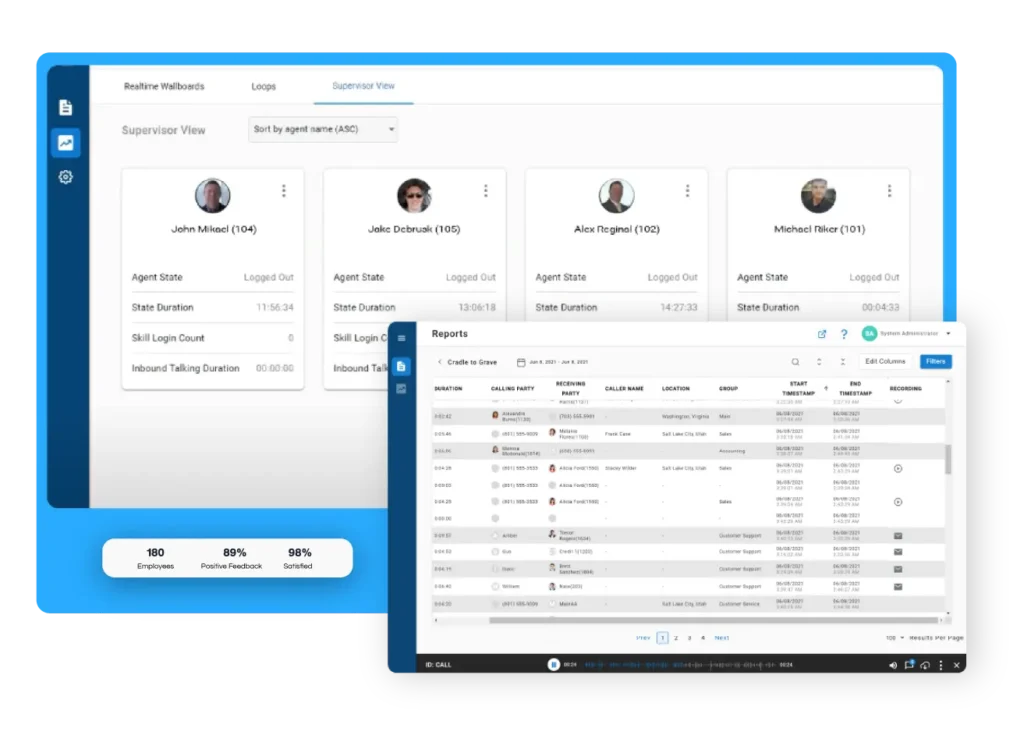
A good AI contact center platform gives supervisors live visibility into queue depth, average wait time, agent status, and which calls are running long. When something starts to drift, you can respond before it becomes a problem. That might mean pulling an agent from a quieter queue, triggering a callback option when wait times hit a threshold, or flagging a call that’s been on hold too long for supervisor review.
Live queue visibility is delivered through Xima’s real-time wallboards.
This is exactly where Suburban Propane ran into trouble before Xima. Operating across 668 locations in 41 states, they had no centralized view of what was happening across their network. When wait times spiked or abandoned calls increased at a location, management found out days after the fact. With Xima in place, they gained a centralized reporting platform that let them monitor each location individually and across the entire business in real time, turning a reactive operation into a proactive one.
3. Historical Reporting That Surfaces Patterns, Not Just Numbers
Call volume and handle time are the starting point, not the finish line. The platforms that help operations leaders make better decisions go further: they show you which issue types are driving volume, which queues are consistently underperforming, and where your first-call resolution rate breaks down.
Essential Credit Union saw this firsthand. Before Xima, their service levels fluctuated between 50% and 70%. After implementing Xima’s custom reporting and real-time data, they brought that figure up to a consistent 90%, with call handle time, wait time, and abandonment rates all improving at the same time. The difference wasn’t staffing. It was visibility.
If your reporting tool gives you raw data but no way to act on it, it’s not doing enough. Look for platforms that let you build custom reports, drill down by queue, agent, time of day, and interaction type, and schedule those reports to land in your inbox without manual effort.
4. Automated Quality Assurance
Manual QA is slow, inconsistent, and covers a small fraction of actual interactions. Suburban Propane’s experience is a good example: with 668 locations and no centralized call recording, reviewing calls for quality across the business was essentially impossible. Practices that worked well at high-performing locations couldn’t be identified or replicated elsewhere because nobody had a clear view of what was actually happening.
AI-powered QA changes this. The platform listens to every call and scores it against your criteria automatically. Supervisors spend less time reviewing recordings and more time coaching. Quality standards get applied consistently across the team, not just for the calls someone happened to pull manually.
Over time, this also gives you a cleaner picture of where your training gaps actually are. Instead of coaching based on a handful of observed calls, you’re working from patterns across hundreds or thousands of interactions.
5. Skills-Based and Priority-Based Routing Rules
Not all contacts should be treated the same way. A customer who’s been waiting 20 minutes deserves different handling than one who just joined the queue. A high-value account calling about a billing issue may need a senior rep rather than the next available agent. A caller with a specific product question shouldn’t land with someone who has no background in that area.
Skills-based routing solves for all of this. You define the criteria, whether that’s product knowledge, account tier, issue type, or something else specific to your operation, and the platform matches each contact to the agent best positioned to handle it. Priority-based routing adds another layer, making sure the contacts that matter most don’t get buried in a flat queue.
Together, these two capabilities give you real control over the customer experience. Without them, you’re essentially hoping the right call lands with the right agent by chance. With them, you’re engineering that outcome deliberately.
What to evaluate: Ask vendors how routing rules are built and maintained. If it requires professional services every time you want to make a change, that’s a red flag. Your team should be able to adjust rules as your business evolves without going back to the vendor.
6. Wallboards and Team Visibility Tools
Individual dashboards help supervisors. Wallboards help the whole team. When agents can see live queue metrics on a shared display, they have a clearer picture of how the team is performing and where to focus their attention.
This kind of shared visibility tends to improve performance without requiring additional management intervention. When the team can see that wait times are climbing or that a queue is backing up, agents naturally adjust. It creates a sense of shared accountability that top-down reporting often doesn’t.
Xima’s wallboards are configurable so you’re showing the metrics that matter to your specific operation, not a default view built for someone else’s business. You can display real-time stats by queue, by agent, or across the whole center, and update what’s shown as your priorities change.
7. Omnichannel Support with Unified Interaction History
Customers move between channels. They might start with a chat, follow up by phone, and send an email if they haven’t heard back. If those interactions live in separate systems, your agents are constantly playing catch-up.
Think about what that looks like from the customer’s perspective. They explained their issue in a chat yesterday. They called back today because it wasn’t resolved. The agent who picks up the phone has no idea what happened in that chat, so the customer has to start over. That’s a frustrating experience, and it’s entirely preventable.
Xima’s platform ingests every interaction across voice, chat, email, and SMS into a unified data stream tied to a persistent customer profile. The agent handling the follow-up call sees the full picture: what channel the customer used, what was discussed, what was tried, and what was left unresolved. No repeating yourself, no lost context.
It also improves your analytics significantly. If you can only see phone data, your understanding of the customer experience is incomplete. Unified omnichannel reporting shows you the full journey, which makes it much easier to spot where things are falling through the cracks.
8. IVR and Self-Service That Actually Resolves Issues
Self-service only works if it solves problems. An IVR that sends customers in circles and drops them into a queue anyway isn’t self-service. It’s a delay with extra steps.
Xima’s AI-powered IVR goes beyond fixed menu options. Using natural language understanding, it interprets what a caller is actually asking rather than waiting for them to press the right button. It can handle account lookups, appointment scheduling, basic troubleshooting, and status checks without agent involvement, and it integrates with your CRM to pull relevant account data in real time so callers aren’t repeating information the system should already have.
Xima also offers an AI messaging bot for digital channels, handling routine inquiries across chat and SMS with the same logic: resolve what it can, and hand off to a human with full context when it can’t. That context is what makes the handoff feel seamless rather than frustrating. The agent picks up exactly where the bot left off, without the customer having to explain themselves again.
The handoff experience is where most platforms fall short. Make vendors demonstrate it specifically during your evaluation, not just the self-service flow in isolation.
9. Workforce Management and Forecasting
Workforce management is one of those features that sounds operational but has a direct impact on both cost and customer experience. If you’re consistently overstaffed on quiet mornings and understaffed during afternoon peaks, you’re spending more than you need to and still disappointing customers at the wrong moments.
Good AI contact center platforms use historical call data to forecast volume by time of day, day of week, and seasonal patterns. That means your staffing decisions are based on actual data rather than gut feel or last year’s spreadsheet. Over time, the forecasts get more accurate as the system builds a deeper picture of your specific patterns.
For managers, this also makes scheduling conversations easier. When you can show your team a data-backed forecast that explains why you need more coverage on Monday afternoons, it’s a different conversation than asking people to shift their hours based on intuition.
Xima’s workforce management tools are built for contact center teams that need to do more with the resources they have. For smaller teams especially, the ability to forecast accurately and staff accordingly can make a meaningful difference in both service levels and agent workload.
10. CRM and Helpdesk Integration
A contact center platform that doesn’t connect to your CRM or helpdesk creates extra work for everyone. Agents are toggling between systems, manually logging interactions, and working without the full picture of each customer relationship.
The practical impact of this is bigger than it sounds. An agent who has to switch between three tools to find basic account information is slower, more likely to make errors, and less able to give the customer their full attention. A platform that surfaces the right information automatically changes what that interaction looks and feels like.
Xima integrates directly with your CRM, embedding communication controls within your existing system so agents work from one place. Interaction data flows automatically, agents see relevant customer context before they pick up the call, and managers get reporting that reflects the full operation rather than just the phone queue.
For teams just scaling their support operations, including startups building out their first real contact center infrastructure, getting integration right early saves a significant amount of cleanup work later. The cost of retrofitting a poorly integrated stack is almost always higher than building the connections properly from the start.
What to Look for When You’re Evaluating Platforms
The features above separate a platform that actually changes how your team operates from one that just looks good in a demo. But knowing what to look for is only half of it. The other half is knowing how to pressure-test what vendors are telling you.
A few things worth doing before you sign anything:
Ask to see a live demo, not a recorded walkthrough. Recorded demos are edited to show the best version of everything. A live demo surfaces the friction points, the steps that require workarounds, and the features that are available in theory but clunky in practice.
Ask specifically about the handoff experience between self-service and human agents. This is where most platforms lose the thread. If a vendor can’t show you clearly what the agent sees when a self-service handoff comes in, that’s a gap worth understanding before you commit.
Ask who manages routing rule changes after implementation. If the answer is “your customer success manager” or “our professional services team,” factor that into the total cost of ownership. Your ops team should be able to make configuration changes without going back to the vendor.
Ask what’s included in standard reporting versus what requires custom build. Some platforms look powerful on paper but require significant setup to get to the reports that actually matter to your business.
Xima is built for contact center teams at small and mid-sized businesses who need enterprise-grade capability without the complexity and cost that typically comes with it. See how teams like Essential Credit Union and Suburban Propane made the switch, and what changed on the other side. If your current platform isn’t giving your team the visibility or flexibility they need, it’s worth seeing what a modern setup actually looks like.