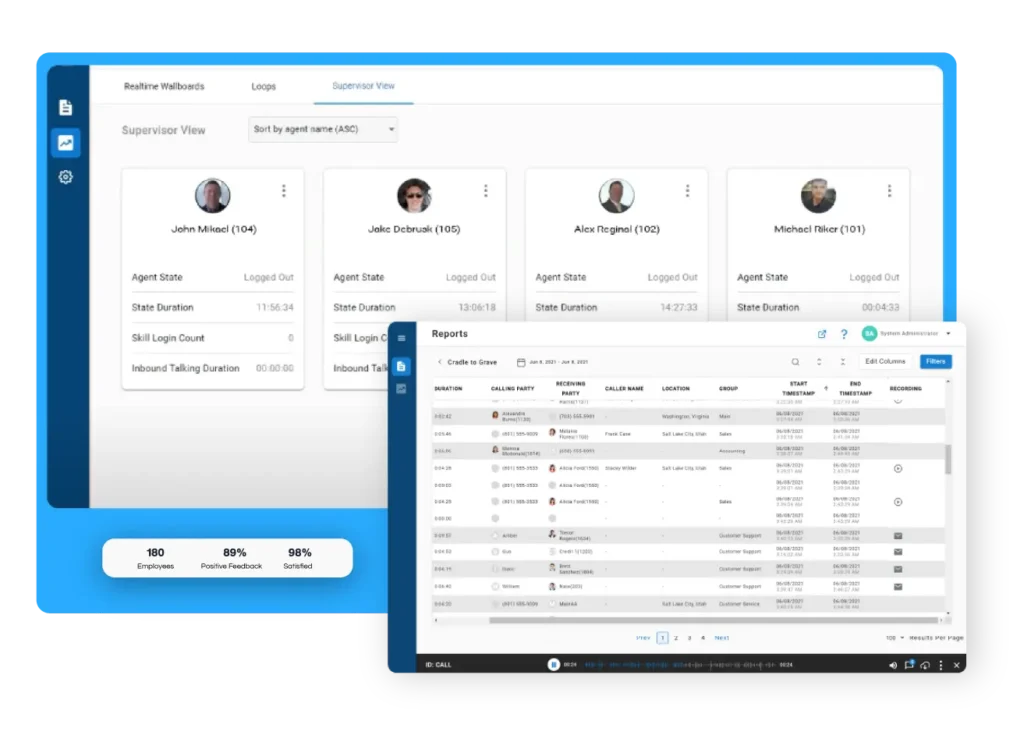

Both solutions offer cloud-based calling. However, they approach voice support using very different foundations. Let’s compare how Xima and Zendesk handle structured voice support, queue management, reporting clarity, long-term scalability, and how costs expand as support operations become more complex.
Key Takeaways for Small Call Center Teams
- Small business call center teams often compare Zendesk and Xima when adding structured voice support to growing service operations.
- Zendesk approaches voice through Zendesk Talk, tightly integrated into its ticketing and case management ecosystem.
- Xima centers its platform around queues, reporting reliability, and real-time supervisor visibility.
- The core difference becomes whether your team operates primarily as a ticketing help desk adding voice, or as a call-driven support environment needing structured oversight.
- Xima’s pricing structure is built around contact center growth, which can help small teams avoid paying for broader helpdesk packaging they may not need.
- The right choice depends on how central inbound and outbound call handling is to daily operations.
Two Different Foundations: Helpdesk-First vs Contact Center-First
Xima and Zendesk both offer cloud calling, but they were built with different operational priorities. That distinction influences how queues are configured, how supervisors gain visibility, and how reporting evolves as support volume increases.
Zendesk’s Helpdesk-Centric Model
Zendesk is built around ticket lifecycle management. Voice interactions through Zendesk Talk are embedded directly into case records, allowing agents to manage calls alongside email, chat, and messaging conversations within a unified interface.
This structure works well for teams that organize their service operations around cases rather than queues. Queue configuration exists, but it typically serves the broader ticket workflow rather than acting as the operational backbone. That can work well for support teams centered on cases, but it may also mean that voice-specific improvements are tied to broader support plan decisions rather than contact center needs alone.
For organizations that prioritize omnichannel coordination and already rely heavily on Zendesk Support, Zendesk Talk can feel like a natural extension of their existing technology ecosystem.
Xima’s Structured Call Center Model
Xima is designed around structured call handling. Queue behavior, routing logic, and supervisor visibility are foundational elements rather than secondary features.
Calls move through clearly defined queues with intentional routing rules. Supervisors can monitor queue performance, agent status, and service levels in real time, which supports active management rather than retrospective analysis.
Reporting is centered on call center metrics that guide staffing decisions and operational adjustments. As volume increases, the platform scales around queue architecture and performance oversight rather than case expansion. Because Xima is organized around call center performance from the start, teams can expand queue oversight and reporting without necessarily moving into broader helpdesk bundles.
Use a callout box here:
Helpdesk platforms often prioritize case tracking and omnichannel coordination, while contact center platforms prioritize queue logic, predictable call flow, and live oversight. Understanding which model matches your support structure is critical as call volume grows.
Competitor example:
When Ticketing Depth Matters Most
Zendesk Talk tends to fit best in organizations where the helpdesk is the center of gravity and voice is one of several support channels.
If your team already runs on Zendesk Support, keeping calls inside the same case workflow can feel seamless. Agents answer calls within the familiar interface they use for tickets and digital conversations. Every interaction connects back to a record. Reporting aligns with resolution times, agent productivity, and overall case management performance.
This structure works well when phone support complements email, chat, and messaging rather than defining the operation. Moderate call volume, cross-channel visibility, and unified customer history are often the priority in these environments.
When Queue Control and Visibility Become Critical
In call-centered environments, queue performance is not a background detail; it shapes staffing, service levels, and customer experience in real time. As agent count increases and multiple queues develop, operational clarity becomes harder to maintain inside ticket-first systems. Leadership needs insight into queue buildup, agent availability, handle time trends, and adherence to service targets throughout the day.
At that stage, the platform must fundamentally support structured call flows. Visibility into queues, not just cases, becomes the operational anchor. Reporting must reflect call center dynamics rather than simply layering call data onto ticket analytics.
What Changes as Support Volume Grows?
Most small teams do not feel the strain immediately. Early on, a single queue and a handful of agents can operate comfortably inside almost any system.
As call traffic rises, routing logic becomes more nuanced. Teams introduce skill-based routing, priority queues, overflow rules, and service level targets. Supervisors need clarity into how those rules perform in practice, not just how they were configured.
In a ticket-centric system like Zendesk, scaling often means expanding workflows, automations, and reporting layers tied to cases. Voice data lives alongside other support channels, which can work well if digital interactions remain the primary focus. However, queue visibility may remain secondary to ticket tracking, and supervisors may rely more heavily on historical reporting than live operational insight. As support complexity grows, teams may also find that deeper voice functionality is linked to broader support plan expansion.
In Xima’s contact center-first system, scaling centers on queue architecture. Additional agents, new queues, and higher volume increase the need for predictable call flow and real-time visibility. Reporting focuses on service levels, handle time trends, and queue performance rather than case-resolution metrics. Supervisors can adjust staffing or routing decisions during the day instead of reacting after the fact. That structure can also make cost planning easier for teams whose growth is tied primarily to contact center performance.
Because of these differences, small businesses need to consider which platform can scale alongside their operations with minimal disruption.
Feature Comparison: Zendesk Talk vs Xima
Platform differences are easier to see in daily execution than in marketing language. Both systems support calling, routing, reporting, and integrations, but they behave differently under real workload conditions.
The table below compares how Zendesk Talk and Xima support queue structure, supervisor oversight, reporting clarity, and long-term scalability for small business teams.
Capability | Zendesk Talk | Xima |
Core calling | Cloud calling embedded within the Zendesk support ecosystem, designed to extend ticket-based workflows with voice. | Cloud-based calling built specifically for structured inbound and outbound contact center operations. |
Queue management | Basic queue routing tied closely to ticket assignment and helpdesk workflows. | Queue management is foundational, with routing logic designed for predictable call flow and structured team oversight. |
Reporting and dashboards | Reporting integrated with Zendesk Support analytics, often centered on ticket metrics and agent activity. | Reporting focused on call center performance, with real-time and historical metrics tailored to queue and call management. |
Supervisor visibility | Visibility connected to ticket activity and call logs within the Zendesk interface. | Real-time oversight into queues, agent status, call handling, and operational performance. |
Agent experience | Agents work within the Zendesk interface, managing calls alongside tickets and digital conversations. | Agent workflows centered on efficient call handling, minimizing friction during high call volume periods. |
CRM and business integrations | Deep integration within the Zendesk ecosystem, plus third-party app marketplace support. | Integrates with 300+ CRMs and business systems to support reporting accuracy, call tracking, and workflow control. |
Pricing structure | Tiered pricing based on Zendesk support plans, with voice layered into broader helpdesk packages. | Pricing aligned to contact center usage and operational requirements rather than bundled ticketing tiers. |
Scalability for growing teams | Scales well for teams expanding digital and ticket-based support alongside voice. | Scales around increasing call volume, agent count, and supervisory complexity in structured contact center environments. |
This comparison highlights how each platform supports day-to-day call center management rather than listing every feature available. Small teams should focus on queue control, reporting clarity, and workflow alignment with their support model.
Pricing and Long-Term Cost Considerations
Zendesk pricing is structured around its broader support plans. Voice is added within that framework, so cost adjustments often follow changes in helpdesk tier or bundled feature access. For teams expanding digital channels alongside calling, this structure can feel aligned with overall support growth.
Xima’s pricing is tied more directly to contact center usage. Agent count, queue structure, and reporting requirements drive cost rather than broader helpdesk packaging. That alignment can provide clearer visibility into how expenses track with call volume and operational complexity.
Small businesses need to look beyond entry pricing. Consider how costs change when adding agents, creating new queues, expanding supervisor oversight, or formalizing service levels. A platform should remain financially feasible regardless of business growth.
Operational Maturity: Where Does Your Team Sit?
Many small teams begin as ticket-first helpdesks with voice layered in. Over time, call volume increases, queues multiply, and service levels become formal targets rather than informal goals.
That shift signals operational maturity. The team is no longer just resolving cases; it is managing a structured call flow.
If supervisors primarily track ticket resolution and cross-channel activity, a helpdesk-centered model may still fit. If they need live visibility into queue performance, agent availability, and service levels throughout the day, the operation is functioning more like a call center.
Understanding where your team sits on that spectrum makes the Xima vs Zendesk decision clearer. The right platform should reflect how your support environment actually runs, not how it started. That same shift often changes what “affordable” really means, moving the conversation away from entry pricing and toward how efficiently the platform supports queue management, reporting, and day-to-day oversight.
Choosing the Right Platform for Your Support Model
When choosing between Xima and Zendesk, consider the following.
Zendesk’s helpdesk-first model may fit if:
- Ticket resolution is your primary performance metric
- Voice is one of several support channels, not the dominant one
- Supervisors focus more on case lifecycle reporting than live queue conditions
- Cross-channel visibility matters more than queue engineering
Xima’s contact center-first model may fit if:
- Inbound and outbound calls drive daily workload
- Multiple queues, routing rules, or service levels are actively managed
- Supervisors need real-time visibility into agent status and queue performance
- Staffing decisions depend on live call flow data
The choice is less about which platform has more features and more about which structure reflects your operational reality. For many SMBs, that also means choosing a platform where reporting, routing, and supervisory visibility can grow without requiring broader support-platform upgrades that don’t directly improve call center performance.
Getting Started with Xima
When structured call handling becomes central to your support operation, the platform behind it matters. Xima is built for teams that need clear queue control, real-time visibility, and reporting that reflects how a call center actually performs. It supports growing agent teams without forcing voice into workflows designed primarily for tickets. It also gives growing teams a way to add structure and visibility without forcing their budget into a broader helpdesk model when voice operations are the main priority.
If your support environment is becoming more call-driven and more performance-focused, it may be time for an upgrade. Book a demo today to see how Xima can benefit your call center.
FAQs
It can be in the early stages. As call volume, queue complexity, and service level expectations increase, teams often need more structured routing and real-time visibility than basic add-ons provide.
Small businesses should look for clear routing logic, defined service levels, live supervisor visibility, and reporting that reflects queue performance rather than only ticket resolution metrics.
Detailed reporting supports better staffing decisions, faster issue identification, and clearer accountability.
Adding voice to a helpdesk embeds calling into ticket workflows. A dedicated contact center platform centers operations around queue structure, call flow control, and live oversight.
Rising call volume, multiple queues, formal service level targets, and supervisors needing real-time queue visibility are common indicators that it’s time to move beyond basic call tools.