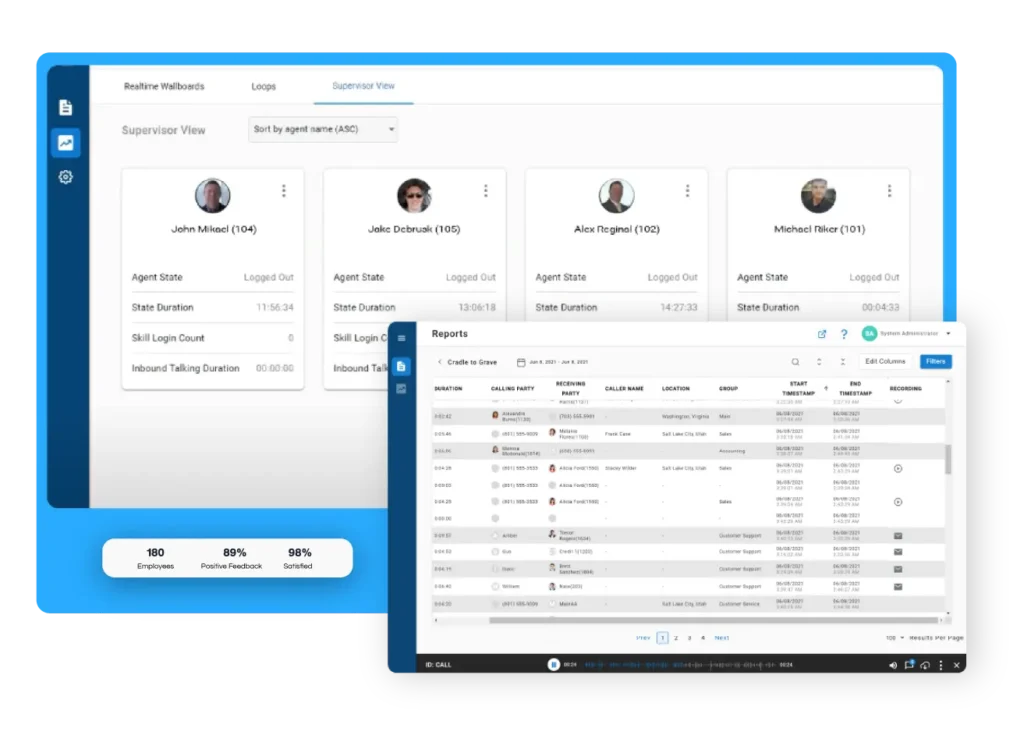

At this stage, many teams begin evaluating more robust platforms, leading to the question of Xima vs. Talkdesk. This comparison of Talkdesk vs. Xima focuses on operational realities that matter most to growing SMBs: setup effort, reporting reliability, pricing over time, and how manageable each system feels as complexity increases. For teams exploring a scalable Talkdesk alternative for call centers, the goal is to identify which platform best supports sustainable, controlled growth.
Key Takeaways for Small Businesses Evaluating Call Center Management Solutions
- Growing SMB contact centers are evaluating how to handle rising call volume, expanding agent teams, and stricter service expectations without sacrificing operational control or visibility.
- Talkdesk is positioned as an AI-driven, automation-forward platform built to orchestrate agents, workflows, and data layers as organizational complexity increases.
- Xima is built around contact center fundamentals, prioritizing queue behavior, reporting accuracy, and supervisor visibility, while integrating practical AI and automation designed specifically for SMB environments, without adding unnecessary complexity.
- The right fit depends on operational maturity, internal technical resources, and whether a team benefits more from advanced automation frameworks or structured, hands-on control.
- Teams managing heavier call volume with direct supervisory oversight needs often prioritize reporting reliability and operational clarity over highly layered orchestration features.
Xima and Talkdesk Support Growing Contact Centers
As SMB contact centers expand beyond basic call routing, platform design philosophy begins to matter. Higher call volume, more agents, and tighter service expectations place pressure on queue management, reporting consistency, and day-to-day supervision. At this stage, differences in how each system handles operational visibility and workflow control become increasingly noticeable in daily performance.
When evaluating Xima vs. Talkdesk, the distinction is not simply about features, it is about how each platform structures growth. The way queues are managed, reports are generated, and supervisors interact with real-time data can directly influence efficiency, coaching effectiveness, and long-term scalability.
Talkdesk’s Automation-Driven Contact Center Platform
Talkdesk is built around intelligent orchestration and automation, with AI embedded across routing logic, workflow configuration, and agent assistance. Its architecture is designed to coordinate agents, automation layers, and customer data within a unified cloud environment.
This automation-first design makes Talkdesk well-suited for organizations scaling rapidly across multiple channels and customer touchpoints. Teams that anticipate complex workflows, cross-channel orchestration, and advanced configuration needs may benefit from its AI-centric approach. However, maximizing that flexibility often requires internal resources capable of managing a more sophisticated setup and ongoing optimization.
Xima’s Operations-Focused Contact Center Model
Xima is designed specifically for managing live contact center operations, with queues, reporting accuracy, and supervisor visibility forming the foundation of the platform. Rather than layering operational tools on top of a broad orchestration framework, Xima centers its architecture around how inbound and outbound support calls are handled day to day.
As call volume and agent count grow, this structure emphasizes clarity and predictability. Supervisors maintain direct visibility into queue behavior, agent performance, and reporting outputs without navigating unnecessary layers of configuration. While Xima integrates AI and automation to support SMB efficiency, its core model prioritizes operational control and reporting reliability over broad tool consolidation.
Feature Comparison: Xima vs. Talkdesk
When evaluating Xima vs. Talkdesk, high-level positioning only tells part of the story. The more meaningful comparison often comes down to how each platform influences daily management, how queues behave under pressure, how supervisors intervene, and how reporting supports decision-making in real time.
The chart below highlights operational differences at a glance, focusing on how each capability affects hands-on contact center oversight rather than listing every available feature.
|
Capability |
Talkdesk |
Xima |
|
Primary platform focus |
Built around AI-driven orchestration that connects agents, automation, and data across channels. |
Built around core contact center operations, with emphasis on predictable call handling and oversight. |
|
Queue design philosophy |
Queues are part of a broader orchestration layer that balances AI, routing logic, and automation. |
Queues are a foundational element, designed for consistent behavior and hands-on management. |
|
Automation and AI usage |
Heavy use of AI for routing, self-service, workflow automation, and agent assistance. |
Selective automation that supports call handling without abstracting day-to-day operations. |
|
Supervisor control model |
Supervisors oversee performance through orchestration layers and analytics views. |
Supervisors directly manage queues, agents, and call flow in real time. |
|
Reporting approach |
Strong analytics with customizable dashboards and AI-informed insights. |
Reporting focused on operational clarity, reliability, and actionable call center metrics. |
|
Workflow complexity |
Designed to support complex, multi-step workflows across channels and tools. |
Designed to keep workflows straightforward as call volume and agent count increase. |
|
Agent interaction model |
Agents work alongside AI tools and automated processes within a unified workspace. |
Agents work in call-focused workflows optimized for speed and consistency. |
|
Integration strategy |
Broad ecosystem integrations intended to orchestrate data across systems. |
Integrations focused on supporting call workflows, reporting, and supervisor needs. |
How to interpret this table:
In a typical Talkdesk vs. Xima evaluation, the difference lies less in capability and more in operational philosophy. Teams seeking extensive AI orchestration across channels may prioritize Talkdesk’s architecture. Teams prioritizing queue predictability, reporting reliability, and direct supervisory control often evaluate Xima as a practical Talkdesk alternative for call centers.
Ultimately, the right choice depends on how your contact center operates today, and how much structural complexity your team is prepared to manage as you grow.
Talkdesk for AI-Driven Contact Centers
Talkdesk may align well with organizations planning to scale quickly across channels and processes. Its automation-first architecture embeds AI into routing, workflows, and agent assistance, making it suitable for teams that view orchestration as central to growth.
In a Xima vs. Talkdesk evaluation, this model often fits contact centers prepared to manage more complex configurations and ongoing optimization as automation expands.
Before moving forward, you should consider:
- Is advanced AI orchestration essential to your growth strategy?
- Do you have the internal resources to manage layered workflows?
- Will added automation simplify operations or increase oversight needs?
The right platform should match not just your call volume, but your operational capacity to manage complexity.
Xima for Growing Contact Centers
For many SMB contact centers, growth increases the need for operational depth rather than orchestration layers. Call-heavy support teams often prioritize consistent queue behavior, clear reporting, and direct supervisory oversight to maintain service levels as demand rises.
Xima aligns well in environments where managers need real-time visibility into queues, agent performance, and call flow throughout the day, not just post-interaction analytics. Businesses that want structured contact center management without enterprise-level complexity often evaluate Xima as a practical Talkdesk alternative for call centers.
Another consideration in a Xima vs. Talkdesk comparison is pricing predictability. For SMBs planning steady growth, transparent models that scale alongside users and usage, without forcing overcommitment to advanced feature tiers, can provide greater budgeting confidence.
Evaluating Fit Based on Operational Maturity
As SMB contact centers mature, their operational needs shift. Adding agents introduces scheduling and performance oversight challenges. Increasing call volume stresses routing logic and queue stability. New service lines often require additional queues and escalation paths.
At a certain point, lightweight phone systems and basic reporting tools stop providing sufficient control. Structured call center management, supported by real-time visibility and reliable data, becomes necessary to maintain service standards while scaling responsibly.
Costs to Consider as Teams Scale
Financial behavior changes as complexity grows. Some platforms bundle advanced automation and orchestration features into tiered packages, which may increase costs as teams expand functionality.
Other models align pricing more closely to core contact center usage, such as users and call management capabilities, allowing SMBs to scale predictably. In a Talkdesk vs. Xima evaluation, understanding how pricing evolves alongside operational growth is essential for long-term planning.
H3 – Moving from Setup to Active Call Management with Xima
Growing SMB teams typically transition quickly from initial setup into active call management with Xima. Early access to queues, reporting dashboards, and supervisor views enables managers to monitor performance in real time and make adjustments as demand fluctuates.
Rather than spending extended periods configuring layered workflows, teams can begin managing live operations with clarity, adjusting staffing, queue behavior, and routing rules as call volume increases.
How Complex Are Your Support Workflows Today?
As you evaluate platforms, assess how your workflows have evolved. Are you managing multiple queues? Do routing rules and escalation paths require frequent adjustments? Is real-time oversight necessary to maintain service levels?
These signals indicate that your contact center system must support more than basic call handling. The question becomes whether your growth requires deeper operational control, broader automation orchestration, or a balance of both.
Choosing Between Automation Depth and Operational Control
Ultimately, the difference in Xima vs. Talkdesk often comes down to operational philosophy. Automation-driven orchestration prioritizes AI coordination across workflows and channels. An operations-focused model prioritizes queue stability, reporting reliability, and hands-on supervisory control.
The right choice depends on how central call handling and visibility are to your daily operations, and how much structural complexity your team is prepared to manage as you grow.
FAQs
In a typical Xima vs. Talkdesk comparison, Talkdesk manages growth through AI-driven orchestration layers that coordinate routing, workflows, and analytics across channels. Xima, by contrast, centers daily management around queues, real-time reporting, and direct supervisor oversight. The difference becomes more noticeable as agent count and call volume increase.
Talkdesk embeds automation deeply into routing, self-service, and workflow management, making AI central to how operations function. Xima integrates automation more selectively, using it to support call handling while preserving hands-on queue control and supervisor visibility. The tradeoff often reflects how much orchestration complexity a team wants to manage.
SMBs should assess whether they have the technical capacity to configure and maintain advanced automation workflows over time. In a Talkdesk vs. Xima evaluation, teams with limited internal IT support may prioritize platforms that provide operational clarity and predictable management. The right fit depends on both growth goals and available oversight resources.
Common signals include rising call volume, the addition of multiple queues, inconsistent reporting, and increased need for real-time supervision. When managers begin manually reconciling data or struggling to maintain service levels, more structured contact center management becomes necessary.
As teams grow, reporting must move from basic call counts to real-time queue monitoring, agent performance tracking, and actionable operational metrics. Visibility becomes less about summaries and more about active management throughout the day. Reliable reporting infrastructure becomes critical to maintaining service consistency at scale.